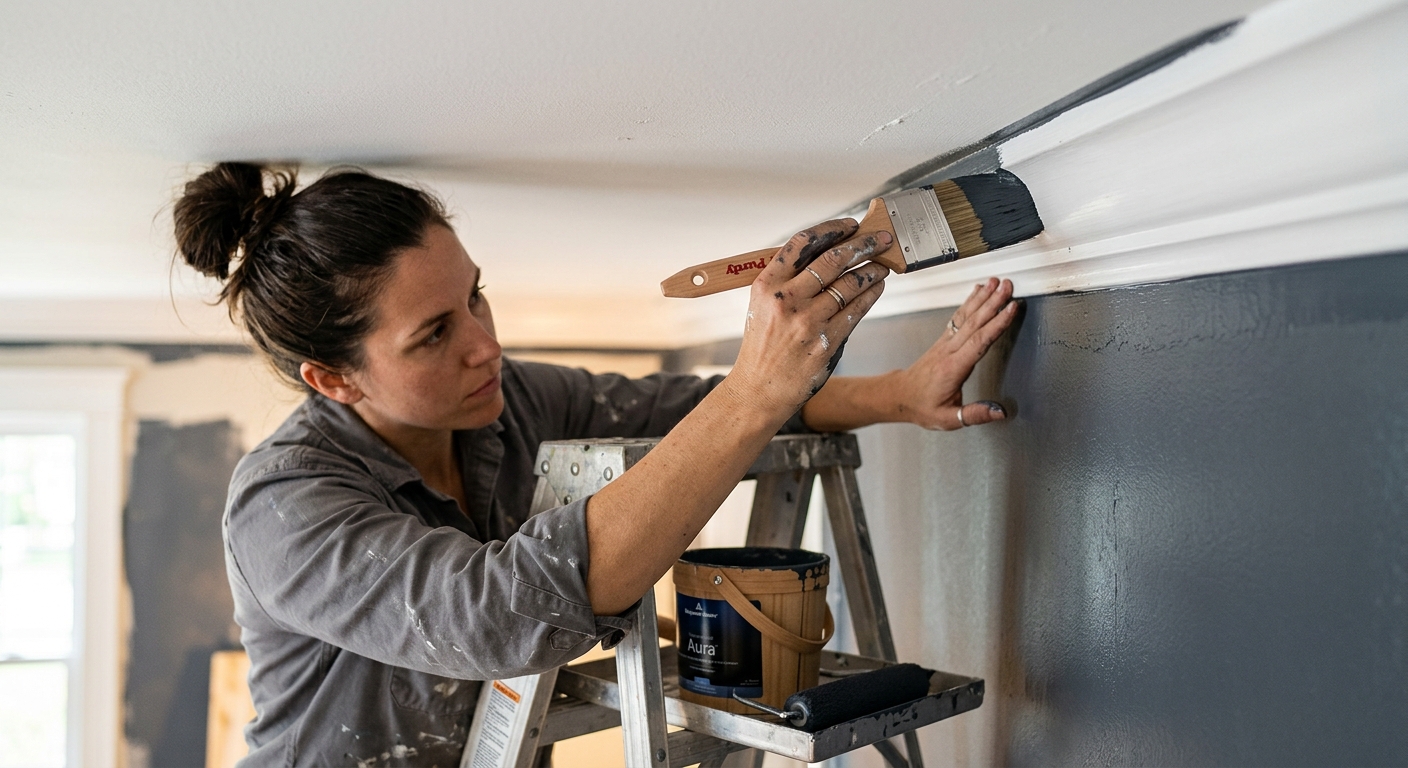
Painting options and costs in West Lorne
West Lorne homeowners typically have a straightforward set of painting choices—interior refreshes, exterior repaints, and high-impact trim or cabinet work—but the cost swings a lot based on prep and the short weather window for outdoor work. With a population of 1,337 (Statistics Canada, 2021 Census), our local market is smaller than the Greater Toronto Area core, so booking quality crews can depend heavily on timing. Also, many residences here are older than newer subdivisions, which usually means more scraping, sanding, patching, and priming before any new topcoat goes on. In practice, prep can be the difference between a job that lasts 7–10 years and one that starts bubbling or peeling sooner.
In the Toronto economic region, exterior painting is tightly climate-bound. Contractors commonly work from late May into June, then again from September to mid-October when temperatures stay above about 10°C for proper application and curing, and humidity is moderate. That compressed season can push exterior pricing up roughly 10–15% in June–August compared with shoulder months. Interior painting, by contrast, is less season-sensitive and can usually be scheduled year-round, with labour and finish level driving the final number.
Within West Lorne, the trade is often in higher demand around the busier residential stretches near Main Street and the broader downtown service area, where homeowners tend to update appearance before selling or after seasonal wear. Use the comparison below to align your expectations with local scope and pricing, and then we can refine the details for your exact surfaces and finish level.
| Service |
What's Included |
Typical Duration |
Price Range |
| Interior — whole home (walls, ceilings, trim) |
Patch & sand, spot prime, walls and ceilings per chosen sheen, caulk where needed, paint trim/doors as scoped, clean-up and dust control |
3–8 days |
$2,200 – $6,000 |
| Interior — per room (standard bedroom or living room) |
Prep, cut-in, paint walls (and ceiling if chosen), light trim touch-ups, basic masking, final clean-up |
1–3 days |
$400 – $1,500 |
| Exterior — full house (siding, trim, soffits) |
Surface wash, scraping/sanding, caulking, primer as needed, full exterior system for siding and trim, detail work around doors/windows |
5–12 days |
$3,000 – $8,000 |
| Exterior — trim and accent colours only |
Prep and prime bare/failed areas, paint trim lines, doors and selected accents, touch up transitions, basic protection for surrounding surfaces |
2–6 days |
$1,500 – $3,800 |
| Kitchen cabinet painting (doors, frames, spray finish) |
Removal where feasible, degrease, sand/scuff, prime, spray finish for doors, re-install, hardware masking or optional hardware prep |
4–10 days |
$1,200 – $3,500 |
| Specialty / faux finish (accent wall, texture) |
Surface preparation for specialty systems, base coat, faux/texture application, multiple small areas for best appearance, protective clear as required |
2–6 days |
$900 – $3,800 |
Prices are estimates only and vary by project scope, site access and material selection.
What affects the price of painting in West Lorne
Two quotes for the “same” repaint can differ by 30–50% across the Toronto region because painting is largely a labour-and-prep trade. In the Greater Toronto Area, exterior work is limited by workable conditions: late May through June and then September to mid-October, with temperatures typically needing to be above about 10°C and steady enough for proper adhesion and cure. When contractors chase a short list of ideal weeks, labour rates and scheduling premiums rise—especially in June–August—pushing exterior projects toward the higher end of the local band, such as $3,000 – $8,000 for a full house repaint.
Older housing stock across the region also changes the equation. More layers of existing paint, aging caulk, and worn wood or drywall often mean scraping, sanding, patching and priming that can represent 50–70% of total labour on a repaint. That’s why an “exterior trim only” job can remain closer to $1,500 – $3,800, while “full house” projects inflate when the siding and multiple trim lines need problem areas rebuilt before the new system goes on.
In West Lorne, a few common site factors noticeably shift cost: (1) frost-damaged or peeling areas near eaves and window trims that require wider feathering and additional primer; (2) stucco or fibre-cement surfaces that need correct prep and primer choice to avoid lifting; and (3) multi-storey access where scaffolding or lifts add time and safety planning. If your project is in downtown-adjacent areas where driveways are tighter, protection and staging time can also add labour even when the surface area looks similar.
| Price Factor |
Why It Matters |
Cost Impact |
| Surface prep — scraping, sanding, patching drywall or wood |
Determines adhesion and smoothness; old defects must be corrected before topcoat |
Often 50–70% of labour on repaints |
| Number of coats — 2-coat system over primer vs. 1 coat over existing |
Coverage and colour uniformity; proper system reduces early fading/peeling |
Can swing labour 10–25% |
| Paint quality tier — contractor-grade vs. premium (Benjamin Moore, Sherwin) |
Hides better, holds colour longer, and can reduce rework when prep is solid |
Material differences plus labour efficiency |
| Ceilings and trim — adds significant time vs. walls-only |
Cutting in, edgework, and masking around trim/doors is labour-intensive |
Commonly adds 20–40% to interior jobs |
| Exterior season window — short season raises summer rates |
Work is compressed; crews book fewer ideal days |
Often 10–15% premium mid-summer |
| Lead-safe precautions — required for pre-1978 homes with lead paint |
Ensures safer sanding/scraping methods and proper cleanup/disposal |
Can add 5–20% depending on conditions |
| Surface material — drywall vs. plaster vs. wood vs. stucco |
Each substrate needs different primers and prep intensity |
Priming and prep time changes |
| Height and access — multi-storey exterior requires scaffolding or lifts |
Safety, staging, and reach affect production speed |
Can add 15–40% on exterior |
Permits & regulations in Ontario
In Ontario, painting work on a typical home generally does not require a permit. Where regulation and health guidance matter is around older homes—especially pre-1978 construction—because lead paint was used commonly in past decades. For that kind of house in West Lorne, recommended lead-safe practices are to test before sanding or scraping, and if lead is present, use lead-safe work methods (wet methods to reduce dust, HEPA vacuuming, and proper disposal of debris). This is not automatically a homeowner-only legal requirement, but professional contractors follow lead-safe protocols because the risk is real and cleanup needs to be handled correctly.
What typically DOES require permits is not normal painting—it’s usually other municipal work (for example, structural changes, window replacement, or electrical/plumbing renovations). Painting itself—interior walls, trim, ceilings, siding and trim coatings—normally does not trigger a permit.
When you hire, confirm your contractor carries liability insurance and has workers’ compensation coverage (WSIB or the relevant WCB coverage for their classification). Then require a written contract that specifies paint brand and sheen, number of coats, and exactly which prep tasks are included (scraping, caulking, spot priming, disposal, and protection). Step-by-step, you can verify coverage by: (1) requesting a WSIB/WCB clearance letter or proof of account in their name; (2) asking for a current certificate of insurance showing your address as an additional insured where applicable; and (3) checking their licence/registration status via the appropriate Ontario contractor listing/registry and their business information match. Keep everything in writing.
Interior vs exterior painting — getting the best result in West Lorne
In West Lorne and across the Toronto market, the difference between a long-lasting paint job and a premature failure usually comes down to prep discipline and system selection—not the label on the paint. Interiors fail most often when patching and priming are skipped or rushed. Fill, sand and prime patched drywall so new paint bonds evenly; for a durable finish, plan for two coats over proper primer rather than one thick coat. Sheen matters too: in kitchens and higher-touch areas, an eggshell or satin typically holds up better than a flat finish, while semi-gloss is often used on trim and doors for cleanability.
For exteriors, the weather rhythm is the limiter. Ontario freezes and thaws, and rain/humidity spikes can interfere with cure. Before painting, caulking must be done and allowed to settle so water doesn’t migrate behind the new coating. Correct primer type matters on wood, fibre-cement, and previously painted surfaces—using the right primer helps prevent peeling and uneven adhesion. In GTA conditions, the focus is temperature-stable performance and proper curing time, not year-round mildew resistance like coastal damp climates—though if you have visible mildew or heavy shade, a mildew-resistant coating or additive is still a smart choice.
Cabinet painting is a strong budget alternative to replacement when the structure is sound. It costs less than full cabinet replacement but still needs sanding/degreasing and proper spray or finish technique for a smooth, wipeable result—especially in older homes where greasy residues and worn coatings are common.
To put pricing in perspective: a full exterior repaint can land around $3,000 – $8,000 depending on prep, height, and substrate, and that premium is justified when failing areas require extra scraping and primer. If your main goal is curb appeal without correcting widespread siding failures, an exterior trim and accents scope closer to $1,500 – $3,800 can deliver a noticeable refresh with less labour.
| Project Type |
Key Prep Step |
Recommended Coats |
Price Band |
| Interior — fresh drywall (new construction) |
Prime bare drywall and fill joints properly for uniform porosity |
1 primer + 2 top coats |
$1,200 – $4,500 |
| Interior — repaint (good condition, no repairs) |
Light scuff, clean, and caulk any tightness changes at trim edges |
2 top coats |
$400 – $3,200 |
| Interior — repaint (patching and priming needed) |
Patch, sand smooth, spot prime bare/toned areas before full coats |
Spot primer + 2 top coats |
$900 – $6,000 |
| Exterior siding (wood or fibre cement) |
Scrape/feather peeling areas, clean, caulk, and prime as required by substrate |
Primer + 2 top coats (system-based) |
$3,500 – $8,000 |
| Exterior trim and accents only |
Remove loose paint, sand edges, and spot prime transitions before painting |
Spot prime + 2 top coats |
$1,500 – $3,800 |
| Kitchen cabinets (spray finish) |
Degrease thoroughly, sand/scuff for bond, prime for adhesion and block resistance |
Primer + 2 finish coats (system-based) |
$1,200 – $3,500 |
How to choose a painting contractor in West Lorne
Choosing a painter in West Lorne is mostly about verification and clarity. Start by confirming Ontario compliance for business protection: request their liability insurance certificate and a WSIB/WCB clearance letter (or equivalent proof of coverage). To check it, look for the insured party name matching their legal business name, confirm the policy is current, and ensure the certificate includes your project address or shows coverage applicable to the work. Then ask for their contractor information and licence/registration status through the relevant Ontario listing/registry, and make sure the contact details are consistent across your invoice, contract, and proof documents.
Next, get 2–3 itemised quotes—ideally broken out by labour tasks (prep, scraping, sanding, caulking, priming, painting, cleanup) and materials (primer and paint type/brand, number of coats, disposal fees). Avoid lump-sum-only proposals when you can; you want the scope spelled out. Read the exclusions carefully: ask what happens if rotten trim is found, whether lead-safe procedures are included for pre-1978 components if testing indicates lead, and whether protection, masking, and disposal are included.
Warranty matters. Ask for a workmanship warranty length and whether it’s tied to a maintained surface condition (for example, caulking or washing). Separate that from any manufacturer warranty on product, and confirm if the warranty is transferable to future owners. For payments, never pay more than 10–15% upfront; hold back until the job is complete and you’ve confirmed final touch-ups and cleanup. Finally, get an agreed start date and a completion estimate in writing, with weather contingency noted for exterior work.
- Verify WSIB/WCB coverage with a clearance letter or proof document before work begins.
- Confirm liability insurance is current and request a certificate of insurance.
- Use an itemised quote (prep, coats, primer, paint brand, cleanup/disposal) rather than a single number.
- Ask whether your quote includes scaffolding/lift costs for multi-storey areas.
- Confirm surface prep details: scraping/patching/spot priming and caulking scope.
- Request the exact paint brand, product line, sheen, and number of coats in writing.
- Clarify disposal: whether paint debris, sanding dust and masking waste are hauled away.
- Ensure lead-safe procedures are described if pre-1978 areas are disturbed (testing and safe methods).
- Get a timeline with start and completion dates, including weather-dependent exterior allowances.
- Confirm warranty terms: workmanship duration and what voids coverage.
- Confirm payment schedule—no large upfront payments; holdback until punch list completion.
- Ask for past project photos that match your home’s substrate (wood/fibre cement/drywall).
Red flags in West Lorne include: refusing to show insurance or WSIB/WCB proof, quoting only “paint and labour” without prep specifics, guaranteeing exact exterior completion regardless of rain/frost, offering unusually low pricing with vague scope, or asking for most payment up front before any preparation starts.
Frequently asked questions — painting in West Lorne
How much does it cost to paint a house in West Lorne?
In West Lorne, total cost depends on whether you’re painting the full exterior or doing an interior refresh, plus how much prep the surfaces need. For a full exterior repaint (siding, trim, soffits), homeowners often land around $3,000 – $8,000, mainly driven by scraping, caulking, priming and access. Interior whole-home projects commonly fall between roughly $2,200 and $6,000 when walls/ceilings and trim are included. If your home has older woodwork or multiple paint layers, budget should account for extra surface prep, which is where costs typically rise. Also remember the exterior season in the Toronto region is short, so timing in June–August can push pricing upward.
How much does interior painting cost per room in West Lorne?
Per-room interior painting in West Lorne commonly ranges from about $400 – $1,500 for a standard bedroom or living room, assuming typical prep and normal ceiling/trim finishes. Costs increase when there’s patching, staining, ceiling work, or extensive trim detailing that needs careful cutting and masking. If you choose higher-sheen finishes or want a premium look across doors and trim, the quote can move toward the top of that band. The biggest swing factor is usually condition: even when paint costs don’t change much, repairs and priming do. Getting a quote that itemises prep and coats helps you compare apples-to-apples across contractors.
When is the best time for exterior painting in West Lorne?
The best time for exterior painting around West Lorne is when temperatures stay reliably above about 10°C for proper curing—typically late May through June, and again from September to mid-October. In the Toronto region, contractors often can’t work all summer in ideal conditions, and June–August demand can push exterior rates 10–15% higher. Also watch for rain and humidity spikes: even if it’s warm, high humidity can slow drying and affect adhesion. Before booking, ask your contractor about their weather contingency plan and how they schedule around rain days to keep the coating system correct. This matters more than most homeowners expect for long-lasting adhesion.
How many coats of paint do I need?
Most quality exterior and interior jobs use a system approach rather than a simple “one coat.” For repaints, a typical plan is primer where needed plus two finish coats for consistent coverage and durability. Interior repainting often becomes 2 top coats over cleaned/scuffed surfaces, with spot primer on patches or bare areas. For kitchen cabinets, the system commonly includes primer plus two finish coats (often with a spray finish) to achieve a smooth, wipeable surface. If someone proposes one thick coat everywhere, it may look fine initially but can lead to uneven sheen, weaker hiding, and a shorter service life. The correct number of coats is driven by substrate condition, existing colour, and whether primer is required.
What paint is best for West Lorne's climate?
For West Lorne’s Ontario climate, the “best” paint is the one matched to your substrate and surface condition, applied at the right time so it cures properly. For exterior siding and trim, choose coatings designed for temperature swings and rain exposure in the GTA—focus on correct primer selection, good caulking, and a paint system that can cure in fall and early summer temperatures above about 10°C. Unlike coastal BC, mildew control isn’t usually the year-round driver; however, shaded or moisture-prone areas can still benefit from mildew-resistant performance. For interiors, durability usually comes from the right sheen (eggshell/satin for many living areas) and solid prep. If you have a pre-1978 home, also ensure safe prep methods if lead paint testing indicates lead.
How long does exterior paint last here?
With correct prep, proper priming, and good application timing, exterior paint in West Lorne commonly lasts around 7–10 years, sometimes longer depending on exposure and surface condition. If peeling started from poor prep or failed caulking, it can shorten the lifespan significantly—especially around window trim, eaves, and joints where water gets into the system. The GTA region’s short exterior season and occasional humidity/rain spikes also influence how fully coatings cure. Homeowners who invest in full surface prep and a complete exterior system typically see better long-term performance than those who only do spot touch-ups. When comparing quotes, ask what portion is prep and how many coats are actually included, not just what paint is used.