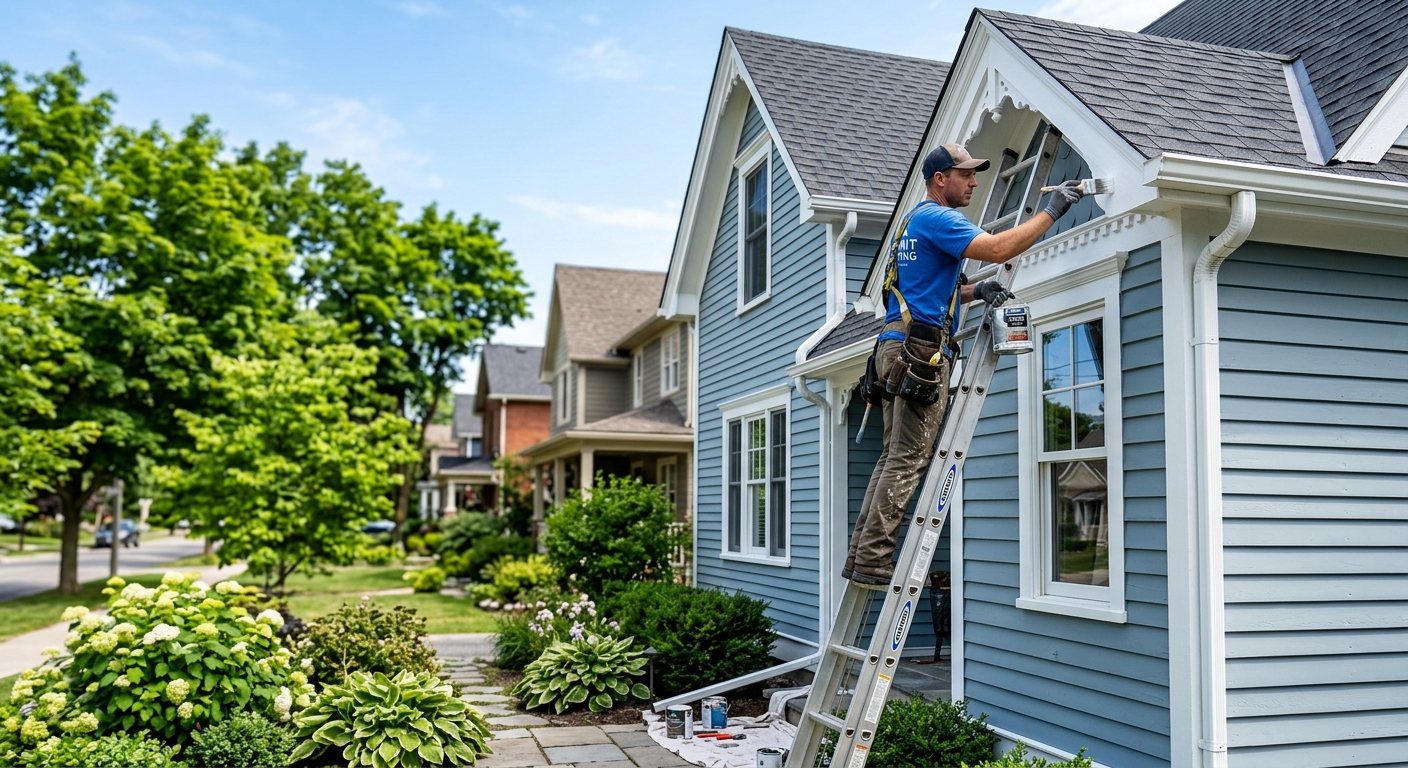
Painting options and costs in North Perth
Painting options and costs in North Perth depend on both the age of local housing and the short, practical window we have for exteriors. In North Perth and the surrounding Stratford–Bruce Peninsula area, more homes were built before 1981, and that matters because older coatings often require deeper prep—scraping, patching, caulking, and priming—before paint can hold. In many pre-1978 homes, contractors also follow lead-safe work practices (even when it’s not a homeowner legal requirement) to reduce risk during sanding or scraping. (Statistics Canada, 2021 Census)
North Perth’s continental weather and freeze–thaw cycles influence when exterior paint can be applied and how long it needs to cure. Unlike coastal BC, we generally don’t deal with year-round dampness, but Ontario humidity and temperature swings still push the job toward late spring to early fall. Add to that the high proportion of single-detached homes in the area and the fact that many crews prioritize exterior work first, and you’ll typically see tighter scheduling (and sometimes higher labour rates) in neighbourhoods like Clifford and the rural roadways leading toward Listowel.
Interior work is less season-bound, but older plaster spots, nicotine or moisture staining, and detailed trim can still move costs quickly. For budgeting, it helps to compare typical price ranges for each service first, then refine the scope after a site visit—so the numbers you receive match what you actually need. Use the table below as your planning baseline.
| Service |
What's Included |
Typical Duration |
Price Range |
| Interior — whole home (walls, ceilings, trim) |
Protect floors/furniture, patching & sanding as required, prime bare spots, caulk where needed, paint walls/ceilings, paint interior trim/doors (per scope), clean-up and final walkthrough |
5–14 days |
$1,800–$4,800 |
| Interior — per room (standard bedroom or living room) |
Prep/patching (light to moderate), prime as needed, paint walls and ceiling, mask edges, basic trim touch-ups (as specified) |
1–3 days |
$600–$1,600 |
| Exterior — full house (siding, trim, soffits) |
Pressure wash (where suitable), scrape/sand loose paint, caulk cracks, prime bare or problematic areas, paint siding + trim + soffits, site protection and clean-up |
7–18 days |
$3,000–$7,000 |
| Exterior — trim and accent colours only |
Surface cleaning, spot-sanding/scraping, prime bare spots, paint trim rails, fascia, doors/stairs accents (as selected) |
3–8 days |
$1,500–$3,800 |
| Kitchen cabinet painting (doors, frames, spray finish) |
Remove/label hardware, degrease, de-gloss or sand, prime, spray finish doors/frames, re-install, new caulking at gaps if needed |
4–10 days (plus dry time) |
$1,200–$4,000 |
| Specialty / faux finish (accent wall, texture) |
Surface leveling as needed, base coat + specialized finish, protective clear if required, touch-ups and blending at edges |
1–6 days |
$800–$3,200 |
Prices are estimates only and vary by project scope, site access and material selection.
What affects the price of painting in North Perth
In North Perth and across the Stratford–Bruce Peninsula region, you can see the same “paint the house” project quoted 30–50% apart because the cost drivers aren’t just paint—they’re preparation, access, and scheduling. Exterior work is tightly climate-bound here, and the market demand spikes during the late spring to early fall period when daytime temperatures are consistently in the manufacturer-recommended range and surfaces are dry enough for proper curing. That compressed exterior season also means crews get booked quickly, so labour can price higher in the summer rush. Coastal BC typically has a longer workable window, but humidity and frequent precipitation can slow drying and increase mildew-management steps; in Alberta, temperature swing risks push contractors toward different product systems. Ontario sits in the middle: we’re not constantly soaked like coastal regions, but freeze–thaw and spring dampness still require strong acrylic exterior coatings and disciplined prep.
Older housing stock throughout the region increases cost because scraping, sanding, caulking, and priming can represent 50–70% of repaint labour on many homes. For example, repainting a pre-1981 home (over half of local dwellings are built before 1981) often means more time correcting failed edges and bare spots before applying the $1,500–$7,000 exterior ranges. (Statistics Canada, 2021 Census) A second example: interior work may fall in the $600–$3,000 band per typical scope, but if you’re dealing with patched plaster or nicotine/mildew staining, the hidden primer steps and additional stain-blocking can push the job toward the top of that range.
In North Perth, two practical examples usually explain the difference between “reasonable” and “expensive” quotes: (1) whether the contractor includes caulking and priming of bare wood before paint, and (2) whether they plan for height/access (ladders vs. scaffolding) on multi-storey elevations.
| Price Factor |
Why It Matters |
Cost Impact |
| Surface prep — scraping, sanding, patching drywall or wood |
Prep determines adhesion; poor prep leads to peeling or flashing |
Often +20–60% versus “paint-only” estimates |
| Number of coats — 2-coat system over primer vs. 1 coat over existing |
Coverage and durability depend on film build and uniform sheen |
Can add $300–$1,500+ for larger areas |
| Paint quality tier — contractor-grade vs. premium (Benjamin Moore, Sherwin) |
Higher solids and better tint stability improve coverage and longevity |
Material difference may be $150–$600; labour savings can offset |
| Ceilings and trim — adds significant time vs. walls-only |
Cut-in, masking, and detailing increase labour hours |
Typical +15–35% on interior scopes |
| Exterior season window — short season raises summer rates |
Fewer days to schedule increases demand and urgency |
May shift pricing upward during peak weeks |
| Lead-safe precautions — required for pre-1978 homes with lead paint |
Safe handling adds time for controls, cleanup, and disposal |
Often +10–30% on affected areas |
| Surface material — drywall vs. plaster vs. wood vs. stucco |
Different substrates need different primers and prep methods |
Can swing total cost by $500–$2,000+ |
| Height and access — multi-storey exterior requires scaffolding or lifts |
Access equipment and safety steps slow production |
Commonly +$400–$2,000 depending on elevation |
Permits & regulations in Ontario
In Ontario, painting itself generally doesn’t require a permit for typical interior or exterior repainting. However, there are important compliance expectations when dealing with older homes. For properties built before 1978, health guidelines strongly recommend testing for lead paint before sanding or scraping, and using lead-safe work practices if lead is present—such as wet methods to reduce dust, HEPA-filtered vacuum cleanup, controlled containment where appropriate, and proper disposal. This isn’t usually a homeowner “permit” issue, but it is standard practice for professional contractors in Ontario to manage safety risks responsibly.
Work that often triggers additional requirements isn’t “painting” per se, but related activities: if you’re removing materials beyond simple paint work (for example, stripping large areas of lead-containing coatings or doing invasive drywall demolition), the scope can change how safety controls are handled. Homeowners should still expect clear job-site controls, especially during scraping, sanding, or surface removal.
Step-by-step for a North Perth homeowner: (1) Ask for the contractor’s Ontario business information and confirm their operating legitimacy through the appropriate online business registry tools; (2) request a certificate of liability insurance showing active coverage—your contractor should provide it before work begins; (3) request proof of workers’ compensation coverage (WSIB/WCB) relevant to the province; (4) get a written contract that specifies the paint brand/line, sheen, number of coats, which prep tasks are included (e.g., caulking, priming, repairs), and disposal/cleanup responsibility. If lead-safe measures are needed, insist the plan is written into the scope.
Interior vs exterior painting — getting the best result in North Perth
For a long-lasting paint job in North Perth, the difference between a finish that lasts 6–10 years and one that fails early is usually preparation quality and correct product selection for our freeze–thaw swings and summer humidity. In interiors, surface prep matters more than brand: filling, sanding, and priming are what prevent flashing and peeling over joints or repaired areas. Sheen selection also controls wear—flat/eggshell in low-traffic areas, satin for living areas, and semi-gloss for trim and doors where scuffs are common. A practical rule: two coats over a proper primer almost always outlasts “one thick coat” because coverage is achieved uniformly and film build is consistent.
Exteriors are where mistakes show up fastest. Ontario conditions require meticulous scraping/sanding of loose paint, caulking before topcoats to prevent water ingress, and priming of bare or problematic surfaces. Primer type matters: wood/fibre cement/substrates may need different bonding primers and stain-blocking approaches depending on what’s coming off the wall. North Perth exteriors also benefit from mildew-resistant systems for bathrooms/under-eaves and from acrylic exterior coatings designed for temperature fluctuations. In older pre-1978 homes, contractors should apply lead-safe methods during sanding/scraping to protect the household and workers.
Cabinet painting is often the best “budget alternative” to replacement when the boxes are sound: refinishing a kitchen can deliver a large visual upgrade without the cost and disruption of a full replacement. For instance, if a full interior-refresh with trim could land around the $1,800–$4,800 range, cabinet refinishing may be a focused spend in the $1,200–$4,000 band—often justified when you want a high-impact look while keeping the rest of the home’s layout.
| Project Type |
Key Prep Step |
Recommended Coats |
Price Band |
| Interior — fresh drywall (new construction) |
Prime all drywall, tape/mud imperfections, sand smooth, caulk changes of plane |
2 coats over primer |
$900–$2,800 |
| Interior — repaint (good condition, no repairs) |
Clean/de-gloss if needed, spot-prime any stains, light scuff sanding |
2 coats (thin, even application) |
$600–$2,200 |
| Interior — repaint (patching and priming needed) |
Patch/fill, sand flush, prime repairs to prevent flashing |
2 coats with spot-priming (sometimes 3 in tricky stain areas) |
$900–$3,000 |
| Exterior siding (wood or fibre cement) |
Scrape/sand loose paint, caulk cracks, prime bare and stained areas |
2 coats over correct primer system |
$3,000–$7,000 |
| Exterior trim and accents only |
Surface cleaning + spot prep, prime exposed/failed areas |
2 coats (spot-primed as needed) |
$1,500–$3,800 |
| Kitchen cabinets (spray finish) |
Degrease, de-gloss, sand, prime for adhesion, control dust and finish dry time |
2–3 coats depending on colour change and primer choice |
$1,200–$4,000 |
How to choose a painting contractor in North Perth
Choosing the right contractor matters in North Perth because exterior work is scheduled into a short window, and older homes often require more prep than homeowners expect. Start by verifying coverage and legitimacy. For Ontario contractors, ask for a certificate of liability insurance (current dates and the insured party name matching the contractor you hire) and request WSIB/WCB proof for workers. If they can’t provide it, treat that as a major problem. Next, get 2–3 itemised written quotes. Itemised should mean labour hours by area (prep, prime, paint, trim, cleanup), and material allowances (primer type, paint line, supplies) rather than a single lump sum with vague wording.
Read the scope carefully. Confirm what’s excluded: lead-safe testing (if needed), power washing method, ladder vs. lift/scaffold costs, patching responsibilities, drywall repairs, caulking, waste disposal, and whether paint matching/tinting is included. Permits usually aren’t required for normal painting, but your contract should still be explicit about prep and compliance steps.
Warranty should be in writing: workmanship warranty length (e.g., touch-up period and what causes it covers), product/manufacturer warranty terms, and whether the warranty is transferable to you. Payment schedules are another tell—never accept a plan requiring more than 10–15% upfront, and build in a holdback until the full job is complete and cleaned. Finally, require a start date and estimated completion in writing; in Ontario, weather gaps can affect exteriors, so the timeline should include contingencies.
- Ask for proof of liability insurance and active WSIB/WCB coverage before work starts.
- Confirm the contract lists the paint brand/line, sheen, and number of coats.
- Require a written scope for scraping/sanding, caulking, and primer coverage (not “as needed” only).
- Check whether disposal and site cleanup are included.
- Get clarity on surface repair: who patches, who sands, and what’s included in “small repairs.”
- Make sure trim, doors, and ceiling details are explicitly included or excluded.
- Ask how colour changes are handled (tinting primer, additional coats).
- Confirm whether they use moisture-resistant systems on exterior areas prone to mildew.
- For older/pre-1978 homes, ask for their lead-safe work approach if scraping/sanding is planned.
- Inquire about access equipment (ladders vs. lift/scaffold) and who pays if height requires it.
- Review warranty terms in writing and what you must do for coverage to apply.
- Use an itemised quote and compare apples-to-apples (materials, coats, and prep steps).
Red flags in North Perth: a quote that says “we’ll paint over it” without detailing prep; reluctance to show insurance/WSIB/WCB paperwork; demanding heavy upfront payment beyond 10–15% without a signed scope; no written warranty or vague “manufacturer warranty only”; and a contract that omits caulking, priming of bare/failed areas, or disposal/cleanup responsibilities.
Frequently asked questions — painting in North Perth
Do I need to worry about lead paint in an older North Perth home?
If your North Perth home was built before 1978, you should plan for lead-safe precautions. Ontario doesn’t typically require a permit for homeowners painting, but health guidance recommends testing before you sand or scrape, and using lead-safe controls if lead is present (wet methods to reduce dust, HEPA vacuum cleanup, and proper disposal). This is especially relevant in older housing stock—over half of local dwellings were built before 1981, which often means older paint layers. (Statistics Canada, 2021 Census) A professional contractor in Ontario should be able to explain their approach before quoting prep, and your written contract should state what containment/cleanup is included. If the contractor can’t discuss lead-safe methods for pre-1978 coatings, it’s a red flag.
How long does it take to paint a house?
Timing depends mainly on prep complexity and how many areas are included. In North Perth, interior whole-home work often takes about 5–14 days, while a single room can be as quick as 1–3 days (drying and curing still affect exact scheduling). Exterior painting is more weather-dependent: in the Stratford–Bruce Peninsula region, most exterior work is realistically scheduled late May to early October, with contractors needing surfaces dry enough for proper cure. Freeze–thaw and summer humidity can slow progress, so the schedule can stretch if there are rain windows. For a typical exterior full house repaint in the $3,000–$7,000 band, many crews plan around 7–18 days including prep, caulking, and multiple coats. A written start date and weather contingency help you avoid surprises.
What's the difference between paint quality tiers?
Paint quality tiers mainly affect coverage, durability, and how forgiving the product is during application. Premium lines from brands commonly used by professional painters often have better solids and tint stability, which can reduce the risk of flashing or uneven sheen—especially on exteriors where temperature swings and humidity challenge drying. Contractor-grade products can be perfectly fine, but the number of coats and the prep quality become even more important to achieve a consistent finish. In North Perth, where many homes need extra scraping/sanding and priming, the “best result” usually comes from matching the correct primer system plus the right number of coats, rather than chasing only a higher-end label. This is why you might see interior quotes ranging within the $600–$3,000 band: prep and film build are deciding factors, not just the paint can price.
How do I compare painting quotes?
To compare quotes fairly in North Perth, ask for itemised details instead of relying on the total number. Make sure each quote includes the same prep: scraping/sanding, caulking, patching, and priming of bare or stained areas. Confirm the same scope for trim and ceilings—many “room” quotes exclude trim unless specified. For exteriors, compare whether power washing is included (and how), whether failed caulk lines are removed and replaced, and what primer system is used. It’s also important to compare the number of coats: a two-coat system over primer is not the same as “one coat over existing.” If one contractor lands near an exterior range like $1,500–$3,800 for trim-only, but omits priming or caulking, that quote often isn’t truly apples-to-apples.
What paint sheen should I use in different rooms?
In Ontario homes like those in North Perth, sheen choice is about cleanability and how light reflects. Flat paint hides wall imperfections best, so it can work in low-traffic areas like some bedrooms, but it marks more easily. Eggshell is a common compromise for living areas: it’s more washable than flat while still looking soft. Satin (often used for family rooms and hallways) balances durability and appearance well. Semi-gloss is typically best for trim, doors, and moulding because it cleans well and resists scuffs. For kitchens and bathrooms, many homeowners prefer semi-gloss or satin on trim and walls where moisture and cleaning are frequent. Your contractor should recommend sheen based on room use and surface condition, especially if repairs are present.
Can I paint my house exterior in spring or fall in North Perth?
You can start in spring, but success depends on drying conditions and temperature. In the Stratford–Bruce Peninsula area, exterior work is usually scheduled late May to early October because applicators need daytime temperatures that stay within manufacturer-recommended ranges and surfaces that are dry enough for proper curing. Spring can be unpredictable: cold mornings, damp siding, and freeze–thaw can cause poor adhesion or premature failure if paint goes on too early. Fall can also be risky if nights cool quickly or if humidity rises before the coat has fully cured. That’s why reputable contractors often won’t commit to an exterior start if the forecast can’t support stable conditions. If you want to plan, ask about booking early for summer windows—exterior pricing can be higher during peak scheduling in North Perth.