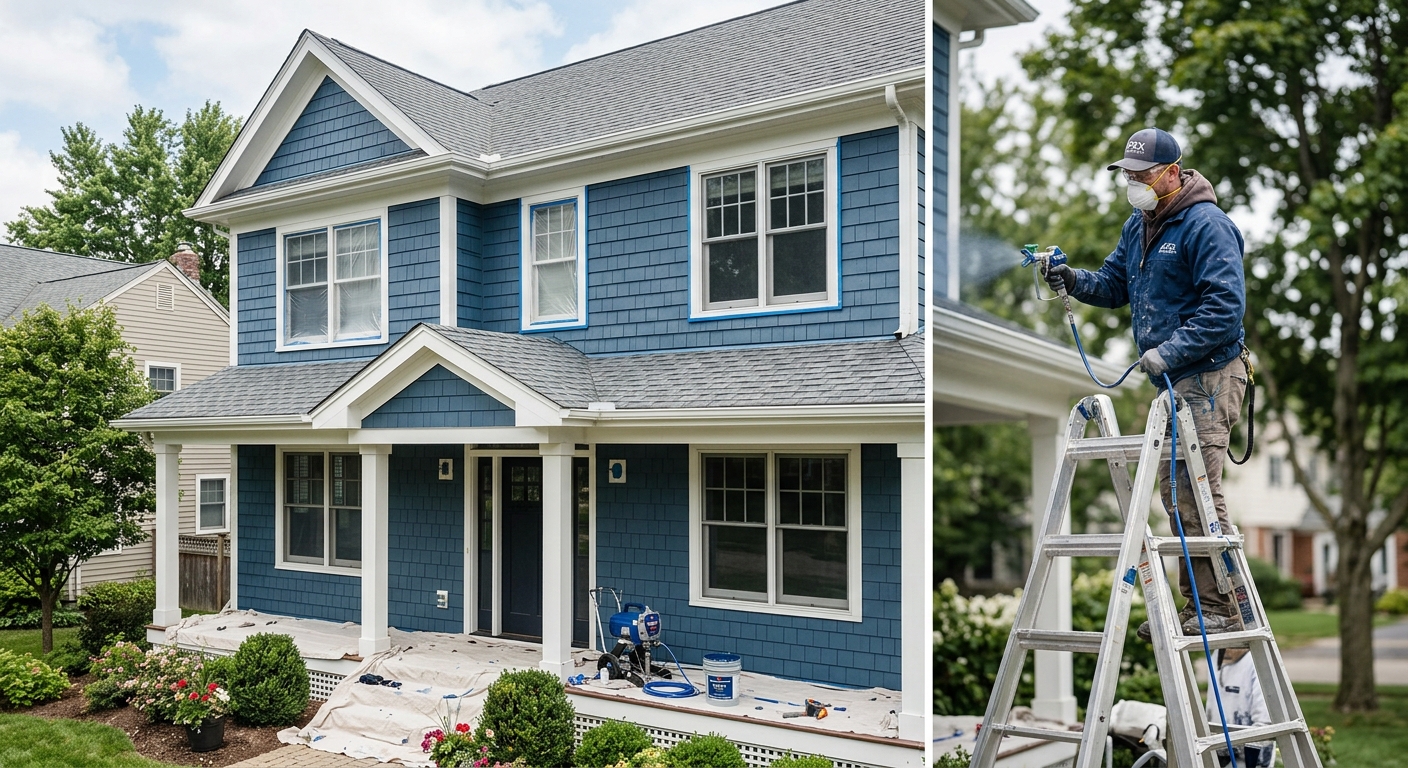
Painting options and costs in Downtown Cambridge
Painting in Downtown Cambridge means planning around a short, reliable exterior window and a lot of older housing stock. In Downtown Cambridge specifically, the area includes housing types that commonly pre-date modern finishes; in the broader region, population is relatively compact at 3,117 residents (Statistics Canada, 2021 Census), which helps explain why local contractors often prioritize the neighbourhoods with the most repaint demand first. You’ll notice this most around Galt and parts of the downtown core where renovations cluster and buyers expect “move-in ready” walls and curb appeal. Older homes typically need more prep—scraping, patching, sanding and priming—and pre-1978 properties can involve lead-safe precautions before any sanding or scraping.
In the Kitchener–Waterloo–Barrie market, exterior pricing is strongly affected by schedule pressure. Demand for exterior work is compressed into late spring through early fall when temperatures are stable and surfaces dry. That concentration can push rates upward in mid-summer, while exterior projects started too early or too late often cost more because crews have to re-mobilize and repaint sections that didn’t cure properly. Interior work is steadier, often filling winter capacity and stabilizing availability when exterior season is slow.
Below is a practical comparison of common painting options and realistic cost ranges to help you line up apples-to-apples quotes before you book for May through September.
| Service |
What's Included |
Typical Duration |
Price Range |
| Interior — whole home (walls, ceilings, trim) |
Protect floors, mask, prep and patch, prime as needed, paint walls/ceilings, caulk, basic trim prep and 1–2 finish coats; cleanup and touch-ups |
5–10 days |
$4,200–$7,500 |
| Interior — per room (standard bedroom or living room) |
Prep/patch, spot prime where required, paint walls; optional ceiling; caulk corners and trim edges if included |
1–3 days |
$2,500–$4,200 |
| Exterior — full house (siding, trim, soffits) |
Pressure wash (as needed), scrape/sand, caulk and repair, prime bare spots, 2-coat exterior system, paint trim/soffits; site protection and cleanup |
7–16 days |
$5,800–$9,000 |
| Exterior — trim and accent colours only |
Surface prep for trim, prime where required, paint accents/trim only; typically excludes full siding repaint |
3–8 days |
$2,500–$5,500 |
| Kitchen cabinet painting (doors, frames, spray finish) |
Degrease, sand/scuff, prime with adhesion primer, spray doors/drawer fronts, paint frames, reinstall hardware and touch-ups |
5–12 days (plus dry time) |
$2,300–$4,500 |
| Specialty / faux finish (accent wall, texture) |
Layout and protection, specialized prep, texture/application system, sealing and finish coats |
1–5 days |
$800–$3,000 |
Prices are estimates only and vary by project scope, site access and material selection.
What affects the price of painting in Downtown Cambridge
Even when two homeowners describe the “same” painting job in Downtown Cambridge, quotes across the Kitchener–Waterloo–Barrie region can differ by 30–50%—and that’s normal. The difference usually isn’t the topcoat; it’s the prep scope (what’s deteriorated), the coat count (what’s hiding without flashing), and the labour logistics (how crews can work without delays). Exterior projects also move with the calendar: in Ontario and Alberta, the window for exterior work runs roughly late May to early October, because temperatures need to stay above about 10°C and rising during application. Coastal BC can paint longer, but humidity and mildew risk force extra attention, product choice and weather timing—so inland Ontario is all about schedule reliability and surface dryness.
For Downtown Cambridge, older homes are a cost driver. Scraping peeling paint, patching drywall or repairing wood rot, sanding edges, caulking joints and priming stained areas commonly take 50–70% of total labour on a repaint. A concrete example: a typical exterior full-house repaint can land in the exterior $5,800–$9,000 band when prep is moderate, but it can stretch toward the upper end when multiple boards need repair and additional primer is required for adhesion. On the interior side, a “same-room” repaint can look inexpensive until it turns into patching and priming; that’s why interior per-room work that starts in the interior $2,500–$4,200 range may rise quickly if walls are damaged or stained.
In practical terms, two common Downtown Cambridge scenarios raise cost: (1) facades with more trim detailing (more edges to caulk and cut in), and (2) properties with previous layers of failing paint, where scraping and stabilization become time-consuming. Conversely, if surfaces are already sound and you’re staying in the same sheen and colour family, the project can remain closer to the mid-range.
| Price Factor |
Why It Matters |
Cost Impact |
| Surface prep — scraping, sanding, patching drywall or wood |
Adhesion depends on what you remove; damaged areas require mechanical prep and repair |
High; often 50–70% of exterior repaint labour |
| Number of coats — 2-coat system over primer vs. 1 coat over existing |
Coverage, uniformity, and hiding depend on primer use and prior colour |
Medium to high; can shift total by 10–25% |
| Paint quality tier — contractor-grade vs. premium (Benjamin Moore, Sherwin) |
Better binders and pigments can reduce recoat needs and improve washability |
Low to medium; materials differ, labour still dominates prep-heavy jobs |
| Ceilings and trim — adds significant time vs. walls-only |
Cut-ins, masking and drying time increase labour even if product quantity is similar |
Medium; commonly adds 15–35% to interior |
| Exterior season window — short season raises summer rates |
Scheduling pressure increases overhead and may require crew re-mobilization |
Medium; can push exterior toward upper band |
| Lead-safe precautions — required for pre-1978 homes with lead paint |
Proper containment, HEPA vacuuming and disposal add time and cost if lead is present |
Medium to high on affected projects |
| Surface material — drywall vs. plaster vs. wood vs. stucco |
Different substrates need different primers and repair approaches |
Medium; wrong primer can force rework |
| Height and access — multi-storey exterior requires scaffolding or lifts |
Safe access means more time, equipment and setup |
Medium to high; can significantly raise exterior labour |
Permits & regulations in Ontario
In Ontario, painting generally does not require a permit. What can change the rules is the presence of hazardous materials or related work types—painting itself is usually permit-free, but the practices around prep can be regulated indirectly by health and safety expectations. For homes built before 1978, health guidelines recommend testing for lead paint before sanding or scraping. If lead is present, lead-safe work practices are standard for professional contractors: using wet methods to control dust, HEPA vacuuming, and proper disposal of debris. This isn’t typically a legal requirement placed on homeowners, but it’s what responsible crews follow because lead dust is a serious hazard.
For contractor compliance, you should confirm three things before signing: the contractor carries liability insurance, has WSIB coverage (workers’ compensation), and provides a written contract. Your contract should clearly state paint brand and sheen, number of coats, surfaces prep included (scraping, sanding, patching, priming), and whether caulking and disposal are part of the job.
Step-by-step for Downtown Cambridge homeowners:
- Ask for the contractor’s Ontario business details and current proof of insurance documents.
- Request an insurance certificate (liability) naming you/property as appropriate.
- Confirm WSIB clearance or coverage details for workers on site.
- Look for a clear scope listing prep and coat counts—avoid “paint as required” wording without specifics.
- Verify there’s an explicit section on disposal and jobsite cleanup.
Don’t rely only on verbal assurances—proof and a written scope protect you if the job needs follow-up.
Interior vs exterior painting — getting the best result in Downtown Cambridge
The difference between a long-lasting paint job and a premature failure in Downtown Cambridge is usually preparation and timing, not marketing. Interiors live and die by surface condition: filling and sanding, priming where repairs were made, and using the right sheen for the room. In kitchens and hallways, semi-gloss or satin on trim and washable wall products typically perform better. A common mistake is skipping primer after patching; two coats over a proper primer almost always outlast one thick coat because primer balances porosity and reduces flashing.
Exteriors, meanwhile, are all about Ontario’s repaint reality—water management and adhesion. Even if the “look” is fine on Day 1, peeling can start where caulking wasn’t addressed or where primer wasn’t matched to the substrate. Before finish coats, crews should caulk cracks and joints, repair soundness issues (wood rot, blistering, failing caulk), and prime bare and stained spots. In Downtown Cambridge, you’ll typically see better results when the product system suits the temperature and drying conditions in the Kitchener–Waterloo–Barrie window, which supports proper curing over late spring through early fall.
Cabinet painting is a good budget alternative to replacement when prep is thorough: degreasing, scuff-sanding, adhesion primer and a controlled spray finish help doors withstand daily wear. For pre-1978 homes, lead-safe precautions should be part of the prep plan before sanding or scraping.
Where price differences are justified: if your exterior quote is closer to the exterior $5,800–$9,000 range, it’s often because the contractor is budgeting real prep time (repairs and priming). If you choose a low bid that under-scopes scraping and priming, you may end up paying again within 3–5 years due to adhesion failures—costing more than doing it right the first time.
| Project Type |
Key Prep Step |
Recommended Coats |
Price Band |
| Interior — fresh drywall (new construction) |
Seal and prime for uniform absorption, then sand lightly for a smooth finish |
Prime + 2 finish coats (walls/ceilings), trim as specified |
$4,200–$7,000 |
| Interior — repaint (good condition, no repairs) |
Clean and spot-prime scuffs/stains; light sanding for bonding |
1–2 finish coats (often 2 for colour change), minimal priming spots |
$2,500–$5,500 |
| Interior — repaint (patching and priming needed) |
Patch, sand flush, spot-prime repairs so the finish doesn’t flash |
2 finish coats with primer on repairs (system varies by stain) |
$3,200–$7,000 |
| Exterior siding (wood or fibre cement) |
Scrape and sand failing coatings, caulk joints, prime bare/repair areas |
Primer as required + 2 finish coats |
$5,800–$9,000 |
| Exterior trim and accents only |
Trim-focused prep: scrape loose paint, sand edges, prime and caulk |
1–2 finish coats after primer depending on coverage |
$2,500–$5,500 |
| Kitchen cabinets (spray finish) |
Degrease thoroughly and use adhesion primer before finishing |
Primer + 2 durable finish coats |
$2,300–$4,500 |
How to choose a painting contractor in Downtown Cambridge
Start by verifying licensing and coverage the right way. Ontario painting work is commonly delivered without a permit, but contractors still must be properly insured and able to work safely. Ask for proof of liability insurance (so you’re protected if something is damaged) and WSIB coverage for their workers. To check, request the certificate of insurance (with policy dates) and WSIB clearance details—then confirm the documents are current and match the company doing the work. If a contractor can’t provide documentation quickly, that’s usually a sign to keep shopping.
Next, get 2–3 quotes that are itemised. You want a breakdown that separates labour and materials, and lists what prep is included: scraping, sanding, drywall patching, priming, caulking and disposal. Avoid lump sums with broad exclusions like “prep as necessary” or “paint only.” Also ask how long they expect to keep the area dry between coats and what they do for weather delays during the late spring to early fall window.
Warranty matters: confirm workmanship warranty length (how long they’ll return for peeling, failing adhesion or missed coverage), whether the product/manufacturer warranty is included, and whether you need to register anything. For payment, never pay more than 10–15% upfront; use a holdback until completion and final walk-through. Get the timeline in writing: planned start date, estimated completion date, and what happens if the weather shifts.
- Request proof of liability insurance (active policy, proper coverage limits).
- Verify WSIB clearance/coverage for workers on your site.
- Ask for a written scope listing prep steps and surface conditions treated.
- Confirm number of coats and primer requirements (especially for patching).
- Make sure caulking and trim edge preparation are explicitly included.
- Clarify disposal and site cleanup (drop cloth removal, debris hauling).
- Confirm paint brands and sheen levels used in each room/area.
- Ask how they protect floors, furniture and landscaping during exterior work.
- Review the prep photos process (before work and after sanding/priming).
- Get a detailed timeline with weather contingency built in.
- Use a payment schedule with a final holdback after touch-ups.
- Check workmanship warranty terms before signing.
Red flags in Downtown Cambridge: vague scopes that don’t mention priming/caulking, pressure for large upfront payments, refusing to show WSIB/insurance documents, skipping surface protection and cleanup details, or promising “one-coat coverage” over repaired or previously stained areas.
Frequently asked questions — painting in Downtown Cambridge
What colours add the most resale value in Downtown Cambridge?
For Downtown Cambridge (and much of Ontario), the safest resale-friendly choices are bright, neutral, and consistent across rooms: warm whites, soft greiges, and light warm-toned beiges. These colours photograph well for listings and can reduce buyer hesitation—especially in older homes where natural light varies by layout. If you want personality, add colour through an accent wall or updated trim colour rather than painting every room a bold shade. In practice, I often steer homeowners toward a “main wall neutral + slightly richer trim” approach so the home feels clean and cohesive. If your exterior is being repainted, many buyers also prefer classic curb-appeal palettes (not overly trendy) because they look intentional and hold up visually from spring through fall (Statistics Canada, 2021 Census).
How much does it cost to paint a house in Downtown Cambridge?
Cost depends on whether you’re painting the interior, the exterior, or both—and how much prep is required. For a typical exterior full-house repaint in Downtown Cambridge, many projects land in the $5,800–$9,000 range when scraping, caulking, patching and priming are included as needed. Interior costs vary even more because rooms, ceilings, and trim drive labour time; whole-home interior projects commonly fall into the $4,200–$7,500 range depending on the number of rooms, whether patching/priming is needed, and trim detail. If your home has older paint failure (common on older facades), prep can become the biggest portion of labour—so two “similar” homes can legitimately land far apart. The best way to firm up pricing is an itemised, room-by-room scope that shows prep and coat count.
How much does interior painting cost per room in Downtown Cambridge?
Per-room interior pricing is usually driven by how much repair and prep is needed and whether ceilings and trim are included. For a standard bedroom or living room, a realistic range in Downtown Cambridge is typically $2,500–$4,200 when prep is moderate and you’re painting walls (with optional ceiling depending on scope). If the room has patching from water damage, cracked plaster-like repairs, or stains that require priming, the job can climb toward the top of the band because spot-priming and additional sanding steps are labour-intensive. Also, sheen choice matters: if you’re doing semi-gloss/satin for washability in high-use areas, that’s still part of a quality system and may require extra care during application to avoid lap marks.
When is the best time for exterior painting in Downtown Cambridge?
For exterior painting in Downtown Cambridge, timing is everything because the region’s exterior window is short and weather-sensitive. In the Kitchener–Waterloo–Barrie market, crews typically aim for late May through early October. The ideal window is when temperatures are above about 10°C and moving upward during application, with surfaces dry enough to bond properly. Ontario’s summer schedules fill quickly, so earlier bookings in May or early June can reduce rush costs. If rain is forecast or humidity is high, a professional team may delay to protect curing and avoid issues like blisters or poor adhesion. Many homeowners also find that the best results come when lead/primer/prep work is completed before peak summer humidity so the finish coats can cure steadily.
How many coats of paint do I need?
Most quality repaint systems follow a “primer where needed + two finish coats” approach. In interiors, when walls are in good condition, some rooms can be done with 1–2 finish coats depending on coverage and colour change; however, patching or stain control usually requires primer first, then two finish coats to prevent flashing. For exteriors, two finish coats over primer (as needed) is the norm for durability, especially in Ontario where rain cycles and temperature swings stress coatings. If a contractor suggests “one thick coat” for a repaint, ask how they’re treating repairs and what primer system they’re using. Proper sanding, caulking, and primer selection are what make multiple coats perform, not just the number of coats themselves.
What paint is best for Downtown Cambridge's climate?
Downtown Cambridge sees true seasons: cool shoulder weather in spring and fall, hot dry days in summer, and cycles of moisture exposure. For that kind of inland Ontario climate, choose a premium exterior coating system designed for durability and adhesion, with primer matched to the substrate (wood, fibre cement, stucco-like surfaces). If moisture issues are present—like old caulk failures or areas that stay damp—ask about systems that include mildew-resistant components and strong bonding primers. For interiors, prioritize washable, scuff-resistant finishes in high-traffic areas (satin/semi-gloss trim; wall sheens by room use). Contractors often base paint choice on the prep condition: if the surface prep is correct, even standard premium-grade paints perform well; if prep is skipped, the “best paint” won’t hold. Quality prep is typically the difference between a mid-range exterior repaint and one that lasts.