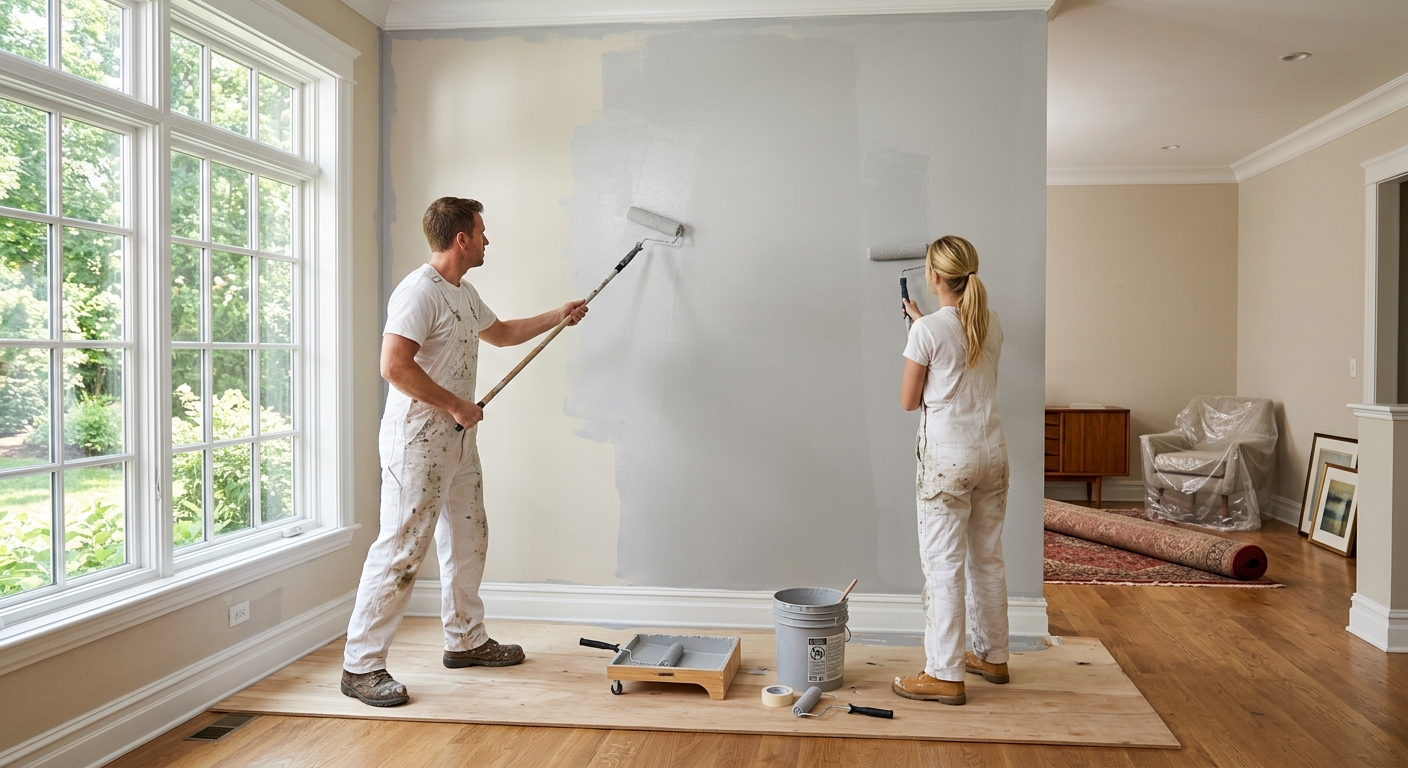
Painting options and costs in Mississauga
Mississauga homeowners typically choose between quick interior refreshes and higher-cost exterior work because our climate is seasonal and the schedule is tight. For many properties—Ontario homes with a substantial portion built before 1981 (37.9% in Mississauga, Statistics Canada, 2021 Census)—repainting usually involves extra labour: more scraping, sanding, caulking, spot-priming and sometimes lead-safe precautions around older trim. That prep work is where paint jobs often expand from a “simple repaint” into a full surface-repair and priming project.
Cost is also shaped by the Greater Toronto Area’s exterior painting window. In practice, contractors plan around late May to June and again from September to mid-October when temperatures stay above about 10°C for the hours needed for application and curing. Humidity spikes can slow dry times and increase the odds of problems like flashing or poor adhesion, so the best weeks get booked first—often contributing to higher pricing in June–August. If you’re in areas with lots of two-storey homes and older streets, like Streetsville, you’ll notice consistent demand for exterior repaints and trim work.
Below are typical Mississauga price ranges by service so you can compare quotes consistently before you book site visits and confirm scope.
| Service |
What's Included |
Typical Duration |
Price Range |
| Interior — whole home (walls, ceilings, trim) |
Move protection/masking, patching of minor defects, sanding, primer where needed, paint (walls/ceilings), basic trim touch-ups, caulking at common joints |
5–10 days |
$2,000–$6,000 |
| Interior — per room (standard bedroom or living room) |
Protection/masking, prep of existing surfaces, 2-coat system where required, and paint to room walls (and ceilings if specified) |
1–3 days |
$400–$1,500 |
| Exterior — full house (siding, trim, soffits) |
Surface inspection, washing as needed, scrape/sand of loose paint, caulking, primer on bare spots, 2-coat exterior system, trim/soffit painting, site cleanup |
1–3 weeks |
$3,500–$8,000 |
| Exterior — trim and accent colours only |
Prep focused on trim/accents, scrape/sand loose areas, spot-prime, caulk, paint accents, protection of siding |
3–7 days |
$1,500–$3,500 |
| Kitchen cabinet painting (doors, frames, spray finish) |
Hardware removal (where requested), degrease/clean, light sanding, bonding primer, spray or controlled finish, interior cabinet touch-ups, re-install |
5–14 days (includes dry/cure time) |
$1,800–$4,000 |
| Specialty / faux finish (accent wall, texture) |
Surface preparation for the finish type, specialized material application, sealing/clear coat where needed |
2–6 days |
$600–$3,500 |
Prices are estimates only and vary by project scope, site access and material selection.
What affects the price of painting in Mississauga
In Mississauga and across the Toronto region, two contractors can quote the same “paint the house” task and be 30–50% apart because the difference is usually the hidden prep and risk work—not the finish coat. Exterior jobs, in particular, are tightly climate-bound in the GTA: contractors typically rely on late May through June and again September to mid-October, when temperatures are reliably above about 10°C and curing isn’t interrupted by rain or cold snaps. That shorter “ideal” season concentrates demand and creates summer scheduling pressure, which is why exterior painting commonly trends toward the higher end of the $1,500–$8,000 band during June–August. Coastal BC can offer a longer calendar, but persistent humidity and dampness force different product choices and careful mildew management; in the GTA, the main constraints are frost, rain, and humidity spikes rather than year-round moisture.
Mississauga’s older housing stock also increases labour. With 37.9% of homes built before 1981 (Statistics Canada, 2021 Census), repainting often means dealing with multiple paint layers and more time spent on scraping, sanding, caulking and priming—work that can represent 50–70% of total labour on a repaint. For example, if your home’s exterior prep is extensive, the price can move from a mid-range exterior estimate around the $1,500–$3,500 trim/accent style cost up toward the $3,500–$8,000 full-house band because scaffolding time and primer/bare-spot coverage increase.
In practice, cost may rise if you have peeling window trim, cracked caulk lines at lower brick/siding transitions, or hard-to-access eaves; it may be lower if surfaces are already sound and you only need a light scrape and spot-prime.
| Price Factor |
Why It Matters |
Cost Impact |
| Surface prep — scraping, sanding, patching drywall or wood |
Prep determines adhesion and final appearance; older layers require more labour and sometimes additional priming |
Often +20–40% labour on repaints |
| Number of coats — 2-coat system over primer vs. 1 coat over existing |
Proper coverage prevents flashing, patchiness, and early wear |
+5–15% depending on baseline condition |
| Paint quality tier — contractor-grade vs. premium (Benjamin Moore, Sherwin) |
Premium coatings typically offer better hide, durability and colour stability |
+5–20% materials; may reduce rework |
| Ceilings and trim — adds significant time vs. walls-only |
Cut-in work, protection and detailed masking increase labour |
+10–25% for trim-heavy rooms or ceilings |
| Exterior season window — short season raises summer rates |
Contractors schedule around workable curing weather and limited “ideal” weeks |
+10–15% in June–August |
| Lead-safe precautions — required for pre-1978 homes with lead paint |
Safe containment/cleaning takes time; disposal and HEPA vacuuming add labour |
+10–30% when lead is present or suspected |
| Surface material — drywall vs. plaster vs. wood vs. stucco |
Different substrates need different primers, adhesion methods and sanding intensity |
+10–25% depending on materials |
| Height and access — multi-storey exterior requires scaffolding or lifts |
More setup time, safety requirements, and slower work pace |
+15–40% on taller or complex facades |
Permits & regulations in Ontario
In Ontario, painting typically does not require a permit for residential properties, including interior and exterior repainting. However, health guidelines matter—especially in homes built before 1978, which is common across Mississauga’s older neighbourhoods. Professional best practice is to test for lead paint before sanding or scraping, and if lead is present, follow lead-safe work practices (wet methods to reduce dust, HEPA vacuuming, plastic containment where feasible, and proper disposal). For homeowners, these precautions are not always legally mandated in the way they are for contractors working under workplace health rules, but they are the standard approach professionals use to reduce exposure risk.
Some work can require permitting—generally when you’re changing building systems or doing structural/major exterior alterations (for example, replacing exterior cladding or altering openings), not simply applying paint. Painting itself remains permit-free in most cases.
When hiring in Mississauga, verify three things: (1) liability insurance (ask for a certificate of insurance), (2) WSIB/WCB workers’ compensation coverage (to protect you and their crew), and (3) a written contract that lists the paint brand/line, sheen level, number of coats, surface prep steps, and what’s excluded.
Step-by-step homeowner checks: ask for a current insurance certificate, confirm WSIB/WCB account coverage (or equivalent documentation), and ensure your contract references the exact scope. If any contractor refuses these basics, treat it as a red flag and choose another bidder.
Interior vs exterior painting — getting the best result in Mississauga
In Mississauga, the difference between a long-lasting paint job and a premature failure is usually the prep and the system choices—not just the colour. For interiors, start with filling, sanding and priming. Drywall that’s been patched needs a proper primer to prevent flashing; scuffed areas need sanding to create a uniform surface. Sheen selection matters by room: kitchens, bathrooms and entryways typically hold up better with eggshell or satin than flat paint, which scuffs more easily. A two-coat approach over a correctly primed surface almost always outlasts a “thick one-coat” strategy because it ensures even film build and consistent hiding.
For exteriors, Ontario’s temperature swings, rain events and humidity spikes make surface prep and adhesion critical. Caulking should be completed before painting so the coating system bridges the right joints and reduces water ingress paths. Primer type also matters: different substrates (wood, fibre cement, masonry, previously painted surfaces) require the right primer for bonding and stain control. Unlike coastal BC—where mildew-resistant products are the main defensive product choice—the GTA is more about getting the timing right so coatings cure properly after application.
Cabinet painting is often a smart mid-cost alternative to replacement. If you’re comparing replacement at a higher budget, cabinet spraying is frequently a more realistic investment—especially when you can keep boxes and only refinish doors and fronts. For pre-1978 homes, lead-safe precautions apply if sanding or scraping older trim/paint is needed on both interiors and exteriors.
Example: if an exterior repaint quote lands around the $3,500–$8,000 range, that premium is justified when it includes extensive scrape/sand, caulking, bonding primer on bare wood, and two full exterior coats—not just a fast top-coat. If prep is minimized, you may see peeling or patchiness earlier and end up paying again.
| Project Type |
Key Prep Step |
Recommended Coats |
Price Band |
| Interior — fresh drywall (new construction) |
Prime all drywall and filled areas to unify absorbency before topcoating |
1 primer + 2 topcoats |
$1,200–$3,000 |
| Interior — repaint (good condition, no repairs) |
Light scuff-sanding, thorough cleaning, and spot-priming of any stains/repairs |
1 prime (spots) + 2 topcoats |
$400–$1,800 |
| Interior — repaint (patching and priming needed) |
Sand/feather edges, caulk as needed, prime patches so they match the surrounding surface |
1 primer + 2 topcoats |
$900–$3,000 |
| Exterior siding (wood or fibre cement) |
Scrape loose paint, address bare areas with primer, and caulk gaps before coating |
2-coat exterior system over primer where required |
$3,500–$8,000 |
| Exterior trim and accents only |
Protect siding carefully and prep only the trim surfaces you’re repainting |
Spot-prime + 2 coats |
$1,500–$3,500 |
| Kitchen cabinets (spray finish) |
Degrease, sand/scuff, and apply a bonding primer system for durable adhesion |
1 primer + 2 finish coats (spray-applied for smoothness) |
$1,800–$4,000 |
How to choose a painting contractor in Mississauga
Start with verification. In Ontario, while painting itself often doesn’t require a permit, a reputable Mississauga contractor should still carry the proper coverage. Ask for a current certificate of liability insurance—your certificate should show the insured party, limits, and the effective dates. For workers’ compensation, confirm WSIB/WCB coverage documentation so you’re not exposed if a painter is injured on your property. Don’t rely on verbal assurances; request documents before work begins.
Next, get 2–3 itemised written quotes. You want a breakdown that separates labour from materials, and lists what’s included in surface prep (scraping, sanding, patching, priming), what products are being used (brand/line/sheen), and which areas are included (ceilings, trim, soffits, cabinet interiors). Confirm whether disposal is included (paint tins, masking and debris) and whether power washing/wall washing is included for exteriors.
Warranty matters: ask for the workmanship warranty length and whether it applies to peeling, adhesion failure, or flashing under normal conditions. Product/manufacturer warranties may require correct surface prep and application methods—so make sure the contractor’s written prep scope aligns with those requirements. Payment schedules should be conservative: never pay more than 10–15% upfront, and hold back a portion until the job is complete and you’ve done a walkthrough.
Finally, insist on a written timeline with a start date and completion estimate. Exterior work is weather-dependent, but a clear schedule helps you plan around the GTA’s late May/June and September mid-October windows.
- Verify liability insurance with a current certificate (effective dates and limits shown).
- Confirm WSIB/WCB workers’ compensation coverage with documentation.
- Ask for proof of experience with similar Mississauga home types (especially pre-1980 prep demands).
- Request itemised quotes separating labour and materials (not one lump sum).
- Ensure prep scope is written: scraping, sanding, caulking, patching, primer on bare spots.
- Confirm what’s included in cleanup and disposal of paint waste and debris.
- Clarify exclusions: lead testing, asbestos/odour remediation, structural repairs, drywall replacement.
- Get the exact paint brand/line and sheen level in writing.
- Ask whether caulking is done before painting and what joints are included.
- Review warranty terms for workmanship and whether it’s transferable or cancellable.
- Use a payment plan with only 10–15% upfront and a holdback until final sign-off.
- Require a written schedule with realistic weather contingencies for exterior work.
Red flags to watch for in Mississauga: a quote that skips surface prep details, no proof of WSIB/WCB and liability insurance, “we’ll just paint over it” statements on peeling/exfoliating areas, no written warranty terms, or pressure to pay a large deposit upfront before prep materials and staging are confirmed.
Frequently asked questions — painting in Mississauga
What paint is best for Mississauga's climate?
For Mississauga (Ontario), the “best” exterior choice is a coating system designed for adhesion and temperature swings—especially because our workable season is mostly late May to June and again September to mid-October. For siding and trim, contractors typically pair a correct primer (based on substrate and previous paint condition) with a quality exterior topcoat and a true 2-coat system. In practice, the biggest performance differences come from prep: scraping loose paint, caulking, and priming bare spots so the finish cures uniformly. Home interiors can use standard interior coatings, but sheen matters; eggshell or satin is usually a better fit for kitchens and hallways. If your home has older trim layers (common in Mississauga; Statistics Canada, 2021 Census), proper bonding/spot-priming is essential to avoid early peeling.
How long does exterior paint last here?
Exterior paint life in Mississauga depends on prep quality, product line, and exposure to rain and humidity spikes—not just the brand. In our region, when the scrape/sand/caulk/prime steps are done correctly and the work is scheduled in a workable curing window, many homeowners see longer service life from properly installed 2-coat systems. If prep is rushed, you can see failures sooner—sometimes within a few seasons—because adhesion breaks down where coatings were applied over loose or unsealed surfaces. Budget-driven quotes that land toward the lower end of the exterior band (for example, $1,500–$3,500 for trim-only work) can still last well, but only if the scope truly addresses all weak points. For full-house repaints in the higher band, we typically allocate more time to prep and priming, which is what extends longevity.
Should I paint or replace my cabinets?
In Mississauga, painting cabinets is often the better choice when the cabinet boxes are solid and you’re aiming for a refreshed look without the disruption of a full replacement. Cabinet painting (doors/frames refinished with a spray-applied finish) can be a cost-effective alternative to replacement, especially if your goal is a modern white, warmer neutral, or colour shift. That said, if cabinets have water damage, warped rails, or failing hardware and joinery, replacement may be more practical. Ask for a quote that includes degreasing, sanding/scuffing, bonding primer, and a full finish schedule—those steps drive durability. As a rough reference, cabinet painting commonly sits in the mid-range of the overall painting bands (often around $1,800–$4,000 depending on scope and finish level). A good contractor will also discuss cure/dry timing so doors are handled correctly.
How do I prep walls before painting?
If you’re prepping yourself in Mississauga, the core goals are clean, flat, and uniform absorption. Start by removing dust and grease: wipe with a suitable cleaner and rinse if the product requires it. Fill holes and dents with spackle or joint compound, then sand smooth. Feather edges so you can’t feel the repair when running your hand over the surface. Caulk only where it’s appropriate (like trim seams) and let it cure fully. Spot-prime patched or stained areas—especially if you have water stains, nicotine marks, or heavy scuffs—because unprimed patches often show through. Avoid painting over peeling paint or chalky surfaces; those need scraping and sanding first. If you want a smooth interior finish, plan on sanding and priming as needed—this is often more important than the topcoat brand.
Do I need to worry about lead paint in an older Mississauga home?
Yes, it’s smart to be cautious with older homes in Ontario. Many Mississauga properties were built before 1981 (37.9% built before 1981, Statistics Canada, 2021 Census), and lead paint risk is highest in older pre-1978 layers. For homeowners, you’re not typically required to do formal lead testing as a permit step for painting, but professional contractors follow lead-safe practices when lead is suspected or testing indicates it’s present. That may include wet methods to limit dust, HEPA vacuum cleaning, and careful disposal of debris. If you’re hiring, ask whether the contractor will test or assumes lead-safe precautions (and how they contain dust). The best approach is to choose a contractor who documents their lead-safe process and includes it in the written scope when working on older trim, windows, or exterior railings.
How long does it take to paint a house?
The timeline in Mississauga depends on interior vs. exterior and how much prep repair is required. Interior whole-home painting commonly takes several days to about a week or more when you’re adding ceiling work, significant patching, and lots of trim. Exterior projects are more weather-dependent and usually follow the usable seasonal windows (late May to June and again September to mid-October), because coatings need time above roughly 10°C to cure after application. Full-house exterior repaints can take 1–3 weeks including setup, surface prep, caulking, multiple coats, and cure/dry time between stages. Cabinet painting is typically measured in workdays plus cure time, often extending over about 5–14 days. If your quote is around $3,500–$8,000 for a full exterior, it generally reflects more prep and drying time—so the schedule should be longer than a quick trim-only repaint.