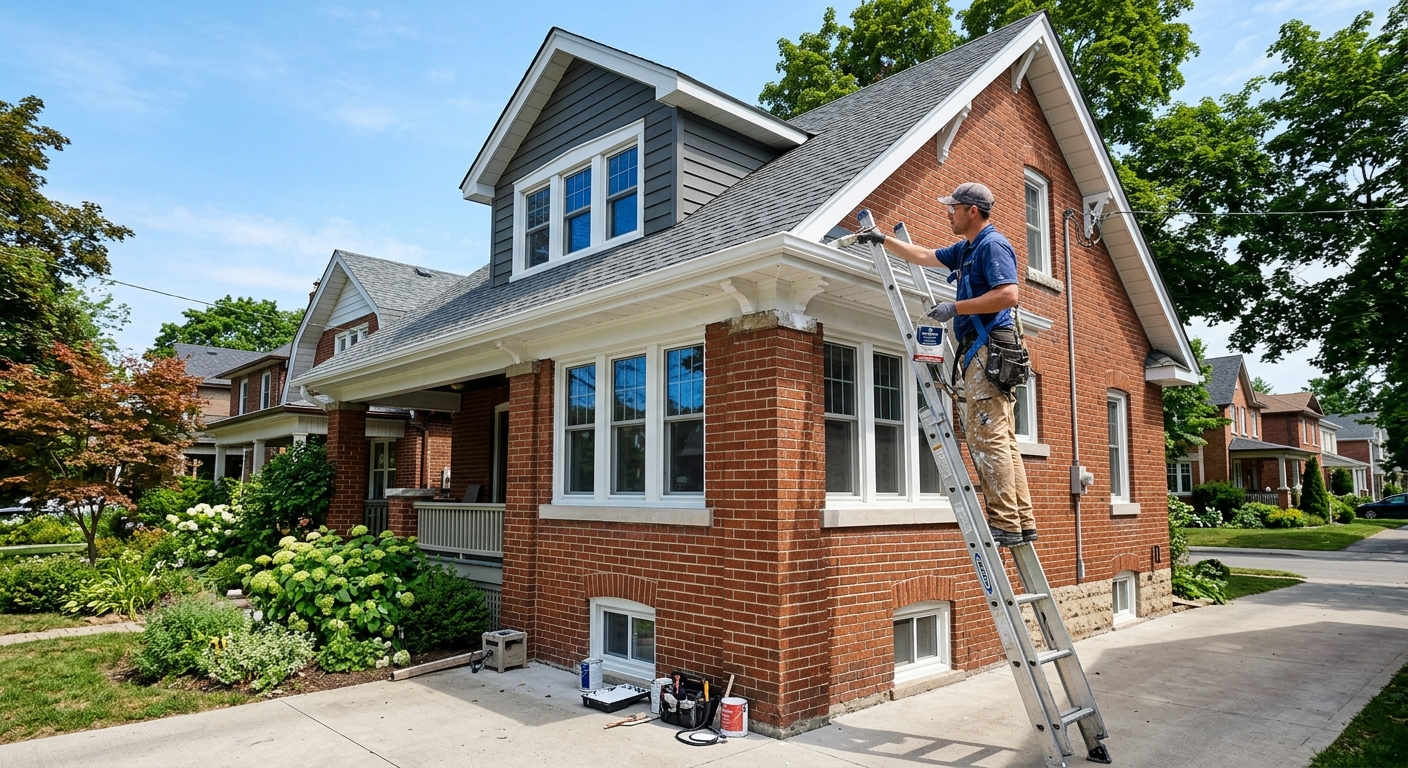
Painting options and costs in Forest Hill South
Forest Hill South is a neighbourhood where homeowners tend to care about curb appeal, and that shows up in the way quotes are built. With a population of 10,732 (Statistics Canada, 2021 Census), you’ll often see competitive scheduling—but exterior work is still limited to a few good stretches. That matters because many local houses are pre-1980, and older construction typically needs more preparation: scraping, patching, caulking and primer work can take longer than the actual rolling or spraying. For pre-1978 homes, professionals also treat lead-safe practices as standard when sanding or scraping old trim and window areas (not because a permit is required, but because it’s best practice for worker and family safety).
In the Toronto area, contractors usually work from late May through June and again from September to mid-October, when temperatures stay above about 10°C for 24–48 hours and humidity is manageable. That “short-season” demand is why exterior pricing commonly sits at the upper end of regional bands in June–August, while interior projects can be booked year-round. In Forest Hill South, the trade often feels busiest around key streets and older residential blocks near the hillier sections, where multi-storey facades and window-heavy elevations are common—extra height/access and more detailed trim work push labour up.
Below is a practical comparison of common scopes so you can sanity-check estimates before you request an itemised quote.
| Service |
What's Included |
Typical Duration |
Price Range |
| Interior — whole home (walls, ceilings, trim) |
Protect floors/fixtures, prep and patch, prime as needed, caulk where required, 2-coat finish where applicable, basic touch-ups and cleanup |
5–12 days |
$2,200 – $6,000 |
| Interior — per room (standard bedroom or living room) |
Prep, spot-prime patches, 2-coat walls, light trim work (door casings/accessible baseboard areas), tidy and final walk-through |
1–3 days |
$400 – $1,800 |
| Exterior — full house (siding, trim, soffits) |
Wash, scrape/sand, repair caulking and minor wood repairs, prime exposed areas, 2-coat system, detail work around windows/eaves |
2–6 days (plus cure windows) |
$3,500 – $8,000 |
| Exterior — trim and accent colours only |
Targeted prep on trim rails, around windows and decorative sections, prime exposed areas, 2-coat finish on selected elevations |
1–4 days |
$1,500 – $4,500 |
| Kitchen cabinet painting (doors, frames, spray finish) |
Degrease, remove/mark hardware as needed, sand and prime, spray/roll finish, re-install and final hardware alignment |
5–14 days (including dry time) |
$1,200 – $4,000 |
| Specialty / faux finish (accent wall, texture) |
Surface prep for the specialty system, base coat and specialty technique, topcoat/clear where required, dust control and cleanup |
2–7 days |
$600 – $3,500 |
Prices are estimates only and vary by project scope, site access and material selection.
What affects the price of painting in Forest Hill South
In Forest Hill South (Toronto region), you can see the same “paint the whole house” idea swing by 30–50% depending on prep requirements, surface condition, and how strict the scope is. Two contractors might both quote a “2-coat repaint,” but if one includes full prep and primer on bare spots while the other assumes minimal repairs, the labour gap shows up quickly. Paint quality also changes real-world cost—contractor-grade coatings may be cheaper per gallon, while premium systems can reduce the risk of patchy sheen or earlier recoat needs, especially on older surfaces.
Exterior work is the most schedule-sensitive piece in Ontario. In this region, the exterior window is typically late May to early October when temperatures stay above roughly 10°C and are rising during application. Because ideal weeks are limited, June–August demand often increases exterior pricing by about 10–15% versus shoulder months. Unlike coastal BC, where persistent dampness and mildew risk drive higher-end mildew-resistant product choices and very careful timing, the GTA’s main constraints tend to be rain events, humidity spikes and freeze-thaw issues that can disrupt adhesion if prep and curing aren’t managed.
Older homes throughout the broader Toronto market mean preparation can be 50–70% of labour on a repaint: scraping failing paint, sanding rough edges, caulking joints, and priming multiple layers. For example, if your exterior estimate lands near $1,500 – $4,500 for trim-only work, it’s often because the siding is in decent shape and prep stays targeted. If you’re closer to $3,500 – $8,000 for full exterior painting, cost typically rises due to broader scraping/priming coverage, more window/trim detail work, and additional time to correct small moisture-risk areas.
Concrete local examples that commonly move the number up or down in Forest Hill South include: peeling paint on older trim that requires deeper scraping (upward pressure), a facade with lots of small architectural details and multi-storey height (more time for cutting-in and access), and seasons with frequent spring rain (delays that affect scheduling and labour efficiency).
| Price Factor |
Why It Matters |
Cost Impact |
| Surface prep — scraping, sanding, patching drywall or wood |
Paint longevity depends on stable, well-keyed surfaces; failing paint must be removed or sealed correctly |
Often 20–70% of labour depending on condition |
| Number of coats — 2-coat system over primer vs. 1 coat over existing |
Sheen and coverage vary by substrate and prior colour; inadequate coats lead to flashing |
+10–30% when a true primer/2-coat system is required |
| Paint quality tier — contractor-grade vs. premium (Benjamin Moore, Sherwin) |
Better films can level and wear more consistently on trim and high-touch areas |
Materials +5–20%, often less rework risk |
| Ceilings and trim — adds significant time vs. walls-only |
Ceilings need careful cut-in, higher ladder time and stronger prep control; trim requires precision |
Can add 15–40% to interior labour |
| Exterior season window — short season raises summer rates |
Contractor availability tightens when “good weather” weeks are scarce |
Typically +10–15% in June–August |
| Lead-safe precautions — required for pre-1978 homes with lead paint |
Standard practices include controlled dust methods, HEPA vacuuming and proper disposal |
Can add 10–25% to prep time and labour logistics |
| Surface material — drywall vs. plaster vs. wood vs. stucco |
Porosity and bonding differ; plaster and wood often need more attention to adhesion and priming |
Varies widely; +5–30% depending on substrate condition |
| Height and access — multi-storey exterior requires scaffolding or lifts |
Access equipment, protection and safety time increase cost and production time |
Often +15–35% on taller facades |
Permits & regulations in Ontario
In Ontario, painting generally does not require a permit. The work itself is normally handled under standard building maintenance practices. Where regulations show up is mainly around safety—especially for older homes. For properties built before 1978, health guidelines recommend testing for lead paint before sanding or scraping, and using lead-safe work practices if lead is present. That includes wet methods to reduce dust, HEPA vacuuming, and proper disposal of paint debris. This usually isn’t legally mandated for homeowners, but it’s standard practice for professional contractors because controlled dust handling protects both workers and occupants.
There is also a practical “paperwork” checklist you should treat as non-negotiable: confirm your contractor carries liability insurance and has WSIB/WCB workers’ compensation coverage. Ask for proof before work starts and ensure the certificates cover the correct company name and job site.
What typically does require a permit is not painting itself, but related building changes (for example, structural work, certain electrical/plumbing alterations, or permitted façade/structural modifications). If the quote includes only surface prep and coatings, you’re usually not in permit territory.
Step-by-step for Forest Hill South: (1) ask for the contractor’s Ontario business/company details, (2) verify insurance certificate (liability) matches the company, (3) request WSIB/WCB clearance or documentation for insured workers, (4) get a written contract listing paint brand, sheen/finish, number of coats and exactly what surface prep is included, and (5) ensure any lead-safe procedures are described if you’re dealing with pre-1978 trim or windows.
Interior vs exterior painting — getting the best result in Forest Hill South
In Forest Hill South, the difference between a long-lasting paint job and a premature failure usually isn’t “brand roulette”—it’s prep discipline, correct product selection for the substrate, and realistic scheduling around Ontario’s weather. For interiors, start with repairs: filling, sanding and priming matter more than the topcoat. A common mistake is applying one heavy coat to “hide” stains or patchwork. In practice, two coats over a properly primed surface outlasts one thick coat because coverage becomes more uniform and film thickness is controlled. Sheen choice also affects durability and appearance: bathrooms, kitchens and hallways typically perform better in easier-clean sheens (often eggshell or satin), while bedrooms and living rooms often use flat or matte on walls for a softer look.
For exteriors, Ontario’s freeze-thaw and humidity swings make surface prep non-negotiable: wash thoroughly, scrape only what must come off, sand edges smooth, and caulk before painting so water doesn’t track behind trim or into cracks. Primer type matters too—substrate-specific adhesion is what prevents peeling. And while mildew-resistant products are a bigger driver in coastal BC, in the GTA you still benefit from good-quality systems that handle humidity spikes and keep film stable during curing.
Cabinet painting is a smart budget alternative to replacement, especially when the box and hardware alignment are sound. If your kitchen cabinets are structurally fine, you can often spend roughly $1,200 – $4,000 to re-spray and repaint, rather than replacing and redoing counters and floors—which typically costs far more.
For pre-1978 homes, lead-safe precautions should be part of the plan when scraping or sanding older trim around windows and railings. You may pay more upfront, but it’s the difference between a “quick coat” and a safe, compliant prep process.
| Project Type |
Key Prep Step |
Recommended Coats |
Price Band |
| Interior — fresh drywall (new construction) |
Seal drywall and patch seams; spot-prime repairs for consistent sheen |
Primer + 2-coat finish |
$900 – $2,800 |
| Interior — repaint (good condition, no repairs) |
Clean, light degloss/scuff, caulk small gaps, spot-prime if needed |
2-coat finish (primer only where required) |
$400 – $1,500 |
| Interior — repaint (patching and priming needed) |
Patch/sand thoroughly; prime repairs and stains to prevent bleed-through |
Primer + 2-coat finish on affected areas |
$700 – $2,200 |
| Exterior siding (wood or fibre cement) |
Wash, scrape failure points, caulk joints correctly, prime bare spots thoroughly |
Prime + 2-coat exterior system (full coverage as scoped) |
$3,500 – $8,000 |
| Exterior trim and accents only |
Targeted scrape/sand and thorough caulking around window/trim interfaces |
2-coat finish over spot-prime |
$1,500 – $4,500 |
| Kitchen cabinets (spray finish) |
Degrease and sand to ensure adhesion; careful primer for uniform bonding |
Primer + 2-coat topcoat (spray/controlled finish) |
$1,200 – $4,000 |
How to choose a painting contractor in Forest Hill South
Choosing the right contractor in Forest Hill South starts with proof, not promises. First, verify Ontario licensing and corporate details through the appropriate online channels, then confirm insurance: request a current certificate of liability insurance naming the correct business entity and ensuring the policy is active for the project dates. Next, confirm WSIB/WCB coverage for workers (not “we’ll subcontract” unless the subcontractor provides their own proof). If the contractor can’t provide clear documentation, that’s a serious risk factor for you and your property.
Then get 2–3 itemised quotes. A good quote breaks out labour and materials and clearly lists what’s included in prep (scraping, sanding, caulking, priming), what coats are planned, and what sheen/finish is being used. Scope exclusions are where projects drift—things like disposal of paint debris, protection and masking, power washing, and whether window/door hardware removal is included can change final cost.
Warranty matters too: confirm the workmanship warranty length in writing, whether product/manufacturer warranties apply to the specific coatings used, and whether any warranty is transferable if you sell the home. Payment schedules should be controlled—never more than about 10–15% upfront, and hold back a portion until the job is complete and touch-ups are done. Finally, insist on a timeline in writing with a start date and completion estimate, especially for exterior work where weather delays are common.
- Ask for liability insurance and WSIB/WCB proof before signing
- Verify the company name on certificates matches the contract
- Request itemised labour/material breakdown (not only a lump sum)
- Confirm prep scope: scrape/sand depth, caulking, stain sealing and priming
- Specify paint brand, colour codes, sheen and number of coats
- Clarify exclusions: disposal, power washing, hardware removal, masking quality
- Make sure product handling includes dry-time and curing expectations
- Ask about lead-safe approach for pre-1978 homes where sanding/scraping occurs
- Confirm surface protection plan (floors, landscaping, windows, landscaping spray)
- Get a written warranty for workmanship and finish touch-ups
- Agree on a payment schedule with a holdback until completion
- Confirm start date and completion timeline in writing
Common red flags in Forest Hill South include: quotes that only say “we’ll prep and repaint” without detailing coats and primer; contractors who won’t provide insurance/WSIB/WCB documentation; very low bids that skip caulking or major prep; pressure for large upfront payments; and missing written scope for disposal and surface protection.
Frequently asked questions — painting in Forest Hill South
What colours add the most resale value in Forest Hill South?
In Forest Hill South (and across Toronto), resale-friendly palettes usually lean to timeless neutrals and classic contrasts rather than bold, trendy statements. On exteriors, homeowners commonly do best with warm whites, soft creams, light greys, and muted greige, paired with darker trim colours that define windows and eaves. On interiors, consider an off-white or warm neutral on walls with a slightly higher-sheen washable finish in higher-traffic rooms. These choices also help with matching existing trim and doors, which can reduce rework when you repaint later. Your repaint schedule matters too: if exterior work is done in the late May to June or September to mid-October windows, sticking to proven colours can minimize unexpected touch-ups. (Statistics Canada, 2021 Census)
How much does it cost to paint a house in Forest Hill South?
For Forest Hill South, the cost depends heavily on whether you’re painting the full exterior or only trim, plus how much surface prep the house needs. A typical full exterior repaint often falls in the $3,500 – $8,000 range when scraping, caulking and priming are included across siding and trim. If the siding is in good shape and the work is mainly accents, trim-only projects are more often around $1,500 – $4,500. Interior projects vary even more by ceiling height, stairwells and how many repairs are needed; whole-home interior scopes commonly run from the low thousands up to several thousands. Plan for the short exterior season in the GTA—June work can carry a premium if ideal weather windows are tight.
How much does interior painting cost per room in Forest Hill South?
Per-room interior painting in Forest Hill South typically depends on whether you’re doing walls only, how much trim work is included, and whether there’s patching. A standard bedroom or living room repaint usually lands in the $400 – $1,800 range. When the room is in good condition and only needs cleaning, light scuffing and two coats, it can be closer to the lower end. If you have patching, stain blocking, or significant trim/ceiling work, the cost moves upward because prep and cut-in time rise. A key detail: ask whether the quote includes primer for repairs and what sheen is being used on walls, because that affects both the appearance and how many coats are needed.
When is the best time for exterior painting in Forest Hill South?
The best time for exterior painting in Forest Hill South is when temperatures are stable and the paint can cure. In the Toronto region, contractors usually target late May through June, then again from September to mid-October, when temperatures stay around or above 10°C for application and curing (often with 24–48 hours of good conditions). Early spring can be risky due to rain and temperature swings, and mid-winter is unsuitable for adhesion and proper dry time. Because summer demand is high during June–August, pricing can be 10–15% higher when ideal weeks are scarce. If you can flex into September, you often get better availability without sacrificing performance.
How many coats of paint do I need?
Most quality paint systems are built around two coats on the finished surface, but the total “coat count” depends on priming and surface condition. For interior repaint jobs in good condition, two coats over properly prepared walls is common. If there are repairs, stains, or areas where bare material shows through, a primer coat becomes necessary—so you might see primer plus two finish coats on affected spots. For exterior painting, the usual approach is a primer (where needed) followed by two coats for the full system, especially where scraping has exposed bare wood or compromised paint film. A contractor who promises “one thick coat” often cuts corners on coverage consistency and sheen uniformity.
What paint is best for Forest Hill South's climate?
For Forest Hill South and the broader Toronto area, you want exterior coatings designed for freeze-thaw cycles and Ontario humidity swings, not just “interior paint made for outdoors.” Look for a high-quality exterior system appropriate for your substrate (wood or fibre cement) that includes proper primer compatibility and strong adhesion. The GTA’s main issues are rain timing, humidity spikes and cold nights early/late in the season, rather than the year-round dampness you see in coastal climates. That’s why the selection should focus on temperature-stable application and curing, plus good prep and caulking—those are often more important than brand marketing. On the interior side, choose washable, appropriate sheens by room: eggshell/satin in kitchens and hallways, and softer finishes in lower-traffic spaces.