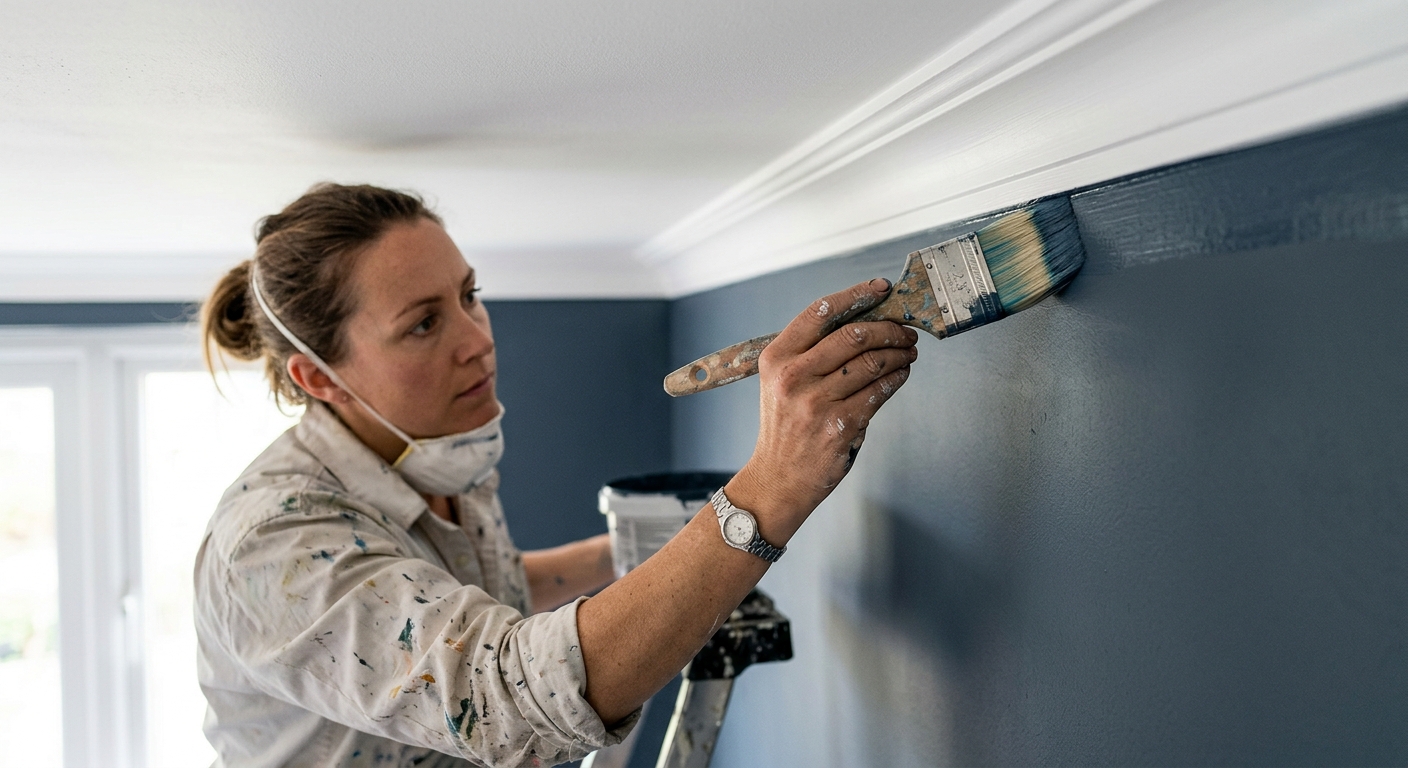
Painting options and costs in Plattsville
In Plattsville, painting costs come down to prep time, surface condition, and how quickly the work can be scheduled during Ontario’s workable weather. With a small town population of 1,366 (Statistics Canada, 2021 Census), there are fewer crews available than in core Toronto, so “good calendar weeks” can get booked quickly—especially for exterior projects. Plattsville also has a lot of older housing stock in the wider Toronto market; in many pre-1980 homes, you’ll typically find more peeling, older caulking failures, and multiple paint layers, which means more scraping, sanding, patching, and priming before any topcoat goes on. In those cases, lead-safe work practices are a common contractor standard for homes built before 1978, even though permits aren’t typically required for painting in Ontario.
Toronto-area exterior painting is tightly climate-dependent. Contractors usually target late May through June and again September into mid-October, when temperatures stay above about 10°C for proper adhesion and curing, and humidity is manageable. During June–August, demand often pushes exterior pricing up roughly 10–15% when crews are stretched across the GTA. Interior painting is less weather-sensitive and can be scheduled year-round, but labour still drives cost—ceiling height, stairwells, furniture moving, and the finish level (basic refresh versus higher-sheen trim and designer colours) all affect time on site.
To compare apples-to-apples, use the typical ranges below for common Plattsville scope sizes, then we’ll match your job to the correct prep and coating plan in the quote.
| Service |
What's Included |
Typical Duration |
Price Range |
| Interior — whole home (walls, ceilings, trim) |
Patch and sand, prime as needed, two topcoats on walls/ceilings where required, prep/masking, and painting of interior trim/doors; basic cleanup |
3–7 days |
$2,000 – $6,000 |
| Interior — per room (standard bedroom or living room) |
Prep, patching, sand/spot prime, prime as needed, two coats on walls; optional ceiling paint depending on scope; mask/protect floors |
1–3 days |
$400 – $1,800 |
| Exterior — full house (siding, trim, soffits) |
Surface wash/decontaminate, scrape/sand, caulk where needed, prime bare spots, two-coat system on siding and trim, protective masking, cleanup |
5–14 days |
$3,500 – $8,000 |
| Exterior — trim and accent colours only |
Spot prep (scrape/sand/caulk), prime where required, two coats on trim/accent areas; limits to specified elevations/surfaces |
2–6 days |
$1,500 – $4,500 |
| Kitchen cabinet painting (doors, frames, spray finish) |
Removal/labeling, de-grease, sand/scuff, prime (bonding primer), spray finish on doors and boxes, reinstallation, hardware masking |
4–10 days (plus drying/curing time) |
$1,200 – $4,000 |
| Specialty / faux finish (accent wall, texture) |
Surface prep for texture, basecoat, specialty application, sealing/finish coating, careful edging at transitions |
1–4 days |
$600 – $5,000 |
Prices are estimates only and vary by project scope, site access and material selection.
What affects the price of painting in Plattsville
In Plattsville and across the Toronto area, two quotes for what sounds like the same job can differ by 30–50% because contractors price the unseen work: prep, condition, access, and coating system choices. Exterior repainting is especially sensitive to timing. In the GTA, the exterior season is limited—typically late May to early October—so when crews are booked in June–August, availability tightens and prices often run 10–15% higher for full house work. By contrast, coastal BC has a longer “working” window but persistent dampness and mildew pressure change product choices and scheduling discipline.
Prep is the budget lever. In Ontario and Alberta, the window for exterior adhesion and curing is narrower, and older homes often need more surface work. On many pre-1980 properties, scraping and sanding are not optional: peeling edges, cracked caulking, and chalky paint require more time than homeowners expect. That preparation can be 50–70% of total labour on a repaint, which is why exterior projects can swing from roughly the mid part of the $1,500 – $8,000 range up toward the higher end when multiple elevations need repair and priming. Interiors usually move within the $400 – $6,000 band based mostly on labour duration (masking, ceiling/trim, and how many rooms need two-coat coverage).
Concrete Plattsville examples: (1) a two-storey home with hard-to-reach eaves may require scaffolding or lifts, increasing exterior labour; (2) heavy sun-fading and patchy adhesion may force additional priming cycles, adding cost; (3) freshly repaired drywall always costs less than repainting with unknown prior coverage and stains, because stains sometimes require stain-blocking primer before topcoat.
| Price Factor |
Why It Matters |
Cost Impact |
| Surface prep — scraping, sanding, patching drywall or wood |
Determines adhesion; removes failing paint and restores substrate |
Often the largest driver; can account for 50–70% of labour on repaints |
| Number of coats — 2-coat system over primer vs. 1 coat over existing |
Coverage and durability depend on proper coat build-up |
Can shift total cost by 10–25% depending on coverage and primer needs |
| Paint quality tier — contractor-grade vs. premium (Benjamin Moore, Sherwin) |
Pigment, washability, and hide affect how smoothly the job finishes |
Material premium may add 5–15% but often reduces rework |
| Ceilings and trim — adds significant time vs. walls-only |
Higher edges require more masking, cutting-in, and careful brush/roller work |
Often adds 15–35% to interior scopes |
| Exterior season window — short season raises summer rates |
Temperatures and curing windows are time-limited in Ontario |
Typically adds 10–15% during tight scheduling periods |
| Lead-safe precautions — required for pre-1978 homes with lead paint |
Safer sanding/scraping methods, HEPA vacuuming, and disposal handling |
May add noticeable labour/material time; increases cost variability |
| Surface material — drywall vs. plaster vs. wood vs. stucco |
Different substrates demand different primers and prep profiles |
Primer and prep can add 5–20% depending on condition |
| Height and access — multi-storey exterior requires scaffolding or lifts |
Safety equipment and time-on-task increase with access complexity |
Can add several hundred to over a thousand dollars for larger homes |
Permits & regulations in Ontario
In Ontario, painting typically does not require a permit for standard interior and exterior painting work. However, there are important rules of thumb professionals follow—especially in homes built before 1978—because that’s where the risk of lead paint exposure comes into play. For those homes, health guidelines recommend testing for lead paint before sanding or scraping, and using lead-safe work practices if lead is present. Contractors commonly use methods like wet scraping/sanding where appropriate, HEPA vacuuming, containment and careful debris disposal. Homeowners are not automatically legally required to do this testing for a private paint job, but it is standard professional practice to protect workers and occupants—particularly when trim, windows, railings, and exterior surfaces are being disturbed.
Two other items should always be confirmed before work starts: (1) liability insurance and (2) workers’ compensation coverage (WSIB/WCB) for insured subcontractors and employees. Also ask for a written contract that clearly states the paint brand and sheen, the number of coats, which surfaces are included, and what preparation tasks are in-scope (scraping, sanding, caulking, priming, and cleanup).
To verify coverage step-by-step in Plattsville: request the contractor’s liability insurance certificate (showing limits and your address/location listed), ask for WSIB/WCB clearance or account information, confirm the contractor’s standing using provincial contractor listings where applicable, and ensure the contract lists the exact scope—including whether disposal is included and whether any specific permit pulls are expected (rare for painting).
Interior vs exterior painting — getting the best result in Plattsville
The biggest difference between a long-lasting paint job and a premature failure in Plattsville is not the topcoat—it’s the prep and the ability to dry/cure under local conditions. For interiors, surface preparation matters most: filling dents, sanding edges, and priming patches or stain-prone areas so the finish looks uniform. Sheen selection also changes durability and cleanability. Flat is best left for low-touch ceilings, while eggshell or satin is commonly chosen for living rooms and bedrooms; higher-traffic areas and trim often benefit from satin or semi-gloss for easier wiping. In practice, two coats over a properly primed surface always outlast one thick coat because it reduces holidays and uneven sheen.
For exteriors, Ontario’s climate makes prep and product compatibility non-negotiable. Caulking should be done before painting so water doesn’t sit behind joints. Primers must match the substrate—wood versus fibre cement versus previously painted metal or masonry—and correct adhesion is crucial when rain and humidity spikes occur. While BC crews lean heavily toward mildew-resistant formulations due to persistent dampness, GTA projects typically focus on temperature-stable application and good drying schedules between showers. With older Plattsville homes, lead-safe precautions may apply before scraping or sanding pre-1978 paint on trim and windows.
Budgeting insight: if your exterior only needs trim and accents, choosing that option can keep costs closer to the lower end of $1,500 – $8,000. For example, upgrading trim colour without repainting the whole siding often avoids a full surface prime cycle—saving labour—while still improving curb appeal. But if siding is failing (peeling, chalking, or widespread bare spots), “trim-only” work can make the house look better temporarily while the underlying problem continues.
| Project Type |
Key Prep Step |
Recommended Coats |
Price Band |
| Interior — fresh drywall (new construction) |
Prime drywall and sand for a uniform surface; address joint compound sheen differences |
1 primer + 2 topcoats |
$1,200 – $6,000 |
| Interior — repaint (good condition, no repairs) |
Clean/degloss lightly if needed, spot prime minor stains, then minimal sanding |
2 topcoats (spot-prime as required) |
$400 – $3,500 |
| Interior — repaint (patching and priming needed) |
Patch, sand, and prime repairs/stained areas to prevent flashing |
1 coat primer on patches + 2 topcoats |
$800 – $5,000 |
| Exterior siding (wood or fibre cement) |
Scrape failing paint, sand edges, caulk where required, prime bare spots |
2-coat system over primer (with prime as needed) |
$3,500 – $8,000 |
| Exterior trim and accents only |
Spot prep: scrape/sand, caulk transitions, prime bare or stained areas |
2 coats on trim (spot primer where required) |
$1,500 – $4,500 |
| Kitchen cabinets (spray finish) |
Degrease thoroughly, sand/scuff, bonding primer, and control overspray for a clean finish |
Primer + 2 topcoats (often sprayed for smoothness) |
$1,200 – $4,000 |
How to choose a painting contractor in Plattsville
Choosing the right painting contractor in Plattsville starts with proof, not promises. First, confirm Ontario coverage: request the contractor’s liability insurance certificate and check it lists your project address (or at least your municipality) and shows valid coverage limits. Next, ask for WSIB/WCB clearance or account information—so you know workers are covered if something happens on site. If the company uses subcontractors, make sure they’re included in your coverage plan, not just the lead contact.
Then get 2–3 itemised written quotes. A good quote breaks out labour and materials separately, and it spells out what’s included in prep (scrape/sand, caulking, priming, drywall patching) and what isn’t (for example, electrical repairs, carpentry, or replacing damaged trim). Clarify disposal: is bagging/hauling included, and who cleans up at the end of each day?
Read the warranty carefully: workmanship warranty length should be stated clearly, and product/manufacturer warranties (where offered) should be described in plain language. Ask whether the workmanship warranty is transferable if you sell the home. Payment schedule matters too—never allow more than 10–15% upfront; hold a portion back until the job is complete and inspected. Finally, insist on a written timeline with a start date and completion estimate, since Ontario’s exterior window can change with weather.
- Request proof of liability insurance and verify it’s current.
- Confirm WSIB/WCB coverage (and that subcontractors are covered).
- Ask for 2–3 references from similar-sized GTA projects.
- Get an itemised labour/materials quote, not a single lump sum.
- Confirm which surfaces are included (ceilings, trim, doors, soffits, backs of shutters).
- Check scope for prep: scraping, sanding, patching, caulking, and priming.
- Ask how they protect landscaping, siding edges, and windows during prep and painting.
- Verify primer type is included where bare or stained areas exist.
- Ask for paint brand and sheen (and whether premium lines are optional add-ons).
- Clarify cleanup and disposal at the end of each day.
- Confirm warranty terms: workmanship duration and what voids it.
- Review payment schedule—no more than 10–15% upfront; holdback until final walk-through.
Red flags I often see in Plattsville-area leads: quotes that don’t specify the number of coats, vague language like “prep as needed” with no commitment, refusing to provide insurance/WSIB proof, asking for large deposits up front, and starting without a written timeline—especially for exterior work where weather windows are tight.
Frequently asked questions — painting in Plattsville
How do I choose a painting contractor in Plattsville?
Start by verifying coverage in Ontario: ask for a current liability insurance certificate and WSIB/WCB clearance information. In Plattsville, you’re likely hiring within the Toronto regional market where small crews can rotate between jobs, so the paperwork matters. Next, request 2–3 written, itemised quotes that show labour and materials, plus the prep scope (scrape/sand, patching, caulking, and priming). Be wary of bids that only list a paint brand and ignore surface preparation—prep is where quality is won or lost. If you’re budgeting exterior, remember full exterior work usually sits around the $3,500 – $8,000 band depending on repair and priming; compare quotes based on what surfaces are included, not just the final total.
How many coats does an exterior repaint need in Plattsville?
Most exterior repaints in Plattsville are done as a two-coat system, but the exact “number of coats” depends on how much primer is needed. If you’re repainting siding and trim where bare or repaired areas exist, you typically need primer on bare spots plus two topcoats for full coverage and durability. In the GTA, contractors also have to time work so temperatures stay above roughly 10°C and the coating can cure between rain/humidity spikes—so scheduling affects productivity and, indirectly, the number of allowed back-and-forth touch-up days. If your job is trim-only with limited prep, pricing often lands around $1,500 – $4,500, but you still shouldn’t accept “one coat” over chalky or failing areas.
What is the best primer for older Plattsville homes?
For older Plattsville homes, the “best” primer depends on what you’re priming: scraped wood, fibre cement, previously painted trim, or areas stained by moisture. In pre-1978 homes, professionals commonly treat the situation more carefully because sanding or scraping may involve lead paint. If lead paint is present, lead-safe work practices (testing, wet methods/HEPA cleanup, and proper disposal) are standard. For the coating system itself, contractors typically use bonding primers for adhesion over existing surfaces that are sound, plus spot primers for bare areas and repaired sections. Where stains bleed, stain-blocking primer may be required before topcoat. A correct primer choice is one reason exterior jobs can swing across the $3,500 – $8,000 range—saving time on primer usually costs more later.
Should I paint or wallpaper my Plattsville home?
For most Plattsville homeowners, painting is the safer, lower-risk choice—especially in older homes with patchy walls or variable surface texture. Wallpaper can look great, but it usually requires highly consistent wall preparation, and removal later can be disruptive. Paint also offers easier touch-ups when you have scuffs around doors, stairways, or dining/kitchen walls. If your interior walls are in good condition, a repaint with proper patching and priming typically fits the $400 – $6,000 range depending on number of rooms and whether ceilings/trim are included. If the goal is a single accent wall, a specialty finish (including texture or faux options) can give wallpaper-like impact without wallpaper seams—but it still requires careful prep. If you want, I can suggest the best sheen for each room for durability.
How do I fix peeling exterior paint in Plattsville?
Peeling exterior paint usually can’t be fixed with a “quick topcoat.” The correct approach is to stop the failure at the surface: scrape off loose paint back to sound edges, sand feathered boundaries, and then caulk any failed joints so water doesn’t get behind the coating. After that, prime bare or repaired areas and apply the full two-coat system. In Plattsville’s Ontario climate, timing matters—contractors must apply and allow curing during temperature-friendly windows and between rain/humidity spikes, or adhesion can suffer. If the peeling is extensive, that’s a sign preparation time will be high, which is why full exterior repainting often sits within the $3,500 – $8,000 band. If you’ve got pre-1978 trim involved, ask about lead-safe practices before sanding/scraping begins.
What colours add the most resale value in Plattsville?
In Plattsville and the broader Toronto market, resale value typically favours clean, neutral palettes that photograph well and match a range of furniture and finishes. Soft whites, warm off-whites, and light greys are common “safe” choices for trim and ceilings, while muted greiges and understated earthy tones often work for main walls. The biggest practical resale tip is consistency: paint adjacent rooms in coordinated tones and avoid dramatic colour jumps unless you’re doing an intentional accent wall. If you’re updating exterior trim and accents, choosing a crisp trim colour can create visible curb appeal without the cost of a full repaint—often keeping you in the $1,500 – $4,500 trim-only range. Exact colour still depends on sunlight exposure and siding tone, so bring samples to the quote and confirm the final palette in writing.