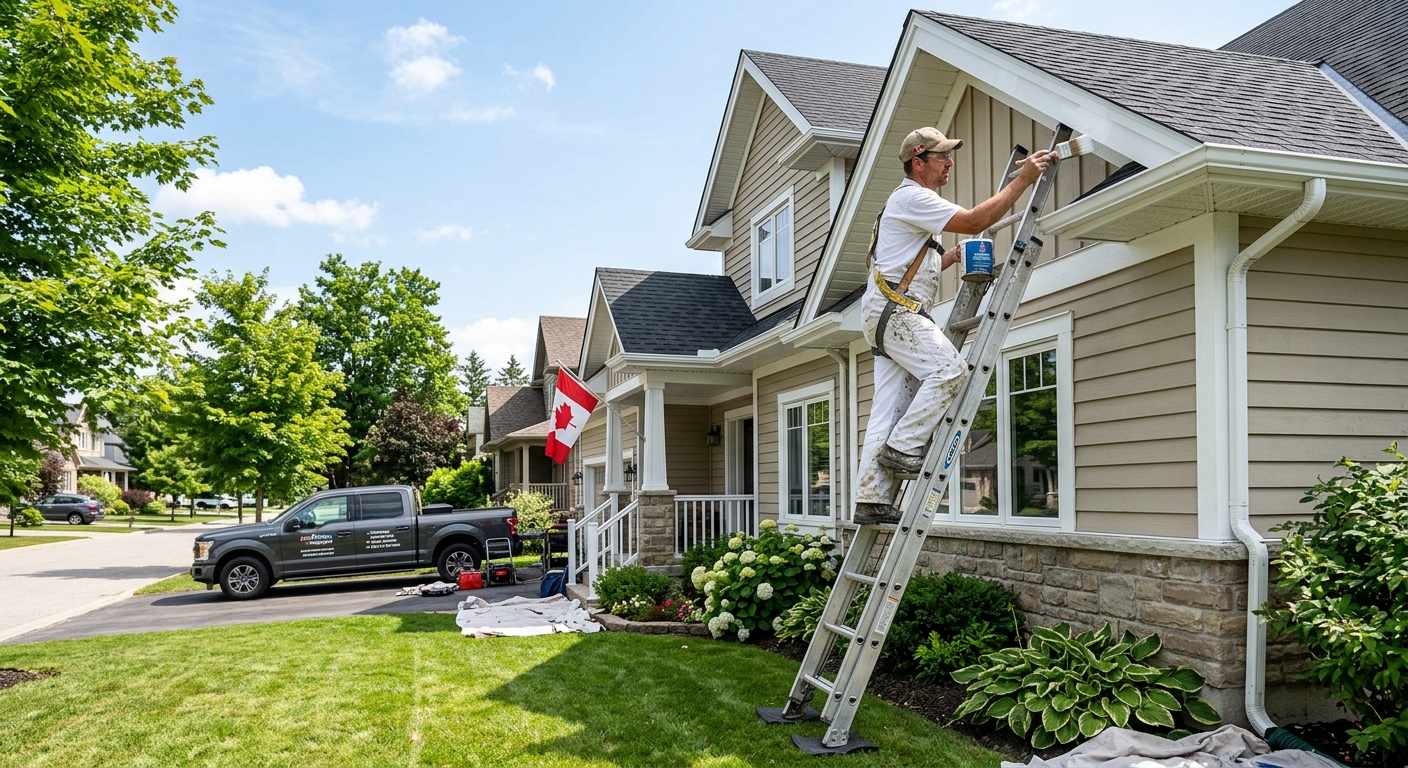
Painting options and costs in Chatham
In Chatham, Ontario, homeowners usually choose between fast interior refreshes and more schedule-sensitive exterior work. One reason quotes can feel “all over the map” is that Chatham‑Kent’s housing stock includes many older properties—about 31.9% of the local population is from households in which older, established neighbourhoods are common in the Windsor–Sarnia region (Statistics Canada, 2021 Census). Older homes typically need extra prep like scraping, patching, caulking, and priming, and pre‑1978 paint may require lead-safe handling before sanding or scraping. At the same time, Chatham’s exterior painting is highly seasonal: in this southern Ontario region, the practical window is generally late May through early October, when temperatures are warm enough for proper curing and surfaces stay dry. That short season compresses contractor availability and can tighten scheduling, especially when multiple nearby towns (and crews) are competing for the same stretch of weather.
You’ll often feel the trade demand most in established areas such as the north end near McNaughton Avenue and along residential corridors toward King Street. If you’re planning an interior job, you can usually book year-round, but winter interiors still need proper ventilation to manage odours and drying times. Exterior projects, however, hinge on dry, stable conditions; that’s why professional pricing builds in prep time and materials appropriate for repainting aged siding, trim, and soffits.
Below are typical ranges for common painting scopes so you can compare quotes consistently—especially between “walls-only” and “whole home” work.
| Service |
What's Included |
Typical Duration |
Price Range |
| Interior — whole home (walls, ceilings, trim) |
Preparation (protect floors/trim), patching as needed, sanding where required, caulking, primer on bare/spot areas, 2-coat finish on walls/ceilings, full trim work, cleanup |
5–10 business days |
$2,100–$3,500 |
| Interior — per room (standard bedroom or living room) |
Prep and protection, wash/spot clean, patch/sand minor defects, caulk where needed, prime if required, 2-coat finish on walls/ceiling, basic trim touch-ups |
2–4 business days |
$800–$1,600 |
| Exterior — full house (siding, trim, soffits) |
Power wash, scrape/sand, caulk joints, spot prime, prime bare wood/patches, 2-coat exterior system (siding + trim/soffits), back-rolling/edging as needed, final cleanup |
1–3 weeks (weather-dependent) |
$3,000–$6,000 |
| Exterior — trim and accent colours only |
Surface prep on trim only, caulking/spot priming, 2-coat finish on trim/selected accents, protection for nearby surfaces, cleanup |
3–7 business days |
$1,500–$3,200 |
| Kitchen cabinet painting (doors, frames, spray finish) |
Degrease, proper sanding and de-glossing, repairs as needed, bonding primer, sprayed/rolled finish for durability, hardware removal/re-install, protective coating on adjacent surfaces |
5–12 business days (including dry/cure time) |
$1,200–$2,500 |
| Specialty / faux finish (accent wall, texture) |
Layout/colour planning, specialized prep, primer system, multiple application steps depending on effect, protection and finishing coats |
2–6 business days |
$600–$3,000 |
Prices are estimates only and vary by project scope, site access and material selection.
What affects the price of painting in Chatham
In Chatham and across the Windsor–Sarnia economic region, two quotes for what looks like the “same paint job” can differ by 30–50% because the big cost drivers are usually hidden: surface condition, prep complexity, access, and the right product system for the substrate. While you might see interior painting priced on a per-room basis, exterior work is priced around labour intensity and weather timing. In Ontario (including Chatham), the exterior painting window is typically late May to early October—temperatures need to be above about 10°C and rising during application, with surfaces staying dry so coatings cure properly. That compressed season concentrates demand, so schedules tighten and labour rates can rise during peak weeks.
Older homes are another major factor across this region. Many mid‑century properties require more prep—scraping peeling paint, sanding rough edges, caulking gaps, and spot priming aged substrates. On repainting jobs, prep can represent 50–70% of total labour. For example, a lightly weathered exterior might land closer to the lower end of the exterior band (around $1,500–$3,200 for trim/accent-only), while a full-house repaint on older siding often climbs into the upper exterior band (up to $3,000–$6,000) once you factor in extensive scraping, priming, and additional coats.
Concrete local examples: (1) Heavy scuffing and chalking on sun-exposed trim increases sanding/priming time; (2) poorly caulked joints can force extra prep and re-caulking before paint to prevent future moisture issues; (3) multi-storey homes near busier corridors often require lifts/scaffolding, adding both labour and safety setup time.
| Price Factor |
Why It Matters |
Cost Impact |
| Surface prep — scraping, sanding, patching drywall or wood |
Determines adhesion and finish smoothness; aged substrates need stabilization |
Often +20% to +50% on repaints |
| Number of coats — 2-coat system over primer vs. 1 coat over existing |
Proper film build improves durability and uniform sheen/coverage |
Can shift +10% to +30% |
| Paint quality tier — contractor-grade vs. premium (Benjamin Moore, Sherwin) |
Premium lines usually cover better and handle application/ageing |
Materials +5% to +20%; labour may drop with better coverage |
| Ceilings and trim — adds significant time vs. walls-only |
Higher risk of drips and detail work increases prep and masking time |
Often +15% to +40% |
| Exterior season window — short season raises summer rates |
Weather-permitting scheduling and crew compression increases overhead |
Peak-week jobs can cost +10% to +25% |
| Lead-safe precautions — required for pre-1978 homes with lead paint |
Containment, wet methods, HEPA cleanup, and disposal add time and materials |
Can add +15% to +60% depending on extent |
| Surface material — drywall vs. plaster vs. wood vs. stucco |
Different substrates need different primers and prep approaches |
Varies widely; wood/stucco can add +10% to +35% |
| Height and access — multi-storey exterior requires scaffolding or lifts |
Safety setup, protective measures, and slower pace |
Often +10% to +30% |
Permits & regulations in Ontario
For most painting in Ontario, you do not need a permit. Painting itself typically doesn’t require municipal approvals, regardless of whether you’re doing interior or exterior work in Chatham. What matters more is compliance with safe work practices—especially for older homes. In properties built before 1978, health guidelines recommend treating the risk of lead paint seriously. While this is not typically legally mandated for homeowners as a permit issue, professional contractors generally follow lead-safe work practices if lead paint is present or strongly suspected: wet methods (to limit dust), HEPA vacuuming, careful containment, and proper disposal of debris.
Some work does require permits or additional approvals, but it’s usually tied to structural changes or regulated hazards—not routine painting. Typical “painting-only” tasks that usually do not need a permit include wall/ceiling repainting, trim painting, and repainting siding/soffits. If your project includes demolition, major renovations, or window/door replacements (which can be part of a larger exterior envelope project), that’s where permitting may come into play.
Before signing, verify three things: (1) the contractor’s liability insurance (request a certificate of insurance), (2) WSIB/WCB coverage for workers’ compensation (ask for proof of coverage/registration), and (3) the contract details. A good written contract should specify paint brand and sheen, number of coats, surface prep included (scrape/sand/prime/caulk scope), and what’s excluded (like lead testing or extensive repairs).
Step-by-step for homeowners in Chatham: ask for the COI for liability insurance and the WSIB/WCB clearance or proof document; confirm the certificate matches the company name; then, verify licensing/credentials using the appropriate Ontario business/contractor listings (and ensure the crew you’re hiring is actually covered).
Interior vs exterior painting — getting the best result in Chatham
In Chatham’s climate—hot, humid summers followed by cooler, damp shoulder seasons—the difference between a lasting job and a premature failure comes down to prep discipline and system matching. For interior work, surface prep beats brand marketing every time: filling and sanding (to remove dents and ridges), proper caulking for gaps, spot-priming stained or porous areas, and using the right primer for repairs. Sheen matters too. Flat/eggshell products hide wall imperfections, while satin or semi-gloss on trim withstands cleaning better. The longevity rule of thumb is simple: two coats over a properly primed surface outlast one thick coat, even if that “one coat” looks good the day it’s finished.
For exterior work in Ontario, prep is the deal-breaker. Caulk before painting where needed to seal joints and prevent water ingress, and use a primer appropriate for the substrate (for example, bonding/adhesion primers on older or chalky wood and properly conditioned surfaces). Ontario’s outdoor curing requirements also mean timing matters—rain, late-day temperature swings, and dew can sabotage dry-to-touch and full cure. This is why a paint system planned for the Windsor–Sarnia region’s weather rhythm is more reliable than “whatever we have in stock.” In British Columbia, crews often rely more on mildew-resistant strategies due to persistent moisture; in Alberta, temperature stability drives product selection. In Chatham, you mainly need temperature-curing and moisture-aware application.
Cabinet painting is a smart alternative to replacement when frames and boxes are solid—professionals focus on degreasing, bonding primer, and a durable finish. For pre‑1978 homes, lead-safe precautions (containment, wet methods, HEPA cleanup) protect occupants and workers during scraping or sanding.
Where the price difference is justified: if exterior prep shows widespread peeling or failed caulk, the “cheaper” option that skips scraping/spot priming usually costs more later. A trim-only refresh might start around $1,500–$3,200, but a full-house repaint that includes deeper prep and full prime-and-topcoat coverage commonly sits higher, up to $3,000–$6,000.
| Project Type |
Key Prep Step |
Recommended Coats |
Price Band |
| Interior — fresh drywall (new construction) |
Prime new drywall properly to seal and prevent flashing |
Primer + 2 finish coats |
$1,200–$3,200 |
| Interior — repaint (good condition, no repairs) |
Thorough wash/spot scuff + light sanding as needed |
2 finish coats (primer only if stains/repairs exist) |
$800–$1,600 |
| Interior — repaint (patching and priming needed) |
Sand edges smooth and prime patch areas to unify sheen/absorption |
Spot primer + 2 finish coats |
$1,200–$2,700 |
| Exterior siding (wood or fibre cement) |
Scrape/sand + caulk joints before painting; spot-prime bare areas |
Primer (as required) + 2 finish coats |
$3,000–$6,000 |
| Exterior trim and accents only |
Edge prep and caulking on trim lines; prime bare/failed spots |
Primer (as required) + 2 finish coats |
$1,500–$3,200 |
| Kitchen cabinets (spray finish) |
Degrease thoroughly and use bonding primer for adhesion |
Primer + 2 finish coats (system-dependent) |
$1,200–$2,500 |
How to choose a painting contractor in Chatham
Choosing the right painter in Chatham is about verifying coverage and demanding a detailed scope. First, check Ontario business credentials: ask for the contractor’s proof of liability insurance (a certificate of insurance showing coverage and effective dates) and confirm workers’ compensation coverage—WSIB (or the applicable WCB coverage) for any employees. You can ask for a clearance certificate or proof of coverage and verify the company name matches the quote. Never rely on verbal “we’re insured” statements.
Next, get 2–3 itemised written quotes. You want labour and materials separated (paint/primer, caulking, sanding supplies, disposal fees), and clear line items for prep: scraping, sanding, patching, caulking, and priming. Ask whether permits are included if your scope touches regulated renovations (most paint-only work won’t need a permit, but associated work sometimes does). Confirm disposal: will they remove all debris, protect landscaping/driveway surfaces, and clean gutters if required by scope?
Warranty matters in both directions: a workmanship warranty (often covering adhesion/peeling/defects for a set period) and the manufacturer’s product warranty. Ask if the product warranty is tied to the contractor’s application and whether it’s transferable to future homeowners. Payment should stay controlled—typically no more than 10–15% upfront—then hold back a portion until completion and cleanup are confirmed. Finally, require a written start date and estimated completion timeline, since exterior jobs in Ontario are weather-window dependent.
- Ask for liability insurance COI and confirm the coverage is current.
- Request proof of WSIB/WCB coverage for workers.
- Require an itemised quote (labour + materials), not just a lump sum.
- Confirm what surface prep is included (scrape/sand/patch/prime/caulk).
- Make sure number of coats is specified for each surface.
- Check which areas are included (trim, ceilings, soffits, back-rolling, edges).
- Clarify exclusions (lead testing, major repairs, drywall replacement, mould remediation).
- Ask about disposal and jobsite cleanup responsibilities.
- Confirm protection: floors, landscaping, windows/doors, and how overspray is controlled.
- Ask for a workmanship warranty length and what it covers.
- Set a payment schedule with a holdback until walkthrough sign-off.
- Get start/completion dates in writing, including weather contingency for exteriors.
Red flags I see in Chatham include: (1) quotes that skip prep details (“we’ll just paint over it”), (2) no proof of WSIB/WCB coverage, (3) vague product lists (no brand or sheen specified), (4) requiring large upfront payments beyond 10–15%, and (5) no written warranty or unclear responsibility for cleanup and disposal.
Frequently asked questions — painting in Chatham
What paint is best for Chatham's climate?
For most Chatham, Ontario homes, the best choice is the right coating system matched to the surface and the local weather pattern. Interior walls typically do well with a durable interior latex in the right sheen (eggshell/satin depending on room use). For exterior siding and trim, choose a breathable exterior paint/primer system and ensure prep and priming are done for bare or chalky sections. Because exterior work is tightly seasonal in Southern Ontario (late May to early October), the coating needs to handle temperature-curing and maintain a good film build during application. If your home is older, more prep and spot-priming often matter more than the brand. Also, if your painter is offering “premium” topcoat without explaining primer and prep, ask why coverage and adhesion will still hold through Ontario humidity.
How long does exterior paint last here?
Exterior paint life in Chatham depends heavily on prep quality and how moisture is managed. On well-prepared surfaces with correct caulking and priming, many homeowners see roughly 7–10 years of good appearance, and sometimes longer—especially on wood or fibre cement when failures (peeling, cracking, staining) were addressed before coating. Shortcuts like skipping scrape/sand/prime or painting over failing caulk often shorten lifespan dramatically, sometimes to a few seasons. Scheduling also matters: with the warm-weather window in Southern Ontario, coats need proper curing, and damp or misty days can interfere with adhesion. If you’re comparing quotes, use the price bands as a guide: a trim-only refresh around $1,500–$3,200 may look great short-term, while a full exterior system around $3,000–$6,000 typically supports better long-term prep coverage.
Should I paint or replace my cabinets?
In many Chatham kitchens, repainting cabinets is the cost-effective option as long as the boxes and doors are solid and the finish isn’t failing structurally. Painting (especially with a proper sanding/degrease, bonding primer, and durable topcoat) can dramatically upgrade the look without the disruption of replacement. Replacement makes sense if your cabinets are water-damaged, warped, or have loose joinery, or if you want a totally new layout/footprint. A professional cabinet repaint also takes time for dry/cure cycles—so plan around the schedule. Pricing commonly lands in the cabinet band, often from $1,200–$2,500 depending on door count, prep needs, and whether you’re doing a spray finish. If you’re on the fence, ask your contractor to evaluate door condition, hardware compatibility, and whether the prep can achieve good adhesion and a smooth finish.
How do I prep walls before painting?
For homeowners in Chatham, the safest “prep” is mostly about clearing the space: remove or cover furniture, protect floors with drop cloths, and take down wall items (pictures, switch plates, curtain rods). Beyond that, professional preparation typically includes washing/spot cleaning, sanding to de-gloss or smooth imperfections, patching dents/holes, caulking gaps, and priming repaired or stained areas. If you’re doing a DIY pre-spotting yourself, focus on small patch repairs only—use filler compatible with paint, sand smooth after it cures, and wipe dust clean. Avoid sanding without dust control indoors, and don’t try to paint over peeling or flaking patches; those need full removal to the point where the surface is stable. When you request a quote, ask exactly whether they include wash, sanding, patching, caulking, and primer—because those steps are what separate a durable finish from a short-lived one.
Do I need to worry about lead paint in an older Chatham home?
Potentially, yes—particularly if your Chatham home was built before 1978. Health guidance recommends that lead paint be treated as a risk before sanding, scraping, or otherwise disturbing old coatings. While this is not typically handled as a “permit requirement” for homeowners doing painting, professional contractors commonly follow lead-safe work practices when lead is present or likely: wet methods to reduce dust, HEPA vacuum cleanup, and appropriate disposal of debris. If you’re planning to scrape or sand older paint, ask your contractor whether they use lead-safe procedures and what they include in their prep. A detailed scope should mention dust control, containment (if needed), and cleanup standards. If you need testing, you can ask for recommended options before the work begins so prep and costs are planned correctly—especially because lead-safe precautions can meaningfully increase labour and materials on exterior or trim repaint projects.
How long does it take to paint a house?
For Chatham interior work, timing depends on room count and whether repairs are needed. A per-room interior job is often a few business days, while a whole-home interior paint can take about a week or more when you include protection, drying/curing time, patching, and trim details. For exteriors, plan for weather-window delays. In Southern Ontario, the practical exterior season runs roughly late May through early October, so crews often schedule in blocks when temperatures and humidity support proper curing. A full exterior repaint commonly takes 1–3 weeks depending on prep severity, siding condition, and access (for example, lift/scaffold needs). If you’re comparing options, remember scope: trim-only work can finish faster, while full-house prep (scraping, caulking, spot priming, and proper coverage) takes longer—especially on older surfaces.