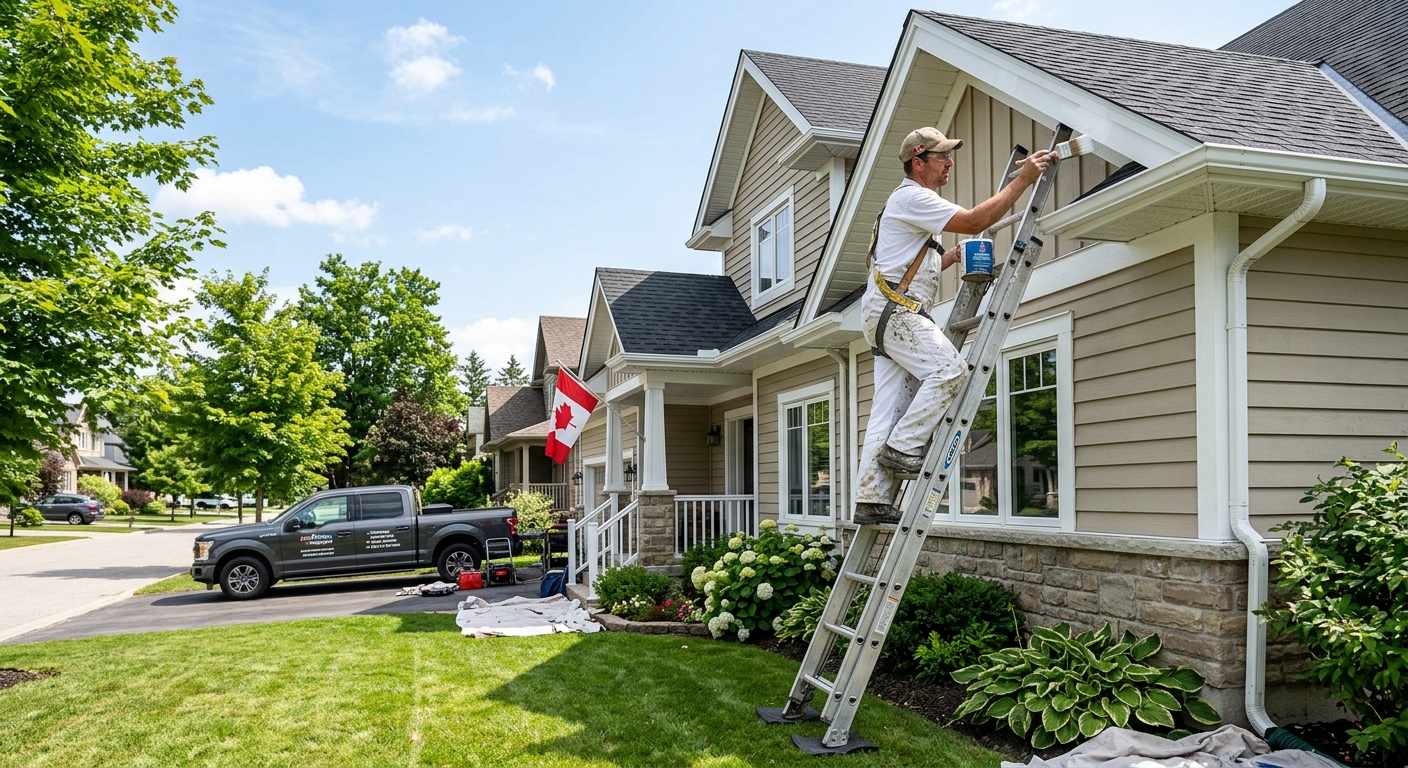
Painting options and costs in Spallumcheen
Painting options and costs in Spallumcheen depend on whether you’re refreshing interiors or tackling the exterior envelope in a short, weather-sensitive window. Spallumcheen is a community where many homes are older—nearly half of local dwellings were built before 1981 (49.4%), which usually means more prep than a brand-new finish: scraping, patching, spot-priming, and sometimes lead-safe work practices if pre-1978 coatings are involved. With 81.1% of households owning their homes (Statistics Canada, 2021 Census), repaint projects are common and customers typically want durable results that can handle Thompson–Okanagan sun, freeze-thaw conditions, and late-season moisture.
In the Thompson–Okanagan region, exterior work is typically concentrated into late spring through early fall when surfaces are reliably dry and temperatures stay comfortably above freezing. That seasonal compression can tighten scheduling and push exterior rates toward the upper end of the city tier during peak months. In older neighbourhoods and older-lot areas around Peachland Road / Hutchinson Road vicinity (and similar established residential pockets), demand can also spike because many homes share similar siding/trim profiles and show the same wear patterns—sun-chalking, minor cracking, and paint film breakdown at caulking lines.
Use the table below as a realistic starting point for budgeting, then we can tighten the estimate once we review your surface condition, access, and sheen/colour goals.
| Service |
What's Included |
Typical Duration |
Price Range |
| Interior — whole home (walls, ceilings, trim) |
Move-out/move-in protection, prep (patching/sanding), caulking where needed, primer on repairs, 2-coat finish system, brush/roll and cutting-in, clean-up |
5–10 days |
$2,200–$6,000 |
| Interior — per room (standard bedroom or living room) |
Prep and patching, caulking to edges, primer on repairs, 2-coat finish, masking floors/baseboards as required |
1–3 days |
$450–$1,800 |
| Exterior — full house (siding, trim, soffits) |
Power washing (as required), scrape/sand where peeling exists, caulking and spot priming, mildew-resistant primer where appropriate, 2-coat exterior system, disposal and jobsite protection |
7–18 days |
$4,800–$12,000 |
| Exterior — trim and accent colours only |
Prep of trim and accents, spot primer where bare/suspect film exists, 2-coat application to selected features, masking and careful edge cutting |
2–7 days |
$800–$3,900 |
| Kitchen cabinet painting (doors, frames, spray finish) |
Degrease and sanding, repair of minor defects, bonding primer, sprayed lacquer/enamel-style finish (or durable acrylic-urethane depending on system), hardware masking, light clean-up |
4–10 days |
$1,900–$5,000 |
| Specialty / faux finish (accent wall, texture) |
Surface preparation for decorative work, base coat(s), layering/texture steps, protective clear coat if required, clean-up |
2–7 days |
$650–$2,700 |
Prices are estimates only and vary by project scope, site access and material selection.
What affects the price of painting in Spallumcheen
Even when two homeowners request the “same” paint job, quotes across Thompson–Okanagan and British Columbia can swing by 30–50% because painting in our region is driven by prep labour, weather constraints, and crew scheduling—not just paint cost. In Spallumcheen, the biggest cost variable is usually surface condition. For exterior work, the Thompson–Okanagan seasonal window is tightly climate-bound: contractors often need reliably dry surfaces and temperatures above freezing during application and curing. That short season (relative to more temperate areas) concentrates demand, so exterior rates can rise in peak summer and urgent jobs may carry scheduling premiums. Coastal BC may have a longer window, but high humidity and intermittent rain make mildew-resistant primers and careful timing more important to avoid blistering and poor adhesion.
Older housing stock is another major driver. Throughout the Thompson–Okanagan region, homes built before the late 1970s often require more scraping, sanding, caulking, and spot-priming before new finish coats—prep can realistically represent 50–70% of labour on a repaint. In practical terms, a trim-only exterior refresh might start around the $800–$12,000 exterior range tier, but once we move into full siding and soffits with widespread adhesion failures, projects naturally climb toward the upper band.
Two concrete Spallumcheen examples: (1) If your siding has peeling at caulk joints and around vents, we’ll need additional scraping and detail sanding, which increases both labour and primer quantities. (2) If your surfaces are intact and mostly sun-faded (chalky but not lifting), we can focus on cleaning, light sanding, and bonding primer—keeping you closer to the lower end of the exterior band. For interior updates, high ceilings or a trim-heavy plan can push a room project from a lower interior per-room range toward whole-home pricing because of the extra cut-in time.
| Price Factor |
Why It Matters |
Cost Impact |
| Surface prep — scraping, sanding, patching drywall or wood |
Poor adhesion and visible defects come from skipped prep, not from “cheap paint” |
Often the largest line item; can add 30–60% |
| Number of coats — 2-coat system over primer vs. 1 coat over existing |
Colour change, tannin bleed, and substrate staining require full systems |
+10–25% depending on condition |
| Paint quality tier — contractor-grade vs. premium (Benjamin Moore, Sherwin) |
Sheen consistency and hiding power affect coats and touch-ups |
Typically +5–20% on materials |
| Ceilings and trim — adds significant time vs. walls-only |
Ceilings and detailed trim increase cutting-in, masking, and finishing time |
Can add 15–40% |
| Exterior season window — short season raises summer rates |
Jobs stack during the reliable weather months; labour and availability tighten |
Often +10–30% at peak timing |
| Lead-safe precautions — required for pre-1978 homes with lead paint |
Containment, HEPA vacuuming, and proper disposal increase labour |
Can add 5–25% (depending on scope) |
| Surface material — drywall vs. plaster vs. wood vs. stucco |
Different substrates absorb differently and require different primers |
+10–30% when switching from “easy” to “difficult” surfaces |
| Height and access — multi-storey exterior requires scaffolding or lifts |
Safer access takes time and can require rentals |
Can add 15–50% for larger homes |
Permits & regulations in British Columbia
In British Columbia, painting typically does not require a permit for standard residential work. However, if your home was built before 1978, health guidelines recommend testing for lead paint before sanding or scraping, and following lead-safe work practices if lead is found. This is not usually something homeowners are legally required to do personally, but it’s standard professional practice. Lead-safe methods include keeping dust down with wet methods, using HEPA vacuuming, proper sealing/containment during disturbed work, and disposing of waste responsibly.
What does require permits in BC is not painting itself, but sometimes related work—e.g., structural changes, certain electrical or plumbing modifications, or work tied to roof/plumbing replacements. Painting projects generally fall under routine maintenance and cosmetic finishes, so they typically do not trigger a permit process. A good contractor will still follow safety standards and best practices.
For homeowners in Spallumcheen, the verification steps are straightforward: (1) Licensing: confirm the contractor’s professional status where applicable on provincial/industry registries (or via their business documentation). (2) Liability insurance: ask for a current certificate of insurance showing the insured party and policy dates. (3) Workers’ compensation coverage: request proof of WCB coverage for any employees/subcontractors. (4) Written contract: ensure it clearly lists paint brand/system, sheen, number of coats, prep inclusions, and disposal. If lead-safe work is anticipated, the contract should spell out dust-control and surface-prep responsibilities.
Interior vs exterior painting — getting the best result in Spallumcheen
The difference between a long-lasting paint job and a premature failure in Spallumcheen is usually prep quality, not the brand on the pail. For interiors, surface preparation comes first: filling nail pops, sanding repair edges until they’re smooth, cleaning off dust, priming repaired drywall, and then applying two full coats. Sheen matters by room and use. Flat or matte can hide wall imperfections in low-traffic areas, but satin or eggshell tends to be more forgiving in hallways and family rooms. Two coats over a proper primer generally outlast “one thick coat” because the first coat seals and the second coat builds a uniform film.
For exteriors, British Columbia conditions make the prep and moisture management non-negotiable. Caulking is typically installed or renewed before painting so you don’t trap failures in the joint. We match primer type to substrate: a bonding primer for suspect film or stained wood, and appropriate systems for fibre cement or areas showing previous chalking. Mildew-resistant products are often specified when staining or damp microclimates show up. In the Thompson–Okanagan market, this also includes temperature-stable coatings and planning around the dry-window for application and curing.
Cabinet painting is a budget alternative to replacement when boxes are solid and the finish can be properly prepped. For example, if you’re considering a cabinet refresh: repainting with a sprayed finish might land in the cabinet band (typically around $1,900–$5,000), while replacement can jump dramatically because of labour, disposal, and hardware changes. For older homes (nearly half pre-1981 locally), we also plan for lead-safe precautions where pre-1978 coatings may be present, especially on trim and exterior features.
| Project Type |
Key Prep Step |
Recommended Coats |
Price Band |
| Interior — fresh drywall (new construction) |
Prime entire surface, skim/fill joints, sand smooth, clean dust |
1 primer + 2 top coats |
$350–$6,000 |
| Interior — repaint (good condition, no repairs) |
Light scuff-sand, clean, spot-prime stains/marks only |
1–2 top coats (commonly 2) |
$250–$3,500 |
| Interior — repaint (patching and priming needed) |
Patch/sand, prime repairs and any scuffed/suspect areas, feather edges |
1 primer + 2 top coats |
$450–$6,000 |
| Exterior siding (wood or fibre cement) |
Scrape/sand failing paint, caulk joints, prime exposed/bare areas, wash and de-mildew as needed |
1 primer (where required) + 2 top coats |
$800–$12,000 |
| Exterior trim and accents only |
Detail prep and feathering edges, remove loose film, spot-prime |
1 primer on bare/suspect areas + 2 top coats |
$800–$3,900 |
| Kitchen cabinets (spray finish) |
Degrease thoroughly, sand and bond prime for adhesion, mask with precision |
1 bonding primer + 2 finish coats (system dependent) |
$1,900–$5,000 |
How to choose a painting contractor in Spallumcheen
Choosing the right painting contractor in Spallumcheen starts with verifying coverage and scope, not just the “final number.” In British Columbia, ask for proof of liability insurance and WCB/worker coverage (for employees and, where applicable, subcontractors). To check: request a current certificate of insurance and confirm it lists the contractor/billing entity, policy dates, and limits. For workers’ compensation, ask for proof of WCB coverage—if a contractor can’t provide it, that’s a serious issue for homeowners. Licensing expectations can vary by business model, but you should always confirm the business is legitimate and operating responsibly.
Next, get 2–3 itemised written quotes that break out labour and materials (not one lump total). Make sure the scope is complete: is power washing included? Is prep included for peeling paint or staining? Is disposal included? Will they mask and protect landscaping, siding edges, and exterior fixtures? Ask whether permits are required for any related work (usually not for painting itself), and confirm prep and painting steps match your home’s age and condition. A proper contract also states workmanship warranty length, whether product/manufacturer warranties apply, and if coverage is transferable. Payment should be structured sensibly: never pay more than 10–15% upfront; use a holdback until punch-list items are complete. Finally, request a written timeline with a start date and estimated completion date.
- Ask for liability insurance certificate (current dates and correct legal business name).
- Confirm WCB/worker coverage before work starts.
- Get quotes itemised by labour and materials (primer, caulk, paint system, disposal).
- Ensure surface prep scope is explicit: scraping/sanding limits, sanding level for repairs, priming requirements.
- Confirm caulking is included and whether it’s done before painting.
- Check for lead-safe work wording for pre-1978 homes (if applicable to your surfaces).
- Clarify whether power washing and mildew treatment are included for exteriors.
- Verify protection plan: floors, landscaping, windows/doors, and nearby fixtures.
- Confirm the number of coats and sheen selections for each area (walls/trim/ceilings).
- Ask what’s excluded: furniture moving, wallpaper removal, deep drywall repairs, or structural work.
- Require start date and completion estimate in writing, tied to weather for exterior projects.
- Use a payment schedule with minimal deposit and holdback until a final walk-through is done.
Common red flags in Spallumcheen include contractors who won’t provide a certificate of insurance or WCB proof, quotes that omit prep for peeling/failed paint, vague language like “paint as needed” with no number of coats, asking for a large upfront deposit, and refusing to put warranty terms and timelines in writing.
Frequently asked questions — painting in Spallumcheen
Can I paint my house exterior in spring or fall in Spallumcheen?
In Spallumcheen, you can often paint in spring or early fall, but timing matters because exterior coatings need dry surfaces and workable curing conditions. The Thompson–Okanagan region typically sees exterior work concentrated late spring to early fall, when temperatures stay reliably above freezing and the surface is dry enough for adhesion. If you’re painting in spring, we schedule around forecasted dry days to avoid trapping moisture under new paint; in fall, we’re mindful of dew and temperature drop at night. If your schedule is fixed, we may recommend adjusting product selection and build time, but you should expect some weather-driven delays. For budgeting, plan that exterior projects commonly land in the $800–$12,000 tier depending on prep and how weather impacts the schedule.
How do I choose a painting contractor in Spallumcheen?
Start with proof: ask for a liability insurance certificate and confirmation of workers’ compensation coverage (for employees and any subcontractors they use). Then request 2–3 itemised written quotes that separate labour and materials and clearly spell out prep. Pay attention to whether they’re specific about scraping, sanding, caulking, priming, and disposal. For warranty, confirm workmanship duration and whether it’s tied to specific conditions (like not washing too soon). In Spallumcheen and across BC, the best results usually come from contractors who treat prep as part of the job—not an optional add-on. If you’re comparing numbers, don’t just choose the lowest; compare what’s included. A fair interior whole-home quote often starts around the $2,200–$6,000 estimate band when repairs and trim are included.
How many coats does an exterior repaint need in Spallumcheen?
For most exterior repaints in Spallumcheen, the standard is a full system: primer where needed (bare wood, failing/peeled areas, or stained spots) plus two top coats for uniform film thickness and better colour durability. If the existing coating is still well-adhered and the surface is in good condition after cleaning, some projects can use fewer coats on certain areas, but the overall target is still two top coats over a properly bonded primer plan. Older homes built before 1981 locally (Statistics Canada, 2021 Census) often need more spot-priming because of sun-chalking and minor joint failures, so “two coats” can become “two coats plus targeted primer.” Exterior repaints typically sit within the $800–$12,000 band depending on how much prep and primer is required.
What is the best primer for older Spallumcheen homes?
There isn’t one single “best” primer for every older Spallumcheen home—what works depends on the substrate and the condition of the existing paint film. Homes built before 1981 are common (49.4% of dwellings) and often show sun-chalking, tannin staining on wood, or small adhesion failures at caulking joints. In those cases, a bonding/adhesion primer is usually required for suspect film, while stain-blocking primers may be used where you see bleed-through. If lead-based coatings are a concern (pre-1978), responsible contractors plan for lead-safe work practices before any sanding or scraping. A good primer choice improves adhesion, reduces the chance of blistering, and helps the topcoat last through BC’s moisture cycles. Primer decisions are usually confirmed during a site inspection, which is why itemised scopes matter when comparing quotes.
Should I paint or wallpaper my Spallumcheen home?
In Spallumcheen, the choice comes down to prep tolerance and how you want surfaces to behave over time. Painting is usually the more durable, maintenance-friendly option because it’s easier to fix scuffs, touch up worn areas, and repaint when you change colours. Wallpaper can look great, but it can be harder to patch if you have future repairs or if moisture issues develop behind the wall. Interiors also tend to be more forgiving than exteriors, so the “best result” is often about the quality of prep—filling, sanding, priming repaired drywall, and choosing the right sheen. A practical example: if your walls need patching, paint often costs less than specialty wallpaper work because repairs and primer are predictable. Interior projects in Spallumcheen can range widely—interior per-room work can start around the $250–$6,000 band depending on scope and trim.
How do I fix peeling exterior paint in Spallumcheen?
Peeling exterior paint should be treated as a prep problem. The most reliable fix starts with identifying what’s failing: loose paint film often comes from moisture intrusion at joints, inadequate bonding from earlier coats, or mildew-related breakdown. Steps typically include scraping all loose material back to firm edges, sanding feathered transitions, cleaning and de-mildewing as needed, and then caulking compromised joints before painting. After that, we apply primer to the exposed/suspect areas and use two top coats for a consistent system. If your home is pre-1978, it’s important to use lead-safe work practices if lead is present, especially during scraping/sanding. Budget-wise, exterior peel remediation can push the job toward the upper portion of the $800–$12,000 exterior tier because prep and disposal time increase substantially.