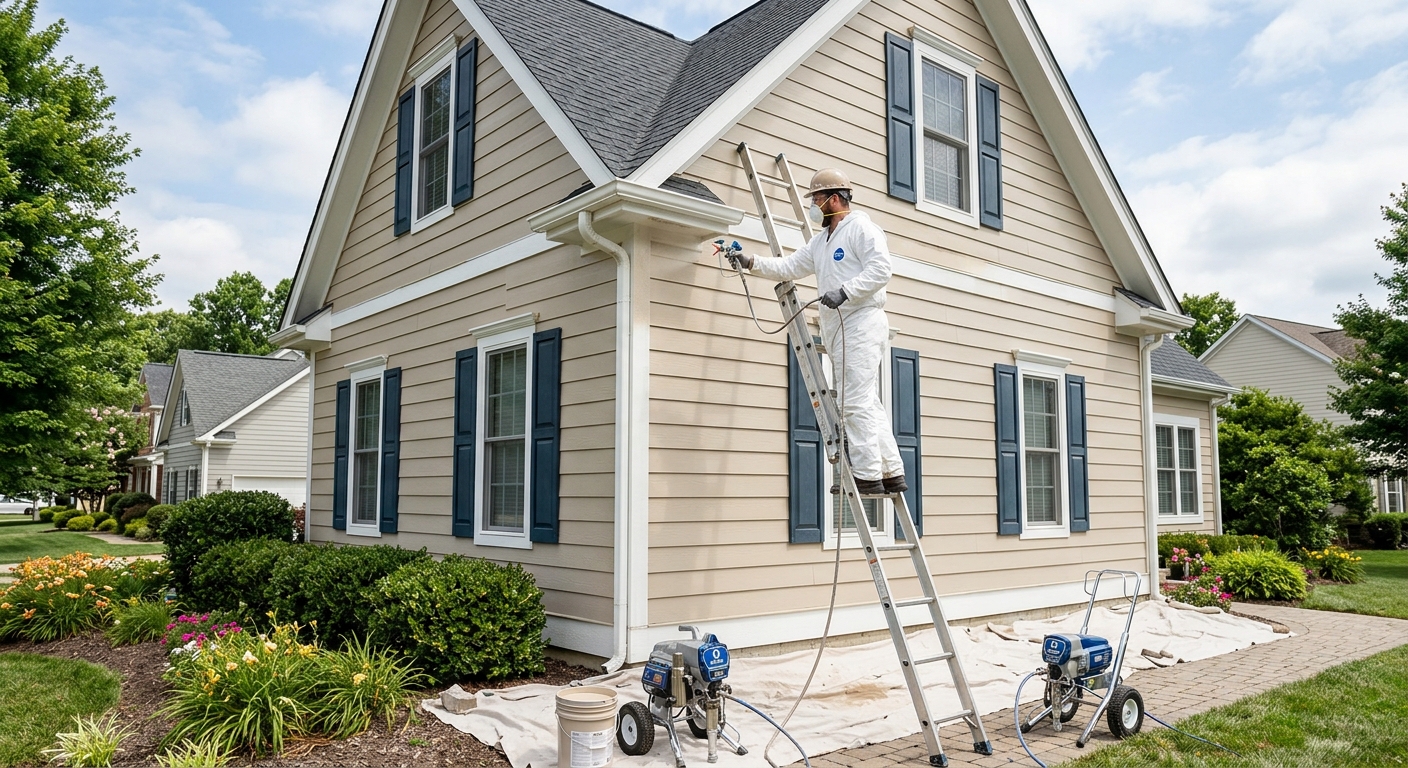
Painting options and costs in Olympic Village
In Olympic Village, painting quotes start with the same basics—surface condition, prep time, and finish quality—but the details can swing your budget fast. Olympic Village’s population is small (9,423 people, based on the 2021 Census), and that often means crews are booked tightly when weather windows open. Also, many homes across the Lower Mainland–Southwest are older than newer suburban builds, so repainting frequently involves more than just rolling a new coat: scraping failing coatings, patching settlement cracks, stain blocking nicotine/wood tannins, and priming properly. On pre-1978 homes, contractors may need lead-paint–safe practices, which adds containment, cleanup, and disposal time.
Lower Mainland–Southwest pricing reflects coastal conditions more than extreme cold. Rain and humidity mean exterior crews can’t simply “work through” damp stretches; they schedule around dry windows, allow for slower drying, and use mildew-resistant, high-adhesion systems for siding and trim. Interiors are steadier year-round, so contractors often shift capacity indoors in fall and winter. In Olympic Village, you’ll commonly see trade demand where older apartment-style wood elements and balcony/trim details are prevalent—near the waterfront edge and older streets with recurring condo turnovers—so prep-heavy repaint jobs tend to book first.
Below is a practical comparison of the options most Olympic Village homeowners ask for, to help you align scope with budget before you request an itemised quote.
| Service |
What's Included |
Typical Duration |
Price Range |
| Interior — whole home (walls, ceilings, trim) |
Move considerations, patching, sanding, caulking where needed, 1 coat primer as required, 2 finish coats, roller/brush work, basic protection and clean-up |
5–12 days |
$3,500–$7,500 |
| Interior — per room (standard bedroom or living room) |
Cut-in/edge work, patch/sand spots as needed, prime stained or repaired areas, 2 finish coats, protection for floors and fixtures |
1–3 days |
$800–$2,200 |
| Exterior — full house (siding, trim, soffits) |
Power wash (as required), scraping and sanding failing areas, patching, caulking prep, primer system for substrate, 2 finish coats, careful dry-window scheduling |
2–6 weeks (weather-dependent) |
$6,500–$14,500 |
| Exterior — trim and accent colours only |
Prep and prime bare/spot areas, caulking where needed, 2 finish coats on trim/accent surfaces, masking to protect adjacent siding |
3–8 days |
$1,800–$4,500 |
| Kitchen cabinet painting (doors, frames, spray finish) |
Degrease, light scuff/sand, repair minor chips, prime system, spray/brush finish approach for smooth look, hardware protection/handling |
5–15 days (including cure time) |
$2,500–$6,500 |
| Specialty / faux finish (accent wall, texture) |
Surface prep for finish longevity, base coat(s), texture/faux application, optional topcoat for cleanability, spot repairs to level the final look |
2–10 days |
$1,200–$7,500 |
Prices are estimates only and vary by project scope, site access and material selection.
What affects the price of painting in Olympic Village
Two quotes for the same “paint the house” job can differ by 30–50% across the Lower Mainland–Southwest and the rest of British Columbia because labour intensity changes with prep, detailing, and weather risk. In our region, the exterior season is weather-bound: coastal BC has a longer calendar than Ontario and Alberta, but high humidity and frequent rain require careful timing, mildew-resistant products, and slower drying. That means crews can’t always apply coats on schedule, and when they do mobilise, they need to finish within dry windows—so rescheduling risk is priced in.
In Olympic Village, most cost variability comes from surface prep on older housing stock. Scraping failing coatings, caulking before painting, spot-priming stained areas, and patching drywall or wood can represent 50–70% of total labour on a repaint. For example, one contractor might price a “whole interior” at the lower end of interior painting (around $300–$8,000) if the home is in clean condition; the same home can climb toward the high end if ceiling stains, tannin bleed, or multiple repaired sections require extra blocking primer. On the exterior side, a trim-only job may sit near the $1,200–$15,000 exterior band’s lower range, but a full recoat with extensive scraping and priming typically moves closer to the mid-to-upper portion.
Concrete Olympic Village examples: (1) peeling paint at soffit edges often forces deeper scrape-and-prime cycles; (2) balcony rails with layered coatings need careful sanding to avoid “fisheyes” and peeling—especially after marine moisture exposure.
| Price Factor |
Why It Matters |
Cost Impact |
| Surface prep — scraping, sanding, patching drywall or wood |
Prep determines adhesion and prevents early peeling and bubbling |
Often the largest swing; can add 40–70% on repainting |
| Number of coats — 2-coat system over primer vs. 1 coat over existing |
Extra coats reduce flashing, patch marks, and uneven sheen |
Typically adds 10–25% depending on condition |
| Paint quality tier — contractor-grade vs. premium (Benjamin Moore, Sherwin) |
Coverage, durability, and stain resistance vary by formulation |
Material add-on of ~5–20% with potential labour offsets |
| Ceilings and trim — adds significant time vs. walls-only |
Cut-in work and detail time increase labour hours |
Commonly adds 15–35% to interior scopes |
| Exterior season window — short season raises summer rates |
Mobilisation and rework risk increase when weather windows are narrow |
Can add 10–30% in peak periods |
| Lead-safe precautions — required for pre-1978 homes with lead paint |
Containment, HEPA methods, and disposal increase labour and materials |
Often adds 15–40% if lead is present |
| Surface material — drywall vs. plaster vs. wood vs. stucco |
Different substrates require different primers and prep approaches |
Can add 5–25% depending on unknown conditions |
| Height and access — multi-storey exterior requires scaffolding or lifts |
Setup time, safety, and slower work raise total cost |
Often adds 10–35% |
Permits & regulations in British Columbia
In British Columbia, painting generally does not require a permit for typical interior or exterior repainting of a home. That said, if your Olympic Village home was built before 1978, health guidelines recommend testing for lead paint before sanding or scraping. If lead is present, lead-safe work practices are expected from professionals—wet methods to control dust, HEPA vacuuming, and proper containment and disposal. For homeowners, this is not typically mandated the same way it is for regulated industrial work, but it’s standard practice for contractors because lead dust is a serious hazard.
What usually does NOT require a permit: repainting walls/ceilings, refreshing trim, painting siding (including spot priming), and cabinet repainting. What may require special handling (not a permit, but procedures): any lead-safe remediation steps when pre-1978 materials are disturbed, plus coordination if there are strata rules or building-access limits in multi-unit areas near Olympic Village.
Step-by-step verification in BC: (1) Ask for the contractor’s business information and check their licensing details through the appropriate BC credential/registry where applicable for painters in your contract scope. (2) Request a certificate of liability insurance and confirm the policy is active and covers painting/contract work. (3) Ask for proof of workers’ compensation coverage (commonly referred to as WCB coverage) for their workers. (4) Get a written contract that lists paint brand and sheen, number of coats, and the exact prep and surface repairs included.
Interior vs exterior painting — getting the best result in Olympic Village
In Olympic Village, the difference between a long-lasting paint job and a premature failure usually isn’t the “fancy” brand—it’s how the surface is prepared and how products are matched to BC’s coastal conditions. For interiors, start with the prep: filling and sanding rough patches, proper caulking, and priming repaired or stain-prone areas. Many homeowners assume sheen is the key decision, but sheen mainly controls cleanability and appearance; the brand matters less than whether repairs were sealed and sanded flat. In busy rooms, eggshell or satin typically balances wipeability with a forgiving look, while flat paints can be harder to clean. Regardless of room, two finish coats over a properly primed surface almost always outlast one thick coat because it reduces flashing and patch visibility.
For exteriors, BC’s humidity and rain make prep non-negotiable. Caulking should be completed before painting to reduce water ingress behind trim and along siding edges. Primer choice matters: use the correct primer system for the substrate and existing coating type, and avoid forcing an incompatible product. While Ontario/Alberta climates can punish cold-weather application, Lower Mainland–Southwest risk is different—mildew growth and slow drying—so crews use mildew-resistant, high-adhesion systems and schedule around dry stretches. On pre-1978 homes, lead-safe protocols may also be required for scraping or sanding.
Cabinet painting is a budget-friendly alternative to replacement, but it’s prep-heavy: degreasing, scuffing, and a proper prime/finish system determine whether doors stay smooth and resist chipping. If you compare options, cabinet refinishing often lands around the interior cabinetry band (roughly $2,000–$8,000), which can justify the cost versus replacement when the kitchen layout is still working for your household.
| Project Type |
Key Prep Step |
Recommended Coats |
Price Band |
| Interior — fresh drywall (new construction) |
Seal drywall properly and sand lightly for uniform texture before finishing |
Primer + 2 finish coats |
$600–$3,500 |
| Interior — repaint (good condition, no repairs) |
Clean, spot-sand, caulk small gaps, then bond and even sheen |
Prime as needed + 2 finish coats |
$300–$2,800 |
| Interior — repaint (patching and priming needed) |
Patch/sand, then stain block or spot-prime repairs so patches disappear |
Primer (spot or full as needed) + 2 finish coats |
$700–$5,200 |
| Exterior siding (wood or fibre cement) |
Scrape failing areas, prime bare substrate, and caulk before finishing |
Primer system + 2 finish coats |
$4,500–$14,500 |
| Exterior trim and accents only |
Mask carefully and sand to create proper adhesion for multi-surface details |
Prime where needed + 2 finish coats |
$1,200–$4,500 |
| Kitchen cabinets (spray finish) |
Degrease thoroughly and use a bonding primer for durable adhesion |
Prime + 2 finish coats (often spray) with cure time |
$2,500–$6,500 |
How to choose a painting contractor in Olympic Village
Choosing the right painter in Olympic Village comes down to verification and clarity. Start with licensing: in British Columbia, confirm the contractor’s credentials appropriate to your scope, and ask for their business details. Next, require proof of liability insurance—request a certificate of insurance showing active coverage and the correct insured name. Finally, ask for workers’ compensation coverage (WSIB/WCB coverage wording can vary, but the key is workers’ compensation coverage for their people). If they can’t provide these documents quickly, move on; your project shouldn’t carry your risk.
Then, get 2–3 itemised written quotes. You want a breakdown of labour hours and materials (paint, primer, patching products), not a single lump-sum number with unclear exclusions. Read the scope carefully: is permit pulling included (usually “no permit” for standard painting, but access rules in multi-unit contexts can be different), is disposal included, and what protection is covered for floors, landscaping, and fixtures? For exteriors in Lower Mainland–Southwest, ask how they manage weather delays and drying time; a vague answer often leads to rushed coats or callbacks.
Warranty matters for both workmanship and products. Ask for the workmanship warranty length and what it covers (peeling, coverage defects, adhesion failures), plus whether manufacturer warranties apply and if they’re transferable to a future owner. In payment scheduling, never pay more than 10–15% upfront; use a holdback until completion and final cleanup. Get a written start date and a completion estimate, including the likely effect of coastal humidity and rain.
- Request insurance and workers’ compensation proof before signing anything.
- Confirm what prep is included: scraping, sanding, caulking, patching, and primer strategy.
- Ask whether paint brand and sheen are specified (not just “good quality paint”).
- Check whether stain-blocking primer is included for water marks, nicotine, or tannins.
- Verify the number of coats per surface (walls vs. ceilings vs. trim).
- Ensure disposal and jobsite cleanup are explicitly included for exterior prep and sanding debris.
- For exteriors, ask how they schedule around rain/humidity and drying times.
- Confirm masking/protection standards around windows, floors, and landscaping.
- Ask about lead-safe practices if your home is pre-1978 and sanding/scraping is involved.
- Get the timeline in writing: start date, estimated duration, and how weather impacts it.
- Require itemised labour and material lines (not just “labour” and “supplies”).
- Use a payment schedule with a holdback until final walkthrough and touch-ups.
Red flags in Olympic Village: (1) quotes that skip or underspecify prep (“paint over whatever’s there”) on an exterior; (2) no mention of primer/caulking strategy for trim and siding; (3) refusal to provide insurance/coverage documents; (4) payment requests with high upfront deposits; (5) vague timelines that ignore weather windows and drying time in coastal BC.
Frequently asked questions — painting in Olympic Village
How much does it cost to paint a house in Olympic Village?
For Olympic Village homeowners, house painting typically lands in the middle-to-upper part of the local bands because prep can be extensive in the Lower Mainland–Southwest. A whole interior repaint commonly ranges from about $3,500–$7,500 depending on ceiling work, repair needs, and trim detail. Exterior costs vary even more because rain and humidity affect scheduling and dry time; a full exterior (siding, trim, soffits) often comes in around $6,500–$14,500. Homes built prior to 1978 can also involve additional lead-safe procedures if scraping/sanding disturbs lead-containing coatings. (Statistics Canada, 2021 Census shows Olympic Village has a population of 9,423, which can mean tighter contractor availability in peak periods.)
How much does interior painting cost per room in Olympic Village?
Interior painting per room is usually priced based on wall area, ceiling coverage, and how much repair and priming the surfaces need. For a typical bedroom or living room, you’ll often see ranges around $800–$2,200. If the room is clean with minimal patching, costs sit closer to the lower side; if you have stained drywall, texture repairs, or lots of trim, pricing moves toward the higher end because prep and cut-in time increase. In British Columbia’s climate, interior humidity is generally manageable year-round, so the biggest driver is still surface condition—not weather. For best comparability, ask your contractor to confirm number of coats and whether repairs get a stain-blocking primer.
When is the best time for exterior painting in Olympic Village?
The best time is when you can work from a dependable dry stretch—coastal BC is often wet and humid, so scheduling is the real challenge. In Olympic Village, many exterior crews aim for late spring into summer and keep a close eye on weather windows rather than relying on calendar dates alone. The goal is to avoid applying over damp surfaces and to ensure adequate drying between coats. If you book in peak summer, expect more competition for crews; if you schedule in shoulder periods, you may get a better rate but with weather-dependent adjustments. Your contractor should specify how they handle rain delays and how they manage drying time to protect adhesion and reduce mildew risk.
How many coats of paint do I need?
Most repainting jobs in Olympic Village should be planned as a prime (if needed) plus two finish coats. If you’re painting over patched, stained, or sanded areas, spot priming or full priming is often required so the finish coat looks uniform. In good condition scenarios—clean surfaces with minimal repairs—contractors may still use 2 finish coats for consistent sheen and coverage. If a quote suggests “one thick coat” to save money, ask how they’ll prevent flashing, patch lines, and early wear. For cabinet painting, it’s also commonly primer plus two finish coats, with cure time—because doors see more wear than walls. The exact system depends on substrate and existing coating type.
What paint is best for Olympic Village's climate?
For British Columbia’s coastal conditions, the “best” paint is the one with the right adhesion, mildew resistance, and durability for your substrate—not just a premium label. For exterior work, look for mildew-resistant, high-adhesion coatings and an appropriate primer system for wood or fibre cement. Trim and high-touch areas benefit from finishes that balance cleanability with long-term colour holdout. For interiors, choose sheen by room function: flat can hide imperfections, while eggshell or satin is typically easier to wipe in living spaces and hallways. If your home is pre-1978, ask about lead-safe prep expectations before sanding or scraping because the paint system only performs well when prep is done correctly.
How long does exterior paint last here?
In Olympic Village, exterior paint life is mostly driven by prep quality and whether the system matches the substrate and existing coating condition. With proper scraping, sanding, caulking before painting, correct primer, and two finish coats applied during suitable dry windows, many homeowners see long service years rather than quick failures. If the job skips adhesion-focused prep or gets painted over damp surfaces, peeling and bubbling can show up sooner—especially around trim joints and soffits where moisture lingers. Humidity and rainfall don’t just affect drying; they affect mildew risk and long-term bonding if the surface isn’t properly cleaned and primed. Your contractor should describe their prep plan and products; that’s what determines longevity in Lower Mainland–Southwest weather.