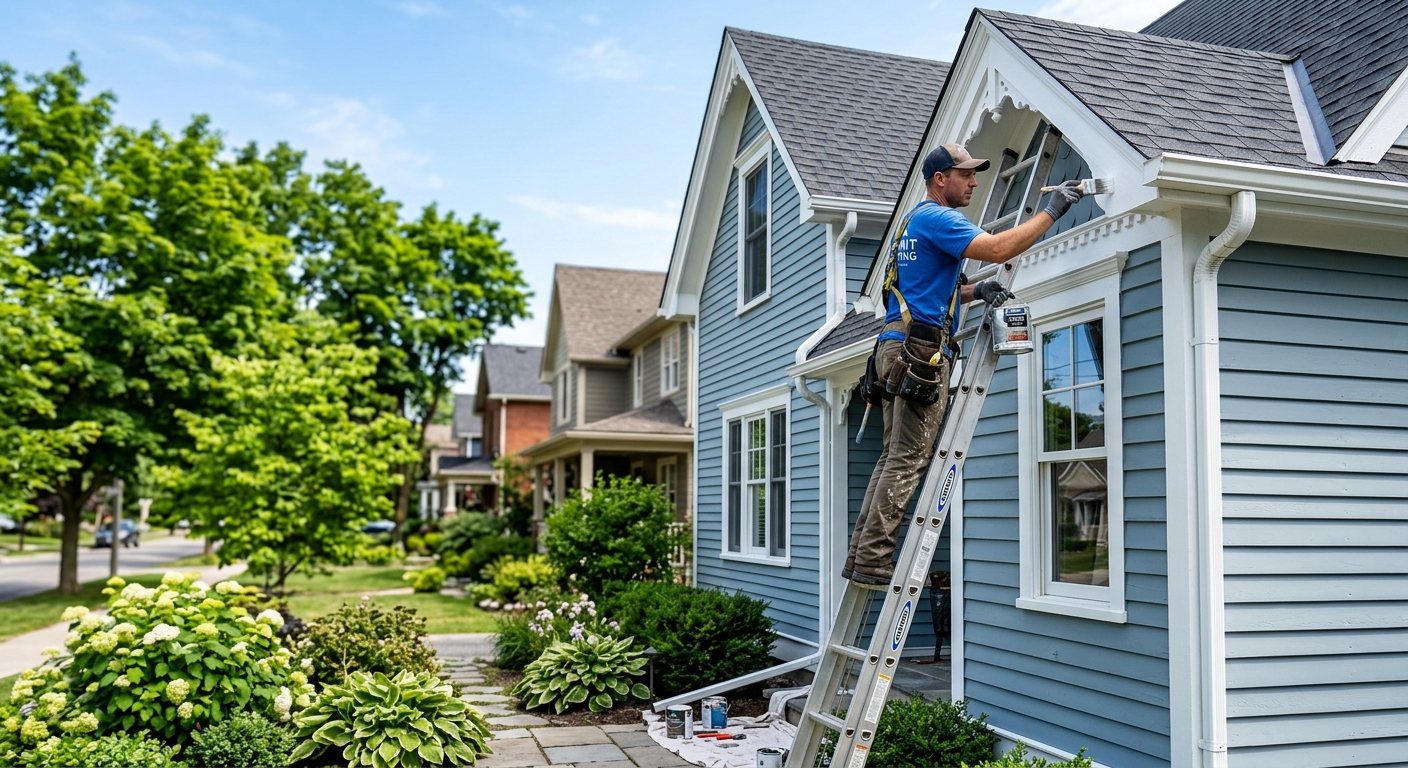
Painting options and costs in Duncan
Duncan is a great place to own a home, and it’s also a place where paint performance is won or lost before the first brush touches the wall. With about 61.3% of local homes built before 1981 (Statistics Canada, 2021 Census), many projects involve more than “a new coat”—you’re often dealing with weathered trim, older caulking, and surfaces that need careful scraping, sanding, patching and priming for a durable bond. Some pre-1978 homes may also warrant lead-safe practices during sanding or scraping, which can add time and setup.
On Vancouver Island and the Coast, exterior work is tightly shaped by the short, reliable stretch when crews can paint and get proper dry/cure conditions—generally when temperatures stay around the workable range and humidity is manageable. Coastal mornings with dew and frequent rain mean we schedule around forecasts and use mildew-resistant, high-quality coatings. That market pressure rewards homeowners who book early, especially in neighbourhoods where turnover and renovations are common—such as the Cowichan Lake Road corridor and the surrounding residential areas near town.
Below are realistic budget ranges homeowners in Duncan typically plan for, with the understanding that prep, height/access, and the condition of your existing surfaces are usually the biggest drivers. Use this as a starting point, then we can tighten the numbers with an on-site scope.
| Service |
What's Included |
Typical Duration |
Price Range |
| Interior — whole home (walls, ceilings, trim) |
Protective coverings, surface washing, patching, sanding where needed, primer (as required), 2-coat finish for walls/ceilings, caulking and paint trim/doors, daily clean-up |
3–7 days |
$4,000–$6,500 |
| Interior — per room (standard bedroom or living room) |
Prep of walls/ceiling, spot priming, 2-coat wall finish, trim/door touch-ups if included in scope, light protection of adjacent areas |
1–3 days |
$2,000–$3,800 |
| Exterior — full house (siding, trim, soffits) |
Scrape/sand as needed, caulking, repair of minor damaged trim, prime bare wood/stains, 2-coat exterior system, paint soffits/fascia/trim, debris disposal |
5–12 days |
$6,500–$12,000 |
| Exterior — trim and accent colours only |
Masking and surface prep of trim areas, prime where required, 2-coat finish on selected elements, coordination for colour transitions |
2–6 days |
$3,500–$7,500 |
| Kitchen cabinet painting (doors, frames, spray finish) |
Hardware removal, deep cleaning/degreasing, light sanding, bonding primer, spray/rolled finish on doors, 2-coat system, reinstallation |
5–10 days |
$1,900–$4,200 |
| Specialty / faux finish (accent wall, texture) |
Prep and sealing, colour matching, application of specialty technique (e.g., sponging/texture/feature finish), clear protection where appropriate |
1–4 days |
$800–$3,500 |
Prices are estimates only and vary by project scope, site access and material selection.
What affects the price of painting in Duncan
In Duncan, it’s common to see the same type of job land 30–50% apart across Vancouver Island and the Coast. Part of that range comes from timing and availability in the tight exterior season, and part comes from how each contractor prices the “invisible” work: prep, priming decisions, surface repairs, and protection. Even before you compare interior paint types, the labour rate and whether a crew budgets for proper curing time can change the total.
For exterior painting here, the weather window is the major constraint. In the region, crews generally target late spring to early fall when conditions support application and at least a full day above about 10°C for proper cure—coastal humidity and rainfall still require careful scheduling. On older homes (with many built pre-1981), surface prep becomes a larger share of labour; scraping, caulking, and priming can represent 50–70% of the total labour time on a repaint. That same prep affects the finish life, especially because damp microclimates can encourage mildew if the wrong coating system is used.
Concrete examples: a two-storey home may need scaffolding or lifts, which can add several thousand dollars and days versus a single-storey bungalow. Conversely, a home with mostly sound siding and intact caulking can land closer to the lower end of the exterior band—around $3,500–$7,500 for trim/accent work—while heavily weathered siding and trim that needs extensive repair often pushes full-house exteriors toward $6,500–$12,000.
Finally, what you choose for paint quality matters. Higher-grade coatings and correct primers reduce rework risk; in coastal conditions, skipping that step often costs more later when peeling or adhesion failures show up.
| Price Factor |
Why It Matters |
Cost Impact |
| Surface prep — scraping, sanding, patching drywall or wood |
Prep drives adhesion and prevents early failure |
Can add $1,000–$4,000 depending on condition |
| Number of coats — 2-coat system over primer vs. 1 coat over existing |
Coverage hides stains/marks and builds durable film |
Often $300–$2,000 difference |
| Paint quality tier — contractor-grade vs. premium (Benjamin Moore, Sherwin) |
Better solids, washability and mildew resistance |
Usually $200–$1,200 on typical projects |
| Ceilings and trim — adds significant time vs. walls-only |
Trim requires precision caulking and steady masking |
Can change total by $500–$2,500 |
| Exterior season window — short season raises summer rates |
Scheduling pressure and weather-driven mobilization |
May raise costs 10–25% at peak |
| Lead-safe precautions — required for pre-1978 homes with lead paint |
Wet methods, HEPA vacuuming, containment and cleanup increase labour |
Typically $400–$2,500 where applicable |
| Surface material — drywall vs. plaster vs. wood vs. stucco |
Each material needs different primers and prep |
Can add $300–$1,800 |
| Height and access — multi-storey exterior requires scaffolding or lifts |
Safety, setup time and protection add cost |
Often $600–$3,000+ |
Permits & regulations in British Columbia
In British Columbia, painting itself generally does not require a permit for typical interior or exterior paint work. However, if your Duncan home was built before 1978, health guidance recommends you test for lead paint before sanding, scraping or disturbing old finishes—and if lead is present, use lead-safe work practices such as wet methods to reduce dust, HEPA vacuuming, and proper disposal of waste. For homeowners, this isn’t usually “permit-based,” but it is standard professional practice because it directly affects worker safety and cleanup quality.
What does require permits is uncommon for straightforward painting, but related tasks sometimes do. For example, permits may be needed if you’re changing structures, adding windows/doors, or doing significant exterior cladding replacements beyond painting—so always confirm scope with your contractor.
To verify a professional contractor in British Columbia, start with three checks: (1) licensing/registration status using the relevant provincial registry for contractors where applicable; (2) certificate of liability insurance—ask for the most current COI and verify the project address is covered; and (3) workers’ compensation coverage (WCB/WSBC). Then request a written contract that spells out paint brand/line, sheen, number of coats, which surfaces get primer, and what prep/repairs are included.
For peace of mind, ask who provides disposal and whether they can supply proof of insurance before work begins.
Interior vs exterior painting — getting the best result in Duncan
In Duncan, long-lasting results come from how the job is prepared and sealed, not from chasing a “best” brand. Interiors fail most often when patching is rushed, dust is left behind, or sheen isn’t chosen for the room’s wear. For interior walls and ceilings, filling cracks/holes, sanding feather edges and priming stain-prone or repaired areas is typically more important than the topcoat name. Sheen choice matters too: flat tends to hide wall imperfections but can scuff; eggshell or satin often works better for living areas, while bathrooms and basements benefit from mildew-resistant finishes. Also, two coats over a properly primed surface nearly always outlast one thick coat—especially in a damp coastal environment where adhesion and coverage determine durability.
Exterior painting is even more prep-driven here. Coastal Vancouver Island conditions make caulking and sealing critical before paint—good caulk lines help prevent water ingress behind trim and siding. Primer selection is also crucial: different substrates (new drywall-like materials, weathered wood, fibre cement, or stucco) require correct bonding primers so the finish film doesn’t peel. For older Duncan homes—many built before 1981—scraping failing paint and using mildew-resistant coatings helps manage marine humidity. If you’re in a colour change situation, correct stain-blocking primer can be the difference between a smooth finish and “ghosting” stains later.
Cabinet painting is a smart budget alternative to replacement when the existing boxes are solid. A common example: a full cabinet replacement can push well beyond the $5,000–$15,000+ range (varies widely), while spray-finished cabinet painting in the typical band of about $1,900–$4,200 often delivers a comparable look at a fraction—provided surfaces are degreased, bonded and sealed properly. For pre-1978 properties, lead-safe precautions during prep are part of doing it right.
| Project Type |
Key Prep Step |
Recommended Coats |
Price Band |
| Interior — fresh drywall (new construction) |
Prime all drywall and spot-prime patches to ensure uniform absorption |
Primer + 2 coats finish |
$2,500–$4,200 |
| Interior — repaint (good condition, no repairs) |
Wash/degloss, light sand, address minor scuffs, caulk small gaps |
1–2 coats finish depending on coverage |
$2,000–$3,800 |
| Interior — repaint (patching and priming needed) |
Patch, sand feather edges, prime repairs and stain-prone areas |
Primer + 2 coats finish |
$2,500–$4,800 |
| Exterior siding (wood or fibre cement) |
Scrape unstable paint, sand rough spots, caulk, prime bare areas |
2-coat exterior system |
$6,500–$12,000 |
| Exterior trim and accents only |
Mask cleanly and prep/prime trim transitions for adhesion |
2 coats on trim/accent areas |
$3,500–$7,500 |
| Kitchen cabinets (spray finish) |
Degrease and bond-prime; controlled spray/finish for a smooth film |
Bond primer + 2 coats finish |
$1,900–$4,200 |
How to choose a painting contractor in Duncan
Choosing a contractor in Duncan is mostly about verification and clarity. First, check British Columbia coverage and credentials: ask for proof of liability insurance (certificate of insurance with the correct business name), then request workers’ compensation coverage (WCB/WSBC) so you’re not exposed if someone gets injured on your property. For licensing/registration status, use the appropriate provincial registry information available online for the contractor’s business and/or trade status.
Next, get 2–3 itemised written quotes. You should see labour and materials broken out—surface prep time, primer allowances, number of coats, paint line used, cleanup/disposal method, and whether trim work includes caulking. Avoid “lump sum” estimates that don’t specify what happens if extra scraping or patching is discovered; reputable contractors price based on condition and state clearly what’s included versus what’s changeable.
Warranty matters: ask for a workmanship warranty length in writing and confirm whether it’s tied to proper surface prep and whether it transfers to a new owner if you sell. For payment, never allow large upfront deposits; a typical safe approach is keeping upfront around 10–15%, with the remainder paid after key milestones and final walkthrough. Finally, insist on a written timeline with a start date, estimated duration, and how weather delays are handled—important on Vancouver Island.
- Request proof of liability insurance before the first day on site.
- Confirm workers’ compensation coverage (WCB/WSBC) is active.
- Verify trade/registration status through BC’s public lookup tools.
- Get 2–3 itemised quotes with labour + material line items.
- Ask exactly what’s included in surface prep (scrape, sand, patch, caulk, prime).
- Confirm number of coats and whether primer is required for repaired/bare areas.
- Clarify sheen and where it’s used (walls vs. trim vs. cabinets).
- Ask how disposal is handled (paint waste and debris removal).
- Look for lead-safe practices if your home predates 1978.
- Review the warranty in writing and ask if it’s transferable.
- Keep deposits modest (10–15%) and agree on holdback until completion.
- Require a start date, estimated completion window, and weather-delay communication plan.
In Duncan, common red flags include: vague scopes like “prep as needed” with no budget/time allowance, quotes that name a paint brand but not the exact line or sheen, promises of exterior work “regardless of weather” without a schedule strategy, refusal to provide a certificate of insurance/WCB proof, and payment terms that ask for large upfront deposits. If you see multiple red flags together, keep looking.
Frequently asked questions — painting in Duncan
What is the best primer for older Duncan homes?
For older Duncan homes (many built before 1981 in the area—Statistics Canada, 2021 Census), the “best” primer depends on what you’re covering. Over weathered wood, you typically need a bonding exterior primer that can grip and resist damp conditions. Over stains or tannin bleed, stain-blocking primer is often the key to preventing discolouration through the finish. If you’re dealing with pre-1978 paint layers, contractors generally follow lead-safe work practices when sanding or scraping to reduce dust and manage waste properly. A good contractor will test/assess the surface condition and recommend primer type accordingly, then specify it in the contract with the correct number of coats so you don’t end up repainting sooner than expected.
Should I paint or wallpaper my Duncan home?
In Duncan and coastal BC, painting is usually the lower-risk choice for moisture-prone areas because it’s easier to prep properly and seal against humidity. Wallpaper can look fantastic, but it can be sensitive to substrate issues like cracking, poor adhesion, or dampness—especially in basements, bathrooms, or near exterior walls. If your walls have repairs, paint (with correct patching, sanding and priming) often gives a more predictable finish. That said, wallpaper can make sense for feature rooms if your contractor guarantees surface prep and uses a suitable adhesive for the wall type. Cost-wise, a room paint job commonly sits around the interior per-room band (about $2,000–$3,800), while wallpaper work can add labour and materials depending on pattern matching and removals.
How do I fix peeling exterior paint in Duncan?
Peeling exterior paint in Duncan usually isn’t solved by “spot painting.” The right approach is: scrape off all loose material to a sound edge, sand feathered areas, remove chalky residue, and clean the surface so the primer bonds. Then caulk where needed—because failing caulk often causes the moisture cycle that leads to peel. Apply primer to bare wood and any repaired zones, using an exterior primer suitable for damp/coastal conditions, and then apply a full 2-coat exterior system rather than a thin patch. If the home is pre-1978, contractors often use lead-safe precautions during scraping/sanding. On weathered surfaces, total costs can climb quickly due to prep time; it’s not unusual for full exterior repaint budgets to land in the broad exterior band of $6,500–$12,000 depending on extent of repair.
What colours add the most resale value in Duncan?
In Duncan, resale-minded colour choices tend to be those that look clean and consistent in coastal light. Neutral palettes—warm off-whites, light greys, soft taupes, and classic greige—generally photograph well and fit both heritage-style and newer homes. For trim, crisp whites (or warm whites) often make a house feel brighter, while restrained accent colours on doors and smaller trim features add curb appeal without overwhelming. If you’re changing from a darker exterior to a much lighter one, plan on proper primer/stain-blocking to avoid bleed-through. Because many Duncan homes are older (with a significant share built before 1981—Statistics Canada, 2021 Census), matching existing architectural details (window trim, fascia, siding profiles) matters as much as the exact hue. For most homeowners, a predictable exterior refresh is more valuable than a high-contrast experiment.
How much does it cost to paint a house in Duncan?
The cost to paint a house in Duncan depends mainly on interior vs exterior, how much surface prep is needed, and whether you’re painting the full house or just trim. For exterior, a full-house repaint commonly falls in the range of $6,500–$12,000 in this tier, because scraping, caulking, priming and multi-coat application take time—especially on older homes. If you’re focusing only on trim and accent colours, budgets often land around $3,500–$7,500. Interior whole-home projects (walls/ceilings/trim) are frequently estimated around $4,000–$6,500. Coastal scheduling also affects contractor availability during the drier late-spring to early-fall window, so early booking can improve value.
How much does interior painting cost per room in Duncan?
Per-room interior painting in Duncan typically depends on ceiling coverage, trim/doors included, and how many repairs are needed. For a standard bedroom or living room with typical prep—washing, light sanding, patching as needed, priming where required—many projects price around $2,000–$3,800. If the room needs significant patching, stain-blocking primer, or extensive trim work, costs can move higher within the interior per-room range. In older homes (many built before 1981—Statistics Canada, 2021 Census), the difference is often the amount of priming and repair work. A good quote should specify whether ceilings are included and whether the scope covers trim caulking and door touch-ups so you can compare apples to apples.