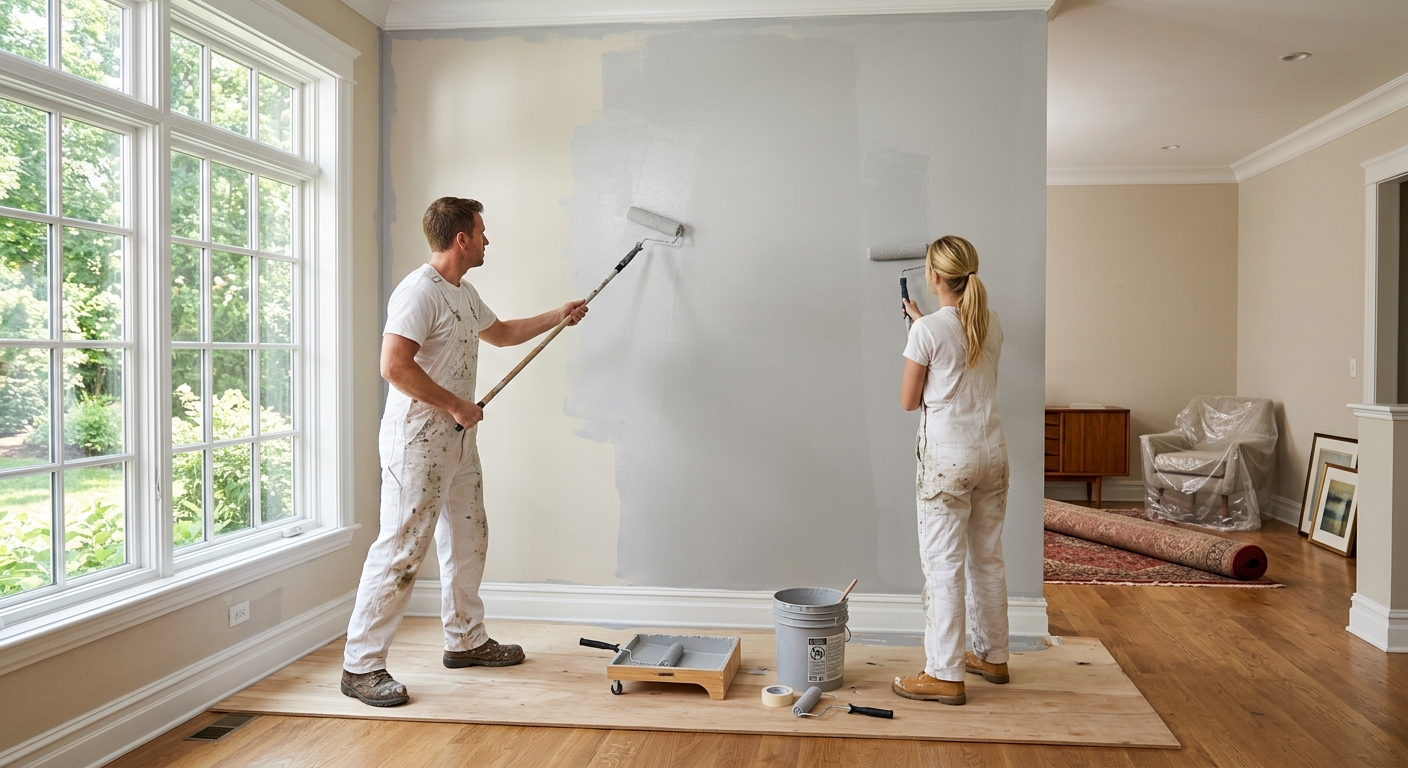
Painting options and costs in Trinity-Bellwoods
In Trinity-Bellwoods, painting choices usually come down to two things: how much prep your home needs and how tight the weather window is for the work. Trinity-Bellwoods and the broader Toronto area include a meaningful share of older housing; in fact, the region’s population is 16,556 (Statistics Canada, 2021 Census), and many homeowners are maintaining pre-1980 properties that often have more paint layers, harder-to-remove caulk, and more patching. For those older surfaces, the “labour” part of painting—scraping, sanding, caulking, spot-priming, and sometimes lead-safe handling for pre-1978 materials—is where quotes start to diverge.
On the interior side, Ontario scheduling is more flexible year-round, but labour is still the biggest cost driver because Trinity-Bellwoods homes frequently have stairwells, window trim, and varying ceiling heights. Exterior work is more seasonal: contractors in the Greater Toronto Area typically target late May through June and then again September to mid-October, when temperatures stay around or above 10°C for proper adhesion and curing. In June–August, limited “ideal” weeks plus peak demand often pushes exterior pricing 10–15% higher. If you’re near the busy stretch around Ossington and Dundas, that can also mean less staging flexibility for crews, which can add time for setup and protection.
To help you compare bids, the table below outlines common options for Trinity-Bellwoods projects and typical durations, then we’ll break down what pushes prices up or down.
| Service |
What's Included |
Typical Duration |
Price Range |
| Interior — whole home (walls, ceilings, trim) |
Move/cover furniture where practical, surface prep (patch/sand), prime as required, 2-coat paint system, caulking at trim edges, clean-up and protective finishing |
4–10 days |
$2,000 – $6,000 |
| Interior — per room (standard bedroom or living room) |
Prep, patching, sanding, prime as needed, 2-coat application to walls; trim work included if specified in scope |
1–3 days |
$450 – $1,800 |
| Exterior — full house (siding, trim, soffits) |
Power wash, scrape/sand, caulking, spot-priming, full 2-coat system on siding/trim where feasible, protection of landscaping/windows, final clean-up |
5–14 days |
$3,500 – $8,000 |
| Exterior — trim and accent colours only |
Prep of trim/porch rails/selected elevations, scrape/sand, prime where needed, 2-coat finish, masking and protective coverings |
2–7 days |
$1,500 – $4,500 |
| Kitchen cabinet painting (doors, frames, spray finish) |
Degrease/clean, remove hardware (as applicable), sanding/scuffing, primer + topcoat (spray where specified), professional finish for doors/frames, re-install hardware |
4–12 days (including curing time) |
$1,200 – $4,000 |
| Specialty / faux finish (accent wall, texture) |
Surface build/prep for the chosen technique, multiple application steps (base, texture, colour, protective topcoat), mock-up if requested |
1–6 days |
$300 – $5,000 |
Prices are estimates only and vary by project scope, site access and material selection.
What affects the price of painting in Trinity-Bellwoods
Even when two homeowners describe the “same” job in Trinity-Bellwoods, bids can swing by 30–50% across Toronto and Ontario because painting is mostly preparation work plus risk management—especially on older surfaces and exteriors. The short, climate-dependent exterior season in the Greater Toronto Area matters directly: crews typically need late May to early October weather where temperatures are staying above about 10°C for proper application and curing. Unlike coastal BC’s dampness (which pushes mildew-resistant product choices and careful timing), the GTA’s main threats are rain, humidity spikes, and frost risk around the edges of the season. When the ideal weeks are limited, scheduling pressure rises and labour rates effectively go up.
For repainting, older homes are a cost accelerator. Many Trinity-Bellwoods properties reflect earlier construction eras; more time is spent on scraping, sanding, patching drywall or wood, re-caulking, and priming over multiple old layers. In practical terms, surface prep can be 50–70% of labour on a typical exterior repaint. If a full exterior is priced in the $3,500–$8,000 band, that higher end often corresponds to extensive caulking and priming, not just more paint.
Concrete examples from our day-to-day work: (1) A wood fascia that’s peeling paint usually needs deeper scraping and more spot-priming than fibre cement panels, which can narrow time and cost. (2) Multi-storey frontages or tight laneway access can require lifts/scaffolding time—sometimes adding a few hundred to over a thousand dollars to an exterior quote. (3) Interior rooms with ceiling heights and lots of trim can move a project from the lower end of the interior-per-room band ($450–$1,800) toward the top end due to masking, detail work, and extra protective finishing.
| Price Factor |
Why It Matters |
Cost Impact |
| Surface prep — scraping, sanding, patching drywall or wood |
Determines adhesion and longevity; damaged areas must be levelled and cleaned properly |
Often the largest cost driver; can be 50–70% of labour on repaints |
| Number of coats — 2-coat system over primer vs. 1 coat over existing |
Coverage and durability depend on correct layering, especially when changing colours or sheen |
Usually +$300–$1,500 depending on how much prep/primer is required |
| Paint quality tier — contractor-grade vs. premium (Benjamin Moore, Sherwin) |
Premium products typically improve coverage, washability, and colour consistency |
Material delta can add roughly 5–20% to total project cost |
| Ceilings and trim — adds significant time vs. walls-only |
Ceilings require careful cutting/rolling and more masking; trim needs extra sanding and caulking |
Can increase interior quotes by 15–40% versus walls-only |
| Exterior season window — short season raises summer rates |
Fewer good-weather days can increase crew rates and push back timelines |
Commonly +10–15% in June–August in the GTA |
| Lead-safe precautions — required for pre-1978 homes with lead paint |
When lead risk is present, extra controls are needed to reduce dust and manage disposal |
Can add several hundred to over $1,000 depending on extent |
| Surface material — drywall vs. plaster vs. wood vs. stucco |
Different substrates need different primers, bonding steps, and drying times |
May add 10–30% when primer selection and prep differ significantly |
| Height and access — multi-storey exterior requires scaffolding or lifts |
Increases labour time, safety controls, and set-up/tear-down costs |
Often +$300–$1,500 for typical row/2-storey complications |
Permits & regulations in Ontario
In Ontario, painting usually does not require a permit. Where projects can become “regulated” is not the paint job itself, but the safety practices tied to building materials and hazardous dust. For homes built before 1978, health guidance recommends testing for lead paint before sanding, scraping, or other work that creates dust, and following lead-safe work practices if lead is present (for example: wet methods to reduce dust, HEPA vacuuming, and proper disposal). This is not something homeowners are personally required to do as a permit step, but professional contractors in Trinity-Bellwoods commonly treat it as standard practice—especially if doors, railings, trim, or window components are being disturbed.
Separately, reputable contractors should carry the right insurance: liability insurance plus WSIB/WCB workers’ compensation coverage. For your written contract, insist it clearly states the paint brand and sheen, the number of coats, and what surface prep is included (e.g., how scraping/patching/priming is handled). Also confirm which items are excluded (for example: full drywall replacement, structural repairs, or removing fixtures beyond agreed scope).
How to verify coverage step-by-step in Ontario: (1) ask for the contractor’s certificate of insurance and read the dates and coverage limits; (2) request evidence of WSIB/WCB coverage—often provided as a current clearance or account reference; (3) verify they’re properly registered for their trade category if applicable, using the province’s online resources; and (4) keep copies of everything with your contract, so you can confirm coverage if there’s damage or an on-site injury.
Interior vs exterior painting — getting the best result in Trinity-Bellwoods
In Trinity-Bellwoods, the difference between a long-lasting paint job and a premature failure is usually prep discipline and the right product choices for how your home actually behaves in Toronto weather. For interiors, surface prep matters more than brand. Filling and sanding nail pops, smoothing patch seams, and spot-priming stains or repaired areas can make the finish look professional and last longer. Sheen choice also changes performance: flat hides wall imperfections (but scuffs more), eggshell is a strong balance for living rooms and bedrooms, satin works well on higher-touch walls and hallways, and semi-gloss on trim/doors holds up to cleaning. Two coats over a proper primer generally outlasts one “thick” coat, because correct film build supports uniform curing.
For exteriors, the priority order is even stricter. Caulking should be completed before paint so water ingress paths are sealed; skipping or “painting over” compromised caulk often leads to blistering or peeling near joints. Primer selection is substrate-dependent: oil/alkyd-based primers are still used where adhesion or stain blocking is required, while latex primers suit many modern surfaces when prep is thorough. In the GTA, products must handle humidity spikes and rain risk during the limited late spring and early fall window—so we focus on proper timing and curing rather than relying on mildew-focused strategies alone (those are more central to BC’s coastal dampness).
Cabinet painting is a good value option when the box is sound—spray-finish doors and frames can refresh a kitchen without full replacement. If you compare budgets: a typical kitchen cabinet paint can land in the $1,200–$4,000 range, while replacing cabinetry usually moves into a completely different (and much higher) cost tier—so cabinet painting is “worth it” when you want a clean look quickly and the surfaces aren’t structurally failing. For pre-1978 homes, lead-safe precautions during scraping and sanding are part of protecting your indoor air and the crew, not an optional add-on.
| Project Type |
Key Prep Step |
Recommended Coats |
Price Band |
| Interior — fresh drywall (new construction) |
Seal/prime properly (especially for compound and suction control), then sand and dust removal |
1 coat primer + 2 coats topcoat |
$1,200 – $5,500 |
| Interior — repaint (good condition, no repairs) |
Degloss/clean lightly, minor patching only, caulking at trim edges, spot-prime any stains |
2 coats topcoat (primer only if required) |
$400 – $4,000 |
| Interior — repaint (patching and priming needed) |
Patch/sand smooth, prime repairs and any bleed-through before colour coats |
1 coat primer on repairs + 2 coats topcoat |
$600 – $6,000 |
| Exterior siding (wood or fibre cement) |
Power wash, scrape failing paint, caulk gaps, spot-prime bare/compromised areas |
2 coat system (with primer as required) |
$3,500 – $8,000 |
| Exterior trim and accents only |
Mask carefully, remove loose coating, sand edges for adhesion, prime bare trim |
2 coats on prepped surfaces |
$1,500 – $4,500 |
| Kitchen cabinets (spray finish) |
Degrease, scuff/sand, prime for adhesion, handle edges/door profiles for uniform coverage |
Primer + 2 topcoat coats (or equivalent manufacturer system) |
$1,200 – $4,000 |
How to choose a painting contractor in Trinity-Bellwoods
Choosing a painter in Trinity-Bellwoods gets easier when you verify coverage first and then compare scope line by line. In Ontario, confirm you’re dealing with a properly insured contractor: ask for their liability insurance certificate and check that it’s current, with the jobsite address listed if possible. For workers’ compensation, request evidence of WSIB/WCB coverage—ideally a clearance letter or direct confirmation with policy/account details. Don’t accept “we’ll be fine”; you want documents you can keep.
Next, get 2–3 itemised written quotes. The best quotes separate labour from materials and list surface prep steps (scraping, sanding, patching, caulking, priming), the coating system (brand and sheen), and how many coats are included. Avoid lump sums that don’t specify what’s excluded (for example: window trimming detail, soffit access, or disposal of paint debris). Ask whether permit pulls are involved (normally not for typical painting) and whether pressure washing is included for exterior work.
Warranty matters, but read it like a homeowner: ask for workmanship warranty length, whether the product/manufacturer warranty is included, and whether it transfers if you sell. Payment schedule should stay conservative—never pay more than 10–15% upfront; hold back a portion until the final walk-through and touch-ups are complete. Finally, require a written timeline with a start date and estimated completion date; exterior jobs can shift with rain and temperature, so the schedule should reference weather contingencies.
- Ask for insurance certificates (liability) and keep copies.
- Confirm WSIB/WCB coverage before work starts; request proof.
- Get an itemised quote: prep steps, coats, paint brand, and sheens.
- Require surface prep scope (scrape/sand/patch/prime/calculate caulking).
- Clarify exclusions: lead-safe scope, drywall replacement, disposal, and repairs.
- Check whether power washing (exterior) is included and how it’s handled around landscaping.
- Ask how they protect floors, stairs, railings, and furniture (and what “move/cover” means).
- Confirm sheen levels by room/feature (walls vs trim vs ceilings).
- Ask for a colour schedule or swatch approval process.
- Get warranty terms in writing (workmanship and any product coverage).
- Agree on payment milestones (10–15% max upfront; holdback until completion).
- Request daily access expectations and noise/disruption limits, especially near the Ossington/Dundas area.
Red flags I watch for in Trinity-Bellwoods: (1) a quote that skips surface prep details but promises “same finish” results; (2) no proof of WSIB/WCB coverage or insurance; (3) refusal to specify paint brand, sheen, and coat count; (4) asking for large upfront payments beyond 10–15%; and (5) vague timelines for exteriors without weather assumptions.
Frequently asked questions — painting in Trinity-Bellwoods
What's the difference between paint quality tiers?
Paint quality tiers mostly affect how consistently the paint covers, how well it resists scuffs and scrubbing, and how smoothly it lays down in real conditions. Contractor-grade products can be a good choice for ceilings and lower-touch areas, but premium lines often cover better in fewer coats and keep colour truer over time—useful when you’re repainting older trim with multiple layers. In Trinity-Bellwoods, prep is still the deciding factor, especially on pre-1980 homes where sanding and priming control adhesion. When quoting, you’ll see the interior range start around $400 for a single room and can climb depending on trim, coats, and product tier. For exteriors, the difference shows up in durability across Toronto’s humidity and rain spikes within the late spring/early fall season (Statistics Canada, 2021 Census).
How do I compare painting quotes?
Compare quotes by matching scope first, not total price. Ask each contractor to list the prep steps (scraping, sanding, patching, caulking, priming), the exact number of coats, and the paint brand and sheen for each surface type. If one quote says “2 coats” but doesn’t say how they treat bare wood, stains, or patched drywall, it’s likely missing primer or preparation time. For exteriors, confirm power washing inclusion, what areas are included (siding, trim, soffits, railings), and whether any height/access costs (lifts/scaffolding) are included or quoted separately. A “cheap” interior repaint can still land in the middle of the range (like $450–$1,800 per room) if it includes correct priming and detail work.
What paint sheen should I use in different rooms?
In Ontario homes in Trinity-Bellwoods, sheen is about balance: hiding vs. cleanability. Ceilings are commonly flat because it hides minor imperfections, but use a quality ceiling paint to avoid chalking. Walls often do best in eggshell or satin depending on use—eggshell is popular for bedrooms and living rooms, while satin is more practical in hallways, kids’ rooms, and kitchens where wipe-downs happen. Trim and doors typically use semi-gloss (or higher) so they clean easily and hold up to frequent contact. Bathrooms and areas with steam can benefit from products designed for moisture resistance. Whatever sheen you choose, ensure proper primer and two-coat coverage—sheen can’t fix patch problems, and it won’t cure adhesion problems created by skipping surface prep.
Can I paint my house exterior in spring or fall in Trinity-Bellwoods?
Yes, and for many homeowners in Trinity-Bellwoods, spring and fall are the sweet spots—if temperatures and rain conditions cooperate. In the Greater Toronto Area, exterior work is typically scheduled from late May through June and again September to mid-October. The practical requirement is that surfaces stay above about 10°C for at least 24–48 hours after application so coatings cure properly and adhesion holds. Rain or heavy humidity right after painting can cause issues, especially on new caulk lines or freshly primed areas. If you’re aiming to repaint in spring, watch for frost/rain transitions; in fall, aim for stable stretches before nights cool down. Timing doesn’t usually change the overall exterior bands dramatically (often $1,500–$8,000), but it can affect whether contractors can fit your project in at standard rates.
How do I choose a painting contractor in Trinity-Bellwoods?
Start with verification: request liability insurance and proof of WSIB/WCB coverage, then keep copies for your records. Next, get 2–3 itemised quotes—labour and materials broken out, not just a lump sum. A trustworthy contractor will spell out what’s included: power washing (for exteriors), scraping/sanding, caulking scope, primer use, number of coats, brand and sheen, and disposal/cleanup. For older homes (common across Toronto and beyond), ask about lead-safe practices for pre-1978 materials if scraping or sanding is involved. Also check warranty terms: workmanship warranty length, what’s covered, and whether it’s transferable if you sell. For price anchors, a per-room interior job often sits around $450–$1,800, while exterior repainting is commonly $1,500–$8,000 depending on prep and scope.
How many coats does an exterior repaint need in Trinity-Bellwoods?
Most exterior repaints in Trinity-Bellwoods follow a 2-coat system over appropriate primer—primer may be needed on bare wood, scraped areas, and any substrate requiring bonding or stain blocking. The number of topcoats is generally two because it ensures uniform coverage, colour stability, and correct film build for durability against Toronto’s humidity spikes and rain risk during the short exterior season. If a contractor proposes “one coat” over existing paint, ask what condition the existing coating is in and whether they’re re-priming problem areas. Preparation drives the outcome: good scraping, sanding, caulking, and spot-priming are what stop peeling from returning. If you’re comparing bids, confirm whether the quote in the $3,500–$8,000 exterior band includes primer coverage and a full 2-coat finish on siding and trim.