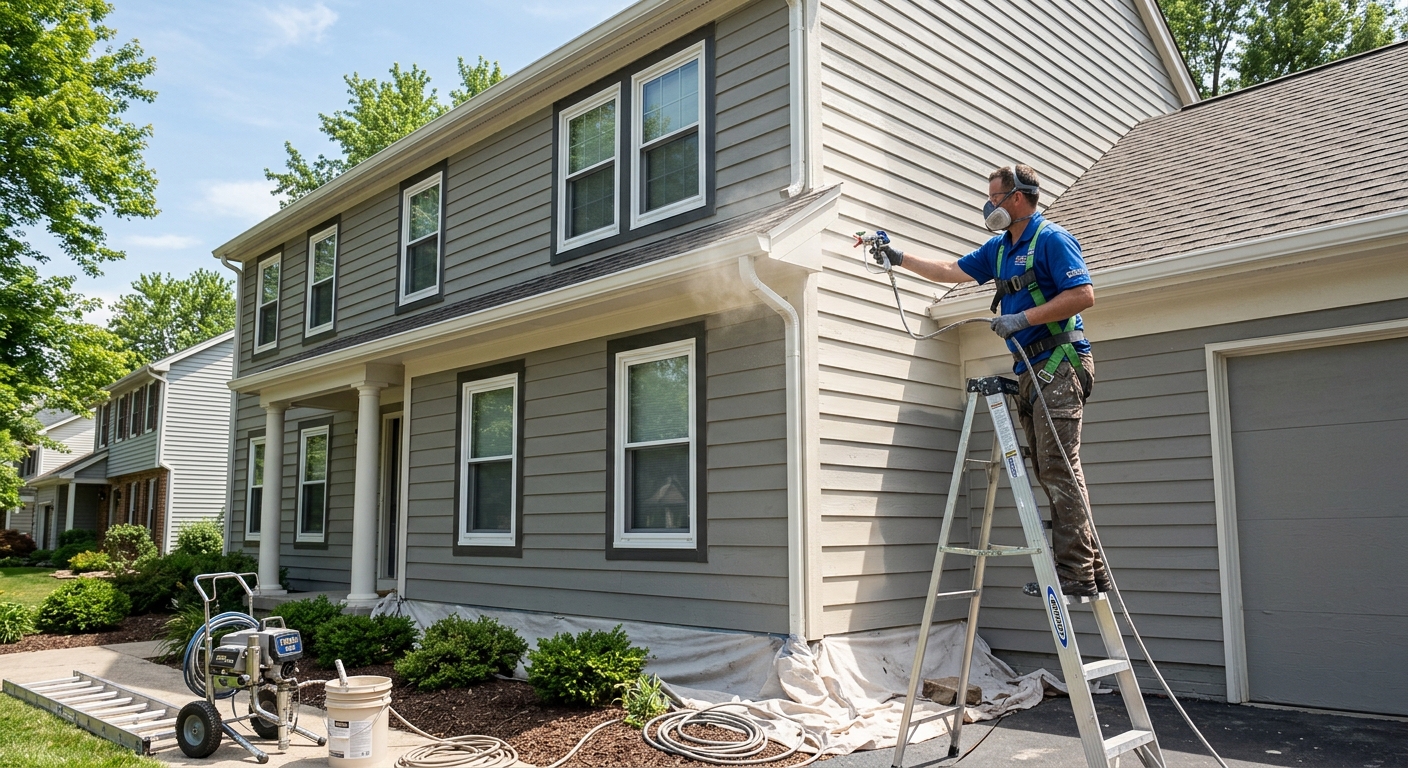
Painting options and costs in Quinte West
Quinte West homeowners usually start with one question: “What will this cost, and what will I get for it?” The short answer is that painting in Quinte West spans a wide range—especially because the region has a lot of older housing stock. In fact, 61.5% of homes in the area were built before 1981 (Statistics Canada, 2021 Census), which often means additional prep like scraping loose paint, patching gaps, caulking, and priming before a fresh topcoat can last. When a home is older, professionals also plan for lead-safe work practices as a precaution if lead-containing paint is present, even though the work is typically not “permitted” in Ontario.
On the pricing side, Kingston–Pembroke schedules tend to tighten because exterior work is weather-dependent. Outdoor work generally clusters into a narrow late-spring to early-fall window, so when crews are booked, the same exterior job can price higher than it would in a more flexible season. Inside, timelines are easier to plan, but older ceilings and trim can still add labour. You’ll commonly see extra demand around waterfront and older cores in areas like Belleville Road and the Trenton-leaning corridors, where homes need frequent repainting and trim touch-ups.
Below is a realistic guide to budget ranges for common project types—then we’ll break down what moves the price up or down.
| Service |
What's Included |
Typical Duration |
Price Range |
| Interior — whole home (walls, ceilings, trim) |
Prep (patch/sand), prime as needed, paint walls/ceilings, paint doors/trim, caulk where required, cleanup |
5–12 days |
$2,200–$6,800 |
| Interior — per room (standard bedroom or living room) |
Prep and patching as needed, prime where required, 2-coat finish on walls, basic trim touch-up |
1–3 days |
$1,200–$2,800 |
| Exterior — full house (siding, trim, soffits) |
Scrape/sand, caulking, prime bare spots, 2-coat exterior system, paint eaves/soffits/fascia where reachable, cleanup |
7–18 days |
$4,000–$9,500 |
| Exterior — trim and accent colours only |
Surface prep on trim, prime as needed, paint trim and selected accents (e.g., railings, fascia, shutters) |
3–8 days |
$3,000–$6,800 |
| Kitchen cabinet painting (doors, frames, spray finish) |
Degrease and sand, prime/sand, spray or brush-finish doors, refinish frames/drawers as agreed, hardware masking, cleanup |
5–14 days |
$2,000–$4,200 |
| Specialty / faux finish (accent wall, texture) |
Surface prep and base coat, texture application or faux technique, protective topcoat, final touch-ups |
2–7 days |
$2,400–$7,500 |
Prices are estimates only and vary by project scope, site access and material selection.
What affects the price of painting in Quinte West
In Quinte West and the broader Kingston–Pembroke region, it’s common to see quotes for what sounds like the “same job” swing by 30–50%. The biggest driver is prep. Two contractors can both quote a “repaint,” but one may include full scraping, caulking, spot-priming, and sanding, while another only rolls topcoat over questionable adhesion. Exterior timing also matters: the exterior painting season is tightly climate-bound in Ontario’s mixed weather pattern. In practical terms, crews generally need temperatures above about 10°C and rising during application, with conditions that allow proper cure. Shorter scheduling windows concentrate demand, and when crews are fully booked, summer rates can rise.
Older homes (61.5% built before 1981, Statistics Canada, 2021 Census) add labour because paint often comes off in patches, not clean sheets. Prep can become 50–70% of labour on a repaint. For a homeowner, that’s why one $4,000 exterior quote might quickly become a $7,000 one if extensive scraping and priming are discovered after we start.
Here are a few concrete Quinte West examples: a two-storey home with fascia/soffits requiring ladders or lifts costs more than a bungalow because access time increases. A siding job with failing caulk lines usually needs careful re-caulking before painting to prevent water ingress—otherwise you may see early failure along joints. And interior cost can change drastically if ceilings show stains or if trim needs restoration; switching a “walls-only” plan to a full trim package moves many projects into the higher interior range (for example, closer to the $1,500–$7,000 total interior band). In the end, the paint quality tier and the coat strategy must match the condition, not just the budget.
| Price Factor |
Why It Matters |
Cost Impact |
| Surface prep — scraping, sanding, patching drywall or wood |
Prep determines adhesion and longevity; older paint often requires more repair work |
Can shift total by +$600 to +$3,000 |
| Number of coats — 2-coat system over primer vs. 1 coat over existing |
Coverage and durability drop if you don’t build the proper film thickness |
Often +$400 to +$1,500 |
| Paint quality tier — contractor-grade vs. premium (Benjamin Moore, Sherwin) |
Premium lines typically offer better hide, block resistance, and washability |
Material-driven +$200 to +$1,000 |
| Ceilings and trim — adds significant time vs. walls-only |
Masking, cutting-in and smoothing are labour-intensive |
Interior +$500 to +$2,400 |
| Exterior season window — short season raises summer rates |
Weather limits cure times and compresses scheduling availability |
Can add +5% to +20% during peak |
| Lead-safe precautions — required for pre-1978 homes with lead paint |
More containment, HEPA vacuuming and disposal controls change labour |
Often +$300 to +$1,200 |
| Surface material — drywall vs. plaster vs. wood vs. stucco |
Different materials demand different primers and prep methods |
+10% to +30% depending on substrate |
| Height and access — multi-storey exterior requires scaffolding or lifts |
Safety setup and time add cost; protects surfaces and corners |
+ $600 to +$2,500 |
Permits & regulations in Ontario
In Ontario, painting typically does not require a permit for residential projects. Where regulation shows up is mainly in health and safety practices, not in a permit application. For homes built before 1978, health guidelines strongly recommend testing for lead paint before sanding or scraping, and—if lead is present—using lead-safe work practices such as wet methods (to limit dust), HEPA vacuuming, proper containment, and safe disposal. This is not generally “homeowner-permit” driven, but professional contractors in Ontario commonly follow these precautions to protect occupants, workers, and neighbours.
Also verify your contractor is properly insured and set up to work. A legitimate painting business should carry liability insurance and have WSIB or WCB workers’ compensation coverage for employees. Ask for proof before work starts, not after.
Step-by-step verification in Quinte West:
- Request a written contract (not just an estimate) that specifies paint brand/line, sheen level, number of coats, and exactly which surface prep steps are included.
- Ask for a Certificate of Insurance—confirm it lists liability coverage and that it remains active.
- Ask whether the crew is covered by WSIB/WCB; request a clearance/coverage proof if applicable.
- Check the online business registry or contractor listing used in Ontario for the company’s standing, and confirm the quote is from the same entity you’ll pay.
What DOES require permits in most Ontario municipalities generally involves structural changes or electrical/plumbing work—painting itself usually does not. If a contractor proposes “permit pulling” for paint alone, ask for specifics in writing.
Interior vs exterior painting — getting the best result in Quinte West
In Quinte West, the difference between a paint job that looks great for years and one that fails early comes down to preparation, correct product pairing, and realistic application timing. For interiors, surface prep is more important than the topcoat brand. Filling and sanding nail pops, patching scuffed drywall, and priming stains or repairs will almost always outperform “buying a premium paint” while skipping primer. Choose sheen intentionally: flat paint hides wall imperfections but can be harder to clean; eggshell or satin is typically better for living areas; semi-gloss on trim is more forgiving and withstands frequent wiping. Two proper coats over an appropriate primer generally outlast one thick coat—especially in kitchens and hallways that get routine cleaning.
For exteriors, Ontario’s freeze–thaw cycles and changing humidity mean caulking and adhesion are non-negotiable. Professionals should caulk before painting to seal joints, then prime bare or weathered areas so the finish can form a continuous barrier. Primer selection matters: different substrates (bare wood, previously painted surfaces, and fibre cement) require primers that match adhesion and moisture behaviour. While coastal BC painters focus heavily on mildew-resistant strategies, Quinte West projects focus more on temperature-stable application and proper cure time in spring and early fall.
Cabinet painting is a smart budget alternative to replacement when your boxes are solid and doors are in good condition. For example, repainting cabinets often lands in the $2,000–$4,200 range for spray-finish work, whereas replacing an average kitchen typically runs far higher—so the money saved is often justified if prep and primer are done right. For pre-1978 homes, lead-safe precautions should still be planned where sanding or scraping is required.
| Project Type |
Key Prep Step |
Recommended Coats |
Price Band |
| Interior — fresh drywall (new construction) |
Prime bare drywall and sand smooth for uniform texture |
1 primer + 2 finish coats |
$1,800–$5,200 |
| Interior — repaint (good condition, no repairs) |
Light scuff-sand and spot prime only where needed |
2 finish coats (prime spots as required) |
$1,500–$4,800 |
| Interior — repaint (patching and priming needed) |
Patch, sand, and stain-block/prime repairs for consistent sheen |
1 primer over patched areas + 2 finish coats |
$2,200–$6,800 |
| Exterior siding (wood or fibre cement) |
Scrape loose paint, caulk joints, prime bare substrate thoroughly |
2 exterior coats over primer system |
$4,000–$9,500 |
| Exterior trim and accents only |
Masking and full prep on trim edges to prevent early peeling |
2 coats (primer on bare spots) |
$3,000–$6,800 |
| Kitchen cabinets (spray finish) |
Degrease, sand properly, and prime for adhesion before topcoat |
Primer + 2 topcoats (system-dependent) |
$2,000–$4,200 |
How to choose a painting contractor in Quinte West
Choosing a painter in Quinte West is less about the lowest number on paper and more about confirming the contractor can deliver the right prep and protection steps for our housing stock. Start by verifying Ontario coverage: request proof of liability insurance and ask for WSIB/WCB coverage for workers. In practice, you’ll typically see a Certificate of Insurance emailed to you before scheduling, and coverage/clearance documentation where relevant. If a contractor can’t provide documentation promptly, that’s a serious warning sign.
Next, get 2–3 itemised written quotes rather than one lump sum. The best estimates break out labour and materials, and they spell out prep work such as scraping, sanding, patching, caulking, primer type, and cleanup. Look for exclusions: is lead-safe handling included if your home is pre-1978? Is masking of floors and landscaping included? Is waste disposal included, or will you be left with bags and bins?
Warranty matters too. Confirm the workmanship warranty length (often workmanship is covered for a defined period), whether product/manufacturer warranty is separate, and whether any warranty is transferable if you sell the home.
Payment schedule: never pay more than 10%–15% upfront. Use holdback until the job is complete and inspected. Finally, get a written timeline with an estimated start date and completion estimate.
- Ask for a written scope: prep steps, caulking, priming rules, and number of coats.
- Confirm paint brand/line and sheen for each surface in writing.
- Request proof of liability insurance before the first day of work.
- Verify WSIB/WCB coverage for insured employees.
- Confirm lead-safe approach for pre-1978 homes (testing plan or containment plan).
- Check how they protect landscaping, windows, and exterior lights.
- Make sure disposal is included (no “you handle it” surprises).
- Get jobsite and weather communication expectations for exterior timing.
- Ask about colour change procedures and stain-blocking for problem areas.
- Confirm surface patching standards (feathering, sand/smooth, prime).
- Review warranty details in writing (workmanship vs product warranty).
- Use a payment schedule with a holdback until final walkthrough.
Red flags I see in Quinte West: quotes that omit prep and just mention “2 coats,” refusal to provide insurance/coverage proof, no written scope or unclear paint brands, aggressive demands for large upfront deposits, and promises to do exterior work regardless of weather/cure conditions.
Frequently asked questions — painting in Quinte West
How many coats does an exterior repaint need in Quinte West?
Most exterior repaints in Quinte West are planned as a 2-coat finish over an appropriate primer system. The number of coats depends on substrate condition and how much bare or repaired material you have after scraping and sanding. For older homes (61.5% built before 1981, Statistics Canada, 2021 Census), you often get primer coverage where adhesion is questionable, then 2 finish coats to achieve consistent colour and film build. In day-to-day budgeting, homeowners frequently land in the exterior full-house band of $4,000–$9,500 when prep is included.
What is the best primer for older Quinte West homes?
For older Quinte West homes, the “best” primer is the one matched to what it’s covering. After scraping and sanding, we typically use primer where bare wood or patched areas are exposed, and we may select a stain-blocking product if repairs or tannins bleed. If the existing surface is sound and well-adhered, primers are often limited to problem spots rather than the entire elevation—unless there are major adhesion or uniformity concerns. Because Quinte West housing includes a large share built before 1981 (Statistics Canada, 2021 Census), prep and primer selection are key to avoiding early peeling and blistering, especially along joints and corners.
Should I paint or wallpaper my Quinte West home?
In most Quinte West homes, paint is the practical choice, particularly in rooms that get cleaned often (kitchens, hallways) or where humidity fluctuates. Wallpaper can look fantastic, but it demands very consistent wall prep—any cracks, patches, or uneven drywall will telegraph over time. If your home is older (many are, with 61.5% built before 1981, Statistics Canada, 2021 Census), wall repairs can be more labour-intensive either way. For homeowners, a paint repaint can often fit within interior whole-home budgets like $2,200–$6,800, while wallpaper installation usually adds specialty labour and increases risk if the wall isn’t perfectly prepared.
How do I fix peeling exterior paint in Quinte West?
Peeling exterior paint is usually a sign of adhesion failure, moisture intrusion, or both—so the fix isn’t “cover it and move on.” In Quinte West, the reliable approach is: scrape all loose material back to sound edges, sand feathered boundaries, remove any chalky residue, and inspect for failing caulk around trim joints. Then caulk before finishing (to reduce water ingress), prime bare areas with a suitable primer, and apply a full 2-coat exterior system. Because the exterior season is tightly weather-bound in Ontario, rushing application can trap moisture issues under the new coat. Proper prep is what keeps the repaint from returning to peeling in 1–2 seasons.
What colours add the most resale value in Quinte West?
There’s no single “right” colour for every buyer, but in Quinte West, neutrals and light-to-medium shades tend to photograph well and appeal to a broader range. Practical resale winners are crisp whites, warm off-whites, greige/taupe, and muted warm greys. For exterior trim, homeowners often do best with consistent, classic contrast—especially on older homes where colour cohesion matters around windows and fascia. If you’re repainting interior walls and ceilings together, neutral wall colours with satin/eggshell finishes typically hold up to cleaning and show fewer scuffs. Your contractor can help you test swatches in daylight, since Ontario lighting changes across the day and seasons.
How much does it cost to paint a house in Quinte West?
The cost depends on interior vs exterior scope, how much prep is required, and access. For interiors, whole-home projects commonly fall within the local band of $1,500–$7,000, with higher totals when ceilings, trim, and repairs are included. For exteriors, full-house repainting often lands in the low-to-mid $3,000–$10,000 range, moving upward when there’s significant scraping, caulking, and priming. Quinte West’s older housing stock (61.5% built before 1981, Statistics Canada, 2021 Census) frequently increases prep labour, which is why “same-colour” jobs can vary across neighbourhoods. A written, itemised quote is the best way to confirm your exact range.