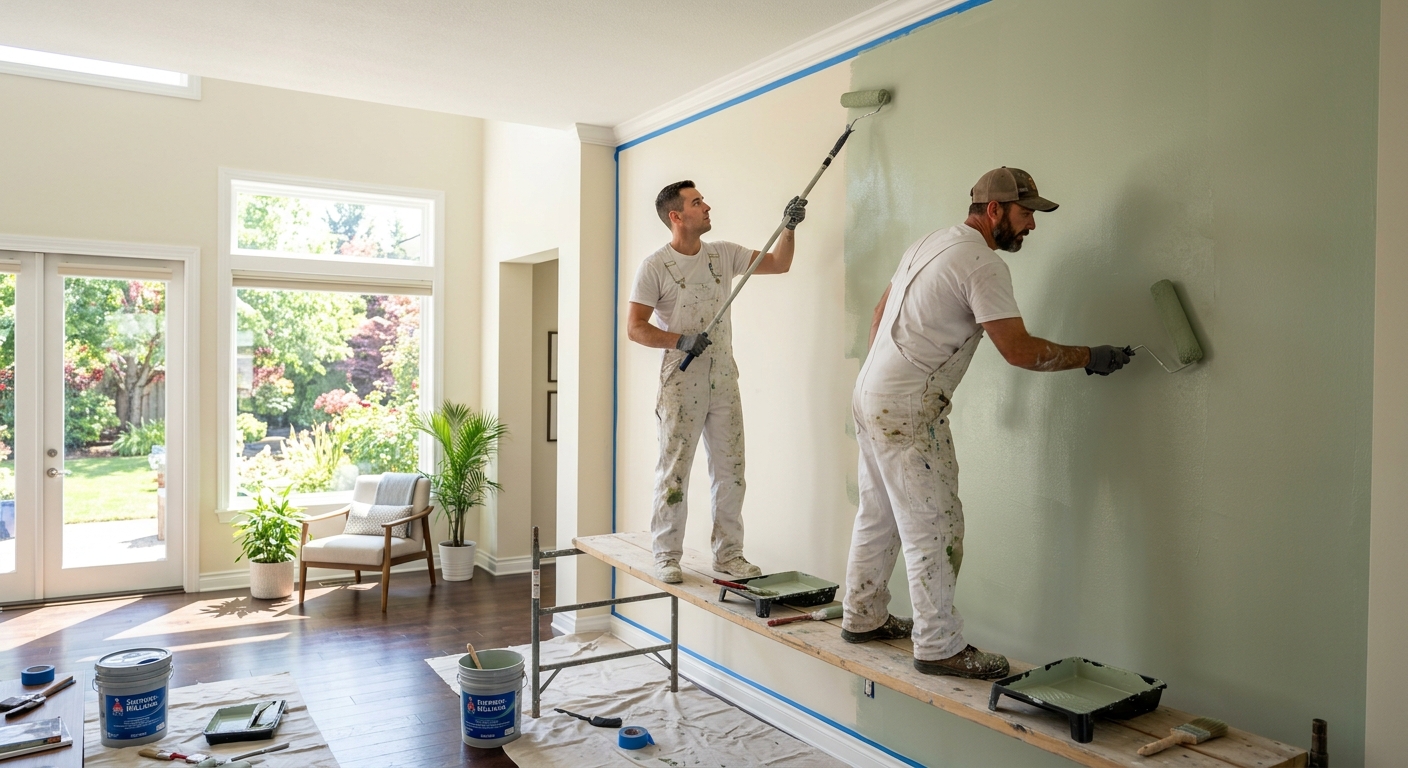
Painting options and costs in Mill Courtland Woodside Park
Mill Courtland Woodside Park is a compact pocket community within the Greater Toronto Area, and in our experience it’s exactly the kind of neighbourhood where buyers notice paint quality quickly—especially on older siding, trim, and front entry details. With a local population of 3,639 (Statistics Canada, 2021 Census), there’s also steady, year-to-year demand for contractors who can line up the limited outdoor work windows. Just as importantly, Toronto’s housing stock includes many pre-1980 homes, and those typically need extra preparation: more scraping, sanding, patching, caulking, and primer to get a surface that will actually bond. In Ontario, professionals also treat pre-1978 paint as a lead-safe work consideration, particularly on trim, windows, and railings, which adds time and careful cleanup when sanding or scraping is unavoidable.
Cost in the Toronto market is also shaped by seasonality. Exterior painting is most reliable from late May through June and again from September to mid-October, when conditions support adhesion and curing. During the July–August peak, contractors are booked tightly and exterior pricing commonly lands about 10–15% higher than shoulder-season work. By contrast, interior painting is easier to schedule year-round, but labour still varies with ceiling height, stairwells, masking level, and finish choice (basic refresh versus premium colours and specialty looks). If you want a ballpark, use the ranges below as a planning starting point—then we’ll tighten the estimate after a site walk through the surfaces that matter most.
| Service |
What's Included |
Typical Duration |
Price Range |
| Interior — whole home (walls, ceilings, trim) |
Prep and patching; caulk where needed; prime repaired areas; 2-coat finish on walls/ceilings; paint trim and doors; protect floors and fixtures; cleanup |
3–7 days |
$2,200 – $6,000 |
| Interior — per room (standard bedroom or living room) |
Prep and spot repairs; prime patches; 2-coat wall finish; cut-in around trim; light trim touch-ups (optional upcharge) |
1–2 days |
$400 – $1,600 |
| Exterior — full house (siding, trim, soffits) |
Wash; scrape/sand loose material; patch and caulk; prime bare areas; 2-coat exterior system; paint soffits/trim; protect landscaping; cleanup |
1–3 weeks |
$3,200 – $8,000 |
| Exterior — trim and accent colours only |
Wash; scrape/sand spot areas; prime as required; caulk; 2-coat trim/accent painting; focus on visible architectural details |
3–7 days |
$1,500 – $4,500 |
| Kitchen cabinet painting (doors, frames, spray finish) |
Degrease/clean; remove/label doors as applicable; sand/scuff; prime; spray finish for doors; 2-coat build; hardware re-install and touch-up |
5–12 days |
$1,200 – $4,000 |
| Specialty / faux finish (accent wall, texture) |
Custom surface prep and leveling; base coat and texture/application; topcoat sealer; limited area only; final detailing |
2–5 days |
$900 – $3,800 |
Prices are estimates only and vary by project scope, site access and material selection.
What affects the price of painting in Mill Courtland Woodside Park
In Toronto and across Ontario, it’s common to see quotes for the “same” painting project swing by 30–50%. The biggest driver isn’t the paint cost—it’s prep time, coating systems, and scheduling realities. Exterior work in this region is tightly climate-bound: in practice, contractors can only paint when temperatures stay above about 10°C for at least 24–48 hours and humidity is manageable. That’s why the exterior season typically runs roughly late May through early October. Coastal British Columbia often has a longer season, but persistent dampness and mildew risk can push costs up in a different way (mould-resistant product selection and very careful timing). In the GTA, the constraints are frost, rain, and humidity spikes, and that short “ideal” stretch concentrates demand. When crews are booked, labour rates and mobilization costs rise—so an exterior job that could have fit in shoulder season can land closer to the higher end of the $3,200 – $8,000 band in June–August.
Older homes throughout our area also matter. On repainting jobs, surface preparation (scraping, sanding, caulking, patching, and priming) can be 50–70% of total labour. To put it in dollar terms, a house that might otherwise budget around $3,200 can climb by $1,000–$2,000 if there’s extensive blistering, multiple paint layers, or failed caulk joints that need removal and re-sealing before paint. For interiors, the same principle holds: adding ceilings and trim (or switching from walls-only to a whole-home scope) pushes a typical “refresh” closer to the top of the $2,200 – $6,000 range because masking time and cut-in time jump fast.
In Mill Courtland Woodside Park, I often see cost differences driven by three local realities. First, rain-prone days can force pause-and-reschedule on exterior—meaning more crew mobilizations. Second, multi-storey sightlines near driveways often require lifts or careful ladder staging, which adds time and safety labour. Third, pre-1978 trim and railings can take longer because contractors use lead-safe methods when sanding or scraping is needed, including containment and HEPA vacuum cleanup. Those choices aren’t optional if you want a lasting result and a clean site.
| Price Factor |
Why It Matters |
Cost Impact |
| Surface prep — scraping, sanding, patching drywall or wood |
Prep determines adhesion; failing paint usually starts with skipped repairs or glossy, unscuffed surfaces. |
+$400 to +$2,000 |
| Number of coats — 2-coat system over primer vs. 1 coat over existing |
Ontario’s seasonal swings punish weak film build and weak primer coverage. |
+$300 to +$1,500 |
| Paint quality tier — contractor-grade vs. premium (Benjamin Moore, Sherwin) |
Premium lines often give better hiding, durability, and colour stability, reducing rework. |
+$200 to +$900 |
| Ceilings and trim — adds significant time vs. walls-only |
Cut-in detail, masking, and extra coverage time increase labour considerably. |
+$250 to +$1,400 |
| Exterior season window — short season raises summer rates |
Limited “ideal” weather compresses scheduling and increases mobilization costs. |
+10% to +15% in peak weeks |
| Lead-safe precautions — required for pre-1978 homes with lead paint |
Safe work methods increase time and disposal needs when sanding/scraping is present. |
+$300 to +$1,200 |
| Surface material — drywall vs. plaster vs. wood vs. stucco |
Different materials demand different primers, patching techniques, and prep strength. |
+$250 to +$1,800 |
| Height and access — multi-storey exterior requires scaffolding or lifts |
Access changes labour time, safety planning, and equipment rental. |
+$400 to +$2,500 |
Permits & regulations in Ontario
In Ontario, painting work generally does not require a permit for residential homeowners. The bigger compliance items are health and safety practices on older properties, not a municipal approval process. For homes built before 1978, health guidelines recommend testing for lead paint before sanding or scraping, and using lead-safe work practices if lead is present—things like wet methods to reduce dust, HEPA vacuuming, and proper disposal. This isn’t typically “legally mandated” for homeowners in the way a permit would be, but it’s standard practice for professional contractors because it reduces risk to your household and neighbours.
What does require attention (not a permit, but a professional standard) is how the contractor handles containment, cleanup, and documentation when lead-safe conditions apply. Also confirm the contractor carries liability insurance and has WSIB/WCB workers’ compensation coverage for any insured workers. Those are critical in Ontario because they protect you if someone is injured on site.
To verify before signing in Mill Courtland Woodside Park, do this step-by-step: (1) Ask for the contractor’s Ontario licence number (and verify it using the province’s online registry page they provide); (2) Request a current Certificate of Insurance and confirm it lists liability coverage and your property address if offered; (3) Ask for proof of WSIB/WCB coverage (a clearance letter or coverage confirmation number); (4) Get a written contract that lists paint brands/lines, sheen level, number of coats, and the exact prep/disposal inclusions.
Interior vs exterior painting — getting the best result in Mill Courtland Woodside Park
In Mill Courtland Woodside Park, the difference between a long-lasting paint job and a premature failure comes down to how well surfaces are prepared and how the coating system matches Ontario conditions. For interiors, most homeowners notice peeling or cracking first around patch repairs and seams, not because of the brand label. That’s why filling, sanding, priming repairs, and caulking transitions matter more than choosing an expensive topcoat. Sheen choice is also practical: use flat or matte on low-wear areas and consider eggshell or satin in busy rooms for washability. In most cases, two coats over a proper primer beats one “thick” coat—because film build and even coverage prevent blotching and uneven sheen over time.
For exteriors, Ontario’s cycle of rain, humidity spikes, and freeze/thaw is unforgiving. Caulking before painting helps prevent water ingress at joints, and primer selection matters: different substrates (wood, fibre cement, and previously painted surfaces) need appropriate primers for adhesion and tannin blocking where relevant. Exterior prep—wash, scrape loose paint, sand edges, spot prime bare areas—is typically the most cost-effective quality step. If lead-safe precautions apply to pre-1978 trim, that prep must be handled carefully with dust control and HEPA cleanup.
Cabinet painting is a smart budget alternative to replacement when the existing boxes are solid. If you choose a spray-finish approach, the labour and material planning is higher than a basic roll-and-tip job, but it can still be the right value. For example, many homeowners compare replacing a kitchen versus cabinet refinishing; replacing can quickly exceed the $1,200 – $4,000 cabinet band, while repainting offers a faster refresh with similar visual impact when prep is done correctly.
| Project Type |
Key Prep Step |
Recommended Coats |
Price Band |
| Interior — fresh drywall (new construction) |
Seal and prime drywall to prevent flashing and uneven absorption |
Primer + 2 coats |
$900 – $2,500 |
| Interior — repaint (good condition, no repairs) |
Wash and scuff-sand lightly; spot caulk and touch up minor defects |
2 coats (often no full-wall primer needed) |
$400 – $1,600 |
| Interior — repaint (patching and priming needed) |
Sand, fill, and prime repairs to unify the surface |
Primer on repairs + 2 coats overall |
$700 – $2,300 |
| Exterior siding (wood or fibre cement) |
Wash, scrape loose paint, caulk joints, and spot prime bare areas |
2 coats (with primer system as required) |
$3,200 – $8,000 |
| Exterior trim and accents only |
Remove failed material, spot prime, and caulk before topcoat |
Primer (spot) + 2 coats on trim |
$1,500 – $4,500 |
| Kitchen cabinets (spray finish) |
Degrease thoroughly; sand/scuff; prime for adhesion and blocking |
Primer + 2 finish coats (often more for even build) |
$1,200 – $4,000 |
How to choose a painting contractor in Mill Courtland Woodside Park
Start by verifying the essentials for Ontario: licensing status (where applicable), liability insurance, and WSIB/WCB coverage. In practice, you should ask for the contractor’s licence details and then verify them via the Ontario online registry page they provide. For insurance, request a current Certificate of Insurance and confirm it includes liability coverage; for workers’ compensation, request proof of WSIB/WCB coverage (often provided as a clearance letter or coverage confirmation). Don’t accept “we’re insured” without seeing documentation.
Next, request 2–3 itemised, written quotes that break down labour and materials. A good quote lists prep scope (wash, scrape/sand, caulking, patching), primer inclusions, number of coats, and what’s excluded (for example, stucco crack chasing, carpentry repairs, or lead testing if required). Ask whether permits are included—Ontario painting typically doesn’t require permits for the work itself, but good contractors clarify any site access approvals, balcony protections, or disposal handling. Clarify disposal: is it included for scraped material and masking waste?
Warranty matters. Ask for a workmanship warranty length, whether the manufacturer’s product warranty applies to the system installed, and if it transfers to a future owner. For payment scheduling, never agree to pay more than about 10–15% upfront; hold back the remainder until the job is complete, cleaned, and defect-walked. Finally, insist on a timeline in writing: proposed start date and completion estimate, plus what triggers rescheduling during weather windows.
- Verify insurance (Certificate of Insurance) and confirm coverage details.
- Verify WSIB/WCB coverage with a clearance letter or confirmation.
- Ask for an itemised quote (labour + materials), not a lump sum only.
- Confirm number of coats and which areas get primer.
- Require written prep scope: wash, scrape/sand, patching, and caulking.
- Clarify colour selection responsibility (who orders paint, who handles mistakes).
- Ask about ceiling/trim coverage if it’s part of your scope.
- Confirm masking, floor protection, and site cleanup standards.
- Ask how disposal and recycling of paint waste is handled.
- Request a written warranty for workmanship and how defects are corrected.
- Use a payment schedule with a small deposit (10–15%) and a holdback.
- Get the weather/rescheduling approach for exterior work in writing.
Red flags I often see with painting contractors in Mill Courtland Woodside Park: they won’t provide insurance/WSIB proof; they refuse to itemise quotes or specify coats and prep; they ask for a large upfront payment; they don’t include cleanup and disposal details; or they promise “exterior year-round” timelines that ignore Ontario’s temperature and rain constraints.
Frequently asked questions — painting in Mill Courtland Woodside Park
What colours add the most resale value in Mill Courtland Woodside Park?
For Mill Courtland Woodside Park (and the broader Toronto market), resale-friendly colours are usually light, warm neutrals with consistent undertones: soft white, warm ivory, greige, and light greys. They photograph well, pair with typical pre-1980 trims, and make smaller rooms feel brighter. For exteriors, many buyers respond to classic contrasts—cream or off-white siding with darker shutters/railings—because it reads “maintained” even from the street. If you’re repainting older trim, choose colours that cover well (the right primer + 2-coat system matters more than the trend). As a budget reality check, interior “per room” repainting often falls around $400 – $1,600, which makes it easier to update a few high-visibility walls without locking your whole home into a risky colour.
How much does it cost to paint a house in Mill Courtland Woodside Park?
Cost depends heavily on whether you mean interior-only or a full exterior, plus how much prep your surfaces need. For interior painting across a whole home (walls, ceilings, and trim), many projects land roughly within $2,200 – $6,000 depending on square footage, ceiling height, and repair workload. For exterior painting of a full house—siding, trim, and soffits—the typical band is $3,200 – $8,000. In Mill Courtland Woodside Park and the GTA, exterior pricing often increases in June–August because the ideal weather weeks are limited and contractors are booked. If your home has older layers of paint or failed caulk joints, prep time increases and pushes you toward the higher end even before you change paint type.
How much does interior painting cost per room in Mill Courtland Woodside Park?
Most “per room” quotes for a standard bedroom or living room land around $400 – $1,600. That range accounts for differences like wall condition (cracks, patching, stains), whether ceilings are included, and how much trim work is requested. If the room is in good shape and it’s truly a repaint, many contractors can hit the lower end by doing scuff-sanding, spot caulking, primer only where needed, and then two coats on walls. If you have patching and priming required, or you want a higher-end sheen and more careful cut-in around doorways and windows, the total climbs. In older Toronto homes, labour on prep often matters more than the brand—skimping on primer or skipping repair prep leads to visible flashing and faster rework.
When is the best time for exterior painting in Mill Courtland Woodside Park?
For Mill Courtland Woodside Park, the best exterior window is when temperatures stay above about 10°C for at least 24–48 hours and you’re not forecasting rain immediately after application. Practically, contractors commonly work from late May through June, then again from September into mid-October. July–August can still work, but it’s peak demand and weather volatility can increase scheduling pressure, which often pushes costs up by about 10–15%. Because Ontario homes go through freeze/thaw cycles, exterior prep (wash, scrape, caulk, prime) should also be finished carefully so moisture can’t get trapped under a new coat. If your schedule is flexible, shoulder-season work usually gives you more options and can reduce the likelihood of delays.
How many coats of paint do I need?
For most typical residential scenarios in Ontario, plan on a 2-coat system over properly primed surfaces. Interiors commonly use two finish coats: primer on repairs and typically two coats on walls for even hiding and consistent sheen. Exteriors also generally use two finish coats, with primer selected based on substrate and what’s been scraped back to bare material. A common mistake is trying to do “1 coat” by buying more paint or rolling thickly—thicker isn’t the same as proper film build and adhesion. In older Toronto homes, if a previous surface has stains or patch materials that absorb differently, skipping primer is what causes blotching. If your contractor is quoting only one finish coat, ask them how they’ll achieve uniform coverage and whether the surface will be spot-primed before the topcoat.
What paint is best for Mill Courtland Woodside Park's climate?
The best paint for Mill Courtland Woodside Park’s climate is the one matched to the surface and the weather conditions—especially for exterior work. Ontario’s main exterior challenges are rain, humidity spikes, and the freeze/thaw cycle, so for siding and trim you want a durable exterior coating system with correct primer and good adhesion under moderate humidity. If you’re painting older trim or working around multiple paint layers, the primer choice is often more important than the topcoat brand. In general, interior areas benefit from washable interior wall paints with the right sheen: flat/matte for low-traffic areas, eggshell or satin for better cleanability. If you’re budget planning, exterior full-house projects often start around $3,200 – $8,000, and paying for the right product system at the start reduces the chance of premature peeling or flashing.