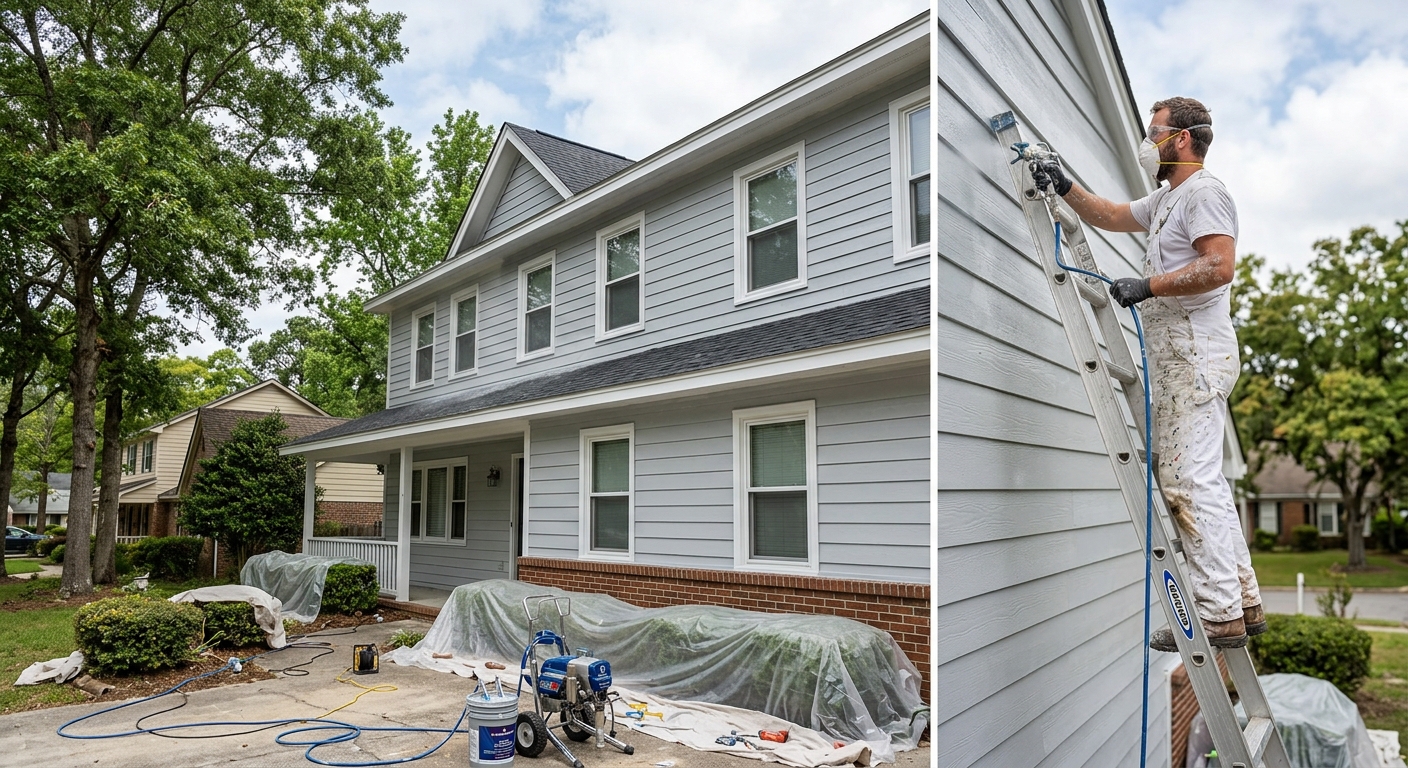
Painting options and costs in Laurelwood
In Laurelwood, deciding between interior refreshes and exterior repaints comes down to preparation time, season timing, and the age of your home. Laurelwood’s population was 5,150 in 2021 (Statistics Canada, 2021 Census), and that smaller local contractor pool means exterior scheduling can get tight when “ideal” weather windows open. Even more importantly, Toronto-area housing stock includes many pre-1980 homes, which typically require heavier prep—scraping, patching, sanding, caulking, and priming—before anyone can talk paint “brand.” In practice, that extra prep work is why two quotes for the same-looking job can land far apart.
Cost in the GTA is also shaped by the exterior season. Unlike places with year-round painting, contractors in the Toronto area usually work late May through June and again from September to mid-October, when temperatures stay above about 10°C for at least 24–48 hours and humidity is manageable. Demand peaks during the short summer window, which often pushes exterior pricing 10–15% higher in June–August. Interiors don’t have that same weather constraint, so labour and finish level drive the majority of cost.
In Laurelwood, trades are especially in demand around the broader residential streets near major commuting corridors (including the area people commonly associate with the Highway 7 corridor), because homeowners are updating older homes and keeping up curb appeal. If you want a budget baseline, start with the ranges below, then match your scope to the right line item.
| Service |
What's Included |
Typical Duration |
Price Range |
| Interior — whole home (walls, ceilings, trim) |
Includes surface protection, caulking of gaps where needed, sanding/spot prep, primer as required, and 2-coat finish for most paints; includes basic trim work and clean-up |
5–10 days |
$1,800–$6,000 |
| Interior — per room (standard bedroom or living room) |
Prep and protection, patching/spot sanding, caulking as needed, primer on repairs, and 2-coat finish on walls (ceiling included if specified) |
1–3 days |
$400–$1,800 |
| Exterior — full house (siding, trim, soffits) |
Pressure washing (or equivalent cleaning), scraping/sanding of failing areas, caulking where needed, primer on bare or stained areas, 2-coat exterior system, and protection/cleanup |
7–16 days |
$2,800–$8,000 |
| Exterior — trim and accent colours only |
Targeted prep and repaint of trim, doors, railings/soffits where specified; includes spot priming and 2-coat finish; excludes full siding repaint |
3–8 days |
$1,500–$4,800 |
| Kitchen cabinet painting (doors, frames, spray finish) |
Includes degreasing, sanding/fixture prep, bonding primer as required, spray application for a smooth finish, light hardware handling, and reassembly |
5–12 days |
$1,200–$4,000 |
| Specialty / faux finish (accent wall, texture) |
Includes design consultation (basic), surface prep for texture/faux, base coats and topcoat(s), and careful finishing around trim and outlets |
2–7 days |
$300–$5,000 |
Prices are estimates only and vary by project scope, site access and material selection.
What affects the price of painting in Laurelwood
In Laurelwood and across the Toronto region, it’s common to see quotes for the “same” painting job vary by 30–50%. The differences usually come from preparation, coating system choice, access conditions, and whether the contractor budgets for repairs and priming—or hopes existing paint will “hold.” Exterior costs in particular are tied to a short, climate-dependent season in this region. Contractors typically plan work from late May through June, then again September to mid-October, when temperatures are above about 10°C and rising during application. The shorter season concentrates demand, and that’s one reason exterior pricing often reaches the upper end of the local band—moving from interior-level simplicity to exterior labour intensity where the price range can climb from roughly $1,500 into the $8,000 area depending on scope.
Older homes around Toronto also change the math. Pre-1980 surfaces often need additional scraping, sanding, caulking, and primer, and that preparation can be 50–70% of labour on a repainting job. Here’s how local conditions can affect your bill in Laurelwood: if you have peeling or poorly bonded trim, prep time increases quickly because every loose edge must be removed and re-primed. If your exterior has multiple cladding types (for example wood trim next to fibre cement or stucco-like surfaces), primer selection and drying times may require more labour steps. On the interior side, higher ceilings, stairwells, and cut-in around abundant trim can push a “per room” job toward whole-home pricing even when the room count is small.
As a practical reference point, a well-prepped interior refresh might land near the lower end of the $400–$6,000 interior band, while a full exterior repaint with more prep often sits closer to the exterior band ceiling of $1,500–$8,000.
| Price Factor |
Why It Matters |
Cost Impact |
| Surface prep — scraping, sanding, patching drywall or wood |
Bad adhesion starts with surface condition; prep determines whether coating systems bond long-term |
High (often 30–70% of labour on repaints) |
| Number of coats — 2-coat system over primer vs. 1 coat over existing |
Coverage and hiding power depend on primer use and the existing colour/porosity |
Medium to high (adds days and material) |
| Paint quality tier — contractor-grade vs. premium (Benjamin Moore, Sherwin) |
Better paint typically covers easier, resists scuffing, and levels more consistently |
Medium (material cost + fewer recoat risks) |
| Ceilings and trim — adds significant time vs. walls-only |
Cutting-in, masking, and finishing around trim increases labour and touch-up time |
Medium to high |
| Exterior season window — short season raises summer rates |
Contractors compete for “ideal” weeks, and weather can force reschedules |
High in June–August (commonly 10–15%) |
| Lead-safe precautions — required for pre-1978 homes with lead paint |
Proper containments, wet methods, and HEPA vacuuming reduce dust exposure |
Medium (adds time and disposal steps) |
| Surface material — drywall vs. plaster vs. wood vs. stucco |
Porosity and bonding differ, affecting primer selection and drying time |
Medium |
| Height and access — multi-storey exterior requires scaffolding or lifts |
Safety setup and staging time can add whole days |
Medium to high |
Permits & regulations in Ontario
For painting in Ontario, a permit is generally not required for typical residential painting work (interior or exterior). Where compliance matters is less about “painting permits” and more about health and safety practices—especially in homes built before 1978.
For pre-1978 homes, health guidelines recommend testing for lead paint before sanding, scraping, or aggressive surface prep, and following lead-safe work practices if lead is present. Professional lead-safe methods include wet methods to reduce dust, HEPA vacuuming, proper bagging/disposal, and minimizing dust migration during prep. While this is not typically mandated for homeowners as a legal obligation, it’s standard practice for contractors to protect occupants and workers.
What does require permits is usually not the paint job itself—rather, it’s other work that might accompany painting (for example, structural exterior repairs, window replacements, or work that triggers building-code or municipal permitting). If your project includes significant exterior rebuilding, electrical work, or window/door changes, confirm the permit responsibility separately.
To protect yourself in Laurelwood, ask for proof before work starts: a written contract stating the paint brand, sheen, number of coats, prep scope, and disposal details; and evidence that the contractor carries liability insurance and WSIB coverage. Homeowners should request the certificate of insurance (liability) and WSIB/WCB clearance or confirmation of coverage. Then verify the contractor’s licence/registration status via the appropriate online Ontario business/professional registry resources (often listed on the contractor’s website or in their proposal package) and confirm the document dates are current.
Interior vs exterior painting — getting the best result in Laurelwood
In Laurelwood’s Ontario weather, the biggest reason paint fails early isn’t usually “bad paint”—it’s insufficient surface prep or poor timing. Interiors tend to fail from patching that wasn’t properly primed, sanding dust left behind, or the wrong sheen choice for the room’s use. Exteriors tend to fail from water ingress paths left unsealed (missing caulk), incorrect primer for the substrate, and coatings applied when the surface or air isn’t within the workable temperature and drying window.
For interiors, start with repairs: filling, sanding, and priming bare drywall or stained areas. A common mistake is skipping primer, then trying to “fix” it with thicker topcoat. Two coats over proper primer always lasts longer than one heavy coat. Sheen matters too: flat/eggshell hides wall imperfections, while satin or semi-gloss is usually better in kitchens, bathrooms, and trim-heavy areas because it cleans more easily.
For exteriors, caulking before painting is crucial. If you skip caulking, water can track behind trim and under coatings, especially during freeze–thaw cycles. Primer type also matters by substrate: wood, previously painted surfaces, and masonry-like materials each have different bonding needs. The Toronto market prioritizes temperature-stable, weather-ready products that cure reliably during the short season when conditions are above roughly 10°C for application and drying.
Cabinet painting is often a budget alternative to replacement. If your kitchen layout is worth keeping, a spray-finished cabinet repaint can dramatically refresh the space—often landing in the $1,200–$4,000 range—without the demolition and lead-time costs of a full cabinet replacement. For pre-1978 homes, the same careful, lead-safe prep principles apply to trim and railings as needed.
Dollar example: if you’re deciding between “patch and repaint” versus “major prep and repaint,” the second option can cost more up front but is often justified when you have widespread peeling. Spending closer to the higher end of the exterior band (near $2,800–$8,000) is often cheaper than repeating work after adhesion issues return.
| Project Type |
Key Prep Step |
Recommended Coats |
Price Band |
| Interior — fresh drywall (new construction) |
Proper drywall primer and sanding to remove raised paper fibres |
2 coats (over primer) |
$1,000–$6,000 |
| Interior — repaint (good condition, no repairs) |
Degrease/light scuff and spot-prime if needed |
2 coats (or as specified by coverage/colour) |
$400–$3,500 |
| Interior — repaint (patching and priming needed) |
Patch with proper compound, sand smooth, and prime patches and stained spots |
2 coats (typically full walls for even hide) |
$900–$5,000 |
| Exterior siding (wood or fibre cement) |
Cleaning, scraping failing areas, caulking, and bonding primer where required |
2-coat exterior system |
$2,800–$8,000 |
| Exterior trim and accents only |
Spot prep + prime bare spots and repaired edges for a seamless finish |
2 coats (over spot primer) |
$1,500–$4,800 |
| Kitchen cabinets (spray finish) |
Degreasing and sanding for bonding, then bonding primer and cabinet-specific topcoat |
2–3 coats depending on product and opacity |
$1,200–$4,000 |
How to choose a painting contractor in Laurelwood
Choosing well in Laurelwood starts with verification. First, confirm Ontario licensing/registration status if applicable to their business profile, then ask for their liability insurance certificate—this shows they can cover accidental property damage. Next, verify WSIB (workers’ compensation) coverage: request WSIB confirmation (clearance/coverage letter or documentation) so you’re not exposed if someone is injured on your property. Contractors should also be able to explain how they stage the work safely around railings, walkways, and exterior elevations.
Get 2–3 itemised written quotes. Not just “total cost,” but labour and materials broken out by what they will actually do: pressure washing/cleaning (or an alternative), scraping and sanding scope, number of coats, primer type, caulking included or not, protection/masking level, and disposal. Carefully read exclusions: ask whether permits are needed for related work (usually not for paint itself), and whether furniture moving, drywall patching, or minor repairs are included.
Warranty matters: insist on a workmanship warranty length (often stated as a period after completion) and ask what it covers. Separate that from the manufacturer’s warranty on the product—those are different, and transferability can matter if you sell your home. For payment schedule, never pay more than 10–15% upfront. Use a holdback until completion and final touch-ups are done, then pay the balance.
Finally, get the timeline in writing: a realistic start date, estimated duration, and what happens if weather pushes exterior work (rescheduling plan, drying-time assumptions, and communication process).
- Ask for liability insurance proof and verify the certificate is current.
- Request WSIB/WCB coverage confirmation before the first day on site.
- Confirm the quote includes surface prep scope (not just “prime and paint”).
- Ensure the number of coats is stated for each surface and colour change.
- Ask what paint line and sheen is being used for each area (walls, trim, cabinets).
- Verify caulking and crack repair is included where exterior gaps exist.
- Confirm disposal cleanup is included (and whether trash/recycling is handled).
- Get a written start date and completion estimate—not a “sometime in June” plan.
- Ask how they protect landscaping, windows, and eaves during exterior prep and painting.
- Review warranty terms in writing (workmanship vs. product/manufacturer warranty).
- Keep payment staged: no more than 10–15% upfront; hold back until punch list.
- Make sure the contract lists exact surface areas and rooms included (avoid assumptions).
Red flags I commonly see with painting contractors in Laurelwood: vague scope language like “prep as needed” without detail, no proof of liability insurance or WSIB coverage, refusal to put paint brands/sheens and coat counts in the contract, lowball pricing that doesn’t match the prep required on older pre-1980 surfaces, and pressure to pay the majority upfront before any primer or caulking work begins.
Frequently asked questions — painting in Laurelwood
Should I paint or replace my cabinets?
If your cabinet boxes are solid and the doors are the main issue (peeling finish, outdated colour, or worn doors), painting is often the better route in Laurelwood. Cabinet painting—especially a spray-finish approach—can refresh the look without the disruption of replacement, and it commonly lands around $1,200–$4,000 depending on the door count and finish level. Replacement makes sense when cabinets are structurally failing (warped boxes, damaged frames) or when you need major layout changes. For pre-1978 homes, safe preparation matters on trim too, and the contractor should discuss dust control if lead is a concern before sanding. Ask for a written scope that includes degreasing, bonding primer, coat counts, and hardware handling so you can compare apples-to-apples.
How do I prep walls before painting?
Homeowner prep can help, but the “make or break” part is usually the contractor-led prep. In Laurelwood interiors, remove wall décor, patch obvious nail holes if minor, and clear furniture for proper masking. If there are greasy areas (kitchen), spot-clean with a degreasing cleaner so the primer can bond—paint over grease causes adhesion failure. For any peeling paint, do not scrape aggressively yourself if the home is older; sanding can create dust. Professionals typically handle sanding, vacuuming, and priming in a controlled way. The contractor should specify cleaning, patching, sanding, caulking where needed, and primer type. Good repainting often costs within the $400–$3,500 range for a room or small areas, but prep gaps can turn a “quick job” into repeat work.
Do I need to worry about lead paint in an older Laurelwood home?
If your Laurelwood home was built before 1978, you should take lead paint seriously. Ontario doesn’t require homeowners to test for lead before painting, but health guidelines recommend testing before sanding/scraping and using lead-safe work practices if lead is present. In practical terms, professionals use wet methods to reduce dust, HEPA vacuuming, containment, and proper disposal so lead dust doesn’t spread through your home. This can slightly increase cost and time, but it’s the right approach for older trim, window sashes, railings, and any deteriorating paint. When you request quotes, ask whether lead-safe protocols are included in the prep line item and what the contractor will do to protect occupants and control dust. Also confirm insurance and WSIB coverage before work begins.
How long does it take to paint a house?
Timing depends on whether you’re doing interior versus exterior work and how much repair prep is required. Interior whole-home projects in Ontario can take roughly 5–10 days for typical scopes (drying times plus masking/cut-in/cleanup), while a single room often runs 1–3 days depending on prep. Exterior work is more sensitive: in the GTA, painting is commonly planned for late May through June and again September to mid-October when conditions support proper curing (temperatures generally above 10°C for 24–48 hours and manageable humidity). If the surface has failing paint, additional scraping and priming extend the timeline. For homeowners comparing quotes, ask for a start date, completion estimate, and how the contractor handles weather delays—especially in peak summer demand when scheduling can be tighter.
What's the difference between paint quality tiers?
In the Toronto region, “paint quality” usually refers to coverage, durability, and consistency—not just colour selection. Contractor-grade products can be perfectly workable, but premium lines (often brands like Benjamin Moore or Sherwin) typically offer better hiding, smoother leveling, and improved washability for high-use areas like kitchens and hallways. That means fewer coats in some scenarios, less risk of streaking, and more reliable performance on trim and doors. For interiors, this can affect scuff resistance and how well the finish withstands routine cleaning. For budgeting, you’ll often see interior estimates fall anywhere from $400–$6,000 based on how much premium product is used and whether the contractor budgets for primer and full coverage. The best comparison is the quote’s coat count and surface prep—not just the brand name.
How do I compare painting quotes?
Compare quotes like a checklist, not by total price alone. First, verify that each quote includes the same scope: surface prep (scraping/sanding/patching), primer type, caulking, protection/masking, number of coats per surface, and disposal/cleanup. For exterior work in Laurelwood and the broader Toronto market, confirm prep and caulking are included, and ask how they handle weather constraints during the short season; the quote should reflect curing needs, not just application time. Second, look at materials detail: paint line, sheen, and whether premium coatings are used. Third, check payment terms and timeline in writing. If one quote is dramatically cheaper, ask what they’re excluding (often primer coverage, repairs, or sanding/feathering). Using the local exterior band of $1,500–$8,000 as a reference, insist the scope justifies where the number lands.