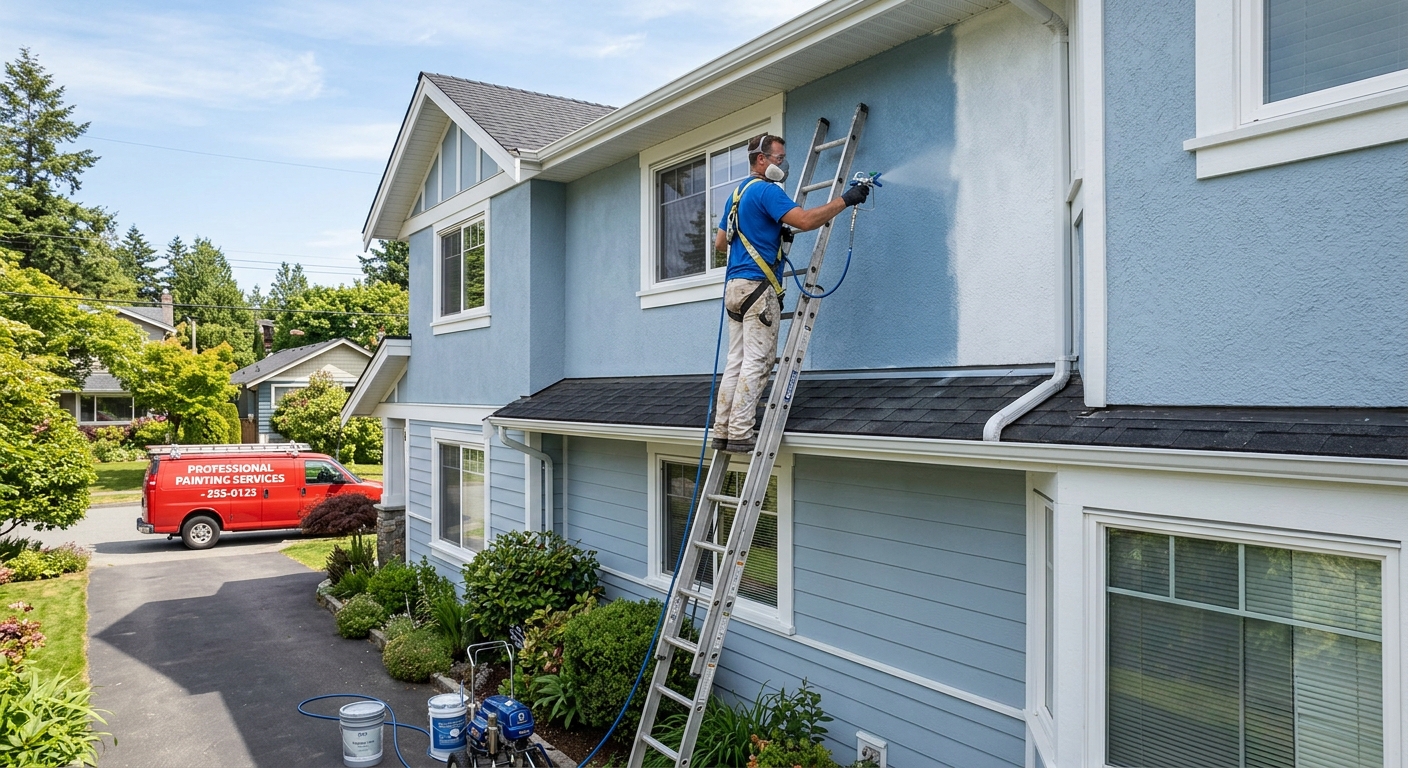
Painting options and costs in Niagara
Niagara homeowners usually have a few paint paths to choose from, and the price swings mostly come down to prep, access and product choice. In Niagara (population 31,180 as of the 2021 Census), many neighbourhoods have housing that’s older than modern construction—older cores in places like St. Catharines and Niagara Falls often need more scraping, sanding, caulking and priming before the “pretty” coats even go on. That’s especially true because repairs and surface cleaning can become the biggest portion of labour on repainting jobs, and pre-1978 homes may trigger lead-safe protocols as a standard contractor practice.
In the Hamilton–Niagara Peninsula market, exterior painting is squeezed into a shorter late spring–early fall window because adhesion and curing depend on warm, dry conditions. Rainy stretches and lake-effect humidity can also slow down dry times, meaning fewer workable days—so scaffolding, multi-storey access, and wood/trim repair tend to raise costs during peak summer. Interior work is more flexible and commonly scheduled in summer or shoulder periods when contractors have capacity and homeowners can keep windows open for ventilation.
If you’re comparing options, it helps to anchor expectations: a whole-house interior refresh can be a few thousand dollars, while exterior work on siding and trim is often a higher-budget project. Use the table below as a practical starting point before you book site measurements and detailed scope review.
| Service |
What's Included |
Typical Duration |
Price Range |
| Interior — whole home (walls, ceilings, trim) |
Protect floors/furnishings, patch & sand, spot-prime, caulk where needed, paint walls & ceilings, clean-up and final touch-ups |
4–8 days |
$2,000 – $5,000 |
| Interior — per room (standard bedroom or living room) |
Prep, patch & sand, prime where required, paint walls and (if included) ceilings; basic trim detail |
1–3 days |
$500 – $2,000 |
| Exterior — full house (siding, trim, soffits) |
Pressure wash as needed, scrape/sand, caulk, prime bare spots, paint siding/trim/soffits, protect landscaping and final clean-up |
5–12 days |
$3,500 – $8,000 |
| Exterior — trim and accent colours only |
Focused prep on trim surfaces, caulk and spot prime, paint selected trim/accents and touch up edges |
2–6 days |
$1,500 – $4,500 |
| Kitchen cabinet painting (doors, frames, spray finish) |
Remove/label doors, degrease, sand and prime, spray finish or sprayed enamel look, reinstall hardware (as applicable), final cure & touch-ups |
4–10 days (including cure time) |
$1,500 – $4,500 |
| Specialty / faux finish (accent wall, texture) |
Surface prep for the effect, base coat, application of the decorative finish, sealing where needed and clean-up |
1–5 days |
$1,000 – $6,000 |
Prices are estimates only and vary by project scope, site access and material selection.
What affects the price of painting in Niagara
In Niagara and across Ontario, two quotes for the “same” paint job can vary by 30–50% because the hidden work—prep, protection, access and drying logistics—changes from house to house. Even on an average repaint, scraping loose paint, sanding irregular surfaces, fixing caulking failures, and priming problematic areas can consume far more labour than homeowners expect. Exterior pricing in this region also gets squeezed by the four-season climate: the exterior painting window typically runs roughly late May to early October, when daytime temperatures are above 10°C and rising during application. In coastal areas near Lake Ontario, humidity and passing rain can interrupt work, which pushes scheduling pressure into summer.
Within the Hamilton–Niagara Peninsula, labour and demand concentrate in older neighbourhoods with more trim, stucco/brick detailing, and weathered wood. For example, a siding repaint can land closer to the lower end when surfaces are sound and access is straightforward, but move toward the upper end when wood repair, heavy caulking, and scaffolding/lift time are required. On interior work, the same principle applies: if your walls are already smooth and only need topcoats, a per-room job may sit in the $500 – $2,000 band, but once you add patching, sanding, and primer coverage across multiple rooms, whole-home projects often climb toward $2,000 – $5,000.
Here are the main cost drivers I see most often on Niagara jobs: older trim that needs scraping and priming before paint, exterior surfaces that require mildew-resistant systems after humid stretches, and height/access that adds time and rental equipment.
| Price Factor |
Why It Matters |
Cost Impact |
| Surface prep — scraping, sanding, patching drywall or wood |
Prep determines adhesion and the durability of the finish; imperfect prep shows through quickly |
Often 30–70% of labour on repainting |
| Number of coats — 2-coat system over primer vs. 1 coat over existing |
Proper coverage typically requires primer plus 2 top coats for even sheen and colour stability |
May shift the job by several hundred to over $1,000 |
| Paint quality tier — contractor-grade vs. premium (Benjamin Moore, Sherwin) |
Premium coatings tend to cover better, resist staining, and last longer in humidity and sun |
Material premium can add ~10–30% to paint line items |
| Ceilings and trim — adds significant time vs. walls-only |
Ceilings and detailed trim require masking, cutting in, and more careful brush/roller technique |
Commonly adds 15–40% on interior scopes |
| Exterior season window — short season raises summer rates |
Fewer dry, workable days increase demand and schedule compression |
Can raise exterior labour pricing during peak months |
| Lead-safe precautions — required for pre-1978 homes with lead paint |
Professional lead-safe methods may require containment, HEPA vacuuming, and proper disposal |
Can add several hours to a full day or more, depending on conditions |
| Surface material — drywall vs. plaster vs. wood vs. stucco |
Each substrate needs different cleaning, priming and adhesion systems |
Changes both prep time and primer/product selection |
| Height and access — multi-storey exterior requires scaffolding or lifts |
Equipment time and safety steps increase labour and rental costs |
Often one of the biggest exterior cost multipliers |
Permits & regulations in Ontario
In Ontario, painting itself typically does not require a permit for residential work—there’s usually no municipal permit required simply to roll on new interior paint or repaint exterior walls. The key regulation-adjacent issue for painting is health and safety on older homes. For homes built before 1978, health guidelines recommend testing for lead paint before sanding, scraping or methods that create dust, and using lead-safe work practices if lead is present (wet methods, HEPA vacuuming, and proper disposal). This isn’t something homeowners are legally mandated to do when they paint themselves, but it is standard practice for professional contractors to reduce risk to occupants and workers.
What does typically require permit-type steps is not “painting” but broader building changes—for example, if your project includes window replacement, structural work, or other regulated alterations, those may fall under separate permits. For pure repainting, the professional checklist is documentation and insurance, not a permit.
Before you hire in Niagara, verify in writing that the contractor carries liability insurance and WSIB/WCB workers’ compensation coverage. Then insist on a written contract that lists paint brand/line, sheen selection, number of coats, and the specific prep steps included. To verify credentials: check Ontario’s contractor registry for business validity, ask for a current certificate of insurance (liability) and a workers’ compensation clearance/coverage confirmation letter, and keep copies with your contract.
Interior vs exterior painting — getting the best result in Niagara
Niagara’s four-season cycle is the real “quality test” for your paint job. Premature failures usually come from rushed prep, poor caulking, or coatings that aren’t matched to temperature and substrate. Inside, the brand matters—but prep matters more. Filling and sanding (especially around dents, patch seams and old texture), priming stains and bare spots, and choosing the right sheen by room use will drive how long the finish looks clean. A true two-coat system over the proper primer almost always outlasts one thick coat because it builds consistent film thickness and coverage.
On exterior surfaces, prep is even more critical in Ontario’s climate. Rain and humidity near Lake Ontario can impact how well paint bonds, so caulking before painting helps prevent water ingress at joints and trim edges. The primer must suit the substrate: different primers are used for raw wood, previously painted surfaces, and areas with adhesion problems. For Niagara, I strongly recommend a mildew-resistant approach for areas prone to moisture and growth, and product selection that performs across typical summer warmth without softening or blistering.
Kitchen cabinet painting is often a budget alternative to replacement. When done with proper degreasing, sanding, priming and a sprayed finish, cabinets can deliver a noticeable refresh without demolition and kitchen downtime. For example, if an exterior repaint is trending toward $3,500 – $8,000 because of full siding and trim prep, some homeowners choose a trim-only refresh in the $1,500 – $4,500 band and reallocate savings to interior work or cabinets.
If your home is pre-1978, plan for lead-safe precautions during scraping or sanding. That doesn’t just protect people—it also protects your timeline because containment and safe cleanup are part of professional workmanship in Niagara.
| Project Type |
Key Prep Step |
Recommended Coats |
Price Band |
| Interior — fresh drywall (new construction) |
Prime bare drywall evenly, fill nail/screw pops and sand flush, caulk trims |
1 primer + 2 top coats |
$1,200 – $3,500 |
| Interior — repaint (good condition, no repairs) |
Clean and lightly scuff-sand; spot-prime any marks; mask carefully |
1–2 top coats depending on sheen/colour change |
$500 – $2,500 |
| Interior — repaint (patching and priming needed) |
Patch drywall/wood, sand feather edges, prime repaired areas to prevent flashing |
2 top coats over primered patches (often full prime if coverage requires) |
$800 – $5,000 |
| Exterior siding (wood or fibre cement) |
Scrape loose paint, sand edges, prime bare spots, caulk joints before coating |
Primer + 2 top coats (typical repaint system) |
$3,500 – $8,000 |
| Exterior trim and accents only |
Concentrated prep on trim edges, caulking, spot-priming, careful masking |
2 top coats over primer on exposed areas |
$1,500 – $4,500 |
| Kitchen cabinets (spray finish) |
Degrease thoroughly, sand for adhesion, prime all surfaces before spraying |
Primer + 2 finish coats (with dry/cure time) |
$1,500 – $4,500 |
How to choose a painting contractor in Niagara
Choosing the right contractor matters as much as paint selection in Niagara, because workmanship—prep, masking, drying and clean-up—is what prevents peeling, flashing and streaking. Start by verifying Ontario coverage items: request proof of liability insurance and a WSIB/WCB clearance confirmation. For licensing/business validity, use Ontario’s contractor/business registry resources to confirm the company is active and properly listed for the work it is advertising. Don’t rely on verbal reassurance—ask to see current certificates and keep copies for your records.
Next, get 2–3 itemised written quotes, not just a lump sum. You want a labour + materials breakdown that shows what’s included (prep level, number of coats, primer type, caulking and sanding), and what’s excluded (moving heavy items, lead-safe containment, disposal, and repairs beyond basic patching). Read the scope carefully for “hidden” omissions: disposal and environmental fees, pressure washing (if needed), scrape testing/containment for older homes, and whether prep extends to trim edges and moulding profiles.
Warranty should be clear and in writing: workmanship warranty length, and whether product/manufacturer warranty is included. Ask if warranties are transferable to a new homeowner if you sell. For payment, keep upfront deposits reasonable—never more than 10–15%—and negotiate a holdback until the job is complete and cleaned. Finally, lock in timeline details: written start date and completion estimate, plus how weather delays on exterior work will be handled given the short late spring–early fall window.
- Confirm liability insurance is current (ask for certificate of insurance).
- Confirm WSIB/WCB coverage (clearance/coverage letter) matches the people doing the work.
- Ask for a written contract listing paint brand/line, sheen, primer use and number of coats.
- Demand a detailed scope: scraping, sanding level, patching responsibility, and caulking plan.
- Clarify lead-safe steps for pre-1978 homes (testing approach and containment/disposal if needed).
- Confirm protection steps: floor coverings, plastic, furniture wrap and how overspray is prevented.
- Ask who handles disposal (paint cans, sanding debris, masking materials).
- Require a prep-to-paint schedule that accounts for dry/cure times (especially on cabinets and exteriors).
- Get at least two colour-change scenarios in writing (if you’re going from dark to light).
- Review the warranty: workmanship term, what it covers, and who honours it.
- Check payment terms: no more than 10–15% upfront; holdback until complete and inspected.
- Ensure the crew reviews edges/trim and completes final touch-ups before close-out.
Red flags I commonly see in Niagara include: “we’ll sand and prime only if necessary” without any written criteria; quotes that don’t list coat counts or primer type; contractors asking for large upfront payments (beyond 10–15%); refusal to provide insurance/WSIB/WCB documentation; and vague warranties that don’t cover workmanship or only reference paint manufacturers without workmanship terms.
Frequently asked questions — painting in Niagara
How do I prep walls before painting?
You can do some prep, but in Niagara (and across Ontario) the biggest quality factor is getting the surface ready for adhesion and consistent sheen. If you’re handling it yourself, start with removing picture hooks and outlet covers, then patch holes with proper joint compound and let fully dry. Sand smooth and wipe dust off with a damp cloth (or a vacuum with a brush attachment). Spot-prime stains, water marks, and any areas that were repaired; unprimed patches often “flash” after the topcoat. For glossy paint, a light scuff-sanding helps the new coating bond. If your home is older (especially pre-1978), avoid aggressive sanding or scraping without thinking about lead-safe dust control—testing and containment are a safer contractor approach.
Do I need to worry about lead paint in an older Niagara home?
In many Niagara neighbourhoods, homes have older finishes, and for properties built before 1978, health guidelines recommend lead paint testing before sanding, scraping or other dust-generating work. You don’t always “see” lead—so the risk is tied to your paint’s age and condition, not just location. For homeowners, there isn’t a permit requirement to repaint, but professional contractors typically follow lead-safe work practices if lead is present: wet methods to reduce dust, HEPA vacuuming, and proper disposal of debris. This can affect both your schedule and cost, because containment and cleanup add labour. If you’re seeing flaking paint on trim or around doors, plan for testing and expect quotes to reflect lead-safe precautions on top of standard prep costs.
How long does it take to paint a house?
Timelines depend on interior vs exterior and how much prep is required. For interior painting in Niagara, a per-room refresh often takes about 1–3 days, while a whole-home job commonly falls around 4–8 days depending on number of rooms, patching, and trim detail. Drying and cure time matter—especially if you’re repainting in a high-use area or moving from dark to light colours. For exterior work, the schedule is constrained by the late spring–early fall window; rain and humidity near Lake Ontario can add delays. Even a “full house” exterior paint job can take 5–12 days of active work, plus weather gaps between coats. If your quote is aiming for the upper end of the exterior band, it’s usually because prep, wood repair, or multi-storey access stretches the timeline.
What's the difference between paint quality tiers?
Paint quality tiers mostly affect coverage, durability, resistance to staining, and how consistently the finish levels. In practice, premium coatings from reputable brands (often found in Niagara showrooms) tend to spread more evenly and may require fewer “fix-up” passes after roller marks or patch boundaries appear. Lower-tier paints can still look good at first, but they may show scuffs sooner in hallways or around switches, and they can be less forgiving on drywall seams or heavily patched areas. That said, the prep quality is usually the deciding factor: two coats over a proper primer typically beat “one heavy coat” with a cheaper paint. When you see different quote totals for the same scope—like interior whole home jobs trending toward the $2,000 – $5,000 band—part of that difference is the coating tier and the labour spent achieving consistent coverage.
How do I compare painting quotes?
Compare quotes like-for-like. Ask each contractor to provide an itemised breakdown showing labour, materials, primer and coat counts, and the exact prep steps included. Make sure the scope states whether ceilings are included, how trim and caulking are handled, and what repairs are covered (basic patching vs full drywall replacement). For older Niagara homes, confirm whether lead-safe testing/precautions are included where needed—quotes that ignore this can later add change costs. Also verify payment terms (10–15% max upfront) and warranty language. When comparing exterior quotes, pay attention to whether pressure washing, scraping, priming bare spots, and disposal are included; those items swing totals a lot. A quote near the $1,500 – $4,500 trim-only band is usually very different in prep and coverage than a full exterior job closer to $3,500 – $8,000.
What paint sheen should I use in different rooms?
In Ontario homes, sheen choice is about cleanability and how forgiving the finish is on wall imperfections. Flat/“matte” hides flaws well and is commonly used on ceilings. For living rooms and bedrooms, many homeowners choose an eggshell or low-sheen for walls: it’s washable enough for day-to-day life but still looks softer than satin. Bathrooms, laundry rooms and areas with moisture often do better with satin or semi-gloss, especially where humidity can affect walls and trim. Kitchens benefit from washable finishes on walls and especially semi-gloss on trim for easy cleaning. If you have repaired drywall, eggshell can still show flashing if primer and prep weren’t done right—so don’t let sheen replace proper priming. If you’re repainting trim, semi-gloss is a common durable choice.