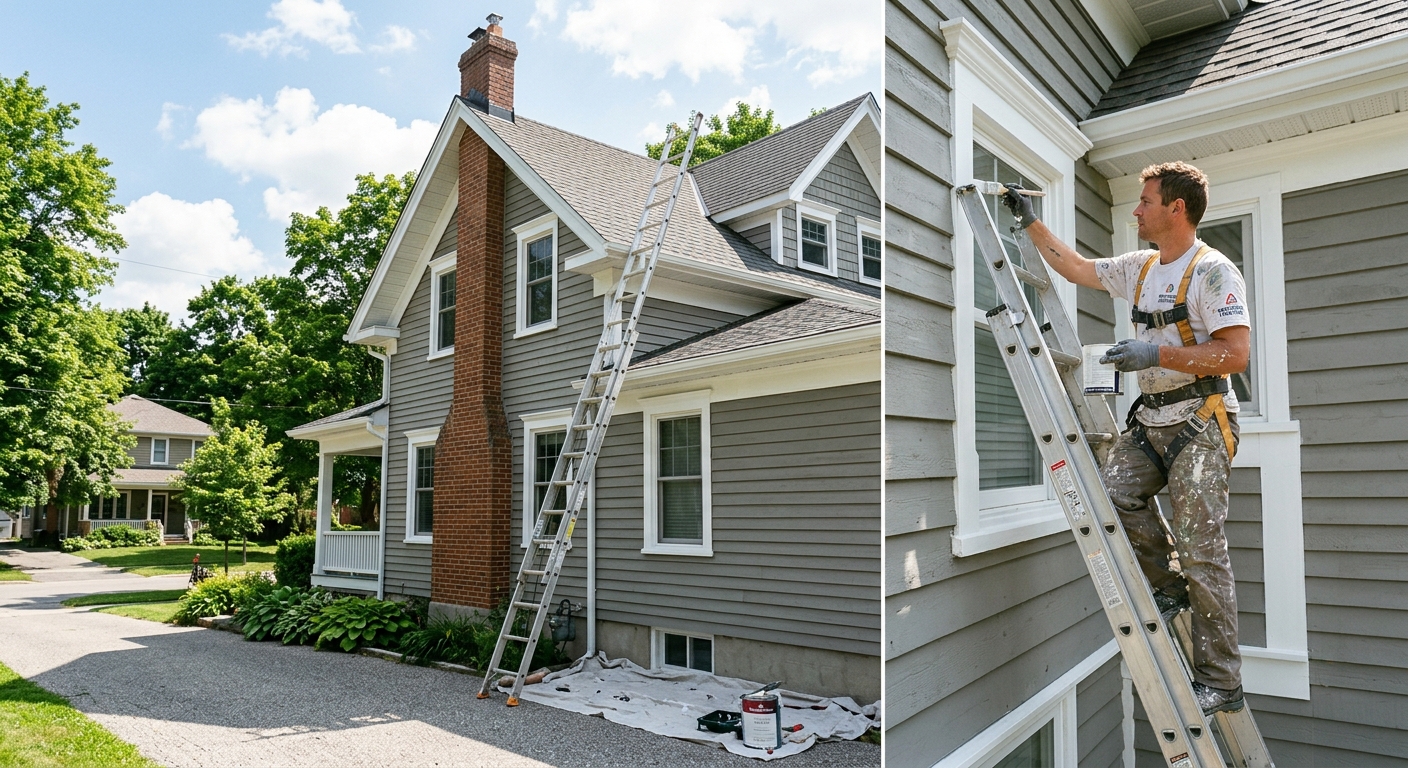
Painting options and costs in Concord
In Concord, Ontario, painting choices usually come down to how much surface preparation your home needs and how much time your contractor can safely schedule during the GTA’s short exterior window. According to the 2021 Census, Concord’s population is 8,255 (Statistics Canada, 2021 Census), and that smaller local market means crews can get booked quickly once late May and June “ideal weeks” arrive. Many households in the Toronto economic region are in older housing stock, so repaints often involve more scraping, patching, caulking, and priming than homeowners expect. For pre-1978 properties, lead-safe work practices are also commonly used by professionals before disturbing old trim, windows, and railings.
In the Greater Toronto Area, exterior painting is tightly climate-dependent. Contractors typically target late May through June and again from September to mid-October, when temperatures stay around or above 10°C and humidity is more moderate, allowing proper adhesion and curing. In June–August, demand spikes in the region, so exterior pricing is often 10–15% higher than shoulder-season quotes—especially for full-house work that requires more coordination (ladders, caulking, staging and longer dry times). Interiors are less season-sensitive, but prep time still drives cost: ceiling height, stairwells, occupant move-outs, and whether you’re doing basic refreshes or upgrading to higher-end colours.
Below is a practical cost comparison for Concord so you can line up scopes and budget realistically before you request itemised quotes.
| Service |
What's Included |
Typical Duration |
Price Range |
| Interior — whole home (walls, ceilings, trim) |
Protect floors; prep/fill/sand as needed; prime patched areas; 2-coat finish on walls/ceilings; clean-up; basic trim painting |
5–10 days |
$2,200 – $6,000 |
| Interior — per room (standard bedroom or living room) |
Protect floors; prep/fill/sand; prime bare spots; 2-coat finish; paint one accent (optional) |
1–3 days |
$400 – $1,400 |
| Exterior — full house (siding, trim, soffits) |
Pressure wash (where suitable); scrape/sand; caulk; prime bare spots; 2-coat exterior system; paint trim/soffits; final clean-up |
7–18 days |
$3,500 – $8,000 |
| Exterior — trim and accent colours only |
Spot scrape/sand; caulk; prime spots; 2-coat on trim/railings/selected areas; protect surrounding surfaces |
3–8 days |
$1,500 – $4,500 |
| Kitchen cabinet painting (doors, frames, spray finish) |
Remove hardware; deep clean/degrease; sand; prime; spray finish; reinstall; optional new hardware prep |
6–12 days |
$1,200 – $4,000 |
| Specialty / faux finish (accent wall, texture) |
Surface prep to achieve a smooth base; custom labour technique; seal coat as required; blending/edge finishing |
1–5 days |
$300 – $5,000 |
Prices are estimates only and vary by project scope, site access and material selection.
What affects the price of painting in Concord
Even when homeowners request “the same paint job” in Concord, Ontario, quotes can vary by 30–50% because preparation and risk management are where labour and materials diverge. In the GTA, one contractor may include full caulking and primer coverage, while another treats caulking as “touch-up” only or only prices 1 coat where a proper 2-coat system is needed. Exterior work is also priced differently because the season is short and tightly weather-dependent: contractors typically plan exterior painting from late May to early October, when temperatures are above about 10°C for application and curing. When summer humidity spikes, crews either wait for better conditions or slow down to meet cure times—both increase labour hours and scheduling overhead.
Compared to coastal damp climates, the GTA’s biggest constraints are rain, frost risk, and humidity swings rather than year-round mildew pressure. That said, older homes (common across the Toronto region) often increase prep time dramatically—scraping loose paint, sanding feather edges, patching failures, priming problem areas and re-caulking. In many repaint projects, surface preparation can be 50–70% of the labour cost, which is why a “full house” repaint can land near the exterior range starting around $3,500–$8,000, while a trim-and-accents job may be $1,500–$4,500 when the main body isn’t being stripped back.
Two local examples: (1) a pre-1980 exterior with cracked caulk at window heads usually requires more labour to scrape and re-seal, raising costs more than adding a higher-end paint; (2) a multi-storey home with soffits, railings and dormers may require lifts/scaffolding, adding access time. Interiors can also vary: high ceilings or lots of trim can push a “per room” job toward the upper end of $400–$1,400 because ceiling/trim edges take time to protect, sand, and cut in cleanly.
| Price Factor |
Why It Matters |
Cost Impact |
| Surface prep — scraping, sanding, patching drywall or wood |
Determines adhesion and how smooth the final finish will look |
+10–35% |
| Number of coats — 2-coat system over primer vs. 1 coat over existing |
Coverage and durability depend on proper build, especially on repairs |
+5–25% |
| Paint quality tier — contractor-grade vs. premium (Benjamin Moore, Sherwin) |
Impacts hide, flow, stain resistance and touch-up longevity |
+3–20% |
| Ceilings and trim — adds significant time vs. walls-only |
More cutting in, masking, and detail work |
+10–30% |
| Exterior season window — short season raises summer rates |
Less “ideal” weather forces tighter scheduling and higher demand |
+10–15% |
| Lead-safe precautions — required for pre-1978 homes with lead paint |
More controls, cleanup methods and careful surface disturbance |
+5–20% |
| Surface material — drywall vs. plaster vs. wood vs. stucco |
Different absorption rates and primer requirements |
+5–25% |
| Height and access — multi-storey exterior requires scaffolding or lifts |
Setup time and safety controls increase labour |
+10–40% |
Permits & regulations in Ontario
In Ontario, painting generally does not require a permit for typical interior or exterior repainting work. The main “regulatory” considerations for homeowners are health and safety practices—especially for older homes. For Concord properties built before 1978, health guidelines recommend testing for lead paint before sanding or scraping, and using lead-safe work practices if lead is present (for example: wet methods to reduce dust, HEPA vacuuming, and proper disposal of debris). While this isn’t legally mandated for homeowners, it is standard practice for professional contractors because it reduces exposure risk during surface disturbance.
What does require a permit is uncommon for painting, but permits can be relevant if your scope includes related structural work, electrical changes, or changes that affect building systems. For pure painting—prep, priming, caulking, and finish coats—no permit is typically needed in Ontario.
Before hiring in Concord, verify your contractor carries liability insurance and WSIB/workers’ compensation coverage. Then insist on a written contract that clearly spells out: paint brand/line, sheen level, number of coats, surface prep scope (including scraping, sanding, patching, priming and caulking), and what clean-up/disposal is included.
To verify: (1) check the contractor’s licensing/registration status through the Ontario contractor registry you’re able to access online; (2) request a certificate of insurance naming you as certificate holder (or confirming coverage for your job site); and (3) confirm WSIB/workers’ compensation account coverage via their WSIB status documentation. Finish by asking for a lead-safe approach statement if you have pre-1978 surfaces involved.
Interior vs exterior painting — getting the best result in Concord
In Concord’s climate, the difference between a long-lasting job and premature failure is almost always preparation and system matching—not just paint colour. Interiors live with everyday temperature swings and indoor humidity, so the biggest drivers are how well the contractor fills, sands and primes. For walls and ceilings, a smooth base matters: proper patching compound set time, sanding to remove ridges, and priming repaired areas so the finish coat looks even. Sheen choice also matters by room—flatter sheens hide imperfections, while semi-gloss or satin handle wipe-down needs better in kitchens, hallways and trim. In practice, two coats over correct primer consistently outlast “one thick coat” because it seals and levels more reliably.
Exteriors are where Ontario weather makes or breaks adhesion. The critical step is surface prep: scrape and sand to remove failing paint, then prime bare or stained sections. Caulking must be done before painting to prevent water ingress behind trim and to keep movement cracks from telegraphing through. Primer type should match the substrate and condition; for instance, wood/fibre cement may need primers tuned for tannin/stain blocking and proper bond. In Ontario, you’ll also want temperature-stable products and scheduling that respects cure time between rain windows.
Lead-safe precautions matter for pre-1978 homes involving trim, windows and railing areas. And if you’re updating a kitchen, cabinet painting can be a smart budget alternative to replacement: a well-prepped spray finish keeps the “new look” at a fraction of a full remodel, commonly landing in the cabinet band of $1,200–$4,000 versus a replacement project that typically costs far more.
Example: if an exterior full-house repaint is quoted near $3,500–$8,000, paying for thorough prep and primer coverage is usually justified because it reduces the chance you’ll be paying again in 2–4 years due to peeling at problem seams.
| Project Type |
Key Prep Step |
Recommended Coats |
Price Band |
| Interior — fresh drywall (new construction) |
Seal and prime properly to prevent flashing, then sand smooth |
1 primer + 2 finish coats |
$900 – $3,000 |
| Interior — repaint (good condition, no repairs) |
Clean, light sand, spot-prime if needed |
1–2 finish coats (often 2) |
$400 – $2,200 |
| Interior — repaint (patching and priming needed) |
Fill, sand, and prime repairs so colour and sheen match |
1 primer (repairs) + 2 finish coats |
$600 – $2,800 |
| Exterior siding (wood or fibre cement) |
Scrape/sand to sound edges, prime bare spots, re-caulk key seams |
2 finish coats over appropriate primer |
$3,500 – $8,000 |
| Exterior trim and accents only |
Feather sand, spot prime, and caulk junctions before paint |
2 finish coats |
$1,500 – $4,500 |
| Kitchen cabinets (spray finish) |
Degrease thoroughly, sand for adhesion, prime for bond |
1 primer + 2 finish coats (spray) |
$1,200 – $4,000 |
How to choose a painting contractor in Concord
Choosing well in Concord, Ontario starts with verifying the basics. Ask for the contractor’s Ontario licensing/registration details (where applicable), a current certificate of liability insurance, and confirmation of WSIB/workers’ compensation coverage. How to check: (1) request documents before work starts, (2) verify the certificate dates and address/job name match your project, and (3) confirm workers’ compensation coverage is active for their business and crew—don’t rely on verbal assurances.
Next, get 2–3 itemised written quotes. I recommend insisting on a breakdown that separates labour from materials and lists what prep is included (pressure wash if appropriate, scraping method, sanding detail, patching scope, priming coverage, caulking and which areas). Clarify whether disposal is included (paint chips, sanding dust bagged and removed), and confirm if any permit-related handling would ever apply to adjacent work (typically not for painting, but you want clear wording about what they do and don’t cover).
Warranty matters too. A workmanship warranty should state a length (commonly 1–2 years for many residential repaint scopes) and what it covers—peeling, flaking, adhesion failures due to prep errors—plus exclusions. Product/manufacturer warranties often depend on correct surface prep and specified systems; ask if the warranty is transferable with proof of original work.
For payment scheduling, never pay more than 10–15% upfront. Hold back a final portion until the job is complete and cleaned. Finally, require a start date and completion estimate in writing—especially for exteriors, because rain and curing windows in the GTA can shift schedules if your contractor isn’t planning.
- Confirm liability insurance is active and sized appropriately for residential jobs.
- Verify WSIB/workers’ compensation coverage before any prep starts.
- Ask what prep is included line-by-line (scrape, sand, patch, prime, caulk).
- Require the contract to list paint brand/line and sheen for each surface.
- Check whether the quote includes protection/masking and floor covering.
- Clarify number of coats and where primer is required (repairs vs. whole areas).
- Confirm disposal and clean-up responsibilities (paint chips and debris removal).
- Ask who supplies caulk, primer and specialty stain-blocking products.
- Review warranty terms in writing (workmanship vs. product coverage).
- Use a payment schedule with a holdback until punch-list items are finished.
- Get a written schedule that includes weather contingencies for exterior work.
- Request references from recent GTA projects with similar surface conditions.
In Concord, red flags I’ve seen include: vague scopes like “prep as needed” with no detail, quoting 1 coat over un-primed repairs, avoiding proof of WSIB/insurance, offering a large deposit (more than 15%), and refusing to put paint brands, sheen, and coat counts into the written agreement.
Frequently asked questions — painting in Concord
How do I choose a painting contractor in Concord?
Start by confirming Concord/Ontario basics: ask for liability insurance and active WSIB/workers’ compensation coverage (request documents, don’t just accept verbal claims). Then compare at least two itemised quotes so you can see prep scope—scraping, sanding, patching, caulking and priming are where the real quality differences show up. For interiors, make sure ceiling and trim prep are described; for exteriors, verify how they handle the GTA weather window (late May to June and September to mid-October) and whether they’ll stop/adjust when rain or curing conditions aren’t right. Finally, insist on a written contract listing paint brand/line, sheen, coat count, and warranty terms. A properly scoped exterior full house often lands in the $3,500–$8,000 range.
How many coats does an exterior repaint need in Concord?
Most exterior repaints in Concord require a 2-coat finish system over appropriate primer. If the contractor is properly prepping, you’ll usually see: prime where surfaces are bare or stained and caulk junctions, then apply two finish coats for consistent coverage and durability through Ontario humidity and rain cycles. If the house is in good shape with minimal repairs, the “extra” coat still matters because moving moisture and temperature shifts can reveal thin coverage later. Where people get burned is when a quote assumes one finish coat over existing paint without priming problem areas—peeling often returns around seams, trim edges and window head caulking. In this market, exterior full-house repaint pricing commonly falls in the $3,500–$8,000 band depending on how much prep is required.
What is the best primer for older Concord homes?
For older Concord homes (especially pre-1978 properties), the “best” primer depends on what you’re covering: bare wood, stained siding, patched drywall/trim, or areas where old paint has failed. In practice, a quality adhesion primer plus targeted stain-blocking is often the right approach when surfaces show rust/tannin bleed or patch issues. The key is matching primer to substrate and condition—wood vs. fibre cement vs. previously painted surfaces. Because Ontario homes can have older paint layers and multiple defect types, reputable pros also treat lead-safe precautions as part of the prep process before sanding or scraping. Ask your contractor to name the primer product/line in your contract and to explain which areas get primer (repairs only vs. full sections). This prevents “thin coverage” failures that can cost you again.
Should I paint or wallpaper my Concord home?
In most Concord homes, painting is simpler and more predictable—especially if you have older plaster, small wall cracks, or prior repair patches. Paint can be matched to the surface condition with the right primer and sanding plan, whereas wallpaper installs demand a very consistent substrate; otherwise seams can lift and patterns can telegraph imperfections. That said, wallpaper can be a good choice for a single accent wall if you want a specific texture or pattern, and if you’re willing to budget for high-quality prep. If you’re trying to keep costs down, painting a single room typically fits the $400–$1,400 range, while specialty finishes like an accent wall or faux texture can move into the $300–$5,000 band depending on complexity. For resale-minded choices, many buyers prefer updated paint in neutral tones.
How do I fix peeling exterior paint in Concord?
Peeling exterior paint is almost always a preparation problem: water got behind the failed coating, or adhesion was insufficient due to loose paint, unaddressed cracks, or missing primer over problem areas. The fix in Concord should include scraping down to sound edges, sanding feathered boundaries, then patching and caulking junctions (window trim, soffits, railings) before painting. After that, apply the correct primer to the exposed substrate and stained zones, then use a full 2-coat finish system. Timing matters because Ontario’s exterior work window is limited; contractors typically schedule late May–June and September–mid-October when temperatures are around/above 10°C and curing conditions are more stable. Avoid “spot painting” only—those areas often peel again unless the root cause (caulk/adhesion/prep) is corrected.
What colours add the most resale value in Concord?
For resale in Concord and the broader Toronto market, buyers generally respond best to clean, neutral palettes with warm undertones and consistent sheen. Think off-whites, greige (not overly yellow), light warm grey, and soft taupes for walls, with crisp trim in a true white or high-contrast near-white. If you want personality, use colour thoughtfully: a muted accent wall or darker entry-door trim can look premium without limiting appeal. Sheen helps too—semi-gloss on trim and satin/eggshell on walls tends to photograph well and withstand cleaning. While colour trends change, durability and surface smoothness matter more than fashionable hues. If you’re budgeting, note that per-room interior painting commonly sits in the $400–$1,400 range, so sticking to a broader neutral plan can keep your project cost-effective while still looking updated.