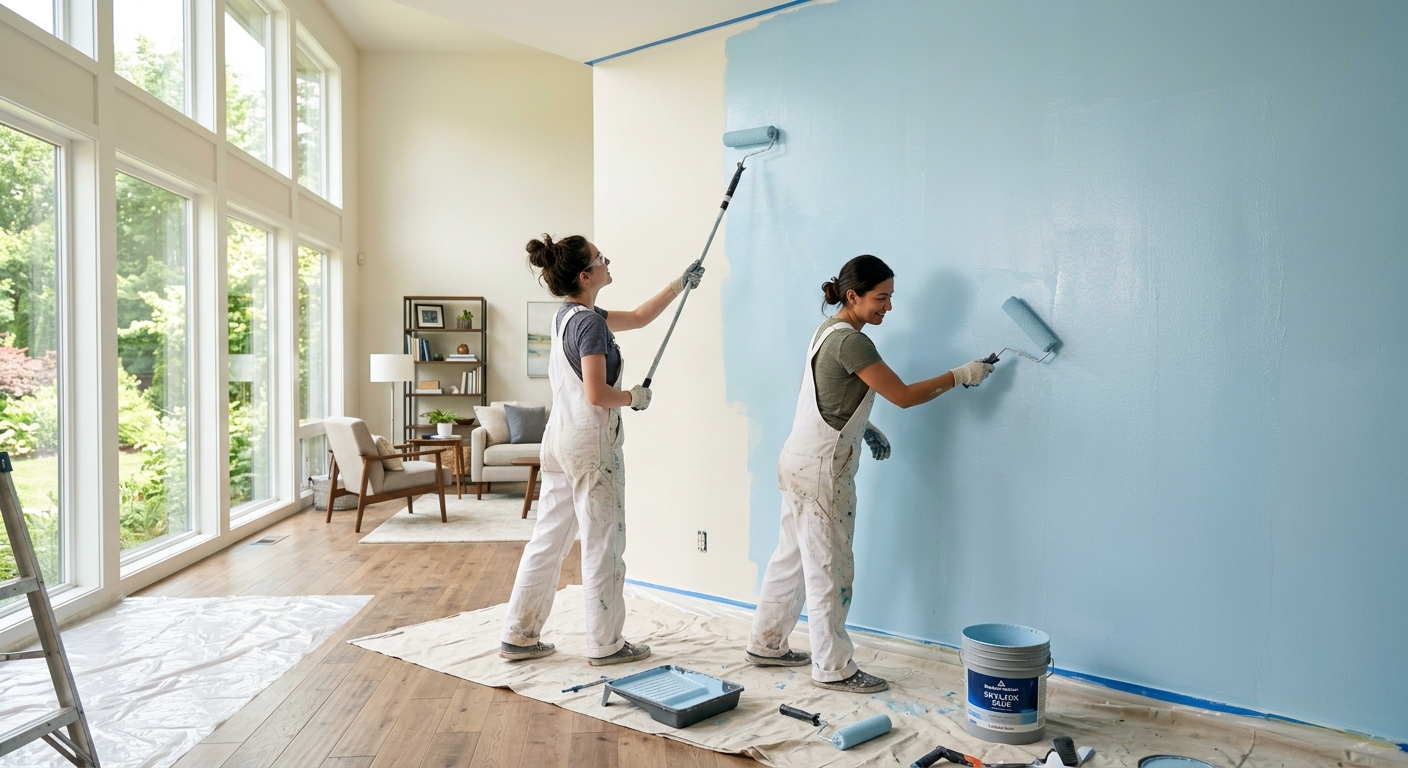
Painting options and costs in Vancouver
Vancouver homeowners typically face two realities at once: a coastal climate that punishes poor prep, and a housing stock where many properties are older. With 43.0% of homes built before 1981 (Statistics Canada, 2021 Census), repainting often means more than “roll and go”—it can involve scraping failing coating, patching settlement cracks, sanding glossy areas, and priming stains (like wood tannins or nicotine). If your home predates 1978, lead-safe practices are also commonly planned by professional crews, especially when they anticipate sanding or scraping. In the Lower Mainland–Southwest, contractor pricing is shaped by short, weather-dependent exterior windows and the need to schedule around rain and humidity; interiors are steadier from fall into winter as crews shift indoors. That’s one reason you’ll often see more variation between quotes for exteriors than for interiors. Demand can be especially high in neighbourhoods with active renovation cycles like Mount Pleasant and along the Broadway corridor, where older homes are frequently refreshed for resale.
To help you compare apples-to-apples, the table below summarizes realistic service ranges for Vancouver, including typical prep and finish expectations. Once you tell your contractor your approximate square footage, number of storeys, and siding/trim material, the estimate usually tightens quickly. Use the ranges as a starting point for deciding whether you’re targeting a mid-budget refresh or a more comprehensive, longer-lasting repaint.
| Service |
What's Included |
Typical Duration |
Price Range |
| Interior — whole home (walls, ceilings, trim) |
Protection, surface repair, prime as needed, 2-coat finish on walls/ceilings, caulking, clean-up; includes basic trim painting |
5–12 days |
$3,000–$8,000 |
| Interior — per room (standard bedroom or living room) |
Protection, patching/sanding where needed, prime on repairs, 2-coat finish; typically includes door trim and one ceiling coat |
1–3 days |
$300–$1,800 |
| Exterior — full house (siding, trim, soffits) |
Power wash/cleaning, scraping & sanding, caulking, stain/spot blocking as required, primer, 2-coat exterior paint; coordinated weather planning |
6–16 days |
$6,500–$15,000 |
| Exterior — trim and accent colours only |
Cleaning, targeted scrape/sand, caulking where accessible, prime bare spots, 2-coat finish on trim/accents |
2–6 days |
$1,200–$5,000 |
| Kitchen cabinet painting (doors, frames, spray finish) |
In-place prep or removal (per plan), degrease, light sanding, bonding primer, sprayed doors/drawers, enamel topcoat, hardware masking; includes touch-ups |
5–12 days (including cure time) |
$2,500–$8,000 |
| Specialty / faux finish (accent wall, texture) |
Design/colour matching, surface build/texture prep, multiple coats as required by technique, protective topcoat where appropriate |
1–7 days |
$500–$12,000 |
Prices are estimates only and vary by project scope, site access and material selection.
What affects the price of painting in Vancouver
Even when two contractors quote “the same” job in Vancouver, you can see swings of 30–50% across the Lower Mainland–Southwest and broader British Columbia. The biggest driver isn’t always paint—it’s prep time, material handling, and scheduling risk. Exterior painting is tightly constrained by coastal rain and humidity, so crews may need to pause between weather windows; that “standby” time shows up as labour and mobilization costs. In Ontario and Alberta, the typical exterior window is shorter in a different way: crews usually need temperatures above roughly 10°C and rising during application. Coastal BC has a longer calendar window, but high moisture means slower drying and a higher need for mildew-resistant, high-adhesion systems. Shorter, concentrated demand can push summer rates up.
Across older neighbourhoods—where 43.0% of homes were built before 1981 (Statistics Canada, 2021 Census)—surface prep can dominate the quote. Scraping loose coating, patching cracks, and priming stain spots can represent 50–70% of total labour on repaints. For exteriors, that’s why a “quick refresh” can land in the lower part of the exterior band (around $1,200–$5,000 for trim-only), while a full proper repaint tends to move toward $6,500–$15,000 once scaffolding, extensive primer, and multiple coats are included.
Two concrete examples from Vancouver: (1) pre-1980 homes with stained trim or tannin bleed often require a specific stain-blocking primer before the topcoat—otherwise you’ll see discolouration through the finish; (2) fibre cement or older wood siding may need different primer adhesion strategies, adding material lines and test patches. Interiors also vary: adding ceiling work and detailed trim turns a walls-only job into a multi-surface finish, which is why whole-home pricing can rise quickly even when wall colours seem simple.
| Price Factor |
Why It Matters |
Cost Impact |
| Surface prep — scraping, sanding, patching drywall or wood |
Poor prep is the main reason coatings fail early; older homes need more attention to bonding and adhesion |
High (commonly 50–70% of labour on repaints) |
| Number of coats — 2-coat system over primer vs. 1 coat over existing |
Full coverage and uniform sheen depend on correct layering, especially when colours change or stains bleed |
Medium to High (+10–30% labour/materials) |
| Paint quality tier — contractor-grade vs. premium (Benjamin Moore, Sherwin) |
Premium products usually deliver better hiding, durability, and washability, reducing rework |
Low to Medium (materials + labour efficiency) |
| Ceilings and trim — adds significant time vs. walls-only |
Ceilings require careful edging and more surface area; trim needs masking, caulking, and smoothing |
Medium to High |
| Exterior season window — short season raises summer rates |
Weather delays can add mobilization and extended crew time between dry periods |
Medium (can become High during peak summer) |
| Lead-safe precautions — required for pre-1978 homes with lead paint |
Containment, HEPA vacuuming, and disposal steps add time and specialized materials |
Medium to High (varies by expected sanding/scraping) |
| Surface material — drywall vs. plaster vs. wood vs. stucco |
Different substrates need different primers and repair methods to avoid peeling or flashing |
Medium |
| Height and access — multi-storey exterior requires scaffolding or lifts |
Access equipment affects labour time, safety planning, and material handling |
Medium to High |
Permits & regulations in British Columbia
In British Columbia, painting typically does not require a permit for ordinary interior or exterior paintwork. For homes built before 1978, health guidance recommends testing for lead paint before sanding or scraping, and following lead-safe work practices if lead is found. While this is not usually “permit paperwork” for homeowners, it is standard practice for professional crews to manage airborne dust and residue using wet methods, HEPA-filtered vacuuming, and proper disposal. If your project involves aggressive surface removal—like sanding old trim, scraping peeling paint, or stripping stained layers—ask your contractor how they plan containment, cleanup, and waste handling.
Before you sign, confirm your contractor carries liability insurance and has the correct workers’ compensation coverage (WSIB is common language in some provinces; in B.C. coverage is administered through the provincial system). Also request a written contract that lists the paint brand/line, sheen level, number of coats, and the scope of surface preparation (including patching, priming, and caulking). Specify what is included for power washing/cleaning, how stained areas are blocked, and whether disposal of scraping debris is part of the price.
To verify credentials in Vancouver, start with the contractor’s public business listing (if available for their trade), then ask for a certificate of insurance showing liability limits, and request proof of workers’ compensation coverage. A clearance letter or coverage confirmation document should match the legal business name on your contract. Finally, keep an itemized scope so you can compare bids line-by-line.
Interior vs exterior painting — getting the best result in Vancouver
In Vancouver, the difference between a long-lasting paint job and a premature failure is usually prep discipline and moisture-aware product choices. For interiors, surface preparation matters more than the brand of topcoat. Filling and sanding properly, then priming repairs and any porous or stained areas, prevents flashing and peeling. Sheen selection also matters: flat paint hides wall imperfections but can be harder to clean; eggshell and satin are commonly chosen for living areas and hallways; semi-gloss is often reserved for trim and doors because it resists scuffs and wipes clean. A key rule: two coats over a proper primer generally outlasts “one thick coat,” particularly when changing colours or repainting over patchwork.
For exteriors, the critical step in British Columbia is surface preparation to manage adhesion under damp coastal conditions. Scrape loose material, sand glossy edges, and caulk effectively before painting so water cannot creep behind the finish. Primer type matters: some substrates bond better with oil-based or specialized primers, while others suit latex systems—your contractor should match primer to siding material and existing coating condition. Because Vancouver’s humidity can extend drying times, pros also choose mildew-resistant, high-adhesion products and plan around dry stretches.
Cabinet painting is a cost-smart alternative to replacement when the box is solid and hardware can be reused; however, it still requires careful degreasing, bonding primer, and sprayed enamel for durability. For pre-1978 homes, discuss lead-safe practices if your paint plan includes scraping or sanding. If you’re deciding between options, it’s often worth paying more for prep: for example, a trim-only exterior refresh in the $1,200–$5,000 range may look good temporarily, but a full proper repaint closer to $6,500–$15,000 is justified when multiple surfaces need scraping, stain blocking, and full primer coverage.
| Project Type |
Key Prep Step |
Recommended Coats |
Price Band |
| Interior — fresh drywall (new construction) |
Prime drywall thoroughly and spot-prime repairs to prevent flashing |
Prime + 2-coat finish |
$3,000–$8,000 |
| Interior — repaint (good condition, no repairs) |
Clean/degloss and lightly sand shiny areas; caulk small gaps |
1–2 coats finish (often 2 for uniformity) over primer only where needed |
$300–$3,500 |
| Interior — repaint (patching and priming needed) |
Patch, sand smooth, and prime repaired and stain-affected areas |
Primer + 2-coat finish |
$1,200–$6,500 |
| Exterior siding (wood or fibre cement) |
Scrape/sand to sound coating, caulk, then prime for adhesion and stain/bleed control |
Primer + 2-coat exterior paint |
$6,500–$15,000 |
| Exterior trim and accents only |
Targeted scraping and caulking; prime bare spots and transitions |
2-coat finish over spot primer |
$1,200–$5,000 |
| Kitchen cabinets (spray finish) |
Degrease, bonding primer, sanding between coats where required |
Primer + 2-coat enamel system (sprayed) |
$2,500–$8,000 |
How to choose a painting contractor in Vancouver
Start by verifying B.C. insurance and coverage, not just “experience.” Ask your contractor to provide (1) a certificate of liability insurance that lists their legal business name and shows coverage; (2) proof of workers’ compensation coverage for their workers; and (3) the correct contact details to match the contract and invoices. Don’t accept a verbal promise—review the documents and confirm coverage dates are current.
Next, request 2–3 itemised quotes. Look for a breakdown that separates labour (prep, masking, coats application, clean-up) from materials (primer, paint line, caulking, sandpaper/blades). A fair quote shows what surface prep is included: cleaning/power washing, scraping loose coatings, drywall patching, stain blocking, priming rules, and whether ceilings/trim are counted separately. Ask whether disposal of debris and paint-related waste is included, and whether a permit pull is required for your scope (most painting does not require one in B.C., but other trades or deck/structural work might).
Confirm warranty terms. A workmanship warranty should be clearly stated (for example, months/years) and should explain what happens if peeling or adhesion failures occur due to workmanship. Also note whether the manufacturer’s paint warranty applies and whether it’s tied to using the specified product, preparation method, and application conditions. Finally, set a realistic payment schedule: never pay more than 10–15% upfront, and hold back a portion until the walkthrough is done and the final clean-up is complete. Get the start date and completion estimate in writing, including how weather delays are handled for exterior work.
- Use the same scope in every bid (square footage, rooms, trim extent, and sheen level).
- Check insurance documents before the job starts and confirm the legal business name matches the invoice.
- Ask for proof of workers’ compensation coverage for the crew who will be onsite.
- Confirm prep inclusions: caulking method, patching responsibility, primer requirements, and stain blocking.
- Get the paint line and sheen specified (flat/eggshell/satin/semi-gloss) rather than “equivalent”.
- Confirm whether ceilings are included and how trim/doors will be handled.
- Ask how they protect landscaping, floors, and fixtures (drop sheets, masking, daily clean-up).
- For exteriors, ask how they manage rainy days—what happens to schedules and dwell time.
- Clarify whether scaffolding/lifts are included for multi-storey homes or billed separately.
- Ensure disposal is included for scraped material and empty paint containers.
- Request a written warranty with duration and what it covers (peeling, bubbling, adhesion).
- Keep payment milestones tied to completed steps, not just “progress”.
Red flags we see in Vancouver include: quotes that omit surface prep (scraping/sanding/priming) yet price an exterior too low; no written scope or paint brand/line; asking for large upfront payments (well above 10–15%); vague warranty wording that doesn’t specify workmanship; and contractors who can’t provide insurance/coverage proof when requested.
Frequently asked questions — painting in Vancouver
How long does exterior paint last here?
In Vancouver and the Lower Mainland–Southwest, exterior paint longevity is strongly tied to prep and moisture management. When scraping to sound coating, proper priming, effective caulking, and mildew-resistant systems are used, many homeowners see results in the mid-to-long range rather than just a couple of seasons. If the existing finish had peeling or was poorly bonded, repainting without fixing the underlying adhesion issues can fail sooner—especially around trim joints and areas that stay damp. Homes built before 1981 (Statistics Canada, 2021 Census) often need more prep, which is one reason full exterior work can be a bigger investment (commonly $6,500–$15,000 for whole-house repainting) but tends to deliver better durability. For trim-only touch-ups, results may be less consistent (often $1,200–$5,000) because underlying siding issues can still drive moisture movement.
Should I paint or replace my cabinets?
Painting kitchen cabinets is usually the smarter first move in Vancouver when the box/frame is solid, the doors are still straight, and you’re comfortable with refinishing the look. Cabinet painting can cost dramatically less than replacement and can be finished in a high-durability sprayed enamel approach. For many kitchens, professional cabinet painting ranges around $2,500–$8,000, depending on door count, whether doors are removed, and how extensive the prep is. You should consider replacement if the cabinets are structurally damaged, have extensive swelling from moisture, or if the finish has failed repeatedly due to deeper substrate issues. If you want, share whether your cabinets are painted wood, MDF, or thermofoil, and whether they’re sagging—then you can judge whether painting is realistic and what prep steps will be required.
How do I prep walls before painting?
For Vancouver interiors, the best prep is usually left to the pro because it determines adhesion and smoothness. Homeowners can still help by clearing rooms, moving furniture, and protecting floors and vents. Practically, wall prep involves cleaning (to remove oils and residue), addressing flaws (patching drywall dents and nail pops), sanding to a consistent texture, and then priming: repaired spots and any stain-prone or porous areas should be primed to prevent bleeding and flashing. Caulking small gaps around trim and baseboards prevents gaps from showing through the finish. If you’re repainting a “good condition” room with minimal repairs, prep is lighter; you may only need a cleaning/degloss and light sanding. If you have patchwork or visible stains, expect more primer and labour—often the difference between a basic room refresh and a more involved interior repaint (ranges can move from roughly $300–$1,800 per room up to higher full-project pricing).
Do I need to worry about lead paint in an older Vancouver home?
It’s a reasonable concern. Vancouver has a sizable portion of older housing—43.0% of homes were built before 1981 (Statistics Canada, 2021 Census). For homes built before 1978, health guidance recommends testing for lead paint before any sanding or scraping and following lead-safe work practices if lead is present. This isn’t usually framed as a homeowner “permit” requirement, but professional contractors commonly plan containment, HEPA vacuuming, wet methods, and proper disposal because sanding old coatings can create hazardous dust. If your plan involves repainting over intact surfaces with minimal disturbance, risk is lower; if you’re dealing with peeling paint, rotted trim, or aggressive prep, it becomes more important. When you get quotes, ask how the contractor will handle lead-safe precautions and what the contract includes for cleanup and disposal.
How long does it take to paint a house?
Timelines in Vancouver depend on whether you’re doing interior, exterior, or cabinets, and how much prep is required. Interiors are more predictable because crews can keep working indoors through fall and winter; whole-home painting commonly takes about 5–12 days once prep and protection are complete. Exteriors are more weather-dependent because rain and humidity can slow drying and force pauses between dry windows, so a full house repaint can take roughly 6–16 days depending on scaffolding needs and how much scraping/priming is required. Cabinet painting has its own rhythm: doors and frames may take about 5–12 days total including cure time, with additional day-to-day handling for spray setup and finish drying. If you’re comparing estimates, don’t just look at “days”—ask how many coats are included and whether the schedule accounts for drying times between coats in coastal humidity.
What's the difference between paint quality tiers?
Paint quality tiers mainly affect hiding power, adhesion, washability, and how forgiving the paint is during application—especially on older Vancouver surfaces where prep conditions can be inconsistent. Premium products from major lines (commonly used by Canadian pros) often provide better coverage with fewer coats to reach uniform colour and reduce the risk of flashing around patches or repaired areas. They can also be more durable in high-traffic interiors and more resistant to mildew when used as intended for exterior conditions. Contractor-grade paints can still perform well, but they may require stricter application practices and sometimes additional coats for full coverage. In practice, the “real” difference often shows up when comparing job scopes: a well-prepped job using a mid-tier product can compete with a poorly prepped job using premium paint. That’s why credible quotes separate prep, priming, coat count, and sheen—not just brand names. For budgeting, interior ranges can be broad (for example, whole-home projects commonly fall within $3,000–$8,000), but the prep and coating system determine the actual outcome.