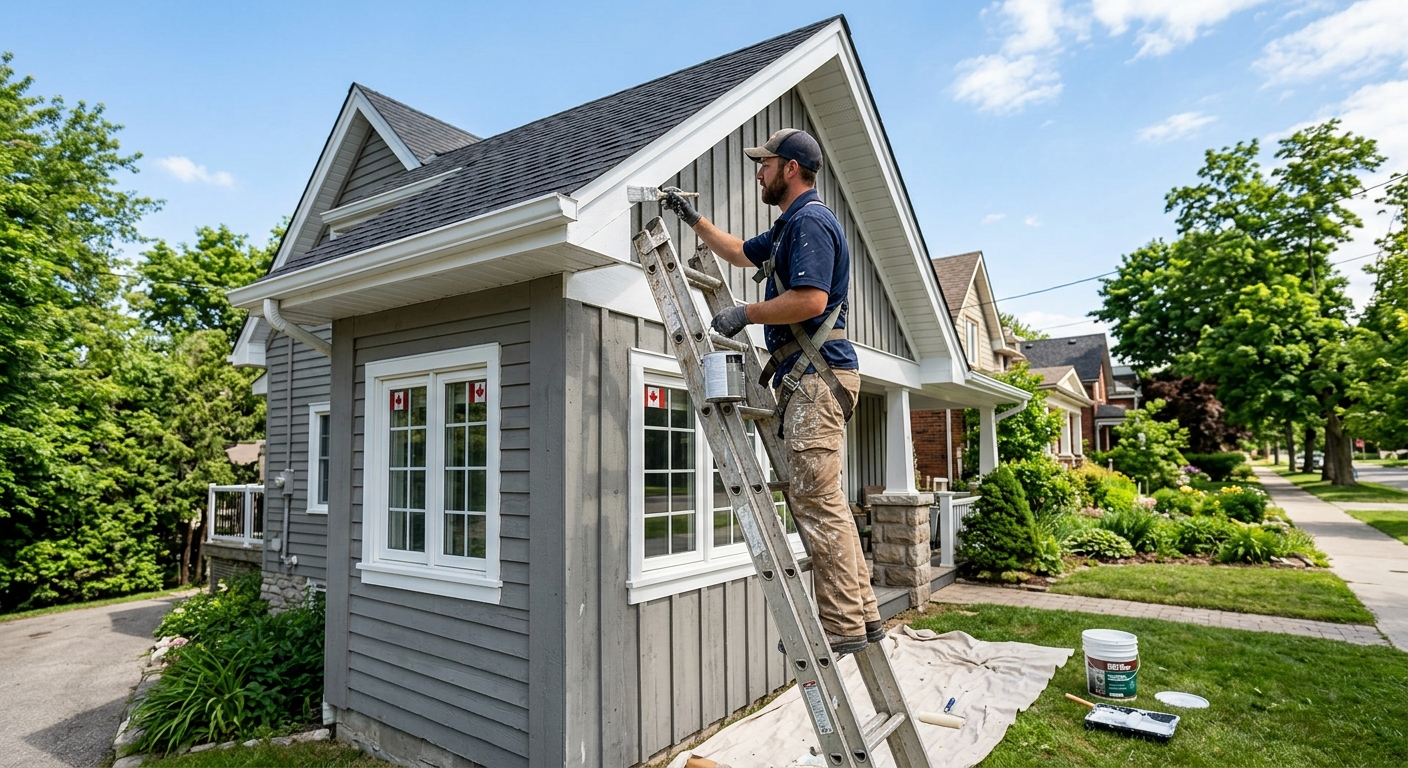
Painting options and costs in North Vancouver
North Vancouver homeowners usually ask the same question—“What will it cost to paint?”—but the answer depends on how much prep your home needs and how the coastal Lower Mainland–Southwest weather window affects scheduling. With 44.0% of local homes built before 1981, many properties carry older paint systems that require more surface scraping, sanding, patching, and stain-blocking primer before a finish coat can perform well. In a community with 14,535 homeowner households (Statistics Canada, 2021 Census), demand for quality painters is steady, and that can influence availability for tight weather periods around winter storms and summer humidity.
Costs in North Vancouver also reflect the trade-offs between interiors (less weather-dependent, more year-round) and exteriors (rain and humidity that slow drying and increase mildew risk). On the North Shore, crews commonly work out of neighbourhoods like Lower Lonsdale and the Grand Boulevard area, where older detached homes and character trim lead to heavier prep and more time on detail work. If you’re repainting, surface prep is often where the budget either rises (peeling, chalking, failed coatings, crack repairs) or stays controlled (clean adhesion, minor caulking and spot patching). Interior pricing is typically simpler to plan because you can shift work indoors during fall and winter, keeping production moving.
Below are realistic local ranges for common projects, so you can compare quotes apples-to-apples before we talk about your walls, trim, and the condition of the existing paint system.
| Service |
What's Included |
Typical Duration |
Price Range |
| Interior — whole home (walls, ceilings, trim) |
Move light furnishings, prep and patch, prime as needed, 2 finish coats, paint trim and doors (masking/edge work), clean-up |
5–12 days |
$3,500–$8,000 |
| Interior — per room (standard bedroom or living room) |
Prep and patch, prime spots only (as required), 2 finish coats on walls, edge work and standard trim coverage |
1–3 days |
$750–$1,800 |
| Exterior — full house (siding, trim, soffits) |
Power-wash, scrape/sand failing areas, caulk as needed, prime bare spots, mildew-resistant system, 2 finish coats (coordination around dry windows) |
7–20 days (weather dependent) |
$4,200–$15,000 |
| Exterior — trim and accent colours only |
Prep and spot prime, caulk accent changes, 2 finish coats on specified trim areas |
3–8 days |
$1,200–$4,800 |
| Kitchen cabinet painting (doors, frames, spray finish) |
Hardware protection, degrease, sanding, bonding primer, spray-ready prep, 2–3 coats system, re-install and light touch-ups |
4–12 days |
$2,200–$6,500 |
| Specialty / faux finish (accent wall, texture) |
Surface prep and smoothing, specialty base coat, application and sealing where needed, limited touch-ups |
2–7 days |
$600–$12,000 |
Prices are estimates only and vary by project scope, site access and material selection.
What affects the price of painting in North Vancouver
In North Vancouver and across the Lower Mainland–Southwest, you can see the same basic “paint the house” scope come back 30–50% apart, even when the colour looks identical. The main drivers are (1) how much prep is required on your specific walls and trim, (2) which products and sheen systems are included, and (3) how contractors manage wet-season scheduling and re-mobilization when drying windows shrink. In other parts of Canada—like Ontario and Alberta—builders plan around colder-season constraints; in coastal BC, the long damp shoulder seasons mean contractors must build risk management into the schedule and choose mildew-resistant, high-adhesion products that perform after repeated humidity exposure.
For example, older homes throughout the region (44.0% built before 1981) often need more scraping and priming, and that prep can become 50–70% of the labour on a repainting job. If your exterior includes peeling spots or tannin-stained wood, stain-blocking primer and additional spot priming raise the cost. If everything is well-adhered and just needs caulking and a maintenance repaint, pricing stays closer to the lower end of the exterior band (for trims and accents, $1,200–$4,800), rather than the full-house range (often $4,200–$15,000).
Two common North Vancouver scenarios show how local conditions move the number: (1) a bright, sunny day can allow interior crews to keep production steady, while (2) exterior work on cedar siding or fibre cement may stall if rain hits mid-coat, causing crews to return later—meaning extra mobilization and product waste. Also, multi-storey access around hillsides and rear lanes can require lifts and added protection, which increases labour without changing the paint amount.
| Price Factor |
Why It Matters |
Cost Impact |
| Surface prep — scraping, sanding, patching drywall or wood |
Determines whether new paint bonds; older coatings often fail in patches |
Can add 20–60% depending on adhesion and repairs |
| Number of coats — 2-coat system over primer vs. 1 coat over existing |
Coverage and durability depend on correct layering, especially after priming |
Typically increases cost by 10–25% when a true 2-coat system is required |
| Paint quality tier — contractor-grade vs. premium (Benjamin Moore, Sherwin) |
Premium coatings often cover better and resist staining/UV longer |
Usually shifts materials by ~5–20%, but can lower labour if fewer passes are needed |
| Ceilings and trim — adds significant time vs. walls-only |
Trim is time-intensive for masking, brushing, and detail accuracy |
Walls-only jobs can cost 15–40% less than whole-home wall+trim scopes |
| Exterior season window — short season raises summer rates |
Coastal humidity and rainfall slow drying; crews need dry stretches to finish safely |
Can add 10–30% during peak scheduling or when weather interrupts coats |
| Lead-safe precautions — required for pre-1978 homes with lead paint |
Extra containment, HEPA cleaning, and disposal time if lead paint is present |
Often adds 15–35% on older exterior or extensive interior scraping |
| Surface material — drywall vs. plaster vs. wood vs. stucco |
Each surface absorbs and bonds differently, affecting primer choice and prep |
Can swing labour by 10–40% based on repairs and adhesion issues |
| Height and access — multi-storey exterior requires scaffolding or lifts |
Safety setup and time to protect landscaping and contain dust |
Commonly adds $500–$3,000+ depending on access complexity |
Permits & regulations in British Columbia
In British Columbia, painting typically does not require a permit for normal residential work. For homes built before 1978, health guidelines recommend that lead paint be tested before sanding or scraping, and that lead-safe work practices are followed if lead is present. This is not something a homeowner is legally required to do in every case, but professional contractors should plan for it—using wet methods (to reduce airborne dust), HEPA vacuuming, proper containment and cleaning, and disposal procedures designed to keep contaminated debris under control.
What DOES require a permit is usually not the act of painting itself, but related work such as structural changes, major electrical/plumbing alterations, or certain accessory/renovation permits—your painter should clarify the scope in writing rather than assume. For the painting portion, the practical “compliance” items are your contractor’s credentials and jobsite controls.
Step-by-step for North Vancouver homeowners: (1) Verify the contractor’s British Columbia licence/registration details via the appropriate provincial online licensing information and check that the business is active for the trade they’re performing; (2) ask for a current certificate of liability insurance—confirm the policy covers residential work in BC and request to see it updated; (3) ask for proof of workers’ compensation coverage (WSIB/WCB coverage in their operating province—if they don’t carry coverage, you should pause); and (4) insist on a written contract stating paint brand line, sheen, number of coats, and the exact surface prep included (including priming and caulking scope).
Interior vs exterior painting — getting the best result in North Vancouver
In North Vancouver, the difference between a long-lasting paint job and early failure usually isn’t the “best” brand—it’s whether the surface prep and coat system match the moisture and temperature realities of the Lower Mainland–Southwest. For interiors, prep wins. Filling and sanding nail holes, smoothing patched drywall, and spot priming stains or patch compounds matters more than the topcoat label. Sheen choice also affects performance and cleaning: flat or matte often hides imperfections in low-traffic areas, while eggshell or satin handles fingerprints and wipe-downs better in kitchens, halls, and family rooms. Two coats applied over a properly primed surface consistently outlast one heavy coat because it builds uniform film thickness and reduces thin spots.
For exteriors, prep is even more critical in coastal BC. North Vancouver’s rain and humidity mean you must caulk before painting—so you seal joints and stop water ingress behind trim and around windows. Primer type must match the substrate: bare or stained wood often requires bonding/stain-blocking primer, while different primers improve adhesion to fibre cement, previously painted surfaces, or areas that have chalked. Mildew-resistant, high-adhesion products are the norm here because damp air and long drying cycles can lead to biological staining if the system isn’t built for it.
Cabinet painting can be a smart alternative to replacement when boxes are solid and doors are the main issue; it typically lands in the mid-range of the cabinet band ($2,200–$6,500) and can avoid full kitchen demolition costs and schedule disruption. For pre-1978 homes, lead-safe precautions should be planned if scraping or sanding is required—containment and cleanup time are part of a professional exterior repaint.
A practical dollar example: if your exterior estimate differs by $1,500, the justification is usually in prep (how much scraping/priming is included) and whether a true mildew-resistant system is specified. A cheaper quote that skips stain blocking or caulking often costs more later.
| Project Type |
Key Prep Step |
Recommended Coats |
Price Band |
| Interior — fresh drywall (new construction) |
Prime all new drywall and sand smooth; address joint compound texture |
1 primer + 2 finish coats |
$1,000–$3,500 |
| Interior — repaint (good condition, no repairs) |
Wash/degloss lightly, spot prime any marks, then sand touch-ups only |
2 finish coats (spot-prime as needed) |
$750–$2,400 |
| Interior — repaint (patching and priming needed) |
Patch drywall/wood, sand smooth, prime repaired areas and stain spots |
1 primer + 2 finish coats (varies by staining/repairs) |
$900–$3,200 |
| Exterior siding (wood or fibre cement) |
Power-wash, scrape failing coating, caulk gaps, prime bare spots |
2 finish coats over primer system |
$4,200–$15,000 |
| Exterior trim and accents only |
Detail sanding and caulking changes, spot prime to match existing adhesion |
2 finish coats |
$1,200–$4,800 |
| Kitchen cabinets (spray finish) |
Degrease + sand for bonding, bonding primer, controlled spray application |
2–3 coats system (primer + 2 finish coats) |
$2,200–$6,500 |
How to choose a painting contractor in North Vancouver
Start by verifying credentials the way a homeowner in North Vancouver should: (1) Licensing/registration—check the contractor’s British Columbia registration details on the relevant provincial registry for the type of work they’re advertising, and make sure the business name and address match their proposal; (2) Liability insurance—ask for a current certificate of insurance (and confirm it’s for residential painting work in BC); and (3) Workers’ compensation coverage—request proof they carry the required coverage for their workers so you’re not left holding risk if someone is injured on site.
Next, get 2–3 quotes that are actually comparable. Ask for itemised written estimates with a labour + materials breakdown (not a lump sum) and clear line items for prep (scraping, sanding, caulking, priming), how many coats are included, and whether ceilings/trim are in scope. Confirm what’s excluded: furniture moving beyond light coverage, lead-safe containment, disposal, power washing, patch repairs, or specialty finishes. For exteriors, ask how they schedule around rain windows and whether they re-mobilize if a coat must be redone due to moisture; for interiors, ask about dust containment and floor/door protection.
On warranty, demand workmanship coverage in writing (how long, what it covers, and whether it’s transferable if you sell). For payment, never let a contract require more than about 10–15% upfront; hold back enough to protect quality until the walkthrough is complete. Also, request a start date and completion estimate in writing.
- Written scope that names rooms/areas, trim coverage, and sheen (e.g., eggshell vs. satin)
- Surface prep responsibilities spelled out (spot prime vs. full prime)
- Caulking included for exterior joints and window/trim transitions
- Disposal and protection duties listed (covers, drop sheets, and cleanup)
- Clear paint brands/lines specified (not “paint of equal quality”)
- Number of coats stated for every surface
- Lead-safe plan mentioned for pre-1978 homes if scraping/sanding is required
- Insurance and workers’ compensation proofs requested before signing
- On exterior jobs: drying-weather approach and recoat timing explained
- Jobsite communication plan (who to call if conditions delay work)
- Warranty length on workmanship and what failures are covered
- Payment schedule with a holdback until final inspection
Red flags in North Vancouver: (1) a quote that promises “no prep” or minimal priming; (2) no written scope or unknown paint brands; (3) refusal to show liability insurance or proof of workers’ coverage; (4) asking for large upfront payments; and (5) vague statements like “we’ll do whatever it takes” without timelines or coat counts.
Frequently asked questions — painting in North Vancouver
How much does interior painting cost per room in North Vancouver?
For a typical North Vancouver interior room—like a standard bedroom or living room—professional painting commonly lands around $750–$1,800 per room. This depends heavily on surface condition and prep: if there’s good adhesion, minimal patching, and you’re painting walls with standard trim coverage, pricing tends to sit near the lower half. If you need wall repairs, more sanding, spot priming for stains or patched drywall, or additional trim/door work, the number moves upward. In the Lower Mainland–Southwest, interior labour is less weather-constrained than exteriors, so you usually pay mainly for prep time and the sheen/quality of the paint system rather than for weather-driven rescheduling.
When is the best time for exterior painting in North Vancouver?
In North Vancouver, the best exterior painting timing is when you can reliably schedule dry weather stretches with lower humidity, so coats can dry to recoat readiness. Coastal BC generally allows more flexibility than the Prairies, but rain and damp air can still slow drying and increase mildew risk—so professional crews often plan around forecast windows rather than a single fixed month. Practically, you’ll usually see best results when exterior work is scheduled from late spring into summer, and when there’s a clear weather run for primer and finish coats. If your home is older (many are built before 1981, Statistics Canada, 2021 Census), prep and priming steps take longer, so earlier booking helps avoid “waiting out” weather.
How many coats of paint do I need?
Most reputable residential systems in North Vancouver use a 2-coat finish plan. If the existing paint is failing, bare wood is exposed, or you’re patching/replacing drywall, you typically also need a primer step, resulting in 1 primer coat plus 2 finish coats. The exact approach depends on coverage and adhesion: a repaint with no repairs may only need 2 finish coats, while a repaint with significant patching and staining often requires spot priming for uniform colour and bond. Avoid “one thick coat” shortcuts—especially on exteriors—because thin spots and uneven film build are what cause early peeling or discoloration in coastal humidity.
What paint is best for North Vancouver's climate?
In North Vancouver and the Lower Mainland–Southwest, the best-performing choice is a coating system designed for damp/coastal conditions: mildew-resistant options for exterior walls and trim, plus high-adhesion primers matched to the substrate (wood, fibre cement, or previously painted surfaces). For interiors, the “best” paint is usually the right sheen by room and family use—eggshell or satin for wipeability in hallways and living areas, and flatter sheens where you want to minimize shine. Quality matters, but prep matters more: proper cleaning, scraping failing areas, and priming bare spots are what keep paint from bubbling or chalking under repeated humidity.
How long does exterior paint last here?
With correct prep and a coastal-appropriate system, many exterior repaint jobs in North Vancouver perform reasonably for years, but the exact lifespan depends on moisture exposure, siding condition, and how much prep is required. Homes with heavy failing coatings, neglected caulking, or unaddressed moisture ingress will shorten service life even if the paint is premium. That’s why your estimate should include power washing, scraping/sanding of failing areas, caulking, and primer on bare spots. If those steps are skipped, you may see premature wear and mildew staining. When you compare quotes, look for whether a full mildew-resistant primer/finish system is included—not just the topcoat price.
Should I paint or replace my cabinets?
In North Vancouver, painting cabinets is often the smart choice when the box frames are solid and the doors or finish are the main issue. A professionally sprayed cabinet painting job typically ranges around $2,200–$6,500, which can be less disruptive than replacement and avoids countertop/labour changes that often come with a full kitchen refresh. Painting is less ideal if the cabinet boxes are warped, the hardware mounting is failing, or the doors are severely damaged. The key is prep: degreasing, sanding for bonding, priming, and then multiple controlled finish coats. If a quote underestimates prep time, that’s a sign you may pay again later due to peeling or rough texture.