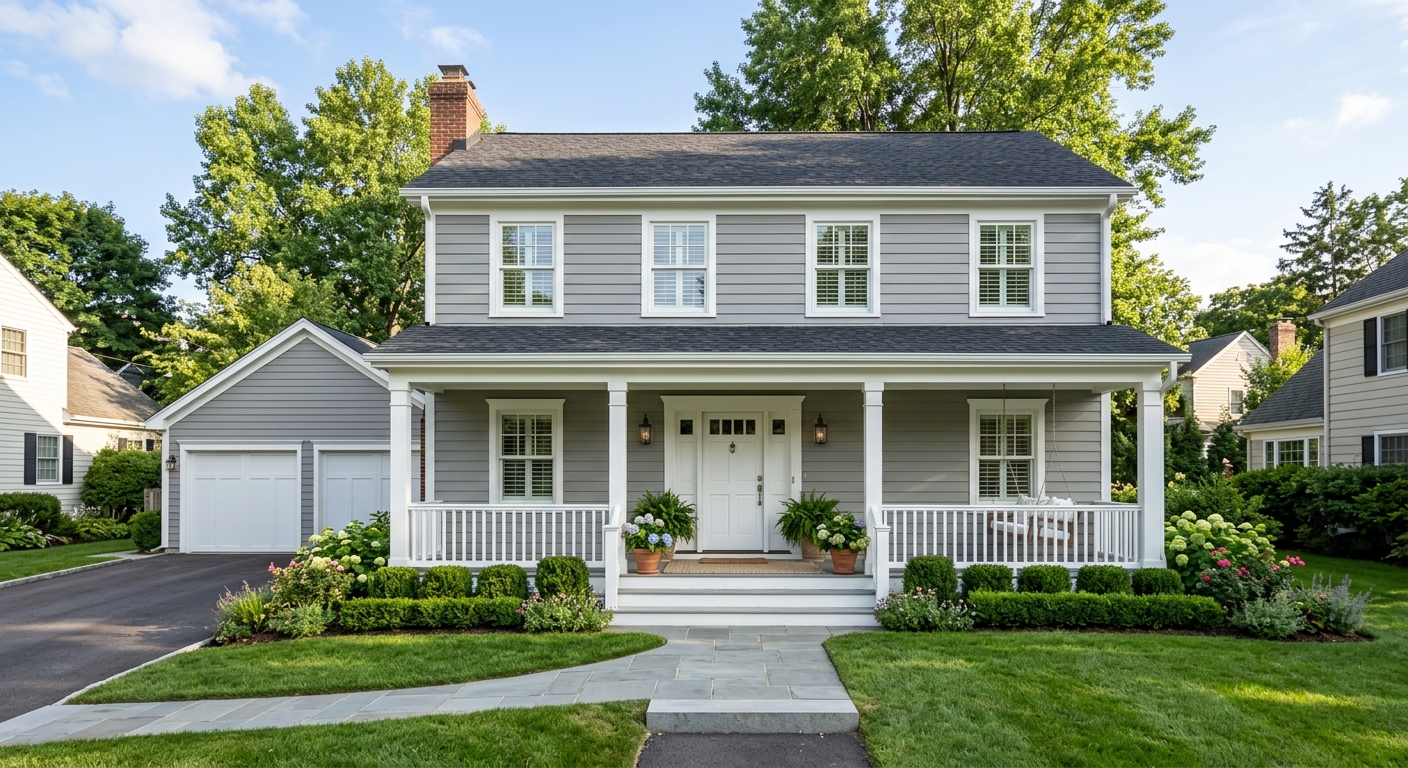
Painting options and costs in Highlands
In Highlands, painting costs usually start with scope, but they’re shaped just as much by timing and prep. About 25.0% of local homes were built before 1981, so many projects include extra scraping, patching, caulking, and priming to stabilise weathered surfaces. On older properties (especially pre-1978), professionals commonly plan for lead-safe practices around sanding or scraping, even when the homeowner is not legally required to do so.
On Vancouver Island and the Coast, exterior work is tightly weather-windowed. Crews aim for stretches with temperatures roughly between 10°C and 30°C and manageable humidity because exterior coatings need several dry hours to apply and at least a full day above 10°C to cure properly. Coastal morning dew, frequent rain, and higher moisture levels can slow progress and increase material choices—mildew-resistant, high-quality coatings are the norm. Demand is especially high around Highlands neighbourhood blocks near the shopping/convenience core, where older stock and frequent repaint cycles keep painters booked during late-spring to early-fall.
That’s why two quotes for the “same colour” can differ: one crew may price more time for prep and coating system quality. Use the table below as a baseline, then we can narrow it down after a site check.
| Service |
What's Included |
Typical Duration |
Price Range |
| Interior — whole home (walls, ceilings, trim) |
Move/cover light contents, patch & sand as needed, caulk where appropriate, prime minor bare spots, 2-coat walls/ceilings, paint trim/doors, clean-up and protection removal. |
5–12 business days |
$3,800 – $6,500 |
| Interior — per room (standard bedroom or living room) |
Prep/patching (minor), prime bare spots, 2-coat walls, paint trim/doors where specified, protect floors and fixtures, clean-up. |
2–4 business days |
$2,000 – $3,800 |
| Exterior — full house (siding, trim, soffits) |
Power wash, scrape/sand peeling areas, caulk gaps, spot-prime, prime where needed, 2-coat siding/trim/soffits, final detail touch-ups, disposal and site clean. |
7–18 business days (weather-dependent) |
$6,000 – $12,000 |
| Exterior — trim and accent colours only |
Clean, scrape/sand as required, caulk, spot prime, 2-coat trim/accent areas, careful masking for clean lines. |
3–7 business days (weather-dependent) |
$3,500 – $6,800 |
| Kitchen cabinet painting (doors, frames, spray finish) |
Degrease, de-tension/label where needed, light sanding, cabinet-grade primer, spray or brushed finish, 2-coat system, hardware protection, re-install. |
5–12 business days |
$1,800 – $5,000 |
| Specialty / faux finish (accent wall, texture) |
Surface prep for finish to “read” correctly, base coat colour, multi-step application, controlled dry times, clear protection where appropriate. |
2–10 business days |
$900 – $4,500 |
Prices are estimates only and vary by project scope, site access and material selection.
What affects the price of painting in Highlands
In Highlands and across the Vancouver Island and Coast region, the same paint job can land 30–50% apart between contractors because prep time, coating systems, and scheduling risk are priced differently. Exterior pricing is the most sensitive. On the coast, contractors typically work within short, reliable weather stretches—roughly daytime conditions around 10°C+ with reasonable humidity—because coatings need time to dry and then cure. Coastal BC’s marine conditions add dew and rain risk, so crews often build in extra contingency days and choose mildew-resistant coatings designed for damp environments. By contrast, the demand compression pushes peak-season labour rates up; when the season is short, painters book tighter schedules and charge accordingly.
Older housing stock is another major driver. Many homes in the area include siding/trim that’s been repainted more than once, meaning more scraping, sanding, caulking, and priming. On a repainting job, prep can represent 50–70% of labour. In dollar terms, that’s how an exterior job can move from around $6,000 toward $12,000—not because paint got more expensive, but because time on labour-intensive prep increased.
Here are concrete local examples of cost swing. A house with failing caulking at window trim often needs re-caulking before paint; ignoring it leads to bubbling and higher rework later. Similarly, pre-1981 properties (25.0% locally) may require additional lead-safe procedures during aggressive scraping, which increases labour and cleanup time. On the flip side, a newer, well-maintained home that only needs cleaning and light sanding can stay closer to the lower end of interior ranges like $2,000 per room or under $6,500 for whole-home work.
| Price Factor |
Why It Matters |
Cost Impact |
| Surface prep — scraping, sanding, patching drywall or wood |
Determines adhesion and long-term durability; coast moisture exposes weak spots. |
Often the biggest driver (adds the equivalent of hundreds to thousands). |
| Number of coats — 2-coat system over primer vs. 1 coat over existing |
Proper hiding usually requires a primer + two finish coats, especially over stains. |
Can change total cost by 15–30% for similar areas. |
| Paint quality tier — contractor-grade vs. premium (Benjamin Moore, Sherwin) |
Premium coatings typically flow better, resist mildew better, and cover with fewer defects. |
Material cost rise, often partly offset by smoother application. |
| Ceilings and trim — adds significant time vs. walls-only |
Trim lines and ceiling cuts require more masking, precision, and dry-time management. |
Commonly adds hundreds per room; whole-home can add $1,000+. |
| Exterior season window — short season raises summer rates |
Weather risk means crews schedule tightly and may carry standby costs. |
Can push exterior pricing toward the top band in peak weeks. |
| Lead-safe precautions — required for pre-1978 homes with lead paint |
May require containment, HEPA vacuuming, and proper disposal during sanding/scraping. |
Often adds labour and cleanup time; varies by condition and scope. |
| Surface material — drywall vs. plaster vs. wood vs. stucco |
Different substrates need different primers and prep methods for adhesion. |
Can shift both labour and material selection by hundreds. |
| Height and access — multi-storey exterior requires scaffolding or lifts |
Access affects safety and labour time; masking and protection increase effort. |
Major swing factor on exterior, especially on taller elevations. |
Permits & regulations in British Columbia
In British Columbia, painting typically does not require a municipal building permit for homeowners. The main “regulatory-like” considerations are health and safety. For homes built before 1978, health guidelines strongly recommend testing for lead paint before sanding or scraping, and using lead-safe work practices if lead is present. In professional settings, that usually means wet methods to reduce dust, HEPA vacuuming, and proper bagging/disposal. It’s not generally something homeowners are forced to do by law for a DIY project, but it is standard practice for contractors and the safest approach when disturbing older paint.
What DOES commonly require permitting is not painting itself, but related work such as electrical/mechanical changes, structural modifications, or certain large-scale environmental abatement scenarios. Simple repainting, caulking, and cosmetic surface prep generally do not.
Before work starts in Highlands, confirm three things. First, ask for their liability insurance certificate (you should see your address listed as the jobsite). Second, verify they have workers’ compensation coverage (WSIB/WCB—naming varies by jurisdiction/coverage setup, but the contractor should provide proof). Third, request a written contract that specifies paint brand/line, sheen, the number of coats, the surface prep included, and whether power washing, disposal, and masking are part of the scope.
To verify: check for any contractor standing/licence details through provincial contractor registry listings, then ask the contractor for certificates of insurance and clearance/coverage proof. If they can’t provide documentation before quoting, treat that as a red flag.
Interior vs exterior painting — getting the best result in Highlands
The difference between a long-lasting paint job and premature failure in Highlands is usually prep discipline and the right system for the surface—not the “brand” alone. Inside, proper filling, sanding, and spot-priming determine how smoothly walls look and how well paint grips. Sheen choice matters for wear: flatter sheens hide wall imperfections but can scuff in high-touch areas; eggshell or satin typically performs better for living spaces, hallways, and family rooms. For bathrooms and basements where moisture and mildew risk is higher, crews often recommend mildew-resistant formulations and appropriate sheen. Regardless of topcoat, two coats over a proper primer generally outlasts one heavy coat because coverage and durability improve when the paint film has the correct thickness from multiple applications.
Outside, British Columbia’s marine conditions make prep non-negotiable. Caulking should be addressed before painting to prevent water ingress behind trim and siding. Primers are substrate-specific: oil-based primers can be used on certain stains/woods, while latex systems are common for many repaint situations—your painter should match the primer to the material and existing coating condition. Mildew-resistant topcoats and temperature-stable products matter because coastal humidity and coastal dew can interfere with dry time and film formation. For trim and accents, careful masking is what keeps lines crisp and reduces touch-ups later.
Cabinet painting is a cost-smart alternative to replacement when frames and doors are structurally sound; a well-prepped, spray-finished cabinet system commonly sits in the $1,800 – $5,000 range. If your cabinets are warped, separating at the joints, or the finish is failing from moisture, replacement or deeper renovation may be the better value.
For pre-1978 homes, lead-safe precautions should be planned around sanding/scraping so the job is safer and cleaner—especially where older paint is peeling or flaking.
| Project Type |
Key Prep Step |
Recommended Coats |
Price Band |
| Interior — fresh drywall (new construction) |
Prime bare drywall + fill nail/screw pops, then sand smooth for an even sheen |
1 primer + 2 finish coats |
$3,000 – $6,500 |
| Interior — repaint (good condition, no repairs) |
Light sanding/degloss + caulk where needed, then prime only bare spots |
2 finish coats (primer as needed) |
$2,000 – $4,800 |
| Interior — repaint (patching and priming needed) |
Patch, sand, spot-prime to prevent flashing and haloing |
1 spot-primer + 2 finish coats |
$2,800 – $6,500 |
| Exterior siding (wood or fibre cement) |
Scrape/spot-sand peeling areas + caulk gaps + full system primer where required |
2 finish coats + primer as specified |
$6,000 – $12,000 |
| Exterior trim and accents only |
Mask carefully and prep edges to prevent bleeding at caulk lines |
2 finish coats (with spot-priming) |
$3,500 – $6,800 |
| Kitchen cabinets (spray finish) |
Degrease + sand/prime for adhesion before spray topcoat |
Primer + 2 finish coats |
$1,800 – $5,000 |
How to choose a painting contractor in Highlands
Choosing the right painter in Highlands is mostly about proof. In British Columbia, confirm three coverage items before you commit: (1) licensing/registration where applicable for the contractor’s business status, (2) liability insurance and (3) workers’ compensation coverage (WSIB/WCB—contractors should provide proof). How to check: ask for the certificate of insurance and verify it’s active and includes your project as a named certificate-holder/jobsite as applicable. Then request a clearance letter/proof of coverage from the workers’ compensation system the contractor uses, and keep it with your contract paperwork. Finally, verify any licensing/registration details using the provincial online registry pages tied to the company name and/or contractor identifier.
Next, get 2–3 itemised written quotes. You want line items that separate labour and materials, and a clear scope list: prep work (power washing, scraping, sanding, patching, caulking), primer type, brand/line of paint, sheen, number of coats, masking, and disposal. Avoid “lump sum only” proposals that don’t say what’s included.
Look for warranty terms that match the work: workmanship warranty length, whether it covers peeling/failure from prep problems, and whether manufacturer paint warranties apply. Confirm whether the warranty is transferable if you sell the home. For payment, keep it safe: never pay more than 10–15% upfront; hold back until the job is complete, cleaned, and inspected. Require a written start date and completion estimate—coastal weather can shift start times, but a good contractor will document contingencies.
- Itemised quote with paint brand/line, primer specs, sheen, and coat count
- Clear prep scope (what gets scraped/sanded, caulking locations, spot-priming rules)
- Disposal included (paint waste and masking debris), not “by homeowner”
- Written protection plan (floors, landscaping, windows, door hardware)
- Photos of similar recent Highlands/coastal jobs, not just promotional images
- Proof of liability insurance and workers’ compensation coverage
- Confirm lead-safe approach for pre-1978 where sanding/scraping is involved
- Detailed timeline with weather-buffer notes for exterior
- Warranty details in writing (workmanship + product/manufacturer warranty terms)
- Paint tinting and sample procedure for final colour approval
- Payment schedule that protects you (small deposit, holdback, final sign-off)
- Site access plan (lifts/scaffolding) if exterior includes second storey work
Red flags I see in Highlands: (1) they won’t provide insurance/coverage proof, (2) they quote exterior without discussing scraping/priming and weather days, (3) “one coat covers everything” promises, (4) no written prep/disposal scope, and (5) asking for large upfront payments (well beyond 10–15%).
Frequently asked questions — painting in Highlands
How long does it take to paint a house?
In Highlands, interior timelines are typically driven by room count and how much patching/priming is needed. For example, a whole-home interior typically lands in the $3,800 – $6,500 range and often takes about 5–12 business days depending on trim detail and how many coats are required to achieve a uniform finish. Exterior timelines are more weather-dependent. On Vancouver Island and the Coast, crews usually schedule exterior painting during late-spring to early-fall when temperatures are roughly in the 10°C to 30°C window and humidity is manageable; frequent rain, morning dew, and curing time can extend the calendar even if workdays are steady. If your home needs extensive prep (common on older stock—25.0% built before 1981 in the local profile), add time for scraping, caulking, priming and spot repairs.
What's the difference between paint quality tiers?
Paint quality tiers mostly affect coverage, durability, and application behaviour. Premium contractor lines often lay down smoother, resist mildew better in damp conditions, and tend to have improved hide—meaning fewer defects and fewer “watch spots” after drying. Contractor-grade paints can be perfectly fine for many interiors, especially when prep is done correctly and you use the right primer and number of coats. For exteriors in coastal British Columbia, coating performance matters because moisture and dew influence film formation; that’s why many crews favour mildew-resistant, higher-quality systems for siding and trim. In pricing, you’ll see this reflected in bands like $6,000 – $12,000 for exterior full-house work, where the system quality and the labour time to prep properly usually justify the difference.
How do I compare painting quotes?
To compare quotes in Highlands, don’t compare only the total number—compare the scope. Ask each contractor the same questions: What’s included in surface prep (power wash, scrape/sand to sound material, patching, caulking)? Which primer is used and where is it required? How many coats on siding/trim and how many coats on walls/ceilings? Are ceilings and trim included, and are doors included? Confirm the exact paint brand/line and sheen. Also check exclusions: disposal, masking, minor repairs, and whether lead-safe precautions are planned for pre-1978 areas that may be disturbed. A quote that’s lower because it “doesn’t include prep” often fails earlier in BC’s humidity and can cost more later. Choose the quote that’s detailed and consistent, not the one with the most vague wording—even if it lands near the same band like $3,500 – $6,800 for trim/accent-only exterior painting.
What paint sheen should I use in different rooms?
In a coastal climate like Highlands (Vancouver Island and the Coast), sheen choice is about washability, light reflection, and how the surface imperfections show. Typically, flat/matte helps hide wall imperfections but is less scuff-resistant. Eggshell or satin is a strong fit for living rooms and bedrooms because it balances cleanability with a soft look. Kitchens and hallways usually benefit from satin or semi-gloss on trim and higher-touch areas because wipe-down resistance matters. Bathrooms and basements should use a mildew-resistant coating suited to damp environments, and many homeowners choose an appropriate sheen that won’t highlight patching marks. If you want a crisp, wipe-clean look on trim and doors, semi-gloss (or the product’s recommended equivalent) is common. Regardless of sheen, two coats over a proper primer is what prevents uneven sheen patches over time.
Can I paint my house exterior in spring or fall in Highlands?
Yes, but timing is everything in British Columbia. In Highlands, exterior painting works best when the day-to-day conditions support proper drying and curing: roughly 10°C and rising during application, manageable humidity, and enough dry hours between coats. Spring can be workable if temperatures hold steady and rain doesn’t interrupt the cure window; fall can also work in stretches, but dew and earlier wet spells can slow progress. Coastal conditions mean rain and morning dew are common, so contractors often build schedules around forecasts and may extend the calendar if storms roll in. If you’re targeting exterior work, booking early in the late-spring to early-fall window can reduce schedule risk and helps you get more competitive pricing within the exterior range of about $6,000 – $12,000. Always ask for the plan for delays and re-scheduling.
How do I choose a painting contractor in Highlands?
Start with verification. Ask for proof of liability insurance and workers’ compensation coverage (WSIB/WCB—contractors should provide documentation). Then confirm they can show a clear, written scope and timeline. For homeowners in British Columbia, you should also expect lead-safe practices for homes built before 1978 if sanding/scraping is involved; that includes wet methods/HEPA vacuuming and proper disposal when lead is present (recommended by health guidelines for professionals). Get 2–3 itemised quotes separating prep work, primer, paint brand/line, sheen, and coat count—don’t accept vague “materials included” language. Review workmanship and product warranty terms, and make sure payment stays conservative: no more than 10–15% upfront, and keep a holdback until you’ve inspected the completed work. Finally, if you’re comparing pricing, use the band context—exterior full-house painting often sits around $6,000 – $12,000 depending on prep and coating system quality.