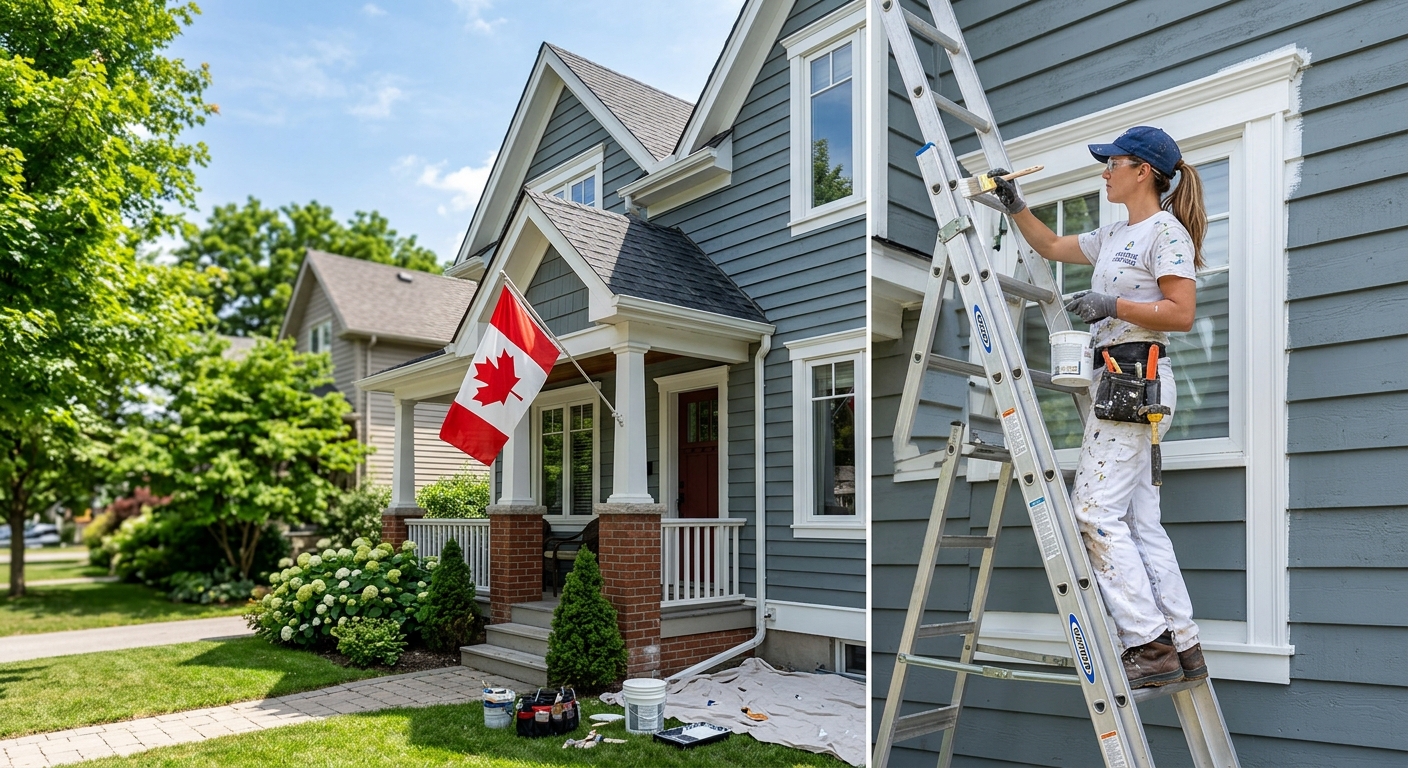
Painting options and costs in Coldstream
Coldstream homeowners typically have a few practical painting pathways to choose from—freshening interiors, refreshing trim, or taking on a full exterior repaint. With 3,675 homeowner households and most homes being single-detached (82.8% of dwellings), many projects are straightforward in layout, but the prep workload can still vary a lot. Coldstream also has a large older housing base: 45.2% of homes were built before 1981, and that often means more time spent scraping loose paint, patching, caulking, and priming before colour coats. In older homes, contractors may also use lead-safe work practices if pre-1978 coatings are present, even though the work is typically not permitted in British Columbia.
In the Thompson–Okanagan region, exterior painting costs are shaped by scheduling reality. Exterior work is generally compressed into a late spring–early fall window when surfaces are dry and temperatures stay above freezing. That concentrated demand can put pressure on summer crew availability, especially in neighbourhood pockets like West Coldstream, where older homes and larger lots often drive more frequent repaint cycles. If the job is urgent or weather windows are tight, pricing can move toward the higher end of the band—particularly for full-house exterior work that needs careful prep and multiple coats.
Use the table below as a realistic starting point for planning your scope, materials, and timeline in Coldstream, then discuss site conditions with your painter for a tighter estimate.
| Service |
What's Included |
Typical Duration |
Price Range |
| Interior — whole home (walls, ceilings, trim) |
Prep/patching, sanding, caulking, primer where needed, wall/ceiling paint, trim/door touch-ups or full trim coat, dust control, basic cleanup |
4–10 days |
$1,800–$6,000 |
| Interior — per room (standard bedroom or living room) |
Prep/patching, primer where needed, paint on walls and ceiling, optional trim brush work (may be touch-up vs full coat depending on scope) |
1–3 days |
$250–$1,200 |
| Exterior — full house (siding, trim, soffits) |
Surface inspection, scraping/sanding, patching, caulking where needed, primer system for substrate, 2-coat exterior finish, protection for landscaping/windows, cleanup |
5–14 days |
$3,500–$12,000 |
| Exterior — trim and accent colours only |
Light prep, spot-prime as required, 2-coat brush/roll finish on trim accents (not full siding repaint) |
2–6 days |
$800–$3,500 |
| Kitchen cabinet painting (doors, frames, spray finish) |
Hardware removal, degreasing, sanding/abrading, bonding primer, sprayed finish, reinstallation, optional minor repairs to doors |
4–12 days |
$2,000–$5,000 |
| Specialty / faux finish (accent wall, texture) |
Surface prep tailored to the product, base coat, specialty texture/application, sealing/topcoat, cleanup |
1–5 days |
$300–$6,000 |
Prices are estimates only and vary by project scope, site access and material selection.
What affects the price of painting in Coldstream
In Coldstream and across the Thompson–Okanagan, it’s common to see quotes for the “same” job differ by 30–50% once you compare prep, product system, and access. Exterior jobs especially swing because the exterior painting season is tightly climate-bound in the region: in many interior BC areas, crews rely on a late spring–early fall stretch when temperatures stay reliably above freezing and rain is intermittent enough for proper drying and cure. In Ontario and Alberta, the window is often roughly late May to early October and requires above-10°C conditions during application; in comparison, coastal BC may have a longer season but more humidity and mildew risk. In Coldstream, that means painters often book fast in peak summer, and urgent work can carry a premium.
Older housing stock is another cost driver. With many homes built before 1981 (45.2% citywide), scraping and sanding loose paint, caulking gaps, and spot-priming become standard steps. On repainting jobs, surface prep can reach 50–70% of total labour—so a “fresh coat” that turns into patching and primer work naturally moves you toward higher price points. For example, a typical exterior full-house repaint can land anywhere from about $3,500 up to $12,000 depending on how much prep is required, while an interior whole-home repaint might range from roughly $1,800 to $6,000 based on ceiling/trim workload and repair needs.
In Coldstream specifically, two conditions often push costs up: (1) sun-chalking and multiple existing paint layers that increase scraping time, and (2) wood and trim movement near eaves where caulking failures allow moisture intrusion. Costs can be lower when surfaces are sound, previous coats are well-bonded, and access is easy (single-storey, minimal landscaping disruption).
| Price Factor |
Why It Matters |
Cost Impact |
| Surface prep — scraping, sanding, patching drywall or wood |
Determines adhesion and how evenly paint lays; older coatings often require more labour |
Often the largest driver; can move a quote by 20–40% |
| Number of coats — 2-coat system over primer vs. 1 coat over existing |
Coverage and uniformity depend on substrate and how much colour change is needed |
+10–25% if primer/re-coat requirements change |
| Paint quality tier — contractor-grade vs. premium (Benjamin Moore, Sherwin) |
Higher-end coatings tend to cover better, resist scuffing and fading longer |
Materials shift can add ~5–15% overall |
| Ceilings and trim — adds significant time vs. walls-only |
Ceilings and detailed trim increase masking, cutting-in time and finishing passes |
Can add 15–30% for trim-heavy homes |
| Exterior season window — short season raises summer rates |
Weather-dependent scheduling concentrates demand in late spring to early fall |
Urgent jobs may see 10–25% premiums |
| Lead-safe precautions — required for pre-1978 homes with lead paint |
Containment, HEPA vacuuming and disposal increase labour and setup time |
Typically +10–20% where lead-safe methods are needed |
| Surface material — drywall vs. plaster vs. wood vs. stucco |
Different substrates require different adhesion/bonding primers and application |
Can change prep steps by 10–30% |
| Height and access — multi-storey exterior requires scaffolding or lifts |
Access affects safety, pace and equipment rental |
Often +10–30% depending on lift/scaffold needs |
Permits & regulations in British Columbia
In British Columbia, painting typically does not require a permit for standard interior or exterior work. Where rules do matter is in health and safety practices—especially for older homes. For homes built before 1978, health guidelines recommend testing for lead paint before sanding, scraping, or aggressive surface prep. If lead is present (or suspected), responsible contractors use lead-safe work practices such as wet methods to reduce airborne dust, HEPA vacuuming during dust-generating steps, and proper disposal of debris. This isn’t usually a legal requirement for homeowners, but it is standard practice for professional contractors because the work can be high-risk.
Separately, confirm your contractor carries liability insurance and has workers’ compensation coverage (WCB) so you’re protected if something goes wrong on site. For your written contract, ask for specifics: paint brand and line, sheen selections, number of coats, prep scope (what gets scraped/sanded/primed), and whether caulking is included. Even without permits, a clear scope prevents disputes.
What typically requires a permit: major structural changes, demolition, or any work that changes building systems. Painting itself generally does not.
How to verify a contractor in Coldstream: check the contractor’s licensing/registration status using the relevant BC trade registry entry (search the business name), request a current certificate of liability insurance (date and coverage limits visible), ask for proof of WCB coverage (the clearance/status document), and ensure the certificate matches the legal business name on the contract.
Interior vs exterior painting — getting the best result in Coldstream
In Coldstream’s Thompson–Okanagan climate, the difference between a long-lasting paint job and premature failure is mostly prep and system selection—not marketing. For interior painting, the top outcomes come from proper filling, sanding, priming and caulking before colour goes on. A beautiful brand-name paint won’t correct problems like cracking, stains, or uneven sheen if the substrate wasn’t prepared. Sheen also matters by room: flat or eggshell is common for ceilings and lower-traffic walls, while satin or semi-gloss is often better for trim and higher-touch areas. And there’s a straightforward reality: two coats over the right primer (even when you’re using a premium product) typically outlast a “one heavy coat” approach that can trap thin areas and flash unevenly.
For exteriors, the critical step is surface prep in BC conditions: scrape what’s failing, sand edges smooth, patch and caulk to prevent water ingress, and use the right primer for the substrate (and for bonding over prior coatings). In British Columbia, mildew-resistant products and correct drying/cure windows help prevent adhesion failures and blistering when humidity swings. If you’re comparing options, you’ll often see exterior pricing start in the lower band only when surfaces are sound; once you’re closer to the high end of the exterior range, it’s usually because primer/caulking/scraping workload increased. For instance, upgrading from a minimal prep repaint to a full prep and primer system can justify moving from roughly the lower portion of the exterior band (near $800 for trim/accent work) up toward a full-house exterior repaint that commonly sits around $3,500–$12,000.
Cabinet painting is a budget alternative to replacement when cabinet boxes are solid: you preserve layout and avoid demolition, but you still need degreasing, sanding/abrading, bonding primer and a durable finish. For pre-1978 homes, lead-safe precautions should be discussed for any scraping that creates dust.
| Project Type |
Key Prep Step |
Recommended Coats |
Price Band |
| Interior — fresh drywall (new construction) |
Seal drywall and spot-prime joints/patches for uniform absorption |
Primer + 2 colour coats (or 1 primer + 2 coats as system specifies) |
$3,000–$6,000 |
| Interior — repaint (good condition, no repairs) |
Clean, light sand/scuff, caulk minor gaps, spot-prime stains if needed |
1 primer/spot-prime + 2 colour coats |
$1,500–$3,800 |
| Interior — repaint (patching and priming needed) |
Full patching, sand smooth, prime repaired areas for consistent sheen and coverage |
Primer + 2 colour coats (often more spot-prime for repairs) |
$2,000–$5,200 |
| Exterior siding (wood or fibre cement) |
Scrape/repair failing areas, sand edges, caulk seams, prime correctly for substrate |
2 colour coats over primer system |
$3,500–$12,000 |
| Exterior trim and accents only |
Spot-prep and prime bare/failed areas; caulk cracks before topcoat |
2 colour coats over spot-priming |
$800–$3,500 |
| Kitchen cabinets (spray finish) |
Degrease thoroughly, abrade surfaces, bonding primer for strong adhesion |
Primer + 2 colour coats (system-dependent) |
$2,000–$5,000 |
How to choose a painting contractor in Coldstream
Choosing the right painter in Coldstream starts with verification. In British Columbia, confirm the contractor’s business is properly registered/licensed for the scope they’re doing, then request their certificate of liability insurance and proof of workers’ compensation coverage (WCB). The easiest way to check is to ask for documents before scheduling: (1) look for an active, current liability certificate showing the insured entity name; (2) request WCB proof/clearance showing coverage; and (3) verify the business name on the contract matches the named insured on the insurance.
Next, get 2–3 itemised written quotes rather than one lump sum. The best quotes separate labour and materials, list paint brands and sheens, and include prep steps (scraping, sanding, caulking, priming) so you can compare “like for like.” Carefully read the exclusions: is disposal included, is power washing included, are rotted boards replaced, is caulking included or only “as needed,” and what happens if weather disrupts an exterior schedule?
Warranty should be clear. Ask for the workmanship warranty length (how long they stand behind prep and application) and whether product/manufacturer warranty applies directly and how it’s handled if you sell the home—some are transferable with paperwork. Payment schedule should be conservative: never pay more than 10–15% upfront, and use a holdback until the job is complete and cleaned up.
Finally, timeline matters in Thompson–Okanagan because exterior windows are short. Request the start date and a completion estimate in writing, plus a plan for weather delays.
- Request proof of WCB coverage and liability insurance before work begins.
- Match the legal business name on the certificate to the contract.
- Ask for an itemised quote showing labour and material line items separately.
- Confirm paint brand/line, sheen levels, and the exact number of coats.
- Confirm the prep scope: scraping, sanding, patching, priming, and caulking.
- Ask whether disposal/cleanup is included (and what “cleanup” means).
- Verify lead-safe approach for pre-1978 houses where sanding/scraping is required.
- Ensure the quote includes surface protection (windows, landscaping, eavestroughs).
- Get a written start date and completion target, especially for exterior work.
- Ask for a workmanship warranty in writing, including what’s covered.
- Use a holdback until you’ve done a final walkthrough and approval.
- Avoid quotes that won’t discuss prep or that offer only “one coat” assurances.
In Coldstream, common red flags include: quotes that exclude scraping/priming but assume “good adhesion” anyway, a reluctance to provide insurance/WCB proof, vague scopes that don’t list coats or paint lines, pressure for large upfront payments, and no written timeline—especially problematic for exterior work where weather delays can affect cure and durability.
Frequently asked questions — painting in Coldstream
How much does it cost to paint a house in Coldstream?
For Coldstream, pricing depends heavily on how much prep is needed. A whole-home interior paint refresh typically falls in the $1,800–$6,000 range, while exterior projects are usually higher because prep, caulking, and weather-dependent scheduling add labour and materials. For a full exterior repaint (siding, trim and soffits), many homeowners land in the $3,500–$12,000 band depending on scraping/spot-priming and the amount of failed coating. Coldstream’s older housing stock (45.2% built before 1981) can increase prep time, and lead-safe practices may be discussed for any pre-1978 coatings. (Statistics Canada, 2021 Census)
How much does interior painting cost per room in Coldstream?
Most per-room interior painting in Coldstream is priced by the scope of surfaces (walls only vs. walls plus ceiling and trim). A standard bedroom or living room often lands in the $250–$1,200 range when you include prep, minor patching and proper primer where needed. If there are wall repairs, staining, or significant trim work, the job can move toward the higher end. Two coats over a proper primer is usually the difference between a clean, even finish and a job that needs repainting sooner—so good quotes won’t rely only on “one thick coat.”
When is the best time for exterior painting in Coldstream?
The best time for exterior painting in Coldstream is typically late spring through early fall, when temperatures are reliably above freezing and surfaces can dry properly. In the Thompson–Okanagan region, demand concentrates into a shorter weather window, so June and July often book up faster. Contractors also need enough dry time for proper cure so coatings don’t blister or lose adhesion. If you’re scheduling during shoulder season, expect more careful planning around rain and humidity and potentially higher labour pressure. In short: aim for a late-spring start date if your siding and trim are ready for prep, and don’t wait until the job is urgent.
How many coats of paint do I need?
Most reputable systems use two finish coats over primer for a long-lasting result. For interior repainting, that often means a primer/spot-prime where needed plus two colour coats for uniform coverage, especially if colour is changing or repairs were made. For exterior siding and trim, a common approach is a primer system followed by two exterior finish coats; skipping primer or reducing coats can lead to uneven sheen, poor hiding, and premature failure. If your contractor proposes fewer coats, ask what substrate they’re painting, whether it needs bonding primer, and whether the warranty still applies to adhesion and coverage.
What paint is best for Coldstream's climate?
In Coldstream and across British Columbia’s interior/Thompson–Okanagan, the “best” paint is less about a single brand and more about the correct system: proper primer for the substrate and a durable exterior coating designed for temperature swings and moisture exposure. For older homes with sun-chalking or variable absorption, bonding and sealing primers are often critical. Because mildew and humidity can fluctuate, many contractors favour mildew-resistant exterior products when conditions are right. For interiors, the best choice is usually the right sheen for the room’s wear—flat/eggshell for ceilings and many walls, and satin or semi-gloss for trim and higher-touch areas. Your painter should match products to substrate and prep condition.
How long does exterior paint last here?
With proper preparation and correct coating systems, many Coldstream exterior paint jobs can last several years, with durability strongly tied to what was done before painting. If old coatings were well-bonded and the prep was limited to scuffing/spot-prime, lifespan is often closer to the upper end. If extensive scraping, caulking repairs, and primer re-stabilization were required (common in older homes), the job can still last well—but the key is that failure points were addressed before topcoats went on. Because the region’s exterior work is weather-dependent and seasonal (late spring–early fall), performing prep and coating during suitable drying windows also supports longer performance. (Statistics Canada, 2021 Census)