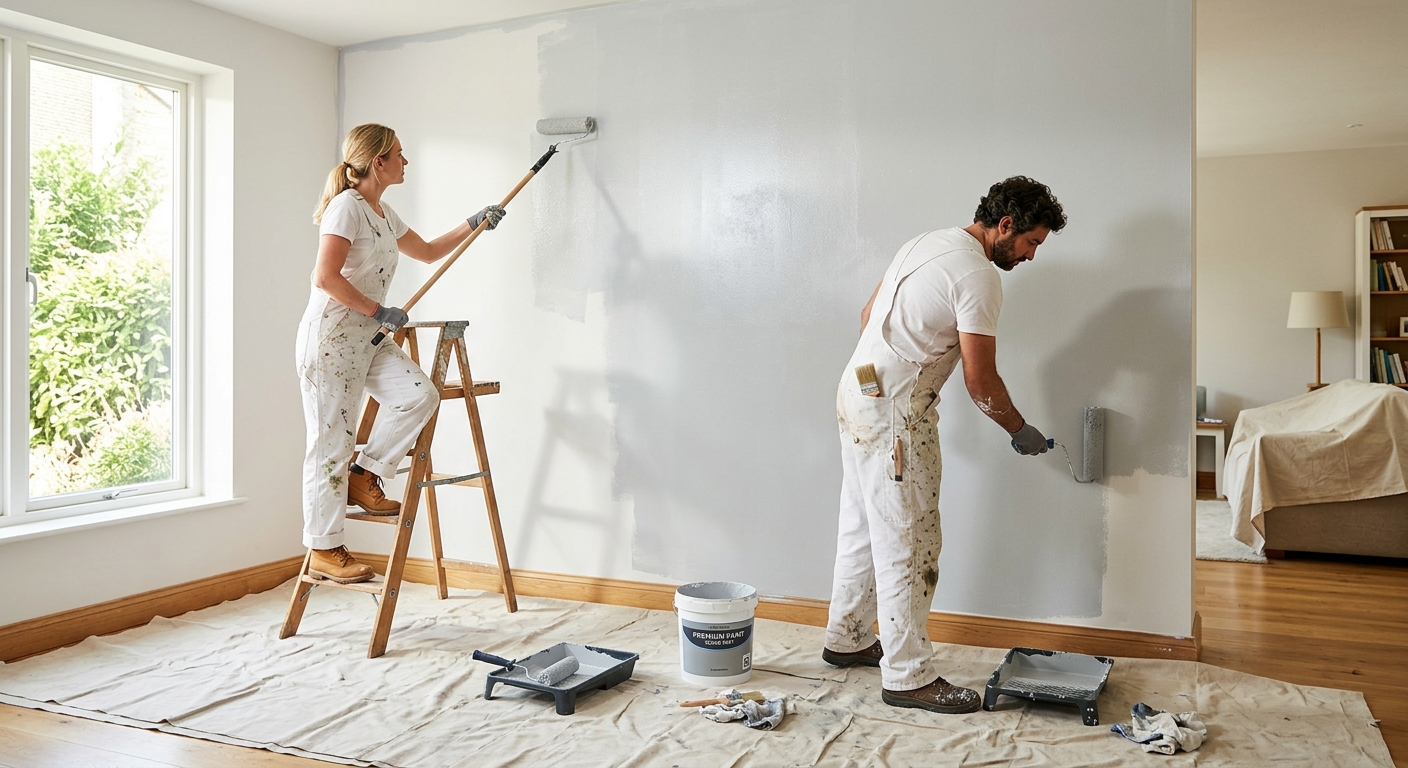
Painting options and costs in Red Lake
Red Lake is a great place to freshen up a home, but it also means planning your paint project around a short, practical exterior season. With 67.7% of dwellings built before 1981, a lot of local repainting starts with heavy prep—scraping loose coating, sanding down weathered areas, patching cracks, and priming before any finish coat. In older homes, professionals also plan for lead-safe work practices when trim, windows, or exterior facades may contain lead-based paint (your contractor should explain the approach before they touch the surface).
In Northwest Ontario, exterior painting costs are typically higher because demand compresses into late spring through early fall. Contractors need stretches of above-10°C weather for application and drying, and on top of that, logistics can be tighter in remote areas. Around town, trade work is especially in demand in and near Railway Avenue / Fourth Street area, where many homeowners are upgrading older siding, soffits, and trim after freeze-thaw seasons.
Interior painting is less weather-dependent, so availability can be steadier—though timelines still depend on surface condition and how much trim work you want. Cabinet and trim refinishing is often the “sweet spot” for budget-conscious updates, but it’s labour-intensive and finishes only look right when prep is done like a coating job, not a quick refresh. Use the table below to benchmark what you’ll likely pay for common projects, then compare quotes line-by-line.
| Service |
What's Included |
Typical Duration |
Price Range |
| Interior — whole home (walls, ceilings, trim) |
Protect floors, prep and patch, prime where needed, 2-coat finish on walls/ceilings, caulk trim gaps, sand dust-control, basic clean-up |
5–10 days |
$4,500 – $8,500 |
| Interior — per room (standard bedroom or living room) |
Prep, fill and sand, prime patched areas, 2-coat finish on walls; includes trim touch-ups as scoped |
2–4 days |
$4,000 – $6,500 |
| Exterior — full house (siding, trim, soffits) |
Pressure washing (weather/condition dependent), scrape/sand, repair caulking and small defects, prime bare/weathered spots, 2-coat exterior system |
7–14 days |
$6,000 – $10,000 |
| Exterior — trim and accent colours only |
Scrape and spot-sand, patch where needed, prime bare areas, 2-coat finish on specified trim lines and accents |
3–7 days |
$3,500 – $6,500 |
| Kitchen cabinet painting (doors, frames, spray finish) |
Degrease, sand, spot-prime, paint doors/drawers/surfaces, optional hardware handling, protective topcoat for durability |
4–10 days (including cure time) |
$2,200 – $4,000 |
| Specialty / faux finish (accent wall, texture) |
Surface build or smoothing as required, application technique, topcoat for washability, localized patching |
1–4 days |
$800 – $2,800 |
Prices are estimates only and vary by project scope, site access and material selection.
What affects the price of painting in Red Lake
Even when two homeowners describe the same job in Red Lake, quotes can swing by 30–50% across Northwest Ontario and Ontario because the “scope behind the scope” changes: prep intensity, surface material, coating system choices, and how tightly labour schedules fit the season. Exterior work is the biggest driver. In Northwest Ontario, the exterior painting window is typically late May to early October, and contractors need temperatures above about 10°C and steady conditions long enough for proper drying and curing. In coastal British Columbia, demand isn’t as sharply compressed by temperature alone, but frequent rain and high humidity require mildew-resistant products and careful timing—so costs rise for different reasons. In Ontario, shorter seasons concentrate demand and raise scheduling pressure, especially for older homes that need more repairs.
Here, older housing stock is common—67.7% of dwellings were built before 1981—so prep can easily consume the majority of labour on repaints. On many jobs, scraping failures and sanding weathered areas can make up 50–70% of total labour time, before a single topcoat is rolled or sprayed. That’s also why a full exterior job might land nearer the $6,000 – $10,000 band, while a smaller trim-only refresh might stay closer to $3,500 – $6,500.
Concrete Red Lake examples: (1) If your siding has peeling edges, spot-priming and feather-sanding get expensive fast because they require careful prep to avoid “ghosting” through the new finish. (2) If your house sits higher or has complex soffit lines, scaffolding or lifts add both time and crew cost. (3) If windows and trim show rough, weathered paint, the job often needs extra sanding and caulking detail work to prevent water ingress at seams.
| Price Factor |
Why It Matters |
Cost Impact |
| Surface prep — scraping, sanding, patching drywall or wood |
Determines adhesion and longevity; poor prep leads to early peeling and flashing failures |
Can account for a large portion of labour; often 50–70% on repaints |
| Number of coats — 2-coat system over primer vs. 1 coat over existing |
Coverage and hiding vary by existing colour, condition, and substrate |
Skipping or reducing coats usually increases rework risk; adds material and labour |
| Paint quality tier — contractor-grade vs. premium (Benjamin Moore, Sherwin) |
Topcoat durability, coverage, and washability vary by tier and formulation |
Premium often costs more per litre but can reduce number of coats |
| Ceilings and trim — adds significant time vs. walls-only |
Cutting in, masking, and detailing are slower than open-wall rolling |
Typically adds several days on whole-home projects |
| Exterior season window — short season raises summer rates |
Less time available for exterior crews increases demand for the same skilled labour |
Prices and scheduling pressure usually push exterior upward in summer |
| Lead-safe precautions — required for pre-1978 homes with lead paint |
Lead paint work requires controlled methods if present on trim/windows/facades |
May require containment, HEPA vacuuming, and extra cleanup time |
| Surface material — drywall vs. plaster vs. wood vs. stucco |
Different porosity and adhesion needs change primer choice and prep |
More porous/irregular materials require more priming and patching |
| Height and access — multi-storey exterior requires scaffolding or lifts |
Access equipment increases time, crew size, and safety planning |
Often the difference between a standard job and a higher band price |
Permits & regulations in Ontario
In Ontario, painting itself typically does not require a permit—painting a residence’s exterior or interior coatings is generally treated as a normal homeowner renovation. Where things change is lead-safe practice for older homes. Health guidelines recommend that, for homes built before 1978, you test for lead paint before sanding, scraping, or aggressive removal. If lead is present, lead-safe methods (for example, wet methods to minimize dust, HEPA vacuuming, and proper disposal) should be followed. For professional crews, these practices are standard even when not “legally mandated” for homeowners, because the risk is tied to dust exposure—not just the paint you can see.
Before you sign anything in Red Lake, confirm two coverage items: liability insurance (so you’re protected if there’s accidental property damage) and WSIB/WCB workers’ compensation coverage (so the contractor’s workers are covered on your site). Ask for certificates before work begins. Also insist on a written contract that specifies the paint brand and product line, sheen level, number of coats, surface prep scope (pressure washing, scraping, repairs, priming), and disposal responsibilities.
What typically DOES require a permit: structural changes, electrical/plumbing alterations, or large exterior changes that affect building permits—not routine painting. What typically does NOT: brush/roll/spray painting as specified in the scope, provided you’re not changing openings or structural elements.
To verify coverage step-by-step: (1) ask for insurance certificate(s) and confirm the policy is current; (2) request proof of WSIB/WCB account/coverage details; and (3) verify licensing/registration details using the Ontario government contractor verification resources (or the contractor’s own registration information) and match the name to the quote. Then keep copies for your records.
Interior vs exterior painting — getting the best result in Red Lake
In Red Lake, the difference between a long-lasting paint job and a premature failure is almost always in preparation and coating selection—not the brand on the label. For interiors, surface prep beats topcoat hype: filling and sanding nail pops, patching scuffs, and priming problem areas (water stains, patched drywall, and bare spots). Sheen selection also matters. Flat paint hides wall imperfections but scuffs more easily, so it’s usually reserved for low-touch areas. Eggshel/low-sheen is often best for living rooms and bedrooms; semi-gloss on trim and doors makes cleaning easier. A key rule: two coats over a proper primer reliably outlast one thick coat because coverage and film build are more consistent, especially on patched or previously painted surfaces.
For exteriors, the “make or break” points in Ontario weather are preparation and sealing pathways. Scraping and sanding remove failing layers; caulking before painting prevents water ingress where gaps exist; and primer type matters for the substrate. Wood and fibre cement may need primers matched to porosity and adhesion requirements, while masonry/patch materials often need spot-primer systems that prevent flashing. Unlike coastal BC (where mildew resistance and humidity management are the focus), Red Lake’s challenge is freeze-thaw movement and seasonal drying demands. That means temperature-stable exterior products and adequate curing time.
Cabinet painting is a smarter budget alternative to replacement when your boxes are solid and frames/doors are in reasonable shape. If your cabinet boxes are warped or structurally failing, replacement may be the only clean fix. As an example, a full kitchen repaint might sit in the $2,200 – $4,000 range; doing it correctly with sanding/priming can be worth it compared with replacing doors and then discovering the surrounding finish wasn’t prepped well.
| Project Type |
Key Prep Step |
Recommended Coats |
Price Band |
| Interior — fresh drywall (new construction) |
Proper drywall primer and joint compound smoothing (fill, sand, caulk gaps) |
Primer + 2 finish coats |
$4,000 – $7,000 |
| Interior — repaint (good condition, no repairs) |
Light sanding/scuffing, spot-prime if needed, dust removal |
1–2 finish coats depending on coverage; typically 2 |
$4,000 – $6,000 |
| Interior — repaint (patching and priming needed) |
Patch drywall, sand flush, prime all repairs and stains as required |
Primer on repairs + 2 finish coats |
$5,000 – $8,500 |
| Exterior siding (wood or fibre cement) |
Scrape/sand failing coating, caulk properly, prime bare/weathered spots |
Primer spots + 2 exterior coats |
$6,000 – $10,000 |
| Exterior trim and accents only |
Feather-sand edges and spot-prime to avoid flashing and peel-back |
2 coats over spot-primer |
$3,500 – $6,500 |
| Kitchen cabinets (spray finish) |
Degrease, thorough sanding, prime for adhesion, controlled spray application |
Primer (if required) + 2 finish coats |
$2,200 – $4,000 |
How to choose a painting contractor in Red Lake
Choosing the right contractor in Red Lake starts with verifying coverage and workmanship expectations. First, ask for their Ontario liability insurance certificate—read the expiry date and confirm it lists your address/name (or at least your project as covered). Next, confirm workers’ compensation coverage (WSIB/WCB). You want to see current documentation showing the contractor is set up to cover their employees; this protects you from liability if someone is injured on your property. If they can’t provide these up front, that’s a sign to move on.
Then get 2–3 itemised written quotes. Ask for a labour + materials breakdown (prep labour, priming, number of coats, paint lines, masking/protection, disposal, and any access equipment). Scope clarity matters: does the quote include pressure washing, scraping, caulking, and primer spot-application? Is disposal included (rag and debris removal)? Does the contractor include surface repairs like patching drywall or replacing failed caulk lines?
Warranty: confirm the workmanship warranty length and whether it covers peeling, cracking, or adhesion failures tied to prep. Product/manufacturer warranties often have conditions (proper surface prep and correct coating system). Ask if warranties are transferable if you sell the home. Payment schedule should be conservative—never pay more than 10–15% upfront; hold back a portion until the job is complete and final walk-through is done. Finally, get the start date and completion estimate in writing, especially for exterior work where the season window is tight.
- Provide liability insurance certificate and confirm it’s current.
- Provide WSIB/WCB coverage proof for employees (not just subcontractors).
- Give 2–3 itemised quotes with labour and materials separated.
- Specify paint brand/product line and sheen level (flat/eggshell/satin/semi-gloss).
- Confirm the number of coats and where primer is required.
- List prep inclusions: scraping, sanding, patching, caulking, pressure washing (if applicable).
- Confirm masking/protection coverage for floors, landscaping, and windows.
- Ask how they handle lead-safe precautions for pre-1978 trim or exterior surfaces.
- Confirm disposal is included (debris, sanding dust cleanup, waste handling).
- Ask about scaffolding/lifts plan if your exterior needs access equipment.
- Get warranty details in writing (workmanship + any product conditions).
- Use a payment schedule with a small deposit and a holdback until final completion.
Red flags to watch for in Red Lake: (1) quoting only “paint” without specifying prep steps or number of coats; (2) refusing to show insurance or WSIB/WCB documentation; (3) asking for large upfront payments (more than ~15%) before prep starts; (4) promising an exterior job outside the realistic warm-weather window; (5) dismissing lead-safe procedures for pre-1978 properties with vague “we’ll just be careful” language.
Frequently asked questions — painting in Red Lake
When is the best time for exterior painting in Red Lake?
For Red Lake homeowners, the best exterior painting window is usually late spring through early fall, when temperatures are reliably above about 10°C and rising during application. This matters because exterior paint needs time to dry and cure enough to resist early peeling and adhesion failure after freeze-thaw cycles return. Northwest Ontario’s exterior season is shorter than many parts of Ontario, so scheduling pressure is real—especially for siding and trim that require scraping and caulking before coatings go on. If your quote is for a “quick” start that lands too late in the season, ask how the contractor manages curing risk and weather contingencies. (Statistics Canada, 2021 Census)
How many coats of paint do I need?
Most exterior and interior projects are best planned as two finish coats, with primer as required by surface condition. If you’re repainting with good adhesion and coverage, you may be able to do less on a small, well-prepared area, but in Red Lake’s older housing stock, hidden repairs and patches often require more than “one coat and done.” On exteriors, a typical system is spot-primer on bare or weathered areas plus 2 finish coats for consistent film build. For budgeting, you’ll usually see full exteriors in the $6,000 – $10,000 band where prep and a proper coating system are included; trim-only jobs land lower, often around $3,500 – $6,500, because the surface area is smaller even though the prep standard should still be high.
What paint is best for Red Lake's climate?
In Red Lake and across Northwest Ontario, the “best” exterior paint is one formulated for adhesion and temperature stability through freeze-thaw cycles, plus proper primer matching for your substrate (wood, fibre cement, or repaired areas). You also want a product that’s breathable enough for long-term performance and compatible with the surface prep method used (scraping, sanding, and spot-priming). While coastal BC prioritizes mildew-resistant coatings due to high humidity and frequent rain, Red Lake’s climate is more about drying/curing windows and freeze-thaw stress. For interiors, choose sheens based on room use—eggshell or satin for walls you’ll clean often, and semi-gloss for trim. For cabinets, a harder, more durable topcoat system helps prevent early wear where doors get used daily.
How long does exterior paint last here?
Longevity in Red Lake depends mainly on prep quality, coating system compatibility, and whether the work was done during a suitable warm-weather curing window. With proper scraping/sanding, correct caulking before painting, spot-priming of bare or weathered substrate, and two finish coats, many homeowners see good performance for multiple years—often long enough to plan the next repaint when the next exterior trim and caulking refresh is due. If the surface wasn’t cleaned properly or failing coating was painted over, you can get early peeling or adhesion issues and end up paying for rework sooner. A contractor should explain how they’ll verify surface readiness and what they’ll do to minimize risk during Red Lake’s tighter exterior season.
Should I paint or replace my cabinets?
Painting cabinets is usually the better option when the cabinet boxes are solid, doors/drawers can be aligned, and the finish problems are mostly cosmetic (scratches, dated colour, or surface wear). In Red Lake homes, where replacing cabinetry can be pricey after logistics, a professional spray-applied cabinet refinishing project is often the most cost-effective refresh—commonly in the $2,200 – $4,000 range depending on cabinet size and prep needs. Replacement can make sense if the boxes are warped, the structure is failing, or you have water damage that can’t be corrected. Ask your contractor to assess door condition, hinge alignment, and whether they’ll prime properly for adhesion and durability.
How do I prep walls before painting?
If you’re preparing walls for an interior paint job in Ontario, the goal is to create a clean, smooth, sound surface. Typically that means removing dirt and grease, washing if needed, filling holes or cracks, sanding bumps flush, and dusting thoroughly. For patched drywall, primer is usually required before topcoat so you don’t get flashing or colour mismatch. If there are stains or questionable moisture marks, prime appropriately (the contractor should specify stain-blocking primer). In homes built before 1981—common around Red Lake—carefully consider whether old trim or specialty surfaces may contain lead paint before sanding or scraping; professional lead-safe methods are the safer route. Always follow the contractor’s prep guidance because “DIY prep” can affect adhesion and warranty.