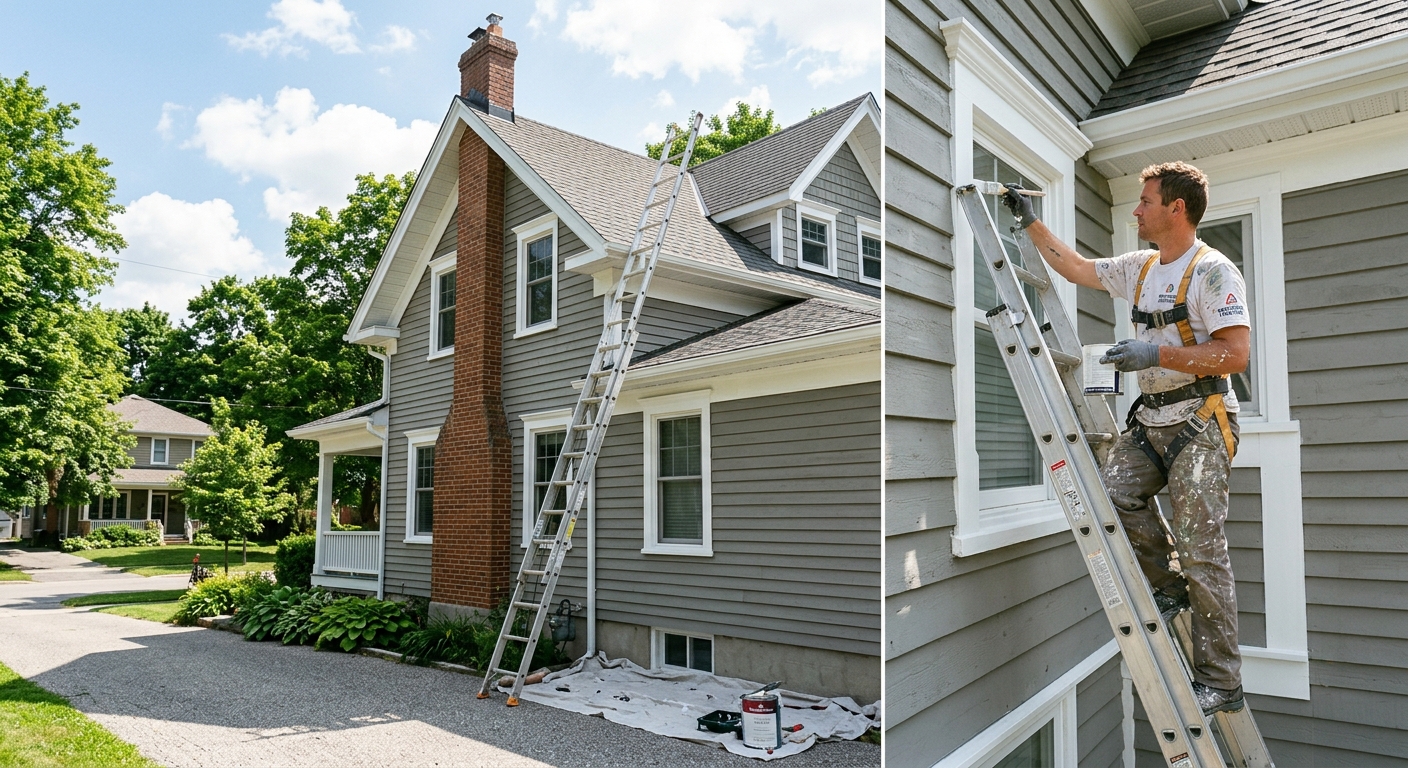
Painting options and costs in Orangeville
Orangeville homeowners often have plenty of choices, but the cost usually comes down to prep intensity, coating system, and the short, reliable weather stretch for exterior work. In Orangeville’s housing mix, 41.7% of homes were built before 1981 (Statistics Canada, 2021 Census). That matters because older surfaces commonly need more scraping, patching, sanding and priming before finish coats can last—prep can become a bigger budget item than paint. If your home predates modern coatings, professional contractors also plan for lead-safe precautions (commonly based on lead paint risk in pre-1978 homes) rather than treating it like a “standard repaint.”
In the Kitchener–Waterloo–Barrie economic region, exterior painting is also shaped by seasonality: demand concentrates roughly from late May to early October when temperatures are stable and surfaces can stay dry during application and dry-to-recoat. That scheduling pressure can tighten availability in summer, so the same scope often prices higher when crews are booked solid. The good news is interior work is steadier, and you may be able to fit it during shoulder season.
In Orangeville, neighbourhoods with older, larger lots—often around downtown/West Side and established family areas—tend to see frequent repaint requests because siding and trim age in sync with routine maintenance cycles. Next, here’s a practical cost comparison to help you line up expectations for scope and timing, then refine it with an itemised quote.
| Service |
What's Included |
Typical Duration |
Price Range |
| Interior — whole home (walls, ceilings, trim) |
Move/cover protection, patch & sand, caulking, prime as needed, two-coat finish on walls/ceilings, prep and paint trim/doors as per scope |
4–8 days |
$4,200 – $7,800 |
| Interior — per room (standard bedroom or living room) |
Protection, patch & sand, caulking, prime where required, two-coat walls, standard trim/doors included if specified |
1–3 days |
$2,500 – $4,200 |
| Exterior — full house (siding, trim, soffits) |
Surface wash, scrape/sand as needed, patch & caulk, prime bare/failed areas, paint full elevations, protect landscaping/eaves/edges |
5–10 days |
$5,500 – $9,000 |
| Exterior — trim and accent colours only |
Spot prep and sanding, caulking, prime where required, two-coat on trim/accents, limited surface wash |
2–5 days |
$2,500 – $5,200 |
| Kitchen cabinet painting (doors, frames, spray finish) |
Degrease/clean, sand & de-gloss, prime, spray finish for smooth sheen, light hardware handling as agreed |
4–10 days (often with cure time between steps) |
$2,200 – $4,800 |
| Specialty / faux finish (accent wall, texture) |
Surface prep for decorative work, masking, application technique, protective topcoat where required |
1–4 days |
$800 – $3,000 |
Prices are estimates only and vary by project scope, site access and material selection.
What affects the price of painting in Orangeville
In Orangeville and the wider Kitchener–Waterloo–Barrie region, it’s common to see quotes for the “same” repaint come in 30–50% apart. The difference is rarely the paint bucket—it’s usually labour hours driven by prep, whether premium coatings are required for adhesion, and how the project is scheduled during the short exterior window. That timing effect is real across Ontario: exterior work is typically completed in a condensed late-May to early-October period when temperatures are above about 10°C and rising during application. If a crew books up in July, the same house can cost more simply because schedules are tighter and rescheduling costs are higher.
Older housing stock increases the prep share. With 41.7% of homes built before 1981 (Statistics Canada, 2021 Census), many facades and interiors include previous patching, older caulking, chalking paint or uneven substrates that need sanding, scraping, caulking and priming. In repaint projects, surface prep can run about half of the labour—so the quote swings quickly if the contractor expects more deteriorated paint or more repairs than another bidder.
Two examples I see often in Orangeville: first, a full exterior scrape-and-prime job on siding that has peeling edges will usually move the project from the lower end of an exterior band into the mid/high range, because adhesion work takes time. Second, a trim-only update over sound paint can stay closer to the lower end—often around the $2,500–$5,200 range—if caulking and spot-priming are the only repairs required. For interiors, the same principle applies: a walls-only repaint can align more with the $2,500–$4,200 “per room” expectation, while adding ceilings and trim pushes labour into the whole-home band.
| Price Factor |
Why It Matters |
Cost Impact |
| Surface prep — scraping, sanding, patching drywall or wood |
Creates adhesion and smooths imperfections; older coatings often require more work |
High (often 40–70% of labour on repaints) |
| Number of coats — 2-coat system over primer vs. 1 coat over existing |
Coverage, hide and durability depend on the correct multi-coat approach |
Medium to High (+10–30% depending on condition) |
| Paint quality tier — contractor-grade vs. premium (Benjamin Moore, Sherwin) |
Premium products often offer better coverage and long-term appearance |
Medium (materials can add 5–20% to total) |
| Ceilings and trim — adds significant time vs. walls-only |
Ceilings require extra prep and careful rolling/cutting; trim needs precision |
High (can materially shift interior pricing) |
| Exterior season window — short season raises summer rates |
Scheduling pressure increases crew costs and reduces flexibility to redo work |
Medium to High |
| Lead-safe precautions — required for pre-1978 homes with lead paint |
Safe containment, HEPA vacuuming and proper disposal increase labour |
Medium (adds time even when repaint is straightforward) |
| Surface material — drywall vs. plaster vs. wood vs. stucco |
Different substrates require different primers and adhesion strategies |
Medium |
| Height and access — multi-storey exterior requires scaffolding or lifts |
Access equipment affects labour time and safety planning |
High (often the difference between lower vs. upper quote ranges) |
Permits & regulations in Ontario
In Ontario, painting typically does not require a municipal permit for homeowners or contractors. Where rules show up is in health and safety practice, not in permitting: for homes built before 1978, health guidelines recommend testing for lead paint before sanding or scraping, and using lead-safe work practices if lead is present. Professional contractors commonly use wet methods to reduce dust, HEPA vacuuming, careful containment and proper disposal for paint debris. While this isn’t usually something Ontario mandates for a homeowner doing their own work, it’s standard practice on professional sites because it reduces risk to occupants and workers.
In addition, a reputable painting contractor should carry the correct coverage for your job. Confirm they have: (1) liability insurance, and (2) WSIB coverage (workers’ compensation). Ask for proof before work starts and keep copies with your contract paperwork.
Also, make sure your written agreement is detailed. It should specify the paint brand, sheen, number of coats, and what surface prep is included (scrape/sand, patching, caulking, priming). If it’s an exterior repaint, ask what the contractor includes for wash, sanding, and spot-priming of bare or failed areas.
How to verify: (1) Request WSIB proof and confirm the coverage is current; (2) ask for a certificate of insurance listing you/your property as appropriate; (3) keep an eye out for clear job documentation and a signed scope. In Ontario, contractor “licences” for painting can vary by trade category and job type, so the safest step is to ask what credentialing (if any) applies and whether they can provide their proof on request—before you book dates.
Interior vs exterior painting — getting the best result in Orangeville
In Orangeville’s climate, the biggest predictor of a long-lasting paint job is prep quality and correct system choices—more than “buying the most expensive paint.” For interiors, start with surface preparation: filling, sanding, caulking and priming where stains, repairs or patch edges show through. Then choose the right sheen by room. Flat paint hides wall imperfections but scuffs more; eggshell and satin handle everyday living better; semi-gloss on trim resists cleaning and wear. Practically, two coats over a proper primer almost always outlast a single thick coat because adhesion and uniform film build matter for both appearance and durability.
For exteriors, the Ontario challenge is water and adhesion failure when surfaces aren’t properly cleaned, sanded and primed. Good exterior work in the Kitchener–Waterloo–Barrie region includes washing, scraping loose coatings, caulking before finish paint to prevent water ingress, and matching primer to the substrate (wood vs. fibre cement vs. stucco). If you want longer service life, this is where you see why a contractor’s prep line-items matter. In BC, mildew-resistant systems and timing around damp conditions are bigger drivers; in inland Ontario like Orangeville, the constraint is getting the job done in a short late-May to early-October window with surfaces staying dry and temperatures stable. That’s why winter or rainy shoulder season repaint requests often shift costs—either by delaying the start date or by changing the contractor’s schedule.
Cabinet painting is a smart alternative to replacement when boxes are solid and the homeowner wants a refreshed look. It’s often less costly than a full kitchen replacement because the “structure” stays in place; you’re paying for prep, priming and a controlled spray finish. For pre-1978 homes, lead-safe precautions should be planned into any sanding or scraping on affected areas.
For example, upgrading from “spot prep only” to a full scrape-and-prime approach on exterior trim can add roughly a few thousand dollars, but it’s often the difference between paint that lasts several years and paint that fails sooner due to peeling edges and poor adhesion. When the substrate is sound, you may not need to over-invest—so the best quotes clearly show what’s being repaired and primed, not just what colour you’re buying.
| Project Type |
Key Prep Step |
Recommended Coats |
Price Band |
| Interior — fresh drywall (new construction) |
Prime bare drywall and spot-prime repairs to prevent flashing |
1 primer + 2 topcoats |
$3,000 – $6,500 |
| Interior — repaint (good condition, no repairs) |
Light scuff-sand, caulk small gaps, spot-prime if needed |
2 topcoats (prime spots) |
$2,500 – $4,900 |
| Interior — repaint (patching and priming needed) |
Patch, sand and fully prime repairs to unify absorption |
1 primer + 2 topcoats |
$3,200 – $7,000 |
| Exterior siding (wood or fibre cement) |
Wash, scrape loose paint, caulk and spot-prime bare/failed areas |
2 finish coats (prime system where required) |
$5,500 – $9,000 |
| Exterior trim and accents only |
Masking + scrape/sand limited to trim, prime bare spots |
2 finish coats (prime spots) |
$2,500 – $5,200 |
| Kitchen cabinets (spray finish) |
Degrease, sand to degloss, prime for bonding, protect hardware areas |
Primer + 2 sprayed finish coats |
$2,200 – $4,800 |
How to choose a painting contractor in Orangeville
Start with verification. In Ontario, you want proof of liability insurance and WSIB coverage for workers. Ask for current certificate documents before the job begins. The most reliable method is to request (a) a WSIB account proof or certificate showing active coverage and (b) a certificate of insurance showing the policy is in force and the work is covered. If the contractor can’t provide these quickly, treat it as a major warning sign.
Next, collect 2–3 itemised written quotes—not one page of totals. You should see line items for prep (scrape/sand/patch/caulk/prime), coatings (brand and sheen), number of coats, and protection/disposal. Ask what’s excluded (for example: removing old caulking to a proper depth, replacing damaged siding boards, moving heavy furniture, or lead-safe containment). Also confirm whether disposal and job-site cleanup are included and whether the quote assumes standard access (ladders vs. lifts/scaffolding).
For warranty, ask for the workmanship warranty length and whether product/manufacturer warranties apply separately. Clarify if the warranty is transferable to a future buyer.
On payment, keep it practical: never pay more than 10–15% upfront. Hold back the final portion until the punch list is complete and materials are confirmed to match the contract.
Finally, insist on a timeline in writing: a start date and an estimated completion date. Painting is weather-dependent in the Kitchener–Waterloo–Barrie region, so the contractor should explain what happens if rain or temperature drops delay exterior coats.
- Request itemised labour and materials (not a lump sum) and compare identical scopes.
- Confirm liability insurance and WSIB coverage before the first day on site.
- Check that surface prep includes scraping/sanding and caulking—not just “two coats.”
- Verify primer type and when it’s used (spot-priming vs. full primer coverage).
- Ask for paint brand and sheen (flat/eggshell/satin/semi-gloss) per room/finish.
- Confirm how repairs are handled: patching depth, sanding method, and spot-priming.
- Clarify protection and cleanup: floors, landscaping, hardware removal/reinstallation.
- Ask whether lead-safe practices are included for pre-1978 surfaces that need sanding/scraping.
- Get the start date, weather contingency plan, and completion estimate in writing.
- Understand disposal: paint debris and masking waste removal should be included or priced.
- Confirm warranty: workmanship duration, what it covers, and the process to file.
- Keep payment milestones: 10–15% deposit max; remainder after completion/punch list.
Concrete red flags I see in Orangeville: (1) quotes that don’t list the number of coats or primer/spot-prime requirements; (2) contractors who won’t provide WSIB and insurance proof; (3) “we’ll do it in any weather” promises for exterior work; (4) very low bids that skip scraping, sanding or caulking; and (5) pressure to pay most of the balance upfront without a signed scope.
Frequently asked questions — painting in Orangeville
What paint sheen should I use in different rooms?
In Orangeville homes, sheen choice is about cleanability and how light reflects off walls. For living rooms and bedrooms, eggshell or satin on walls typically balances scuff resistance with a softer look. Kitchens and hallways do better with satin because fingerprints and splashes wipe more easily. For bathrooms, consider a moisture-tolerant coating where appropriate. Trim and doors usually look best in semi-gloss for durability and crisp edges. Ceilings are commonly flat to reduce glare. If your walls have patching, a contractor may recommend a primer first to prevent flashing—then finish sheen. If you’re budgeting, interior room repaint projects often land around $2,500 – $4,200, but sheen and prep decisions can influence the final total.
Can I paint my house exterior in spring or fall in Orangeville?
Yes, but it’s tricky in Orangeville. The Kitchener–Waterloo–Barrie market is built around a relatively tight exterior window—typically late May through early October—when temperatures stay suitable (often above about 10°C during application) and surfaces can dry properly. Spring and fall can work for sheltered areas or quick touch-ups, but widespread exterior painting is at higher risk of problems from cool nights, dew, or rain-driven moisture. Contractors will usually schedule around forecast stability because redoing failed coats costs more than waiting. If your home needs more prep (common in older stock—Statistics Canada notes many homes here were built before 1981), delay can also mean more time for surface contaminants to return. For a full exterior repaint, most homeowners budget within the $5,500 – $9,000 range depending on how much prep and timing pressure is involved.
How do I choose a painting contractor in Orangeville?
Choose a contractor by verifying coverage, comparing identical scopes, and insisting on an itemised written quote. In Ontario, ask for proof of liability insurance and WSIB coverage before work starts, then ensure the contract lists prep and coatings: paint brand, sheen, number of coats, and what’s included for scraping, sanding, patching, priming and caulking. Get at least 2–3 bids and check that the lower price isn’t skipping steps (especially on exterior repaints). For homeowners in Orangeville, I also suggest confirming whether lead-safe practices are addressed for any sanding or scraping on pre-1978 areas—lead-safe work is often recommended, and professionals plan for it. Lastly, watch the payment schedule: a deposit around 10–15% max is reasonable; holding back until completion is standard good practice.
How many coats does an exterior repaint need in Orangeville?
Most exterior repaints in Orangeville use a two-coat finish system over a primer/bonding base where required. If the existing coating is failing, chalky, peeling, or has bare areas, the contractor should remove loose paint, sand/blend edges, caulk properly, and then prime those spots (and sometimes more broadly depending on substrate condition). In practice, that means: two finish coats for siding/trim, plus primer wherever the surface needs adhesion help. If someone proposes “one thick coat,” that’s usually the path to early failure—especially in inland Ontario where the exterior is exposed to moisture cycles and temperature swings during the repaint season. For budget planning, a trim-only project may fit closer to $2,500 – $5,200, while a full house repaint typically falls around $5,500 – $9,000 based on prep and access.
What is the best primer for older Orangeville homes?
The “best” primer depends on what you’re painting over, not just the age of the house. In older Orangeville homes (many built before 1981), you may encounter different surfaces such as wood, fibre cement, older coatings, or areas that were patched or stained. A good contractor selects a primer based on adhesion needs: spot-priming bare wood, priming repaired drywall, and using the correct system for bonding to previously painted surfaces. If there are tannin stains or problematic spots, stain-blocking primer may be needed. For pre-1978 homes where sanding or scraping is likely, professionals often plan lead-safe precautions, and that affects prep method and containment. Ask your contractor to specify the primer type in writing and where it will be applied. That transparency helps ensure you’re not paying for finish paint while skipping the prep that makes it last.
Should I paint or wallpaper my Orangeville home?
In many Orangeville homes, paint is the more practical choice because it’s faster to maintain and easier to repair if you get a scuff or a seam lifts. Wallpaper can be a great look, but it’s also more sensitive to surface imperfections and moisture conditions—especially on walls with patching, older plaster irregularities, or areas that weren’t properly primed. For older housing stock, paint plus proper patching and priming often gives a longer-lasting, cleaner result. Painting also makes it easier to choose different sheens by room (eggshell for living spaces, satin for kitchens/hallways). Budget-wise, a per-room interior repaint is commonly around $2,500 – $4,200, while wallpaper projects can rise quickly once wall prep and removal risks are accounted for. If you’re set on wallpaper, ask your contractor how they’ll address prep, adhesion, and future removal before committing.