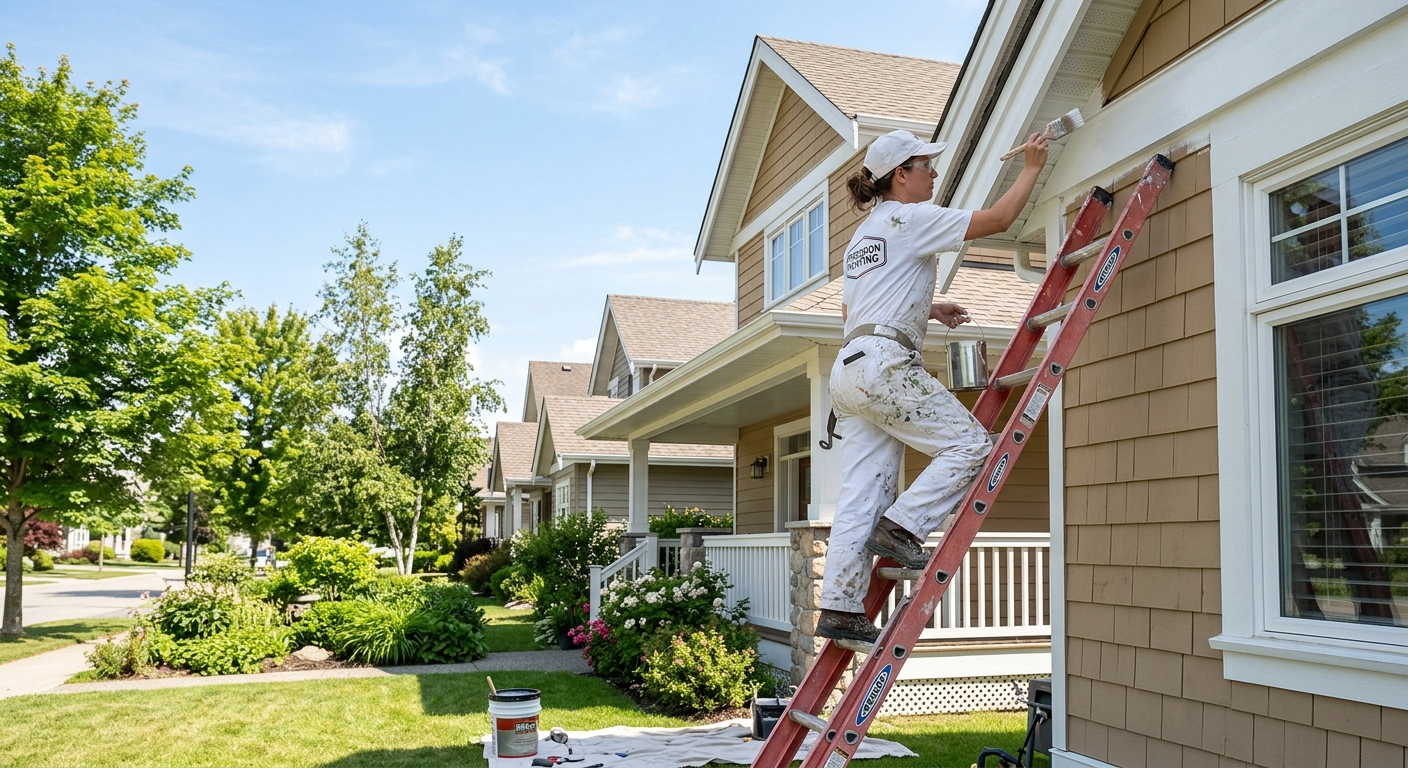
Painting options and costs in Richmond Hill
Richmond Hill homeowners usually have a few different directions to choose from—interior refresh, whole-home exterior, or targeted trim and accents—and the right option comes down to both condition and timing. Richmond Hill’s housing mix matters: about 15.1% of homes were built before 1981 (Statistics Canada, 2021 Census), and those older builds often have more layers of older paint on siding, trim, and doors. That typically means extra scraping, more caulking and patching, and more priming so the new coats can actually bond and stay looking sharp. Homeowner households are also substantial at 78.2% owning (Statistics Canada, 2021 Census), so there’s steady demand for reputable contractors who can hit the schedule without cutting corners.
On cost, the Greater Toronto Area climate plays a very direct role in exterior painting availability. Contractors generally work from late May through June, then again from September to mid-October, when temperatures are safely above about 10°C for application and curing. June–August demand often pushes exterior pricing up roughly 10–15%, because ideal “rain-free” days are limited. In neighbourhoods with lots of curb appeal upgrades—like Oak Ridges and parts of West Beaver Creek—exterior projects tend to book quickly, particularly for full-house siding repainting.
Below are practical pricing bands you can use to compare proposals before you get into the details of prep scope, coat count, and finish level.
| Service |
What's Included |
Typical Duration |
Price Range |
| Interior — whole home (walls, ceilings, trim) |
Surface prep (patching/filling), caulking where needed, priming as required, 2-coat finish system (sheen per room), protect floors and fixtures, cleanup |
5–10 days |
$2,800 – $6,000 |
| Interior — per room (standard bedroom or living room) |
Prep, patching and sanding spots as required, prime bare areas, 2-coat wall finish, basic protection and cleanup |
1–3 days |
$400 – $1,200 |
| Exterior — full house (siding, trim, soffits) |
Power wash (as needed), scrape/sand failing paint, caulking, spot-priming, 2-coat exterior system, protection of landscaping/windows, final cleanup |
1–3 weeks |
$3,500 – $8,000 |
| Exterior — trim and accent colours only |
Targeted prep on trim/accents, prime as needed, 2-coat finish on included surfaces, protection and cleanup |
3–7 days |
$1,500 – $3,800 |
| Kitchen cabinet painting (doors, frames, spray finish) |
Removal/masking (where possible), degreasing, sanding, bonding primer, spray or brush-applied topcoat, hardware handling (per scope), cure time |
5–12 days |
$1,800 – $4,000 |
| Specialty / faux finish (accent wall, texture) |
Surface preparation for the selected decorative system, base coats, specialized application, topcoat/seal as required |
1–5 days |
$300 – $2,500 |
Prices are estimates only and vary by project scope, site access and material selection.
What affects the price of painting in Richmond Hill
In Richmond Hill and across the Toronto region, two “similar” jobs can land 30–50% apart because painting quotes aren’t just about paint—they’re about labour intensity, prep conditions, and how long trades can safely work outdoors. For example, exterior work in our GTA tier is tightly season-bound: crews typically schedule between late May and early October, with application and curing depending on temperatures above about 10°C and manageable humidity for 24–48 hours. That shorter season concentrates demand, which is why summer (June–August) can be about 10–15% higher. Coastal BC has a longer season but persistent dampness and mildew risk, so products and timing are different; in Ontario, the key constraints are rain events, humidity spikes, and frost risk between coats.
Older housing stock also changes the math. With roughly 15.1% of homes built before 1981 (Statistics Canada, 2021 Census), many repaints involve multiple paint layers, tighter caulking needs, and higher prep time. In many repaint projects, surface prep can represent 50–70% of total labour, which is why exterior pricing can swing from the lower end of the $1,500 – $8,000 band to the top end when scraping and priming expand.
Here are a few Richmond Hill-specific examples that routinely affect cost. First, houses with lots of soffits, porch railings, and detailed trim (common in established areas like Oak Ridges) increase height and ladder time, pushing crews toward scaffolding/lifts—more labour, longer timelines. Second, if the existing paint has widespread blistering or peeling, the job becomes more like “remove and rebuild,” which pushes prep-heavy pricing closer to the upper exterior band (often near $6,000–$8,000 for a full repaint). Third, smaller accent work—like trim-only repainting—can still hit the lower end, often around $1,500–$3,800, when surface condition is sound and the scope is well defined. For interiors, prep and finish level dominate: a walls-and-ceilings refresh can stay near the interior backbone ($400 – $6,000), but adding more trim, specialty colours, or detailed repairs moves the price rapidly.
| Price Factor |
Why It Matters |
Cost Impact |
| Surface prep — scraping, sanding, patching drywall or wood |
Bond depends on sound substrate; damaged areas require repair before paint adheres |
Often 50–70% of labour on repaints |
| Number of coats — 2-coat system over primer vs. 1 coat over existing |
Coverage and durability depend on correct coat count; stains and patch areas need extra |
Can shift cost by 10–25%+ |
| Paint quality tier — contractor-grade vs. premium (Benjamin Moore, Sherwin) |
Better pigments and solids often reduce re-coats and improve washability/UV stability |
Material difference can be partially offset by fewer problems |
| Ceilings and trim — adds significant time vs. walls-only |
Trim needs masking, precision edging, and multiple passes for consistent lines |
Often adds 20–40% to interiors when included |
| Exterior season window — short season raises summer rates |
Limited ideal weeks increase scheduling pressure and manpower value |
Typically 10–15% higher in peak demand weeks |
| Lead-safe precautions — required for pre-1978 homes with lead paint |
Proper containment and dust control adds steps, time, and disposal handling |
Prep-heavy increase on older trim/railings and windows |
| Surface material — drywall vs. plaster vs. wood vs. stucco |
Each surface needs different primers and adhesion strategy |
Can add variable prep/priming costs |
| Height and access — multi-storey exterior requires scaffolding or lifts |
Access drives labour time, safety setup, and sometimes rental costs |
Frequently one of the largest exterior multipliers |
Permits & regulations in Ontario
In Ontario, painting typically does not require a permit for a residential home. The main “rules” homeowners run into are health and safety best practices—especially for older paint—and insurance documentation. For homes built before 1978, health guidelines recommend taking steps to manage potential lead paint exposure before sanding, scraping, or disturbing old coatings. Professionals commonly plan lead-safe work practices such as wet methods to control dust, HEPA vacuuming, and careful disposal of debris. While this isn’t usually a homeowner permit requirement, it’s standard practice for professional contractors and a sensible expectation for any thorough repaint.
What DOES require permits is not typically painting itself—rather, it’s usually tied to structural changes, major renovations, or municipal/HOA approvals for façade alterations. Routine sanding and coating replacement on existing surfaces generally does not trigger permits, so you’ll see contractors focus documentation on insurance, not city paperwork.
To verify your contractor in Richmond Hill, ask for three items before signing:
- Insurance: proof of liability insurance (request a current certificate of insurance).
- Workers’ compensation: proof of WSIB/WCB coverage for workers.
- Clear scope contract: written contract that clearly states paint brand/line, sheen, number of coats, and prep scope (including scraping, sanding, caulking and priming where required).
Then, confirm their licensing status using Ontario’s online business/contractor information resources (search the contractor’s legal name). Keep copies of certificates and the written agreement.
Interior vs exterior painting — getting the best result in Richmond Hill
In Richmond Hill, the difference between a long-lasting paint job and a premature failure comes down to preparation discipline and system matching—not just “better paint.” For interiors, surface prep is the make-or-break step: filling dents, sanding for a uniform surface, removing loose material, and priming patched areas. Sheen choice also matters for durability and appearance. For example, bedrooms and living rooms often do well with eggshell or satin for washability without looking too glossy, while kitchens and bathrooms typically need a more robust, cleanable finish strategy. Even if you choose a premium topcoat, two proper coats over correct primer almost always outlast one thick coat because coverage is more uniform and the film cures more consistently.
For exteriors in the GTA, prep determines adhesion through freeze-thaw cycles and seasonal humidity swings. Start with cleaning, then scrape or sand any failing or peeling paint back to sound edges, and caulk before painting to reduce water ingress behind trim and joints. Primer choice matters: different substrates (wood, fibre cement, masonry details) need the right bonding primer so the topcoat can expand/contract and stay adhered. While mildew resistance is a bigger focus in damp coastal climates, GTA exteriors still benefit from using coatings designed for exterior durability, especially when humidity spikes during shoulder seasons.
Kitchen cabinet painting can be a cost-smart alternative to replacement, often landing in the mid-range of the cabinet band when surfaces are well prepped and hardware is managed carefully. For pre-1978 homes, lead-safe precautions should be included for any scraping or sanding on trim and railings—this adds time, but it protects your household and improves job quality.
Where the price difference is justified: if you’re repainting a full exterior and significant peeling is present, paying for thorough prep (closer to the upper exterior band around $3,500 – $8,000) is usually money well spent. Conversely, if the siding is sound and you only want a colour refresh, staying with trim and accent work can be far more economical—often around $1,500 – $3,800—without the full-house labour burden.
| Project Type |
Key Prep Step |
Recommended Coats |
Price Band |
| Interior — fresh drywall (new construction) |
Prime entire drywall surface and sand for smoothness before topcoat |
1 primer + 2 finish coats |
$1,200 – $3,000 |
| Interior — repaint (good condition, no repairs) |
Light scuff-sand and spot-prime any marks or bare patches |
1–2 finish coats (often 2 for best uniformity) |
$400 – $1,800 |
| Interior — repaint (patching and priming needed) |
Fill, sand feather edges, and prime patched areas for consistent sheen/coverage |
1 primer (spots or whole-room) + 2 finish coats |
$600 – $2,400 |
| Exterior siding (wood or fibre cement) |
Scrape failing paint, caulk joints, prime bare areas, and maintain edge adhesion |
1 primer + 2 exterior finish coats (system dependent) |
$3,500 – $8,000 |
| Exterior trim and accents only |
Thorough edge prep on trim lines and careful caulking at seams |
1 primer (where needed) + 2 finish coats |
$1,500 – $3,800 |
| Kitchen cabinets (spray finish) |
Degrease, sand, bond-prime, and control dust for a smooth, durable film |
Bond primer + 2 topcoat coats |
$1,800 – $4,000 |
How to choose a painting contractor in Richmond Hill
Choosing the right contractor in Richmond Hill is mostly about verifying credibility before you compare price. Start with Ontario coverage and proof: ask for (1) liability insurance, (2) WSIB/WCB workers’ compensation coverage, and (3) confirmation of their business details/licensing status through Ontario’s online resources. For insurance, request a current certificate of insurance; for WSIB/WCB, request the clearance/coverage confirmation and make sure it covers the specific workers assigned to your job. Don’t accept “we’re insured” without paperwork.
Next, request 2–3 itemised written quotes rather than a lump sum. Itemisation should include labour line items (prep, sanding/scraping, masking, trim work) and materials (primer type, topcoat brand/line, sealants/caulking, and disposal). Scope clarity matters: confirm what’s excluded (for example, rotted wood repair, window caulking replacement, or lead-safe containment) and whether permit pulling is required (usually not for basic painting) or included if any façade approval applies. Disposal should be stated—professional projects include proper collection and disposal of paint debris and sanding waste.
Finally, review warranty and payment structure. Ask for a workmanship warranty length and whether product warranties are based on proper application and are transferable to the next homeowner. Payment should be staged: never more than 10–15% upfront; hold back a portion until the job is complete and cleaned. Get a start date and completion estimate in writing, and plan around the GTA exterior window (late May–June, and September–mid October).
- Ask for insurance certificates and WSIB/WCB proof before any deposit.
- Confirm lead-safe approach for pre-1978 trim if your home is older.
- Require written prep scope: scraping/sanding level, caulking locations, priming rules.
- Request paint brand and line name (not “premium paint” generally).
- Get sheen recommendations by room (flat/eggshell/satin/semigloss) in writing.
- Ensure caulking is described as “before topcoat” for exterior transitions.
- Confirm protection plan for floors, landscaping, windows and siding edges.
- Ask about how they handle dry time between coats and rain delays.
- Verify disposal is included for debris and sanding waste.
- Require a detailed schedule: start date, daily hours, estimated duration.
- Clarify warranty terms: workmanship, defects, and touch-ups.
- Use a payment schedule with a holdback until final walkthrough.
Red flags I commonly see with less reliable painting contractors in Richmond Hill include: refusal to provide insurance/WSIB paperwork, quotes that say “prime as needed” without explaining what surfaces will be primed, unusually low pricing that ignores scraping/repair prep, deposits higher than 10–15% without a clear schedule, and a contract that doesn’t specify paint line/brand, coat count, or cleanup/disposal.
Frequently asked questions — painting in Richmond Hill
Should I paint or wallpaper my Richmond Hill home?
In Richmond Hill, painting is usually the safer “value per year” choice because it’s faster to update, easier to repair, and more forgiving with temperature and humidity swings. Wallpaper can look amazing in a feature area, but it’s less forgiving if your walls have minor imperfections, and seams can be more noticeable if prep isn’t done thoroughly. If you’re dealing with patched drywall or uneven surfaces—common in older homes (Statistics Canada, 2021 Census)—a quality paint system with proper primer typically hides differences better. For most homeowners, interior painting projects commonly start around the $400 – $1,800 range per room/refresh depending on prep and trim. If you want texture or an accent, consider specialty finish paint instead, which can deliver a similar look without the seam concerns.
How do I fix peeling exterior paint in Richmond Hill?
Peeling exterior paint in Richmond Hill is almost always a surface-adhesion problem, not just a “paint over it” issue. The correct fix starts with identifying and removing the loose/failed coating back to sound edges, then scraping and sanding to stabilize the substrate. Next comes caulking at cracks and gaps so water can’t get behind the system, followed by spot-priming bare or sanded areas using the right primer for the surface (wood, fibre cement, etc.). Only after that should you apply two exterior finish coats. Because Richmond Hill’s exterior schedule is climate-dependent (roughly late May–June and September–mid October when temperatures stay above about 10°C), timing matters too. If the peeling is widespread, budget realistically toward the exterior full-house band of $3,500 – $8,000, because prep is a major part of the total cost.
What colours add the most resale value in Richmond Hill?
Resale value is less about a single “magic colour” and more about selecting tones that look clean in different light and appeal broadly. For Richmond Hill homes—often single-detached and built in varied eras—neutral exteriors tend to carry the widest buyer appeal: soft warm whites, greiges, and muted light greys, paired with darker shutters/trim for contrast. For interiors, a creamy white or warm neutral on walls often photographs well and helps buyers picture their own furniture. If you’re working with older paint layers (Statistics Canada, 2021 Census notes pre-1981 homes are a meaningful share), you may need primer and additional prep to keep colour shifts consistent, which affects cost. A repaint is usually most cost-effective when you stay within a restrained palette rather than drastically changing colour saturation. Interior refreshes often land within the $400 – $1,800 per-room range depending on trim and repairs.
How much does it cost to paint a house in Richmond Hill?
“Painting a house” can mean very different scopes in Richmond Hill—an interior whole-home refresh versus a full exterior repaint changes labour, materials, and the season schedule. As a practical baseline, many homeowners who do a full interior whole-home project tend to fall in the interior backbone of $2,800 – $6,000 depending on how many ceilings/trim lines are included and how much repair work is needed. Full exterior painting is typically higher because of prep and the short Ontario exterior window; that commonly sits in the $3,500 – $8,000 range for siding and trim on a full house. If you’re only doing trim and accents, many projects can land around $1,500 – $3,800 when siding is sound and prep is limited. A proper quote depends on surface condition, height/access, and the number of coats required.
How much does interior painting cost per room in Richmond Hill?
Interior painting per room in Richmond Hill commonly falls around the mid to upper portion of the interior range depending on room size, ceiling height, and prep needs. For a standard bedroom or living room in good condition (minimal repairs), a typical range is often about $400 – $1,200 per room for walls and normal trim inclusion as defined in the scope. If you have patching and priming requirements—cracks, patched drywall, water stains, or lots of touch-ups—the cost can move upward because labour increases and primer/topcoat coverage needs to be consistent. Trim-heavy rooms or adding ceilings can also push the job toward the upper end. Always compare quotes by prep scope: “2-coat system over primer, prep as required” is more meaningful than comparing just the final number.
When is the best time for exterior painting in Richmond Hill?
The best time for exterior painting in Richmond Hill is when temperatures stay reliably above about 10°C for application and curing—typically late May through June, and again from September to mid-October. The GTA season is shorter than coastal regions, so exterior contractors often book quickly for the most “ideal” windows. Rain and humidity spikes can slow down work between coats, and frost risk can impact curing if crews are caught too late in the fall. That’s why many homeowners see better availability and sometimes more stable pricing when they plan for late May–June or early September, rather than pushing into unpredictable weather weeks. If your home has older coatings (Statistics Canada, 2021 Census shows a notable share are pre-1981), plan extra prep time in the schedule because scraping, sanding, caulking and priming take longer when multiple layers exist.