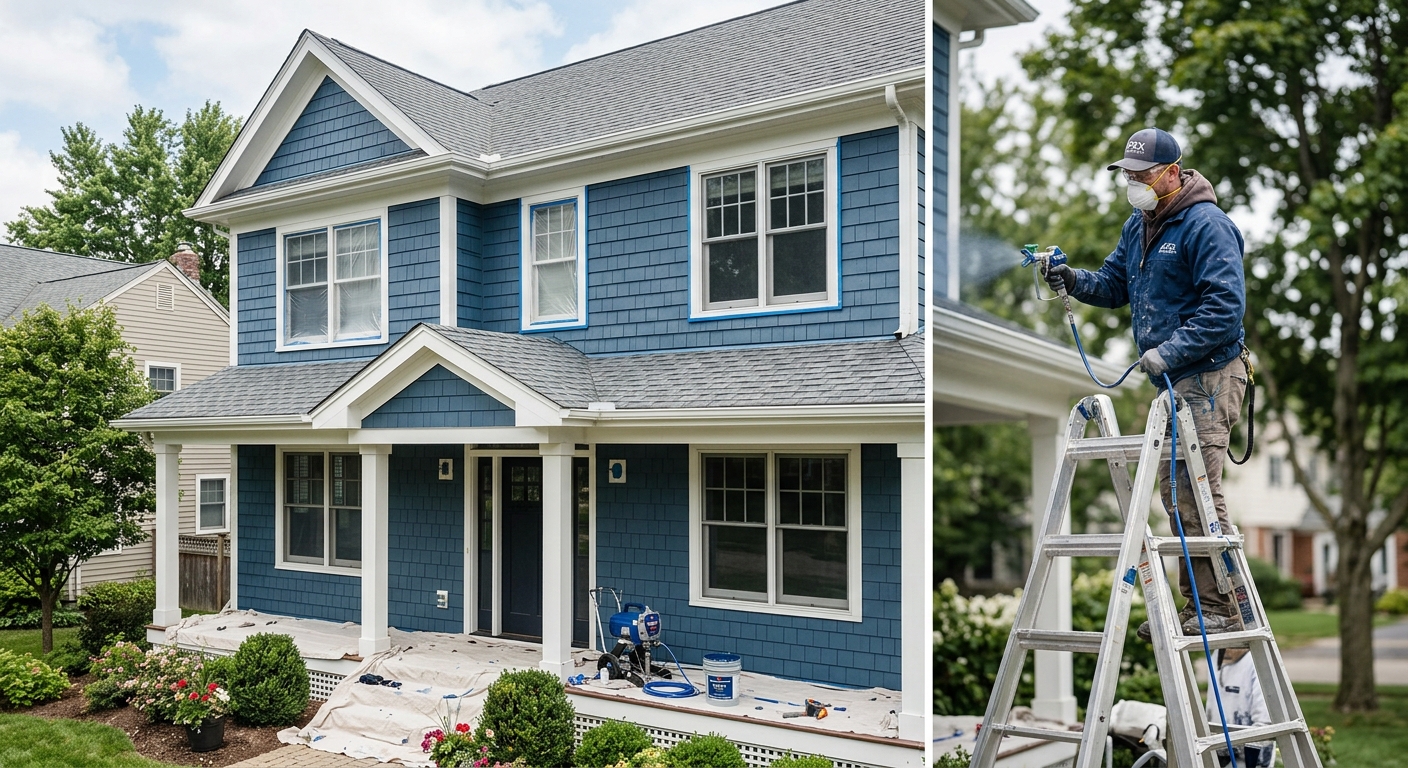
Painting options and costs in Midland
In Midland, Ontario, homeowners typically choose between interior refreshes and exterior repaints based on timing, budget, and how much surface prep their home needs. With 61.6% of local dwellings built before 1981, many jobs start with scraping, patching, caulking, and priming before a finish coat can stick. That matters because older siding and trim often have degraded caulk lines, chalky paint, or minor wood/gypsum repairs that add labour time. If your home is pre-1978, many contractors also use lead-safe work practices (even when homeowners aren’t legally required to do so), because sanding or scraping can release hazardous dust if lead is present.
Costs also reflect the Kitchener–Waterloo–Barrie region’s “short warm-weather window” for exterior work. Contractors plan much of the May through September schedule around temperatures staying above roughly 10°C and surfaces being dry enough for proper film formation. When that weather is stable, crews can move efficiently; when it’s not, scheduling pressure increases and pricing tends to rise. In demand areas often include neighbourhoods with larger detached housing stock and older streets—commonly around Midland’s downtown core and the south end near Hurontario Street—where repainting is a frequent upgrade alongside property maintenance.
Below are realistic starting points for typical Midland scopes, so you can compare quotes apples-to-apples before you book a site visit.
| Service |
What's Included |
Typical Duration |
Price Range |
| Interior — whole home (walls, ceilings, trim) |
Moveables protection, wall/ceiling prep, patching/sanding, caulking, primer as required, 2 finish coats on walls/ceilings, detailed trim work |
5–10 days |
$2,500–$7,000 |
| Interior — per room (standard bedroom or living room) |
Prep and repairs, prime as needed, 2 finish coats, clean-up, basic floor/wall protection |
1–3 days |
$1,000–$2,800 |
| Exterior — full house (siding, trim, soffits) |
Pressure washing (or equivalent surface cleaning), scraping/sanding, caulking, primer on bare spots, 2 finish coats, attention to trim/soffit edges |
7–18 days |
$2,500–$9,000 |
| Exterior — trim and accent colours only |
Cleaning, light prep, scraping of loose areas, priming spot areas, caulking at transitions, 2 finish coats for trim/accent work |
3–8 days |
$1,200–$4,500 |
| Kitchen cabinet painting (doors, frames, spray finish) |
Degreasing, sanding/deglossing, repairs, bonding primer, spray or brush finish (as specified), hardware removal/handling, final clear coat as required |
5–14 days (including dry times) |
$1,200–$4,500 |
| Specialty / faux finish (accent wall, texture) |
Surface flattening/spot priming, labour-intensive technique, protective topcoats, minor patching for seamless blending |
1–6 days |
$800–$3,000 |
Prices are estimates only and vary by project scope, site access and material selection.
What affects the price of painting in Midland
In the Kitchener–Waterloo–Barrie region, it’s common to see the “same” painting job quoted with swings of 30–50% once you compare scope, prep approach, and how labour is scheduled around weather. That difference isn’t just paint—it’s mostly time: matching sheen, masking edges, repairing hidden issues, and doing the prep that prevents blistering, peeling, and scuffing. Exterior work is especially sensitive to schedule because the exterior painting season in Ontario is typically late May through early October, when temperatures are above about 10°C and rising during application. When stable weather is scarce, crews tighten around available dry days, and summer rates climb.
Older homes across Midland also drive costs. With 61.6% of homes built before 1981, you often deal with chalky coatings, mismatched prior repairs, and caulk lines that have failed. In repainting work, prep can be the majority of labour—commonly 50–70%—including scraping loose paint, patching wood/drywall, sanding edges, and priming bare areas. If your home is within the typical exterior full-house range ($2,500–$9,000), those prep realities explain why two quotes can differ even when the finish product is similar. For smaller trim-only scopes ($1,200–$4,500), you’ll still pay for careful edge work and masking, but you can save by limiting where primer and full prep are needed.
Concrete Midland examples: (1) a detached home with older siding often needs more caulking and spot-priming at window/soffit transitions, which increases labour; (2) a job with easy access and minimal height can avoid scaffolding/lifts, keeping costs closer to the lower end; (3) homes with extensive peeling on sun-exposed elevations may require more scraping to reach sound material before top coats go on, which moves the project toward the higher exterior bands.
| Price Factor |
Why It Matters |
Cost Impact |
| Surface prep — scraping, sanding, patching drywall or wood |
Paint can’t bridge over failing coatings or unaddressed damage; prep determines adhesion and smoothness |
Often +20% to +60% depending on condition |
| Number of coats — 2-coat system over primer vs. 1 coat over existing |
Two-coat coverage over proper primer improves durability and colour uniformity |
Can shift total cost by 10% to 25% |
| Paint quality tier — contractor-grade vs. premium (Benjamin Moore, Sherwin) |
Higher-tier paints tend to provide better hide, scrub resistance, and long-term exterior performance |
Materials typically +5% to +20% overall |
| Ceilings and trim — adds significant time vs. walls-only |
Ceilings and detailed trim require additional masking, cutting-in, and careful finish work |
Typically +15% to +40% for interiors |
| Exterior season window — short season raises summer rates |
Dry, warm days are limited; tight scheduling increases crew rates and impacts availability |
Can add +10% to +30% during peak weeks |
| Lead-safe precautions — required for pre-1978 homes with lead paint |
Extra containment, wet methods, HEPA vacuuming, and disposal reduce health risk |
Often +5% to +25% depending on risk/condition |
| Surface material — drywall vs. plaster vs. wood vs. stucco |
Different substrates need different primers and prep strategies for adhesion |
Can swing costs by 10% to 35% |
| Height and access — multi-storey exterior requires scaffolding or lifts |
Safety equipment and time increase overhead and labour efficiency |
Commonly +20% to +50% on bigger facades |
Permits & regulations in Ontario
In Ontario, painting typically does not require a permit for a residential repaint. Where homeowners need to be careful is with how work is carried out, especially on older properties. For homes built before 1978, health guidelines recommend testing for lead paint before sanding or scraping, and using lead-safe practices if lead is present. Professional contractors generally follow lead-safe work practices such as wet methods to minimize dust, HEPA-filtered vacuuming, proper containment where needed, and compliant disposal of contaminated debris. This is not usually a “permit” issue, but it is a safety and duty-of-care issue.
Also confirm contractor protections before you sign anything. Ask for proof of liability insurance and WSIB (or WCB coverage for workers’ compensation, depending on coverage structure). While Ontario doesn’t ask you to pull permits for normal painting, it does matter that the contractor is properly covered if a worker is injured or if there’s accidental damage to your property.
When verifying, do this step-by-step:
- Request the contractor’s liability insurance certificate and check the dates and named insured.
- Confirm workers’ compensation coverage (WSIB/WCB) before work starts.
- Ask for their written contract to specify paint brand/product, sheen, number of coats, prep responsibilities, and what’s included for surface repair.
- Confirm whether any special procedures are included for pre-1978 lead-safe work (if applicable).
Interior vs exterior painting — getting the best result in Midland
Long-lasting paint in Midland comes down to prep quality, correct product choice, and doing the right number of coats—not cutting corners. For interior projects, the biggest differentiator is surface preparation: filling dents, sanding for smoothness, spot-priming stains, and caulking gaps where needed. Topcoat brand matters, but in real-world timelines, sheen choice often matters just as much. In high-use rooms (hallways, kitchens), semi-gloss or satin tends to resist scuffs better than flat paint. And durability-wise, two coats over a proper primer consistently outlast a “thick single coat,” because you get more uniform film build and hide across patches.
For exteriors, Ontario’s freeze-thaw cycles and spring/fall moisture make surface prep and water management critical. Caulking should be done at windows, trim edges, and transitions before finish coats. Primer type should match the substrate—using the wrong base (for example, failing to bond to previously coated surfaces) can lead to premature peeling. Product selection also matters: mildew-resistant formulations are particularly important where moisture lingers (and are a common recommendation for damp-looking areas), while temperature-stable materials help ensure proper application when early/late-season conditions shift.
Cabinet painting is a budget alternative to replacement, but it’s only worthwhile when prep is thorough (degreasing, sanding/deglossing, bonding primer) because kitchen grease can cause adhesion failure. For pre-1978 homes, use lead-safe precautions before sanding or scraping—this can add time and cost, but it protects your indoor air and reduces hazardous dust.
Price-wise, the difference between options is easy to justify. For example, if a “trim-and-accent only” scope is quoted in the $1,200–$4,500 range, spending within that band on proper caulking and spot-priming usually prevents the bigger, higher-cost failure you’d face later during a full exterior repaint in the $2,500–$9,000 range.
| Project Type |
Key Prep Step |
Recommended Coats |
Price Band |
| Interior — fresh drywall (new construction) |
Prime for uniform absorption and seal joint compound before finish paint |
1 coat primer + 2 coats finish |
$2,500–$7,000 |
| Interior — repaint (good condition, no repairs) |
Degrease where needed and lightly sand/scuff for adhesion; mask carefully |
2 coats finish (spot-prime only if required) |
$1,000–$4,000 |
| Interior — repaint (patching and priming needed) |
Fill, sand smooth, prime patches/stains to prevent flashing |
Primer spots + 2 coats finish |
$1,500–$5,500 |
| Exterior siding (wood or fibre cement) |
Scrape/sand to sound material, caulk transitions, and prime bare spots |
2 coats finish over appropriate primer |
$2,500–$9,000 |
| Exterior trim and accents only |
Edge prep and spot priming at stress points (window/soffit transitions) |
2 coats finish on trim/accent |
$1,200–$4,500 |
| Kitchen cabinets (spray finish) |
Bonding prep: degrease, degloss, sand, then prime for adhesion |
Primer + 2 finish coats (system dependent) |
$1,200–$4,500 |
How to choose a painting contractor in Midland
Choosing a painter in Midland is mostly about verifying coverage, getting itemised numbers, and making sure the scope matches how paint actually performs in Ontario weather. Start with insurance: ask for proof of liability insurance (certificate of insurance) and confirm workers’ compensation coverage (WSIB or applicable WCB coverage). When you receive certificates, check the effective dates and make sure the coverage is active for the job period, not expired in the last year.
Next, ask for 2–3 written, itemised quotes. The best estimates separate labour and materials (prep time, masking, sanding/scraping, caulking, primer, finish coats, disposal). Avoid “all-in” lump sums unless the scope is extremely specific—painting failures often start where the quote is vague (for example, what’s included for prep on peeling areas or stained drywall).
Read the exclusions and practical details carefully: is pressure washing included for exteriors, is surface scraping limited, is lead-safe work included for pre-1978 homes, and who handles disposal of paint chips/contaminated debris? Ask about warranty too: workmanship warranty length (and what it covers), plus manufacturer/product warranty terms.
Finally, payment schedule matters. A sensible approach is never paying more than about 10–15% upfront, with progress payments tied to completed milestones and a holdback until the work is finished and cleaned up. Get a written start date and completion estimate.
- Confirm liability insurance certificate is current and covers residential work.
- Confirm WSIB/WCB coverage for workers.
- Use a written contract that lists paint brand/product and sheens.
- Require scope details: scraping limits, caulking locations, priming rules.
- Ask for the number of coats by surface (walls, ceilings, trim, exterior elevations).
- Check whether primer is included for bare spots and repairs.
- Confirm prep methods for older homes (spot-prime vs. full adhesion prep).
- Ask who provides drop sheets, masking, and protection of floors/windows.
- Verify disposal is included (paint chips, sanding dust, caulking debris).
- Get start/completion dates in writing, not “sometime in summer.”
- Confirm workmanship warranty and whether it follows the property or only the homeowner.
- Limit upfront deposit to 10–15% and keep a holdback for completion.
Red flags we see in Midland: contractors who won’t provide insurance/WSIB proof; quotes that omit surface prep details (no mention of scraping, sanding, caulking, or primer); vague “we’ll use good-quality paint” language without brand/sheens; asking for large deposits upfront; and promising unrealistic timelines without considering the late-spring to early-fall exterior window.
Frequently asked questions — painting in Midland
How long does exterior paint last here?
In Midland and across Ontario’s inland climate, the realistic lifespan of exterior paint depends heavily on prep and how the coating handles moisture and freeze-thaw. With good surface prep—scraping loose material, caulking transitions, priming bare spots—and correct application during a dry window, many homeowners see long service life. However, older homes are often the biggest variable: since a large share of Midland housing was built before 1981 (Statistics Canada, 2021 Census), you may find more failing caulk lines, adhesion issues, or patchwork that needs deeper prep. That’s why an exterior full-house repaint (often in the $2,500–$9,000 band) can last far longer than a “trim-only touch-up” when the underlying substrate is still holding moisture.
Should I paint or replace my cabinets?
For many Midland homeowners, painting kitchen cabinets is the smarter move when the cabinet boxes are solid and the doors/drawers are the main issue (colour dated, scuffs, or minor wear). Cabinet painting typically fits the $1,200–$4,500 range, and it can look dramatically better than replacement when done with proper degreasing, deglossing, bonding primer, and a durable topcoat. Replacement is worth considering when boxes are sagging, the hardware system is failing, or the finish is deeply damaged beyond cosmetic wear. If your cabinets have grease buildup (common near ranges), prep is non-negotiable; skipping it is the fastest route to peeling.
How do I prep walls before painting?
For interior walls in Midland, the safest “homeowner prep” is mostly about clearing space and protecting surfaces. You can remove wall decor, cover floors and furniture, and make sure there are no drips or damp spots. Beyond that, professional prep usually includes filling dents, sanding for smoothness, and spot-priming repairs and stained areas to prevent “flashing.” If you’re repainting, light scuffing and cleaning are important so the new coat bonds—especially in kitchens and hallways. Quote comparisons should reflect whether repairs and priming are included, because jobs needing patching and priming often land toward the upper end of interior repaint scopes.
Do I need to worry about lead paint in an older Midland home?
If your Midland home was built before 1978, it’s worth being cautious about lead paint dust. Ontario doesn’t usually require a permit for painting, and homeowners aren’t automatically legally forced to test; but professional best practice is to test before sanding or scraping, and to follow lead-safe work practices if lead is present (wet methods, HEPA vacuuming, and proper containment/disposal). This is one reason two quotes can differ on older houses: lead-safe precautions add labour and equipment even when the finish paint is “standard.” When you request a quote, ask explicitly whether lead-safe procedures are included for pre-1978 work and how they’ll protect occupants during prep.
How long does it take to paint a house?
Timelines vary by interior/exterior, prep needs, and weather windows. For interiors, a whole home often takes several days (commonly 5–10 days) depending on the number of rooms, ceiling height, and how much repair work is needed. For exteriors, expect longer on older homes because scraping, patching, caulking, and priming take time, and the late May through early October weather window limits when crews can paint. A full exterior repaint can be 7–18 days depending on elevations, access, and drying time. If your quote is in the exterior full-house range of $2,500–$9,000, ask the contractor to include a schedule with milestone dates, not just a “start when weather allows.”
What's the difference between paint quality tiers?
Paint quality tiers usually come down to hide/coverage, scrub resistance, consistency, and performance under Ontario conditions. Premium lines (often including brands contractors commonly reference like Benjamin Moore or Sherwin) can cover better, resist scuffs and stains more effectively, and maintain colour longer—especially important on trim and high-touch interior areas. That can reduce the chance you’ll need extra coats or extensive rework after issues like flashing, especially when prep is already thorough. For exterior work, a higher-tier system often supports better adhesion and durability when paired with correct primer and prep. In Midland pricing, materials tier can shift totals within interior ranges like $2,500–$7,000 or exterior $2,500–$9,000, but prep quality is still the foundation for longevity.