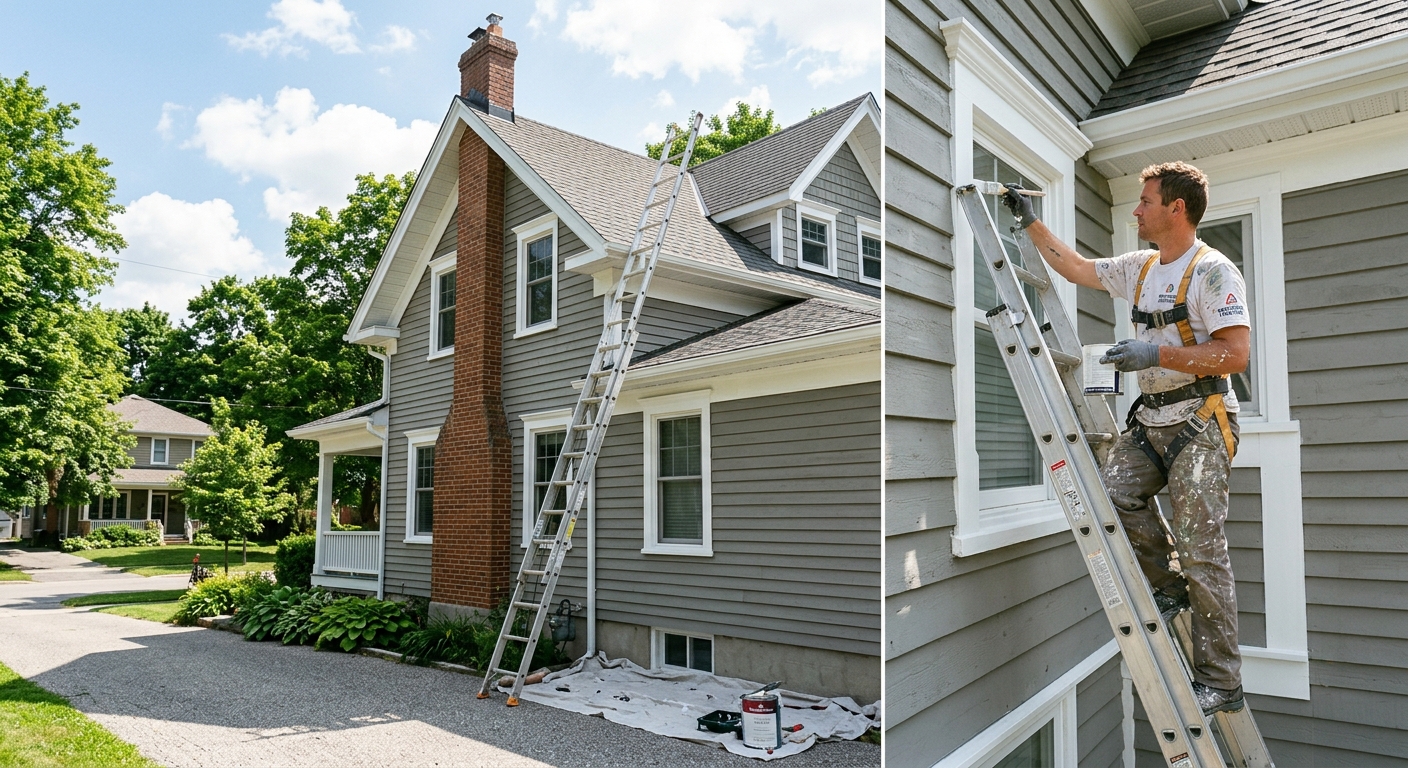
Painting options and costs in Bluewater
Bluewater homeowners usually have two main priorities when they call for estimates: upgrading curb appeal and keeping interiors looking clean and fresh. With about 83.5% of Bluewater households owning their homes, painting is often a planned maintenance project rather than a short-term refresh (Statistics Canada, 2021 Census). That matters because many of the houses in the area were built long before modern paint systems—roughly 60.5% of dwellings were built before 1981—so preparation can be more involved than people expect: scraping loose paint, patching cracks, priming bare areas, and sometimes lead-safe precautions when surfaces may be older than typical coatings.
In the Stratford–Bruce Peninsula region, exterior painting costs are strongly shaped by our continental weather and contractor availability. Unlike coastal BC, Bluewater generally has fewer year-round dampness issues, but humidity and freeze–thaw cycles still drive failure if work is forced when surfaces aren’t dry or when temperatures won’t stay in the manufacturer-recommended range. Exterior work is also concentrated into the late spring through early fall window, so scheduling demand can push exterior pricing toward the upper end. Around Port Elgin and the broader Bluewater area, we often see especially high interest in exterior and trim work for older single-detached homes that need careful prep and better moisture management.
Below is a practical comparison of common services and typical budgeting ranges for Bluewater, which we’ll use to fine-tune your quote once we confirm condition, access, and the product tier you prefer.
| Service |
What's Included |
Typical Duration |
Price Range |
| Interior — whole home (walls, ceilings, trim) |
Surface prep, caulking, filling/sanding, primer where needed, 2-coat topcoat, tape/protect floors and fixtures, clean-up and final touch-ups |
5–10 days |
$1,200–$3,200 |
| Interior — per room (standard bedroom or living room) |
Prep, patching and sanding as needed, 2-coat walls/ceiling, basic trim spot prep/one pass where applicable, protection and clean-up |
1–3 days |
$600–$1,600 |
| Exterior — full house (siding, trim, soffits) |
Power wash (as required), scrape/sand to stable coating, caulk, prime bare areas, 2-coat exterior system, detailed trim work, protection of landscaping/windows |
7–18 days |
$2,500–$7,000 |
| Exterior — trim and accent colours only |
Prep and prime required areas, caulking, 2-coat finish on trim/accents, masking/protection, clean-up |
3–10 days |
$1,500–$4,500 |
| Kitchen cabinet painting (doors, frames, spray finish) |
Degrease, de-gloss and sand, repairs, spray-grade coating for flat/smooth finish, hardware handling as discussed, cabinet box coverage, final cure time |
5–14 days |
$1,200–$4,000 |
| Specialty / faux finish (accent wall, texture) |
Surface prep, base coats, specialty application, protective topcoat (as needed), matching existing sheen/texture |
2–7 days |
$700–$3,500 |
Prices are estimates only and vary by project scope, site access and material selection.
What affects the price of painting in Bluewater
You can get noticeably different quotes for what sounds like the same job in Bluewater and across the Stratford–Bruce Peninsula region—often 30–50%—because painting isn’t just “rolling paint on.” The biggest drivers are prep time, product system selection, and how weather and scheduling affect labour availability during the exterior season. A contractor may quote a lower price if the job is treated as a simple topcoat, but if stable prep (scrape/sand/prime/caulk) is missed, the finish can fail early—especially after our humidity and freeze–thaw cycles.
For exterior work, the season is tightly climate-bound across our region: roughly late May to early October is when daytime temperatures are consistently in the manufacturer-recommended range and surfaces can dry properly for curing. Coastal BC can paint for longer periods, but the trade-off is higher humidity and rain exposure, so mildew-resistant systems and careful timing are essential. In Ontario, the shorter, more compressed season means more scheduling pressure during summer, which can push exterior pricing toward the $1,500–$7,000 regional band. Interior jobs are less season-limited, but they still vary based on patching complexity and access.
Older homes make prep a major cost lever. In repainting scenarios, scraping, sanding, caulking, and priming can represent 50–70% of total labour. For example, bringing a pre-1981 single-detached home that has failing caulk and patchy adhesion back to a stable surface can move an exterior project from the lower end toward the middle of the exterior range. Conversely, a well-maintained home with intact coating and minor touch-ups might land closer to the trim-and-accent band rather than full-house pricing. That’s why a $2,500 exterior estimate and a $5,500 estimate can both be “painting,” but one may include much more prep and primer coverage than the other.
| Price Factor |
Why It Matters |
Cost Impact |
| Surface prep — scraping, sanding, patching drywall or wood |
Stable adhesion and smoothness depend on removing loose material and repairing substrate defects |
Often +$400 to +$2,000 depending on condition |
| Number of coats — 2-coat system over primer vs. 1 coat over existing |
Coverage, hide, and colour change require correct layering for durability |
Commonly +10% to +40% for increased coat count |
| Paint quality tier — contractor-grade vs. premium (Benjamin Moore, Sherwin) |
Premium systems can offer better hiding, durability, and fewer rework issues |
Materials may add +$150 to +$600+ on typical projects |
| Ceilings and trim — adds significant time vs. walls-only |
Ceilings and trim require tighter masking, cutting-in, and more passes |
Often +$300 to +$1,200 |
| Exterior season window — short season raises summer rates |
Higher demand in the limited weather window affects scheduling and labour costs |
Can shift total pricing +5% to +25% in peak periods |
| Lead-safe precautions — required for pre-1978 homes with lead paint |
Safe containment, wet methods, HEPA cleanup and disposal increase labour and cost |
May add +$300 to +$1,500+ for testing/remediation steps |
| Surface material — drywall vs. plaster vs. wood vs. stucco |
Different substrates need different primers, sanding methods, and moisture-tolerance |
Typically +$200 to +$900 based on material complexity |
| Height and access — multi-storey exterior requires scaffolding or lifts |
Access equipment adds setup time, safety controls, and sometimes more labour hours |
Often +$500 to +$2,500+ |
Permits & regulations in Ontario
In Ontario, painting work generally does not require a permit for homeowners to have paint applied. Where regulation does come into play is around workplace safety and lead-safe practices for older homes, not around a “painting permit” for the finished homeowner project. For homes built before 1978, health guidelines recommend testing for lead paint before sanding or scraping, and using lead-safe work practices if lead is present (wet methods to control dust, HEPA vacuuming, proper disposal, and containment). This isn’t typically “legally mandated” for homeowners to do in the same way it would be for a regulated abatement contractor, but it is standard professional practice—especially if the job involves disturbance of old coatings.
What DOES typically require a permit in Ontario is not painting itself; it’s building envelope changes or structural work (for example, major renovations, new windows/doors as part of a larger scope, or any electrical/plumbing alterations). Pure repainting, re-staining, and cosmetic refinishing generally do not trigger permit requirements.
Step-by-step, you can verify your Bluewater contractor is set up properly:
- Ask for their Ontario business details and verify they are legitimately operating in Ontario (and confirm any trade-specific credentials they hold).
- Request a Certificate of Insurance for liability coverage—your contractor should provide it directly.
- Confirm workers’ compensation coverage (WSIB / WCB) with documentation—don’t accept “we’re covered” without a certificate.
- Get a written contract that spells out paint brand, sheen, number of coats, surface prep scope, and what protection/disposal is included.
- If lead testing or lead-safe procedures are discussed, ask how they handle containment, HEPA cleanup, and disposal documentation.
Interior vs exterior painting — getting the best result in Bluewater
In Bluewater’s climate, a long-lasting paint job depends more on prep and correct systems than on chasing the “brand name.” For interiors, start with patching and surface prep: proper filling, sanding, and priming of stains or repairs is what prevents flashing and peeling. Sheen choice matters by room use—flat or ultra-matte is great at hiding wall imperfections in low-traffic areas, while eggshell or satin typically holds up better for families and cleaning cycles. A practical rule we use on-site: two coats over a proper primer almost always outlast one thick coat. If someone is offering “one coat everywhere,” that’s usually a coverage problem hiding behind promises.
For exteriors, the critical difference is Ontario moisture management. Caulking needs to be done before painting so joints seal properly and to prevent water ingress under the coating. Primer selection depends on the substrate: different primers help bond to wood, fibre cement, and previously painted surfaces. You also want products that tolerate temperature shifts and humidity—particularly important through our freeze–thaw cycles. While BC projects can lean heavily on mildew resistance due to constant dampness, and Alberta can stress temperature swings, our Stratford–Bruce Peninsula approach balances both: moisture-tolerant prep, quality acrylic exterior coatings, and careful timing during the late May to early October window.
Kitchens are a special case. Cabinet painting can be an excellent budget alternative to replacement, but only when surfaces are properly de-greased, de-glossed, and sprayed with a finish-grade system—otherwise doors can look uneven or feel sticky early. In cost terms, you may see kitchen cabinet painting around the $800–$4,000 range depending on finish quality and cabinet condition; that can justify itself when replacement would be multiple times higher. For pre-1978 homes, lead-safe precautions should be built into the plan if coatings may contain lead, especially if scraping is required.
| Project Type |
Key Prep Step |
Recommended Coats |
Price Band |
| Interior — fresh drywall (new construction) |
Prime to seal, then sand smooth; address nail pops and joint compounds |
2-coat topcoat over primer |
$800–$2,000 |
| Interior — repaint (good condition, no repairs) |
Clean/de-grease, light scuff-sand, caulk touch-ups, spot-prime if needed |
2-coat topcoat (often primer not required everywhere) |
$600–$1,800 |
| Interior — repaint (patching and priming needed) |
Patch, sand, prime repaired areas to prevent flashing and peeling |
2 coats topcoat + primer on repairs |
$900–$2,800 |
| Exterior siding (wood or fibre cement) |
Scrape to stable coating, caulk correctly, prime properly before topcoat |
2-coat exterior system |
$2,500–$7,000 |
| Exterior trim and accents only |
Mask cleanly and prime bare spots; ensure caulk bonds to dry substrate |
2-coat topcoat on trim/accents |
$1,500–$4,500 |
| Kitchen cabinets (spray finish) |
Degrease, de-gloss, repair and sand; spray-grade prep and primer |
2-coat finish system (primer + topcoat) |
$1,200–$4,000 |
How to choose a painting contractor in Bluewater
Choosing a contractor in Bluewater is mostly about verifying coverage and getting a scope that matches your expectations. Start with Ontario compliance basics: ask for their liability insurance certificate and verify it’s current and includes your address/project type. Next, confirm workers’ compensation coverage (WSIB / WCB) with the appropriate certificate—this protects you if an employee is injured on-site. If they can’t provide documentation quickly, that’s a serious warning sign.
Then, get 2–3 itemised written quotes, not a single lump-sum number. You want a breakdown for labour (prep, cutting-in, cleanup) and materials (primer, topcoat, caulk, sundries). A solid quote also addresses what’s excluded: exterior window caulking, lead testing, disposal fees, furniture move/cover options, and whether repairs are included or treated as a change order.
Warranty matters too. Ask for the workmanship warranty length (and what it covers), plus the manufacturer/product warranty terms and whether it’s tied to being installed by a qualified contractor. Payment should be conservative: never pay more than about 10–15% upfront, and insist on a holdback until the job is complete and touch-ups are finished. Finally, demand a timeline in writing: proposed start date, weather-dependent milestones for exterior work, and a completion estimate.
- Request and review a liability insurance certificate before work starts.
- Confirm WSIB/WCB coverage with a certificate (not just verbal reassurance).
- Ensure the written quote lists paint brand, colour name, sheen, primer type, and number of coats.
- Ask what surface prep is included (scraping/sanding/patching) and what condition triggers extra charges.
- Check protection scope: floors, landscaping, fixtures, and how windows/vents are masked.
- Confirm caulking scope for exterior and whether it’s replaced at cracks/open joints.
- Verify disposal is included (paint waste, debris, and any regulated materials if applicable).
- For pre-1978 homes, ask about lead-safe steps if scraping/disturbance is required.
- Clarify access assumptions: ladders vs. lifts/scaffolding and who supplies them.
- Get a workmanship warranty in writing and ask what voids it.
- Review the schedule: exterior jobs should align with dry-season temperature needs.
- Use a payment schedule with a holdback until final walkthrough is complete.
Red flags in Bluewater include contractors who won’t provide insurance/WSIB documentation, quotes that ignore surface prep (no scraping/sanding/priming detail), “one-coat” claims for repaints, vague warranties (no written terms), and payment requests that exceed 10–15% upfront.
Frequently asked questions — painting in Bluewater
What colours add the most resale value in Bluewater?
In Bluewater and across Ontario’s owner-occupied neighbourhoods, resale-friendly colours tend to be bright, light-reflective, and easy to match. For many homes built before 1981, the goal is to make spaces feel updated without fighting older features like trim profiles and window casings—so warm whites, soft greiges, and light cool-tones often perform best in photos and viewings. On exteriors, a classic “main body light + darker trim” combination usually reads well on older single-detached homes and helps mask minor surface variation. If you’re planning exterior work that lands in the $1,500–$7,000 range, choosing a sensible palette before prep starts prevents costly rework and repainting of primed areas. (Statistics Canada, 2021 Census)
How much does it cost to paint a house in Bluewater?
For Bluewater homeowners, the total cost depends mainly on whether you’re painting the interior, the exterior, or both, plus how much prep the existing surfaces need. A full exterior repaint commonly sits in the $2,500–$7,000 range when scraping, caulking, priming bare areas, and proper exterior coating systems are included. Interior whole-home painting is often budgeted in the $1,200–$3,200 range depending on ceiling/trim coverage and the number of repairs. Quotes can vary widely—particularly in the summer—because the exterior season is short and labour demand rises during the late spring to early fall window. If you want more predictable pricing, start with a walkthrough that identifies whether peeling, failing caulk, or older coating disturbance will require extra prep or lead-safe precautions.
How much does interior painting cost per room in Bluewater?
Interior painting per room in Bluewater typically lands in the $600–$1,600 band for a standard bedroom or living room, assuming normal access and reasonable wall condition. The biggest cost swings happen when repairs are needed (patching, sanding, and priming) and when trim is heavily detailed or includes multiple surfaces like chair rails or built-ins. If your room is in good condition and it’s primarily a repaint, it can sit closer to the lower end of the range. If you have stains or recent drywall work, budget higher because primer work is what stops flashing and uneven sheen. For clarity, ask for an itemised quote showing prep, number of coats, and whether ceilings are included. That’s usually where “per room” estimates either stay fair or jump.
When is the best time for exterior painting in Bluewater?
In Bluewater and the Stratford–Bruce Peninsula region, the best time for exterior painting is when temperatures are in the manufacturer’s recommended range and surfaces can dry and cure properly. In practice, most crews aim for the late May to early October window, when daytime conditions are consistently suitable for application and bonding. This reduces the risk of peeling and poor adhesion that can happen if coatings are applied too cool, too humid, or to damp substrates after freeze–thaw periods. Because the weather window is shorter than in parts of Canada like BC, demand increases in summer and earlier booking helps you secure preferred scheduling. If you’re also dealing with older homes (many built before 1981), planning prep time for scraping and caulking within the dry period is especially important for long-term performance.
How many coats of paint do I need?
Most repainting projects in Bluewater call for a two-coat system. If you’re painting over a properly prepared surface, the usual approach is primer where needed plus two topcoats to achieve coverage, even sheen, and durability. A one-coat strategy may work only in very limited scenarios—like a repaint with an excellent substrate and a minimal colour shift—which is why detailed prep and correct primer are essential. For example, if you’re budgeting interior painting per room (often $600–$1,600), a quote that includes prep and a 2-coat topcoat typically costs more than “one-coat,” but it also reduces the chances of patchiness or the need for quick touch-ups. For exteriors, two coats over primer is standard for stable colour and protective performance through Ontario’s humidity and freeze–thaw cycles.
What paint is best for Bluewater's climate?
For Bluewater’s Ontario climate, the best exterior choice is an acrylic exterior coating system designed to handle moisture exposure, temperature swings, and freeze–thaw effects. Equally important is primer and prep: the right primer for your substrate (wood, fibre cement, or previously painted surfaces) and correct caulking directly affect longevity. While mildew-resistant coatings are often discussed more with coastal conditions like BC, our region still sees humidity-related issues, so quality acrylics and good surface prep are key. For interior walls, selecting the right sheen by room use—often eggshell or satin for living areas and kitchens—helps with cleaning and wear. If you want a realistic budget range, exterior work often sits in the $1,500–$7,000 band depending on prep complexity and coating system selection.