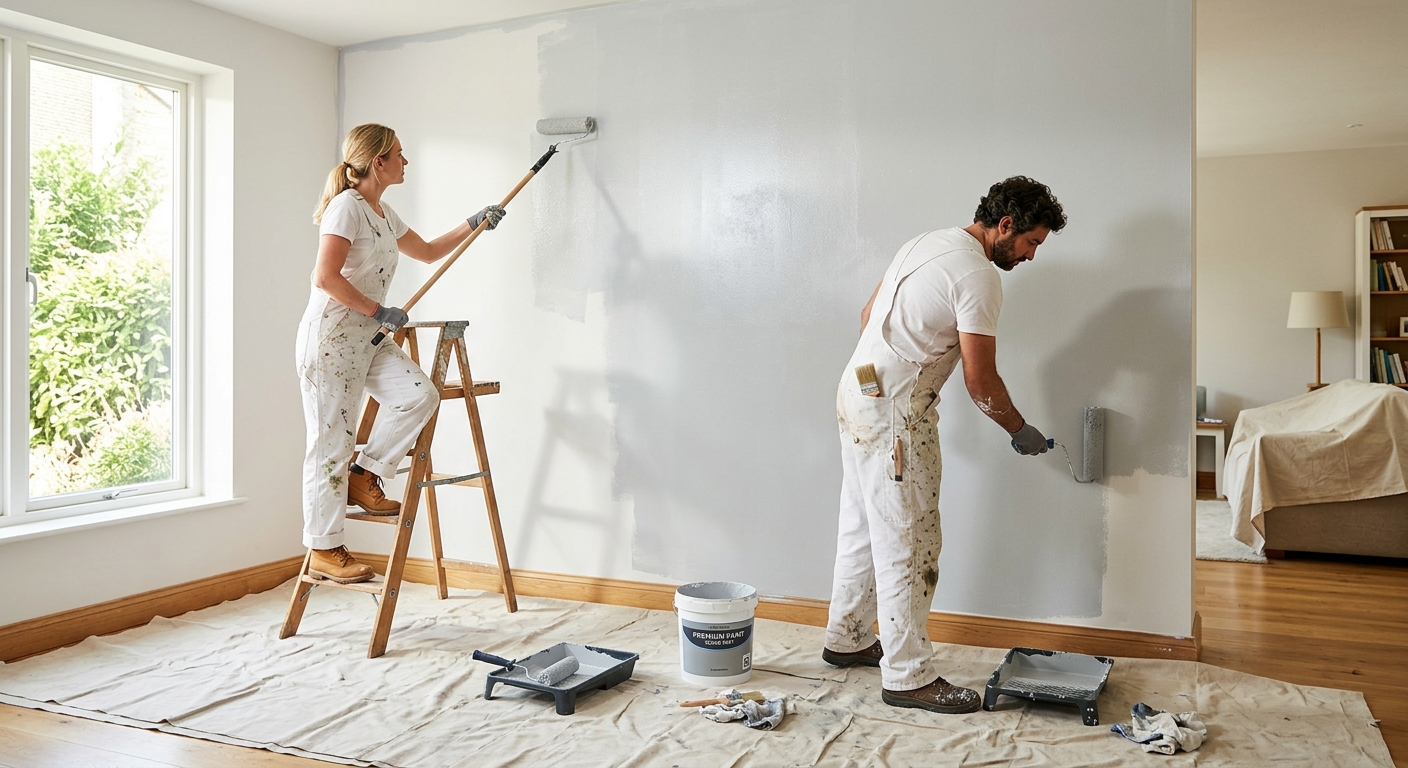
Painting options and costs in Etobicoke
Etobicoke homeowners typically choose between quick interior refreshes and longer, season-sensitive exterior projects. With a population of about 365,000 (Statistics Canada, 2021 Census), the Toronto market keeps steady demand for both, but contractor availability and pricing swing more for exteriors than interiors. In this area, older housing stock is common across many streets and plans, so a repaint often involves extra preparation—scraping, sanding, patching, caulking, and priming—before any topcoat goes on. If your home is in the older bracket, standard lead-safe precautions are also part of professional prep (even though the province does not require homeowners to do lead testing themselves).
Cost is shaped by GTA weather and by how tight the “ideal” exterior weeks can be. In the Greater Toronto Area, exterior painting is generally most practical from late May through June and again from September to mid-October, when temperatures are staying comfortably above about 10°C for proper curing. During peak summer demand (June–August), exterior pricing often lands higher due to limited scheduling windows. That’s also why two quotes for the same siding or trim job can differ even when the paint brand is the same—prep time and scaffolding/lift access often drive the labour.
In Etobicoke—especially around neighbourhoods like Islington-City Centre and the Etobicoke North area—exterior repaint work is in heavy rotation because many homes have mature siding and trim that need periodic maintenance. Use the table below as a baseline for what homeowners typically budget before you request itemised quotes.
| Service |
What's Included |
Typical Duration |
Price Range |
| Interior — whole home (walls, ceilings, trim) |
Protect floors and fixtures, patch/caulk as needed, sand lightly, prime repaired areas, paint walls/ceilings, paint baseboards, doors and trim; basic prep cleanup |
5–10 working days |
$3,000 – $6,000 |
| Interior — per room (standard bedroom or living room) |
Protect surfaces, prep minor scuffs, patch small holes, sand/prime as required, paint walls and one ceiling; include trim/baseboards if present |
1–3 working days |
$400 – $1,500 |
| Exterior — full house (siding, trim, soffits) |
Pressure wash where appropriate, scrape/sand failing paint, caulk joints, prime bare spots, paint full elevation including trim/soffits; includes weather-resilient exterior system |
6–12 working days |
$3,500 – $8,000 |
| Exterior — trim and accent colours only |
Spot prep (scrape/sand/prime as required), caulk where needed, paint trim and selected accent areas; excludes full siding repaint |
3–7 working days |
$1,500 – $4,500 |
| Kitchen cabinet painting (doors, frames, spray finish) |
Remove/label doors if feasible, degrease and sand, prime with appropriate bonding primer, spray or roll finish for doors and visible frames, reinstall hardware (minor adjustments only) |
5–12 working days |
$2,000 – $4,000 |
| Specialty / faux finish (accent wall, texture) |
Design prep, surface patching to ensure pattern consistency, base coat, application of texture/faux product, protective topcoat as required |
2–6 working days |
$700 – $3,500 |
Prices are estimates only and vary by project scope, site access and material selection.
What affects the price of painting in Etobicoke
In Etobicoke and across the Toronto economic region, you’ll often see quotes for the “same” paint job swing by 30–50%. The main reason isn’t the colour—it’s labour. Contractors may price differently for surface prep, how many coats are truly required, how much masking is needed, and whether scaffolding/lifts are required. Even interior jobs can differ because ceiling height, the number of doors and window trims, and the amount of repair work (patching, sanding, priming) changes the labour hours quickly.
Exterior pricing is especially sensitive to the local schedule. In our region, the exterior season is tightly climate-bound: late May to early October is when contractors can reliably apply and have temperatures stay above about 10°C for proper curing, with humidity spikes still needing careful timing. Unlike coastal BC (where persistent dampness and mildew risk change product choices), the GTA’s constraints are frost, rain and those humidity bursts. The shorter “ideal” window means more demand concentration in June–August, and exterior work commonly lands closer to the higher end of the exterior band—often 10–15% higher—especially for multi-storey homes.
Older homes (common around Toronto, including Etobicoke) can add substantial prep time because scraping and priming may be needed across multiple paint layers, not just the new scuffs you see. For repainting, surface prep can represent 50–70% of labour on the job—so if your quote for a full exterior comes in around the lower end of the $1,500 – $8,000 exterior band, it’s usually because prep is lighter and access is straightforward; if you’re closer to $6,000–$8,000, it often reflects extensive scraping, caulking, priming, and lift/scaffold time.
Concrete examples we see locally: a house with peeling trim near eaves (extra scraping and priming) costs more than one where paint is well-bonded; a three-storey front elevation or fenced backyard (more protection and access costs) can push the job toward the upper end. For interiors, complicated stairwells and a higher sheen finish (more stringent prep) can move a “per-room” project toward the middle of the interior range.
| Price Factor |
Why It Matters |
Cost Impact |
| Surface prep — scraping, sanding, patching drywall or wood |
Prep determines adhesion and smoothness; older paint and damaged areas need bonding primer and additional sanding |
High: can be 50–70% of labour on repaints |
| Number of coats — 2-coat system over primer vs. 1 coat over existing |
Existing colour coverage and stain control decide whether 1, 2, or more coats are required |
Medium to high |
| Paint quality tier — contractor-grade vs. premium (Benjamin Moore, Sherwin) |
Coverage, washability, and durability vary; premium lines typically reduce rework and improve longevity |
Low to medium (but can affect total labour if coverage is different) |
| Ceilings and trim — adds significant time vs. walls-only |
Cutting in, protecting edges, and smoothing trim requires more careful labour |
Medium |
| Exterior season window — short season raises summer rates |
Limited “ideal” weeks can increase scheduling and crew costs |
Medium to high in June–August |
| Lead-safe precautions — required for pre-1978 homes with lead paint |
Professionals may use wet methods, HEPA vacuum, containment and proper disposal if lead is present/anticipated |
Medium (can be low if no disruption is needed, high if heavy scraping is required) |
| Surface material — drywall vs. plaster vs. wood vs. stucco |
Different substrates require different primers and prep methods to avoid peeling or flashing |
Medium |
| Height and access — multi-storey exterior requires scaffolding or lifts |
Setup, safety, and protection time increase with height and access limits |
High on taller homes or constrained lots |
Permits & regulations in Ontario
For most painting in Ontario, no permit is required—so homeowners in Etobicoke typically don’t need to apply to the city for a standard interior repaint or an exterior repaint. The key “regulatory” aspect is safe work practice, especially for older homes. For homes built before 1978, health guidelines recommend testing or treating dust and debris as potentially lead-contaminated before sanding or scraping. If lead is present, professionals use lead-safe work practices such as wet methods to reduce airborne dust, HEPA-filtered vacuuming, containment where needed, and proper disposal of debris. This isn’t usually something a homeowner is legally required to do personally, but it’s standard practice for professional contractors to protect workers and occupants.
What DOES require permits in Ontario is not typical painting itself. Painting generally does not trigger permits, but structural changes, electrical work, or significant exterior alterations (like changing the building’s envelope or egress) can require permits—those are handled separately from repainting.
Before you hire, confirm the contractor carries liability insurance and has workers’ compensation coverage (WSIB/WCB). Then, verify credentials in writing: ask for a clearance letter or proof of coverage (and check its date), and request a certificate of insurance showing general liability. For licensing, review the contractor’s profile/registration details on relevant Ontario contractor registries, and ensure the scope in the contract clearly lists paint brand, sheen, number of coats, prep methods, and what’s included in surface repair and disposal. A written contract is also where you should see whether power washing, scaffolding/lifts, and caulking are included.
Interior vs exterior painting — getting the best result in Etobicoke
In Etobicoke, the difference between a long-lasting paint job and an early failure is mostly the prep and the timing. For interiors, topcoat choice matters, but it’s secondary to surface readiness: filling and sanding to remove imperfections, proper priming of repaired spots and stains, and clean edges for crisp lines. Sheen should match room conditions—flat or “matte” for low-touch ceiling surfaces, eggshell for many bedrooms and living rooms, satin for hallways and higher-traffic areas, and semi-gloss for trim because it withstands cleaning better. In practice, two coats over a proper primer system almost always outlast a job that tries to “save labour” with one heavy coat.
For exteriors, Ontario’s freeze-thaw cycles, rain events, and humidity spikes make adhesion critical. You want caulking done before painting (not as a last-minute touchup) so joints shed water properly, and you need primers matched to the substrate—wood, fibre cement, or previously painted surfaces—so the system bonds reliably. Oil-based primers are sometimes used on specific substrates or stain-control situations, while high-quality exterior latex systems are common when compatible with the existing coating and weather window. In the GTA, there’s less persistent dampness than coastal BC, but rain risk and short curing windows still mean crews must watch forecasts and plan around temperature and drying time.
Cabinet painting is a smart alternative to replacement when the existing boxes are solid and you can accept refinishing lead time. It’s also a good example of where budgeting can be justified: in many Etobicoke kitchens, cabinet repainting often lands within the $600 – $4,000 cabinet/trim band depending on whether you’re doing doors only versus full frames with a spray finish. If your quote looks unusually low, ask what’s excluded—degreasing, sanding, primer type, or whether the finish is truly spray-applied to doors.
For pre-1978 homes, lead-safe precautions should be discussed up front since older trim and railings frequently need scraping and may create dust. That prep step costs time, but it protects your home and improves long-term finish adhesion—especially on exterior trim that sees sun and weather cycling.
| Project Type |
Key Prep Step |
Recommended Coats |
Price Band |
| Interior — fresh drywall (new construction) |
Prime/seal drywall and patch joints/fasteners to uniform smoothness |
1 primer/sealer + 2 topcoats |
$1,200 – $4,500 |
| Interior — repaint (good condition, no repairs) |
Light sand, clean surfaces, caulk small gaps, spot-prime if needed |
1–2 topcoats depending on coverage (often 2) |
$400 – $3,000 |
| Interior — repaint (patching and priming needed) |
Patch drywall/wood, sand smooth, prime repairs to prevent flashing |
1 primer + 2 topcoats |
$800 – $6,000 |
| Exterior siding (wood or fibre cement) |
Scrape failing paint, address moisture issues, caulk joints, prime bare spots |
2 coats after primer where required |
$3,500 – $8,000 |
| Exterior trim and accents only |
Thorough scrape/sand of trim, prime bare/spot areas, consistent caulking |
2 coats on trim system |
$1,500 – $4,500 |
| Kitchen cabinets (spray finish) |
Degrease, sand to degloss, prime for adhesion, prep for smooth door finish |
1 bonding primer + 2 finish coats (or equivalent spray system) |
$2,000 – $4,000 |
How to choose a painting contractor in Etobicoke
Choosing the right contractor in Etobicoke comes down to verifying coverage, insisting on itemised scope, and making sure the schedule and warranty are in writing. First, verify Ontario licensing/registration as applicable for the contractor you’re hiring (don’t rely on word-of-mouth). Next, check liability insurance: request the certificate of insurance and confirm the general liability limit is appropriate for residential work. Then confirm workers’ compensation coverage (WSIB/WCB). Ask for proof such as a current clearance letter or coverage documentation, and ensure the dates are valid for the period the crew will be on your site.
Get 2–3 itemised written quotes, not lump sums. The best quotes break down labour (prep, masking, caulking, painting, cleanup) and materials (primer, topcoat, specialty caulking, disposal/power wash if included). Scope review is critical: ask what’s excluded (for example, rot repair, window glazing replacement, heavy plaster work, or lead-safe containment if required). Clarify whether disposal is included and whether sanding dust cleanup is part of the standard service.
Look for a workmanship warranty length and what it covers (peeling, bubbling, adhesion failures from improper prep). Ask whether the product/manufacturer warranty applies only when using specific approved products and whether it’s transferable if you sell. For payment scheduling, never pay more than 10–15% upfront; hold back part of the final amount until the job is complete and cleaned up. Finally, get a start date and completion estimate in writing, including what happens if weather delays an exterior repaint.
- Request proof of liability insurance and confirm coverage is active.
- Confirm WSIB/WCB clearance or coverage documentation before the crew starts.
- Ask whether the quote includes surface prep details (scraping, sanding, priming, caulking).
- Confirm number of coats and whether primer is included where required.
- Ask about paint brand and sheen, and whether they match your expectations.
- Clarify how they protect landscaping, windows, and eavestroughs during exterior work.
- Verify disposal is included (paint chips, masking debris, sanding waste).
- Confirm lead-safe approach for pre-1978 homes (wet methods/HEPA cleanup if needed).
- Ensure the contract states warranty terms and what voids coverage.
- Check payment schedule: limit upfront payment to 10–15% and hold final until completion.
- Get a written timeline with weather contingencies for exterior work.
- Look for a clear cleanup plan (dust control and final walkthrough).
Red flags in Etobicoke: a quote that skips surface prep details (especially scraping/priming), refusing to provide WSIB/WCB proof, asking for large upfront payments (beyond 10–15%), vague scopes like “paint exterior” without specifying caulking/repairs, and no written warranty or contract terms tied to workmanship.
Frequently asked questions — painting in Etobicoke
How long does it take to paint a house?
In Etobicoke, timelines depend more on prep and access than on the actual time rolling paint. A full interior repaint for a typical home often takes about 5–10 working days, while exterior repaints usually take 6–12 working days because of pressure washing, scraping, caulking, and primer drying time. Exterior schedules are also limited by temperature and curing needs—crews generally rely on late May to June and again September to mid-October when conditions are favourable for adhesion and drying. If your home is older (common across Toronto), expect additional time for sanding, patching, and priming of multiple paint layers. If you want trim or soffits included, budget extra labour and masking time.
What's the difference between paint quality tiers?
Contractor-grade and premium paint tiers differ in coverage, washability, and how forgiving the product is during application. Premium lines (often brands like Benjamin Moore or Sherwin in the GTA) generally provide better hiding, smoother touch-ups, and stronger durability—useful in busy areas like hallways and kitchens. That said, quality only performs as intended if prep is done correctly: cleaned surfaces, proper primer, and correct sheen selection matter as much as the paint name on the can. Homeowners sometimes try to reduce cost and end up redoing spots where coverage wasn’t achieved in the right number of coats. That’s one reason interior whole-home jobs usually land in broad bands (for example, $400 – $6,000 depending on repairs and trim coverage), while exteriors can require robust systems to hold up to rain and humidity spikes.
How do I compare painting quotes?
Compare quotes like-for-like. In Ontario, painting itself doesn’t typically require a permit, so quote differences shouldn’t be about “permission”—they should be about scope. Ask for itemised labour and materials, including the number of coats, primer inclusions, and what prep work is included (scrape/sand/patch/calk). Confirm if power washing is part of the job, whether disposal is included, and whether scaffolding/lifts are required and priced. Also check who supplies materials like primer, caulking, and exterior topcoats. A quote that’s much lower than the rest may be skipping prime/repair time or using fewer coats. Use the typical bands as a sanity check—exterior painting commonly falls in $1,500 – $8,000, so a “full house” repaint should not be wildly below that without very limited prep and access.
What paint sheen should I use in different rooms?
Sheen choice in Etobicoke is about balancing appearance with durability and cleaning. Ceilings are commonly matte/flat to hide imperfections. Living rooms and bedrooms often use eggshell or matte for a soft look with reasonable washability. Kitchens and hallways usually do best with satin or an eggshell that can handle frequent wiping. For trim and doors, semi-gloss is common because it resists scuffs and cleans well. The bigger driver of longevity is still prep: patched areas must be primed so sheen reflects light consistently and doesn’t “flash.” If you’re budgeting, remember that changing sheen usually affects labour mainly through how carefully the contractor must sand and prep for a smooth finish—not because sheen itself is always the expensive part.
Can I paint my house exterior in spring or fall in Etobicoke?
Yes, and in practice spring and fall are often the smartest windows in Ontario. In Etobicoke, exterior painting is most successful when temperatures stay above about 10°C and remain there long enough for proper curing after application—typically late May through June and again September to mid-October. Spring can be tricky because rain and cool nights can slow drying and increase the chance of poor adhesion. Fall can work well if the contractor can schedule when rain is less likely and curing time is reliable. If your siding or trim has peeling paint, plan on more prep time and drying between coats. For older homes, lead-safe precautions may also be discussed if sanding/scraping is required.
How do I choose a painting contractor in Etobicoke?
Start by verifying coverage and keeping everything in writing. Ask for proof of liability insurance and WSIB/WCB coverage before work begins. Then get 2–3 itemised quotes with a breakdown of prep, number of coats, paint brand/tier, sheen, and what’s excluded (repairs, disposal, caulking, power washing, scaffolding). Review warranty details for workmanship and confirm whether it’s tied to the prep they will perform. Payment should be conservative—typically no more than 10–15% upfront, with a holdback until completion and cleanup. For a quick budget sense, interior work can range broadly (for example, $400 – $6,000) while exterior full-house painting commonly sits higher (often within $1,500 – $8,000). If a contractor can’t explain the scope and timeline clearly for your specific Etobicoke property, keep looking.