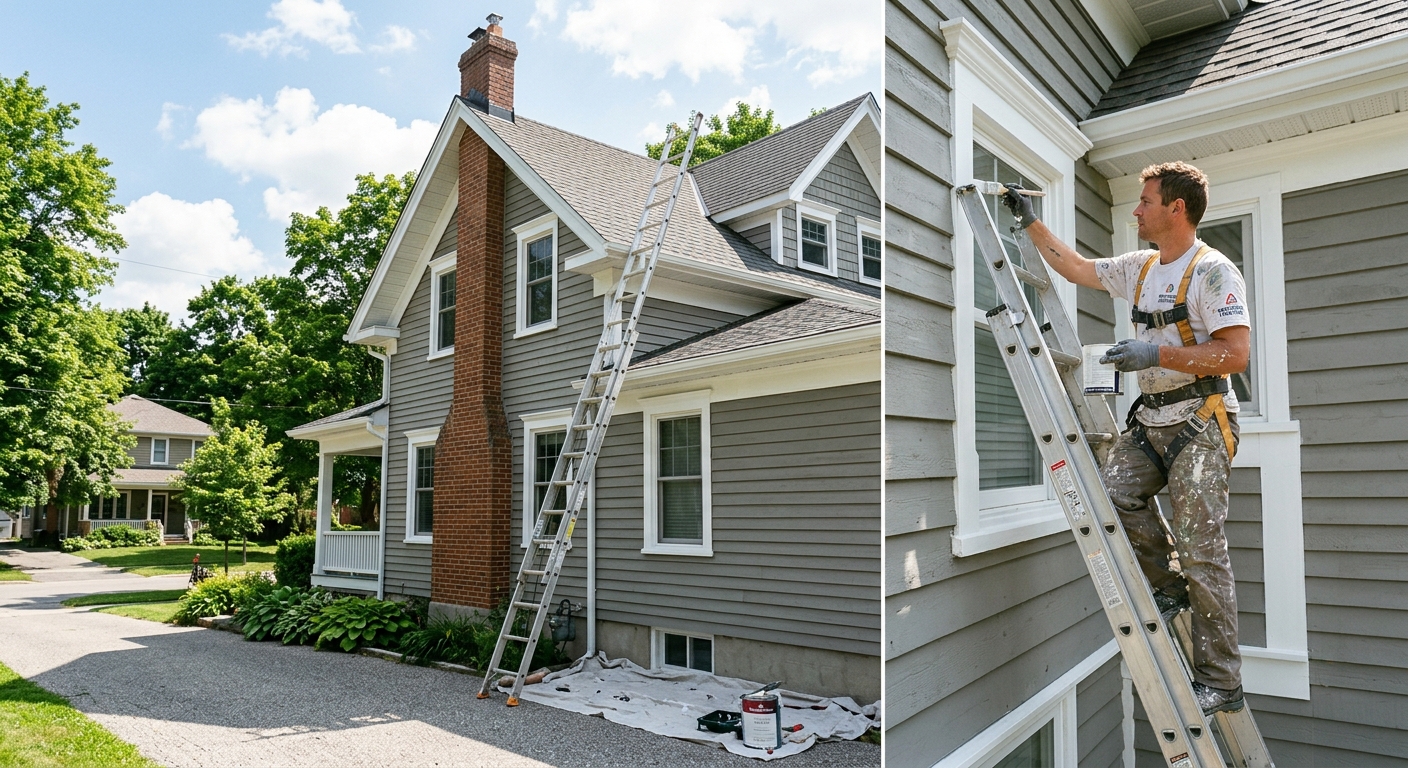
Painting options and costs in Collingwood
Collingwood homeowners have a lot of choice in painting, but the costs tend to follow a predictable pattern once you factor in prep. In Collingwood’s broader region (Kitchener–Waterloo–Barrie), there are many older properties—39.8% of homes were built before 1981 (Statistics Canada, 2021 Census)—and that matters because repainting usually means more scraping, patching, sanding and priming before any finish coats can go on. On the demand side, Collingwood has a sizeable mix of owner-occupied housing: 72.8% of households are homeowners (Statistics Canada, 2021 Census), which generally translates into steady exterior repaint projects when the weather cooperates.
In the Kitchener–Waterloo–Barrie market, exterior work is concentrated into a short, weather-dependent window. When temperatures stay above roughly 10°C, surfaces are dry, and wind/rain are manageable, crews can apply paint and return to complete coats on schedule—so pricing rises when contractors are booked solid for May through September. In neighbourhoods like the downtown and Georgian Triangle area, where many homes show older siding systems and trim details, we often see higher labour for careful prep and masking because small failures (caulking gaps, blistering, worn flashing) become finish-coat problems if they’re not corrected first.
Below is a practical cost comparison to help you budget for common scopes in Collingwood, with ranges based on typical job complexity and local scheduling realities.
| Service |
What's Included |
Typical Duration |
Price Range |
| Interior — whole home (walls, ceilings, trim) |
Protect floors/furniture, patch and sand as needed, caulk gaps, prime where required, paint walls/ceilings in chosen sheen, finish trim/doors, basic cleanup and site protection removal |
5–10 working days |
$4,500–$7,500 |
| Interior — per room (standard bedroom or living room) |
Prepare surfaces, spot prime, paint walls and trim, cover ceilings based on your selection, cleanup |
1–3 working days |
$2,500–$4,500 |
| Exterior — full house (siding, trim, soffits) |
Power wash (as applicable), scrape/sand failing areas, patch and caulk, prime bare spots, paint siding and trim, manage ladder/scaffold needs, cleanup |
7–16 working days |
$6,000–$9,000 |
| Exterior — trim and accent colours only |
Prep and prime accent areas, caulk where required, paint trim/feature surfaces, targeted cleanup |
3–8 working days |
$2,500–$5,000 |
| Kitchen cabinet painting (doors, frames, spray finish) |
Degrease and de-gloss, repair minor damage, prime suitable bonding primer, spray doors for finish quality, paint frames and shelves, re-hang and hardware masking |
5–12 working days (including dry/cure time) |
$2,200–$4,500 |
| Specialty / faux finish (accent wall, texture) |
Surface prep, base coat, texture/faux application, topcoat protection (sheen matched), cleanup |
2–5 working days |
$800–$3,000 |
Prices are estimates only and vary by project scope, site access and material selection.
What affects the price of painting in Collingwood
In Collingwood and across the Kitchener–Waterloo–Barrie region, the same “paint the house” request can land 30–50% apart because the quote is mostly driven by labour for prep, the number of coats, and how many weather days a crew can realistically use. Region-wide demand is seasonal for exteriors; as a result, contractor availability tightens from late spring through early fall, and that scheduling pressure shows up in pricing—especially when homeowners try to book after a few dry weeks instead of earlier. Interior work, by contrast, is steadier, so you’ll often see interior bands like $2,500–$7,000 behave more predictably year to year.
Climate timing is the big lever. In Ontario (including Collingwood), the practical window for exterior application is roughly late May to early October—temperatures must be above about 10°C and rising during application and drying. Coastal BC has a longer season, but high humidity and rainfall increase mildew risk and require moisture-tolerant, mildew-resistant systems; Alberta’s challenge is different again—temperature swings can affect film formation and dry time. In our inland Ontario repaint market, we don’t fight constant rain, but we do fight the calendar: short dry windows concentrate demand, so prep and coat sequencing becomes more expensive when crews can’t wait for the next stable stretch.
Older homes across the region also raise costs. With 39.8% built before 1981 (Statistics Canada, 2021 Census), it’s common to see more fail points that require extra labour—peeling paint, failing caulk lines, chalky surfaces and rough patchwork. On a typical exterior repaint, prep can easily be 50–70% of total labour. For example, a trim-and-accent refresh at $2,500–$5,000 might stay close to budget if surfaces are sound, while a full-house repaint at $6,000–$9,000 climbs quickly when scraping and priming extend across multiple siding elevations and repairs.
Two common Collingwood pricing examples: (1) access—homes with tight driveways or multi-storey fronts often require scaffolding or repeated ladder moves, and that adds labour; (2) substrate condition—older wood or fibre-cement with embedded cracking at joints means additional caulking and primer coverage before finish coats.
| Price Factor |
Why It Matters |
Cost Impact |
| Surface prep — scraping, sanding, patching drywall or wood |
Loose or chalky material will telegraph through new paint unless removed and stabilized |
Often adds 20–60% of labour on repaints depending on failure level |
| Number of coats — 2-coat system over primer vs. 1 coat over existing |
Coverage and hiding power depend on primer use, existing colour, and sheen |
May shift total cost by 10–25% for the same surface area |
| Paint quality tier — contractor-grade vs. premium (Benjamin Moore, Sherwin) |
Higher tiers often provide better durability, coverage and washability |
Typically 5–15% difference in product/material portion, with larger savings if fewer coats are needed |
| Ceilings and trim — adds significant time vs. walls-only |
Ceilings require more masking and careful edge control; trim needs more passes for lines |
Can raise interior totals by 20–40% on “whole home” scopes |
| Exterior season window — short season raises summer rates |
Scheduling risk increases when crews have to compete for dry days |
Often shifts exterior pricing upward 5–20% in peak months |
| Lead-safe precautions — required for pre-1978 homes with lead paint |
Professional lead-safe work reduces dust and manages disposal when lead is present |
Can add 10–30% on older homes with heavy sanding/scraping |
| Surface material — drywall vs. plaster vs. wood vs. stucco |
Different substrates need different primers and patch systems |
May change prep time and primer usage by 15–35% |
| Height and access — multi-storey exterior requires scaffolding or lifts |
More safety time, staging and longer travel/masking cycles |
Can add 10–40% depending on house height and layout |
Permits & regulations in Ontario
In Ontario, painting does not generally require a municipal permit for typical residential work. However, what matters is safety and proper handling when you’re dealing with older paint systems. For homes built before 1978, health guidelines recommend testing for lead paint before sanding or scraping, and using lead-safe work practices if lead is present. That typically includes wet methods to reduce dust, HEPA-vacuum cleanup, proper containment, and appropriate disposal. This isn’t usually something a homeowner is legally compelled to do on their own, but it’s standard practice for professional contractors because it protects workers and occupants.
There are also paperwork basics you should require regardless of permit rules. Ask for proof of liability insurance and workers’ compensation coverage (WSIB/WCB, as applicable to the contractor’s situation). Then insist on a written contract that spells out the paint brand (or equivalent), sheen, number of coats, and what prep is included—especially how failing areas, caulking and priming will be handled.
As a homeowner in Collingwood, you can verify credentials step-by-step: (1) ask for the contractor’s insurance certificate and confirm the policy is active for your project dates; (2) request WSIB/WCB clearance/coverage proof; (3) confirm the contractor’s work history and any required registrations through the appropriate provincial resources; and (4) keep the certificate copies with your signed quote so scope and safety coverage can’t be disputed later.
Interior vs exterior painting — getting the best result in Collingwood
In Collingwood, the difference between a long-lasting paint job and a premature failure is usually not the colour—it’s the prep discipline and how the product system matches the substrate. For interiors, surface preparation (filling cracks, sanding rough patches, priming repaired drywall and stain-prone spots) matters more than the brand of topcoat. Sheen is also practical: flatter sheens hide minor wall imperfections in low-traffic rooms, while kitchens, hallways and entryways typically benefit from satin or eggshell for easier cleaning. The “two coats over a proper primer” rule is where durability comes from—one thick coat may look fine during walkthrough, but it often lacks uniform film build and can wear unevenly.
For exteriors, prep is even more critical in Ontario’s freeze–thaw cycles and seasonal humidity shifts. Caulking should be completed before painting so the caulk has time to cure and create a continuous seal that helps prevent water ingress behind siding and trim. Primer selection is key: latex primers usually pair with acrylic/latex systems on sound masonry or drywall, while oil-based primer can be necessary on specific stain or adhesion issues depending on the substrate and existing coating. Unlike coastal BC—where mildew resistance is often a top priority—the Collingwood challenge is more about proper drying and adhesion over weathered surfaces.
Cabinet painting is a smart budget alternative to replacement when the box is solid and you’re comfortable with a spray-applied finish: it’s typically faster than full cabinet replacement and can refresh the kitchen without moving plumbing or redesign work. For pre-1978 homes, factor in lead-safe precautions if scraping is needed.
Here’s where the price difference is justified: if you’re choosing between interior whole-home painting and trim-only, spending for full prep and a two-coat system might cost in the ballpark of $4,500–$7,500, but it can prevent rework within a couple of seasons that often happens when patching and priming are skipped. Conversely, a trim and accent-only exterior update at $2,500–$5,000 can be worth it when siding is already sound and the failures are limited to edges and decorative details.
| Project Type |
Key Prep Step |
Recommended Coats |
Price Band |
| Interior — fresh drywall (new construction) |
Skim/patch joints, sand smooth, prime thoroughly to lock in absorption |
2 coats over primer (or 1 primer + 2 finish as needed for colour change) |
$2,500–$7,000 |
| Interior — repaint (good condition, no repairs) |
Clean surface, light scuff-sand sheen changes, spot-prime stains if they show |
1–2 finish coats depending on hiding and colour shift |
$2,500–$5,500 |
| Interior — repaint (patching and priming needed) |
Fill/sand repairs, prime new work and any stain/odour-prone areas |
2 finish coats over primer for best uniformity |
$3,000–$7,000 |
| Exterior siding (wood or fibre cement) |
Scrape failing paint, address caulking/seams, prime bare or weathered zones |
2 coat exterior system over primer (spot-prime as required) |
$6,000–$9,000 |
| Exterior trim and accents only |
Remove loose paint, caulk gaps, prime bare trim before colour |
2 finish coats where primer is used; may be 1 coat on sound areas |
$2,500–$5,000 |
| Kitchen cabinets (spray finish) |
Degrease and de-gloss, prime with a bonding system, mask for crisp edges |
2 finish coats for uniform sheen and durability |
$2,200–$4,500 |
How to choose a painting contractor in Collingwood
Choosing the right painting contractor in Collingwood comes down to credentials you can verify, scope clarity, and realistic scheduling. Start with Ontario coverage basics: (1) ask for proof of liability insurance—request the certificate of insurance and ensure it lists your address/project site; (2) request WSIB/WCB clearance or proof of workers’ compensation coverage; and (3) confirm your contractor is properly registered/eligible to work in Ontario where applicable. If they won’t provide documents or can only share verbal assurances, that’s a red flag.
Next, get 2–3 itemised written quotes. You want labour and materials broken out—not just a lump sum—so you can compare prep time, primer type, and coat counts. Read the scope carefully: is power washing included for exteriors? Is disposal included for peeling paint debris? Are you getting caulking and spot priming, or just “paint over whatever’s there”? Also confirm what’s excluded (for example, rotten trim replacement or drywall replacement). A good contract also states workmanship warranty length, whether any manufacturer product warranty applies, and if warranties are transferable to a new owner.
For payment schedule, insist on conservatism: never pay more than about 10–15% upfront. Hold back a portion until the job is complete and cleaned. Finally, timeline matters in Collingwood because exterior projects can stall with weather—so get a start date and an estimated completion window in writing, along with what happens if rain or temperatures delay application.
- Request proof of liability insurance and keep a copy for your records.
- Confirm WSIB/WCB coverage before work starts; ask for clearance proof.
- Ask for an itemised quote: labour, materials, primer, and disposal.
- Make sure the number of coats is written (and where primer is required).
- Confirm caulking and patching are included where needed.
- For exteriors, require details on scrape/sand extent and spot-priming.
- Ask what prep is excluded (trim replacement, structural repairs, rot removal).
- Confirm surface cleaning method (e.g., power wash where appropriate) is included.
- Verify your paint sheen selections by room (walls, trim, ceilings).
- Get a written start date and completion estimate; don’t accept “as soon as possible.”
- Agree on protection: drop sheets, masking, and floor/furniture coverage.
- Use a payment schedule with a holdback until final walkthrough and cleanup.
Red flags I see in Collingwood: (1) quotes that skip or minimize surface prep (“paint over everything”); (2) vague scope language with no written coat count or primer plan; (3) contractors who won’t provide insurance/WSIB proof; (4) requests for large deposits upfront; and (5) no written warranty or a warranty that’s only “materials,” not workmanship.
Frequently asked questions — painting in Collingwood
Can I paint my house exterior in spring or fall in Collingwood?
In Collingwood, you can paint exterior spring and sometimes early fall, but the practical rule is the weather and surface temperature—not the calendar. Ontario exterior painting usually works best in a late May to early October window when air and surface temps are consistently above about 10°C and rising during application. If you paint too early or too late, paint may not cure uniformly, which can lead to premature scuffing, adhesion issues or peeling around trim joints. Because Collingwood’s housing stock includes many older homes, prep time is also a factor—scraping and priming need stable drying days. If you’re budgeting, plan around the typical exterior full-house band of $6,000–$9,000 and book early so you’re not competing for dry-weather crew time.
How do I choose a painting contractor in Collingwood?
Start with verification and then move to scope. Ask the contractor for liability insurance proof and workers’ compensation coverage (WSIB/WCB), and request the certificate documents before any work begins. Then get 2–3 itemised written quotes that break out labour and materials and clearly state paint brand/equivalent, primer plan, and the number of coats. For Collingwood exteriors, make sure the quote includes scrape/sand failing areas, caulking and spot priming—older homes built before 1981 can have more prep needs (Statistics Canada, 2021 Census). Finally, review the payment schedule and warranty terms: a good contractor should not require more than about 10–15% upfront and should provide a workmanship warranty you can rely on.
How many coats does an exterior repaint need in Collingwood?
For most exterior repaints in Collingwood, you’re planning on a two-coat exterior system. The exact approach depends on what’s underneath: if the contractor spots-primes bare or weathered areas, those sections still receive the system’s required coats, and the finished colour typically goes on as two full finish coats for uniform coverage and durability. Where there’s significant scraping back to raw substrate, the primer step becomes even more important. The “two coats over primer” approach helps the paint system tolerate Ontario’s temperature swings and moisture during the year. If your scope is limited to trim and accents, you can sometimes stay in the smaller band of $2,500–$5,000, but the prep and coats on bare edges should still be correct for a clean, long-lasting finish.
What is the best primer for older Collingwood homes?
There isn’t a single “best” primer for every older Collingwood home because the correct choice depends on the substrate and what’s currently on the surface. The contractor should assess whether you’re dealing with bare wood, previously painted latex, oil/stain issues, chalky paint, or areas with heavy peeling. In practice, the best primer is the one that bonds to your existing surface and can be topcoated within the product’s recoat window. On older homes—39.8% built before 1981 (Statistics Canada, 2021 Census)—you may also need lead-safe work practices if sanding or scraping is required for pre-1978 paint systems. A responsible contractor will include a primer plan in writing and won’t guess at adhesion when there are adhesion failures visible.
Should I paint or wallpaper my Collingwood home?
For many Collingwood homeowners, painting is the more reliable long-term option—especially in rooms with higher cleaning needs or where walls have patchwork. Wallpaper can look great, but it’s less forgiving when you have frequent hairline cracking, uneven drywall seams, or older plaster repairs. Painting also offers easier maintenance and repainting cycles: you can choose a sheen that fits the room’s use (flatter sheens hide imperfections; satin/eggshell hold up better to cleaning). If your home has older wall repairs, good prep and spot priming usually outlast decorative coverings. If you’re comparing budgets, a single room in the interior per-room range of $2,500–$4,500 can be far more predictable than wallpaper labour where prep and matching add time.
How do I fix peeling exterior paint in Collingwood?
Peeling exterior paint isn’t something you can solve by painting over it once or “spot touching up.” In Collingwood, peeling typically means the existing coating has failed adhesion or the surface wasn’t properly prepared—often combined with moisture at caulk joints or around trim edges. The fix is a full prep sequence: scrape back loose paint, sand edges smooth, address the cause (commonly re-caulking gaps and improving drainage/flashings), and spot prime bare areas with a primer that matches the substrate. If your home is pre-1978, professional lead-safe practices are standard when sanding/scraping is involved, including wet methods and HEPA cleanup to manage dust. Once the prep is corrected, you can return to the expected two-coat exterior system so the new finish has a stable base. For a full-house repaint, plan around $6,000–$9,000 because prep drives cost.