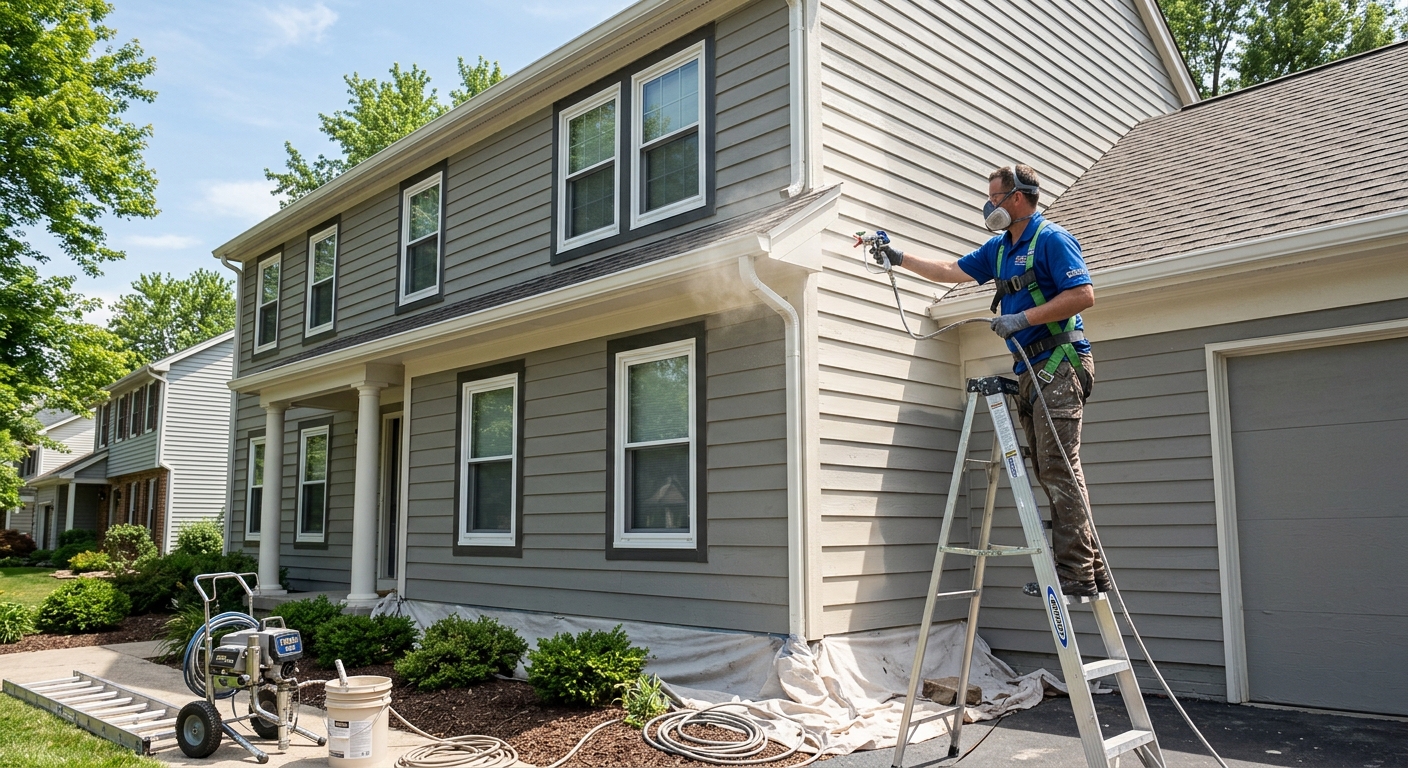
Painting options and costs in South Slope
South Slope homeowners usually ask for “one number,” but the real cost of painting in this part of Surrey and the Lower Mainland–Southwest varies a lot by prep and weather exposure. That’s partly because the area’s housing stock skews older: with 12,782 residents (Statistics Canada, 2021 Census), many properties are mid-century to late-1990s and are often due for repeat repaints. On homes built before 1978, professional painters also plan for lead-paint–safe practices if testing indicates lead is present—extra containment, HEPA vacuuming, and disposal time can noticeably move the price.
Lower Mainland–Southwest pricing is shaped by coastal moisture. Exterior work here is less about deep-freeze and more about rain, humidity, and the need to catch dry windows; painters may need to mobilize, pause, and return so product can cure properly. Interiors are more flexible through fall and winter, so crew availability can feel steadier indoors. In South Slope, trade demand is especially high around the King George Corridor and the neighbourhood pockets near schools and transit routes, where occupied homes benefit from efficient staging and careful protection of landscaping and entryways.
Below are realistic starting ranges you can use to compare quotes before you add scope details like wall repairs, height/access, or upgraded product lines.
| Service |
What's Included |
Typical Duration |
Price Range |
| Interior — whole home (walls, ceilings, trim) |
Surface cleaning, patching small defects, sanding where needed, caulking, primer on repairs/stains, 2-coat system, protection and trim masking |
5–12 working days |
$1,800–$7,500 |
| Interior — per room (standard bedroom or living room) |
Prep and protect, patch/spot prime as required, paint walls and ceilings, basic trim touch-ups |
1–3 working days |
$300–$1,500 |
| Exterior — full house (siding, trim, soffits) |
Power wash, scrape/spot prime failing areas, caulking, mildew-resistant high-adhesion primer, 2-coat exterior finish, careful masking around doors/windows/landscaping |
7–16 working days (weather dependent) |
$4,200–$15,000 |
| Exterior — trim and accent colours only |
Prep and sand, scrape small areas, spot prime, 2-coat finish on trim/accents |
3–8 working days (weather dependent) |
$1,200–$5,500 |
| Kitchen cabinet painting (doors, frames, spray finish) |
Degrease/clean, light scuffing, sanding, repairs, bonding primer, spray finish enamel, hardware masking or touch-ups, re-install doors |
4–10 working days (plus dry time) |
$2,200–$8,000 |
| Specialty / faux finish (accent wall, texture) |
Prep to a higher standard, primer suitable for the system, base coats, texture/faux application, topcoat protection as required |
2–7 working days |
$800–$6,000 |
Prices are estimates only and vary by project scope, site access and material selection.
What affects the price of painting in South Slope
Two quotes for the same looking repaint can differ by 30–50% across the Lower Mainland–Southwest and other Canadian regions because painting is a systems job: surface condition, prep method, materials, and weather scheduling. In South Slope, exterior pricing is most sensitive to the coastal season management. Coastal BC typically has a longer stretch than Ontario and Alberta, but long, damp shoulder periods raise the risk of poor adhesion and mildew growth if products aren’t matched to humidity and applied during suitable dry windows. In practice, crews often book spring-to-summer work around rain patterns and drying times, which can concentrate demand and keep summer labour rates firm.
Prep is the other big swing factor. For many older homes throughout the area, scraping failing coatings, patching settlement cracks, stain blocking nicotine or wood tannins, and upgrading primer adhesion can account for 50–70% of total labour on a repaint. That’s why a “paint only” allowance can quickly turn into a higher-prep project. For example, a home that needs extensive scraping and spot priming can push an exterior project toward the upper end of the $1,200–$15,000 exterior bands, while a trim-only refresh with limited prep may stay near the $1,200–$5,500 range. Similarly, when interiors require patching and primer for repairs, you’ll feel it in the $300–$8,000 interior whole-home band rather than a light “walls-only” repaint.
Concrete local examples I see often: (1) fibre-cement and older wood siding with hairline cracks usually needs more caulking and targeted primer than newer panels; (2) homes with south-facing eaves can mildew faster in shade pockets, so mildew-resistant systems and extra cleaning steps raise labour; and (3) occupied houses near transit routes need more protection time to manage dust and traffic flow.
| Price Factor |
Why It Matters |
Cost Impact |
| Surface prep — scraping, sanding, patching drywall or wood |
Determines adhesion and how long the paint will stay uniform |
Can shift total cost by 25–60% |
| Number of coats — 2-coat system over primer vs. 1 coat over existing |
Proper opacity and coverage reduce streaking and premature wear |
Typically +10–35% |
| Paint quality tier — contractor-grade vs. premium (Benjamin Moore, Sherwin) |
Higher solids and durability often reduce rework and touch-ups |
Materials +5–25% (often offset by fewer problems) |
| Ceilings and trim — adds significant time vs. walls-only |
Masking, cutting in, and extra smoothing take more labour |
Can add 15–40% |
| Exterior season window — short season raises summer rates |
Weather-driven scheduling changes crew availability and mobilization costs |
Often +10–25% in busy weeks |
| Lead-safe precautions — required for pre-1978 homes with lead paint |
Containment, HEPA vacuuming and disposal add time and materials |
Can add 20–100% depending on findings and surfaces |
| Surface material — drywall vs. plaster vs. wood vs. stucco |
Different porosity and bonding requirements change primer and prep intensity |
Can vary by 10–40% |
| Height and access — multi-storey exterior requires scaffolding or lifts |
More equipment, safety planning, and slower productivity |
Can add 15–50% |
Permits & regulations in British Columbia
In British Columbia, painting typically does not require a permit for routine interior or exterior painting work. For homes built before 1978 in South Slope, health guidelines recommend lead paint testing before sanding or scraping, and lead-safe work practices if lead is found. Professional contractors usually follow lead-safe methods such as wet scraping or misting, HEPA vacuuming, proper containment, and correct bagging/disposal. This is not usually something homeowners must do legally for a DIY repaint, but it is standard practice on professional jobs because it reduces exposure risk.
What does require permits is not common for standard painting, but permits can come up if the work overlaps with regulated alterations (for example, structural changes, electrical/plumbing work, or regulated asbestos abatement). Painting alone is generally not in that category.
Before signing, verify three things: (1) the contractor carries liability insurance (ask for a certificate of insurance); (2) workers’ compensation coverage (WCB) for the workers who will be on your site; and (3) you have a written contract that clearly states the paint brand/line, sheen, number of coats, and what prep is included (scrape/prime/caulk/repair scope). To check, you can start by asking for the certificate of insurance and WCB clearance proof, then confirm the contractor’s trade credentials through the appropriate provincial business/contractor listings available online, and match the company name exactly as it appears on the documents.
Interior vs exterior painting — getting the best result in South Slope
The difference between a long-lasting paint job and a premature failure in South Slope is usually prep, not the brand on the label. For interiors, start with filling and sanding where needed, then prime properly—especially over patched drywall, water-stains, or repaired spots. In everyday terms, sheen choice matters too: flat/low-sheen is popular for ceilings, but mid-sheen eggshell or satin is often better for walls that need frequent cleaning. Most importantly, two coats over a proper primer almost always outlast one “thick” coat; it also gives better hiding so you don’t end up with flashing or patch-lines.
Exteriors fail faster when caulking and surface prep are skipped. In coastal BC conditions, you want thorough cleaning, scraping of loose coatings, and spot-priming of exposed substrate, then repainting with products designed for mildew resistance and high adhesion. Caulking should happen before painting so seams seal against water ingress and movement. Primer selection changes by substrate—wood and older coatings may need a specific bonding primer, while other materials may require tailored systems.
Cabinet painting is a smart budget alternative to replacement when the existing cabinets are sound: expect spray-finish enamel with bonding primer and careful masking. For pre-1978 homes, lead-safe precautions apply if scraping or sanding is required—this can add cost, but it prevents unsafe dust and rework.
As a dollar example: a kitchen cabinet refresh can land in the $2,000–$8,000 range, while replacing similar cabinets typically costs far more. If cabinets are structurally fine, the paint system is the justified upgrade; if they’re warped or moisture-damaged, you’ll be paying to repaint problems that replacement would remove.
| Project Type |
Key Prep Step |
Recommended Coats |
Price Band |
| Interior — fresh drywall (new construction) |
Seal and prime for uniform absorption and shrink control |
Primer + 2 topcoats |
$900–$3,500 |
| Interior — repaint (good condition, no repairs) |
Clean and degloss; spot-prime any scuffs or stains |
1–2 topcoats (often 2 for even finish) |
$300–$2,200 |
| Interior — repaint (patching and priming needed) |
Sand, patch, then prime repaired areas to prevent flashing |
Primer + 2 topcoats where required |
$600–$4,800 |
| Exterior siding (wood or fibre cement) |
Scrape failing coatings, clean thoroughly, spot prime, then caulk appropriately |
Primer + 2 exterior coats (system-dependent) |
$4,200–$15,000 |
| Exterior trim and accents only |
Sand/spot-prime and re-caulk where needed along trim lines |
2 finish coats on primed areas |
$1,200–$5,500 |
| Kitchen cabinets (spray finish) |
Degrease, scuff/sand, bonding primer, careful masking |
Primer + 2 finish coats (spray) |
$2,200–$8,000 |
How to choose a painting contractor in South Slope
Choosing the right contractor in South Slope starts with verification. In British Columbia, ask for: (1) proof of liability insurance (certificate of insurance showing your job site is covered); (2) confirmation of workers’ compensation coverage (WCB) for the people who will be working on your property; and (3) a clear written scope with paint system details. To check, request the certificate of insurance and WCB clearance proof directly, confirm the names match the quoting company, and review the online contractor/business registration listings that correspond to that legal entity. If a contractor can’t produce paperwork promptly, treat it as a red flag.
Next, get 2–3 itemised written quotes—not a single lump-sum. The best quotes break down labour, materials, number of coats, primers (including stain-blocking if required), caulking/patching allowance, and surface prep steps. Watch for exclusions like furniture moving limits, disposal, sanding/repair beyond “minor,” or what happens if weather delays an exterior schedule. Disposal and masking/patch protection should be spelled out.
Warranty should be in writing for workmanship (how many years), plus the manufacturer paint warranty terms. Also ask whether the warranty is transferable if you sell your home. For payment schedule, never pay more than 10–15% upfront; hold back the remainder until the job is fully complete and cleaned. Finally, require a start date and completion estimate in writing—especially important for exterior work that depends on rain-free dry windows.
- Ask for WCB proof and liability insurance before work starts; keep copies.
- Confirm the quote includes surface prep: scraping, sanding, patching, priming, and caulking.
- Require the paint line/brand and sheen type to be written on the contract.
- Make sure the number of coats and primer system are specified (not “paint as needed”).
- Clarify whether disposal of scrapings/paint waste is included.
- Verify who handles protection of floors, railings, landscaping, and windows.
- Get an exterior schedule plan (weather windows, drying times, re-mobilization costs).
- Ask about lead-safe procedures if your home is pre-1978 and surfaces need scraping/sanding.
- Request a workmanship warranty length and what it covers (peeling, blistering, flashing, etc.).
- Confirm manufacturer warranty support and the contractor’s responsibility for application.
- Check payment terms: 10–15% max deposit; holdback until final walkthrough.
- Review colour coverage expectations (spray/roller method, number of passes, sheen uniformity).
In South Slope, common red flags include quotes with vague prep (“just paint”), refusal to provide insurance/WCB documentation, unusually low pricing that omits primer or caulking, no written weather strategy for exteriors, and payment requests that exceed 15% upfront. If any of those show up, keep looking.
Frequently asked questions — painting in South Slope
How much does it cost to paint a house in South Slope?
For South Slope, typical estimates depend on whether you’re painting the whole interior, the entire exterior, or both—and especially on prep. A whole interior repaint is commonly in the $300–$8,000 range depending on home size, ceiling/trim work, and whether repairs are needed. For exteriors, a full house repaint (siding, trim, soffits) often lands in the $1,200–$15,000 band because coastal rain and humidity can increase time, and older coatings frequently require extensive scraping and spot priming. If your home is pre-1978, budgeting for lead-safe practices may be necessary if testing indicates lead is present (contractors plan containment and disposal time).
How much does interior painting cost per room in South Slope?
Per-room interior painting in South Slope is often priced based on whether you’re doing just walls or walls plus ceilings and trim, and how much patching/priming is needed. For a standard bedroom or living room, a typical range is $300–$1,500 for a straightforward repaint with good surface condition. If you have drywall repairs, stain blocking, or a lot of trim/cutting, you can see higher end costs because primer and sanding time increase. The Lower Mainland–Southwest market also has variable scheduling, but interior work generally isn’t constrained by the same weather windows as exterior jobs.
When is the best time for exterior painting in South Slope?
The best time for exterior painting in South Slope is during the drier stretch when painters can schedule around rain and humidity. Coastal BC can offer a longer window than more inland provinces, but you still need dry conditions for proper application and curing. Practically, many teams aim for late spring through summer dry periods and build in buffer days for weather. If rain disrupts the schedule, expect re-mobilization time because drying and mildew control are part of a durable system. For homes with lots of caulking and spot priming, waiting for consistent weather is often what protects the finish, even if it means shifting the start date.
How many coats of paint do I need?
Most residential work is planned as a 2-coat system over suitable primer. If you’re repainting with minimal damage, you might be able to do 1 coat only on some surfaces, but for consistent coverage and to avoid flashing, many contractors still recommend 2 coats—especially on ceilings, patched drywall, or when changing colours. Over stain, water marks, or repairs, primer is essential and then you’ll typically apply 2 finish coats. For cabinets painted with a spray finish, the usual approach is bonding primer plus 2 finish coats to achieve a durable, smooth result.
What paint is best for South Slope's climate?
For South Slope and the Lower Mainland–Southwest, the “best” paint is the one matched to moisture risk and surface type—not just a premium brand. Exterior finishes should be mildew-resistant and formulated for high adhesion, because coastal humidity and long damp periods can encourage mildew growth if cleaning and priming are rushed. For interiors, you’ll often get the best results using a durable interior wall finish with the right sheen: ceilings typically need a flatter look, while walls benefit from eggshell/satin for washability. On pre-1978 homes where stains or tannins might bleed, stain-blocking primer is crucial so the topcoat doesn’t fail early.
How long does exterior paint last here?
Exterior paint life in South Slope is usually measured more by prep quality and weather management than by a fixed number of years. With solid surface prep (scraping, caulking, priming) and a proper mildew-resistant system, many homeowners see multi-year performance. However, coastal humidity, repeated wetting, and any skipped repairs can shorten life—sometimes quickly on trim, soffits, and cracked caulking lines where water gets in. That’s why the prep portion is so important: for older homes, it’s common for scraping and priming to represent a large share of labour, and cutting corners can cost you more over time than moving toward the upper end of the exterior range (up to $15,000 on complex jobs).