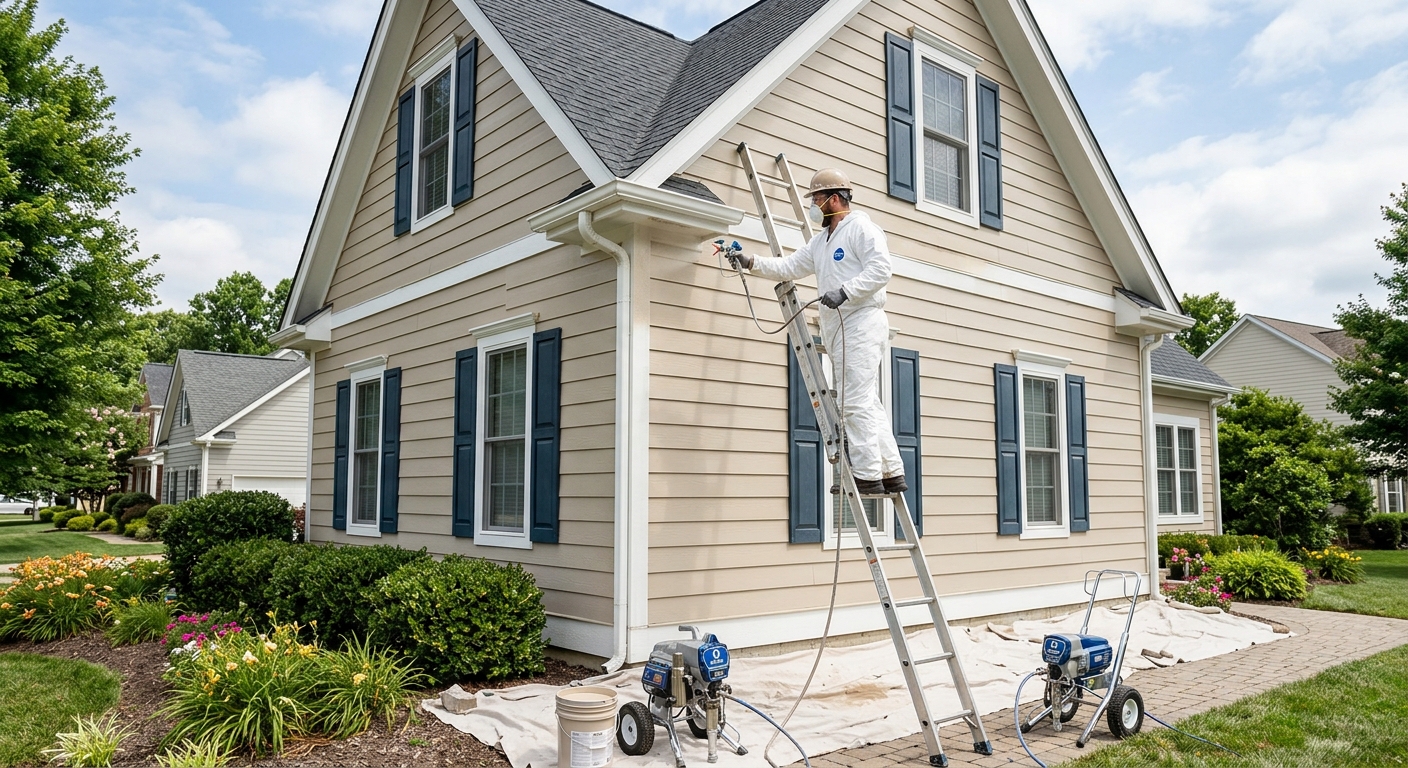
Painting options and costs in Mission
Painting in Mission, British Columbia is all about balancing the realities of our coastal climate with the needs of a housing stock that includes a lot of older homes. In fact, 42.4% of Mission dwellings were built before 1981, which often means more time spent on scraping, patching settlement cracks, and priming to block wood tannins or past stains. On pre-1978 properties, contractors may also use lead-paint–safe practices (containment, HEPA vacuuming, and proper disposal) because failing coatings can release dust during prep.
In the Lower Mainland–Southwest, exterior costs are shaped less by extreme cold and more by rain, humidity, and long shoulder seasons. That translates to scheduling around dry windows, allowing longer drying times between coats, and using mildew-resistant, high-adhesion products designed for coastal conditions. Crews can be busier in fall/winter for interiors, while exterior projects often face tighter summer timelines due to weather windows and competing demand.
In Mission’s more in-demand areas—like the west-side hills closer to the Fraser Valley corridor—homeowners frequently want fast turnarounds because weather delays can impact move-in dates and rental turnovers. The most reliable way to compare quotes is to look at what you’re getting for prep, coating systems, and access—then match that to your budget and timeline. Use the ranges below as a practical starting point.
| Service |
What's Included |
Typical Duration |
Price Range |
| Interior — whole home (walls, ceilings, trim) |
Protect floors/furniture, patch & sand, prime where needed, wall/ceiling coats, caulk/spot prime trim, clean-up |
5–12 days |
$3,500–$8,000 |
| Interior — per room (standard bedroom or living room) |
Cut-in/edging, patch & sand, prime spots, 2 coats on walls, basic trim touch-ups |
1–3 days |
$600–$2,200 |
| Exterior — full house (siding, trim, soffits) |
Wash, scrape failing areas, caulk, prime bare spots, paint siding + trim + soffits, weather-window scheduling |
7–18 days (spread across dry windows) |
$8,000–$15,000 |
| Exterior — trim and accent colours only |
Prep/scuff where needed, prime bare spots, paint trim and selected accents, localized caulking |
3–7 days |
$1,200–$4,500 |
| Kitchen cabinet painting (doors, frames, spray finish) |
Degrease, sand, prime, spray finish, hardware masking, multiple coats for durability |
5–10 days |
$2,000–$7,500 |
| Specialty / faux finish (accent wall, texture) |
Surface preparation to suit texture, custom application, protection and finishing system |
1–5 days |
$500–$6,500 |
Prices are estimates only and vary by project scope, site access and material selection.
What affects the price of painting in Mission
Even when two homeowners request “the same” paint job in Mission, British Columbia, quotes can differ by 30–50% across the Lower Mainland–Southwest and other provinces. In our region, the biggest drivers are prep demands from older coatings and the weather-driven cost of exterior work. In Mission, shorter dry stretches and higher humidity mean more time managing drying conditions, re-checking surface readiness, and re-mobilizing crews after rain. That’s why exterior projects can fall into the mid-range fast (for example, trim-only work might start around the $1,200–$4,500 band), while full-house exteriors can move quickly toward the top end when scraping and priming expand.
Across British Columbia, older homes also raise labour because prep is often 50–70% of repainting work: scraping loose material, caulking gaps, sanding edges, patching drywall, and applying adhesion-promoting primers. With 42.4% of dwellings built before 1981, it’s common to see multiple paint layers, stained surfaces, and areas that need stain blocking before topcoat.
Concrete examples I see in Mission include: (1) fibre cement or older wood siding that needs extra caulking and spot-priming to prevent water ingress, which increases material and labour time; and (2) interiors with textured ceilings or patchwork areas that require more feathering and primer to avoid flashiness under Mission’s natural light. On the interior side, quality systems still pay off—one contractor might quote “walls only” while another includes ceilings and trim, shifting you from a lower interior per-room band up toward whole-home ranges like $3,500–$8,000.
| Price Factor |
Why It Matters |
Cost Impact |
| Surface prep — scraping, sanding, patching drywall or wood |
Prep determines adhesion; older coatings and damaged surfaces fail faster if rushed |
+10% to +40% depending on condition |
| Number of coats — 2-coat system over primer vs. 1 coat over existing |
Proper coverage and uniform sheen hide repairs and stained areas |
+5% to +25% |
| Paint quality tier — contractor-grade vs. premium (Benjamin Moore, Sherwin) |
Premium products often level better and reduce rework and patching call-backs |
+3% to +20% (often offset by fewer problem spots) |
| Ceilings and trim — adds significant time vs. walls-only |
Cut-in, masking, and multiple finish coats take longer than wall rolling |
+15% to +45% |
| Exterior season window — short season raises summer rates |
Rain/humidity and limited dry days require scheduling flexibility and faster turnarounds |
+10% to +35% during peak weeks |
| Lead-safe precautions — required for pre-1978 homes with lead paint |
Containment, HEPA methods, and disposal add labour and handling steps |
+10% to +30% |
| Surface material — drywall vs. plaster vs. wood vs. stucco |
Different substrates need different primers and drying/adhesion strategies |
+5% to +25% |
| Height and access — multi-storey exterior requires scaffolding or lifts |
Access impacts safety, prep detail work, and labour time |
+10% to +50% |
Permits & regulations in British Columbia
In British Columbia, painting typically does not require a permit for residential work. However, health guidelines strongly recommend that for homes built before 1978, contractors test for lead paint before sanding or scraping, and then follow lead-safe work practices if lead is present. That means wet methods to reduce dust, HEPA vacuuming, proper containment, and correct disposal of debris. Homeowners are not generally required by law to do this testing, but reputable contractors build these steps into pre-1978 repainting because it protects occupants and workers and reduces contamination.
What does require a permit is not “painting” itself, but other related work that may trigger permitting—like structural repairs, electrical changes, or large-scale renovations that involve building permits. For straight painting (interior or exterior surface coating, caulking, and prep), permits are usually not part of the job.
Before you hire a painter in Mission, ask for proof and verify in writing:
- BC licence/registration: confirm the contractor’s credentials through the appropriate BC registry listings available online.
- Liability insurance: request a current certificate of insurance listing your contractor.
- Workers’ compensation: ask for proof of coverage for workers (WCB).
- Written contract: ensure it spells out prep scope, primer type, paint brand/line, sheen, number of coats, and disposal/clean-up.
- Lead-safe plan (if applicable): ask what prep steps change for pre-1978 properties.
Interior vs exterior painting — getting the best result in Mission
A long-lasting paint job in Mission is usually won or lost during prep—not at the checkout. For interiors, filling, sanding, spot-priming, and proper caulking control how smoothly the finished surface looks and how well it resists scuffs. Sheen choice matters too: flat paint can hide wall imperfections but may be harder to clean; eggshell is a common compromise for many rooms; satin or semi-gloss typically performs better on trim and higher-touch areas. No matter the brand, two coats over a proper primer generally outlast one thick coat, especially when you’re covering repairs or stain-prone spots.
For exteriors, our Lower Mainland–Southwest climate makes surface preparation the priority. Caulking should be completed before painting to prevent water ingress behind trim and siding edges. Primers must match the substrate—oil-based primers may be used for specific stain/sealing needs, while high-adhesion latex systems are often selected based on siding condition and existing coatings. In coastal BC, mildew-resistant products and weather timing are critical: paint needs to be applied when surfaces are dry and conditions allow proper curing.
Cabinet painting can be a smart alternative to replacement if you want a refreshed look without full reno cost; spray-finish preparation and multiple finish coats are what keep doors looking smooth. And if your Mission home is pre-1978, discuss lead-safe precautions for any scraping that may disturb coated surfaces.
Example of where the price difference is justified: if a contractor quotes exterior trim-only for roughly $1,200–$4,500, but another includes scrape-then-prime on all bare spots and proper caulking, the higher quote is usually worth it because it prevents repeat repainting. On interiors, skipping prep can “save” money in the short term, but it commonly leads to flashing around repairs and touch-ups—costs that quickly narrow the gap versus a complete primer-and-two-coats approach.
| Project Type |
Key Prep Step |
Recommended Coats |
Price Band |
| Interior — fresh drywall (new construction) |
Seal/prime porous drywall and sand nibs; caulk new joints |
Primer + 2 topcoats |
$1,200–$4,200 |
| Interior — repaint (good condition, no repairs) |
Clean, lightly scuff, spot prime if needed |
1–2 topcoats (usually 2 for uniformity) |
$600–$2,800 |
| Interior — repaint (patching and priming needed) |
Feather patches, sand smooth, stain-block/prime as required |
Prime spots + 2 topcoats |
$900–$4,500 |
| Exterior siding (wood or fibre cement) |
Scrape loose areas, pressure wash where appropriate, prime bare spots, caulk gaps |
Primer + 2 topcoats (system dependent) |
$4,500–$15,000 |
| Exterior trim and accents only |
Scuff/scrape, spot-prime, detail caulking at edges |
Prime spots + 2 topcoats |
$1,200–$4,500 |
| Kitchen cabinets (spray finish) |
Degrease, sand, prime, and mask for clean edges and durability |
Primer + 2–3 finish coats |
$2,000–$7,500 |
How to choose a painting contractor in Mission
Start by verifying the basics in British Columbia—then focus on the scope details. For licensing, check the contractor’s registration/credentials through the online BC registry pages available for trades. Ask for a certificate of liability insurance showing current coverage and your address/project scope if possible. Confirm workers’ compensation coverage (WCB) so you’re not exposed if a painter gets injured on site.
Next, get 2–3 itemised written quotes rather than one lump sum. A good estimate breaks down labour and materials, including primers, caulking supplies, sandpaper/patch materials, and cleanup/disposal. Read the scope line-by-line: what surface preparation is included, whether lead-safe work is allowed for pre-1978 homes, and what sheen and product grade they’re using. Clarify exclusions—like whether paint removal from damaged boards is included or if you’re paying extra if the underlying substrate fails.
Warranty is another make-or-break item. Ask for workmanship warranty length and whether it’s transferable to future owners. For payment, never let the schedule drift too far upfront—aim for 10–15% at most, then hold back until completion and touch-ups are done. Require a start date and an estimated completion window in writing, especially for exterior work where rain and humidity can affect drying and re-coating timing.
- Ask for proof of liability insurance (current COI).
- Confirm WCB coverage for all workers.
- Verify contractor credentials/registration via BC online listings.
- Request itemised quotes: labour, prep materials, primer, topcoat, and disposal.
- Ensure the contract lists paint brand/line, sheen, and coat count.
- Confirm caulking and sanding/spot-priming scope (interior and exterior).
- For pre-1978 homes, ask for a lead-safe prep approach (containment/HEPA).
- Ask how they handle dry-time setbacks from rain/humidity.
- Verify protection plans (floors, landscaping, windows/fixtures) and clean-up standards.
- Confirm warranty terms for both workmanship and materials.
- Check payment schedule: keep upfront deposit to 10–15% and use holdback.
- Get a written timeline and who the point-of-contact is for weather delays.
Red flags in Mission: vague scopes that omit primer or coat count, “one coat” promises over stained/patchy areas, no proof of insurance/WCB, unusually low exterior pricing that skips scraping/caulking, and contractors who won’t put product brands and prep steps in the written contract.
Frequently asked questions — painting in Mission
Do I need to worry about lead paint in an older Mission home?
If your Mission home was built before 1978, it’s smart to treat it as a potential lead-paint situation. British Columbia painting guidelines recommend that contractors test for lead before sanding or scraping and then use lead-safe methods (wet techniques, HEPA vacuuming, and proper disposal) if lead is present. This is usually not something homeowners are legally required to do themselves, but it is standard practice for professional contractors because the prep steps disturb old coatings. If your place has peeling paint or bubbling at trim edges, ask your painter how they plan to reduce dust and protect occupants. Given that 42.4% of dwellings in the area are older (pre-1981), lead-aware prep can be a meaningful cost driver in repainting estimates.
How long does it take to paint a house?
Timing depends on whether you’re painting interior, exterior, and how much prep is needed. Interiors in Mission are often the fastest: a typical per-room job can take 1–3 days, while whole-home interior projects commonly run 5–12 days depending on number of rooms and trim detail. Exterior work is more affected by Lower Mainland–Southwest weather—rain and humidity can force pauses between coats—so full-house exterior jobs often take 7–18 days total, sometimes spread across multiple dry windows. If your estimate is “week-long,” confirm it includes priming and dry-time management. For budgeting, whole-home interior pricing commonly sits in a broad band like $3,500–$8,000, while exterior full-house can range higher when prep and scheduling expand.
What's the difference between paint quality tiers?
Higher-tier paints typically cost more because they perform better: better coverage, easier leveling, more durable binders, and more consistent colour over multiple coats. In Mission, where humidity and coastal conditions can stress coatings, the difference shows up as fewer failures at edges and around patched areas. Contractor-grade products can be great when prep is correct, but premium lines are often chosen for demanding surfaces like kitchen cabinets, higher-touch trim, and exteriors where mildew resistance and adhesion matter. What matters most is matching the product system to your substrate and prep work. Even within the same quality tier, skipping primer or using the wrong sheen for wear can cause issues. Use quotes that spell out brand/line and whether you’re getting a true 2-coat system over primer rather than “coverage by thickness.”
How do I compare painting quotes?
Compare quotes like-for-like: ask what prep is included (scraping loose paint, sanding edges, patching drywall or wood), what primer is used, and how many coats of topcoat you’ll receive. A common quote gap is ceilings and trim—some “interior” quotes include only walls. Another gap is disposal and clean-up: if debris hauling isn’t included, the final cost can creep up. For exteriors, confirm how they manage rain/dry windows and which mildew-resistant products they plan to use. For a Mission homeowner reference point, interior whole-home ranges often land around $3,500–$8,000, while trim-only exteriors can start around $1,200–$4,500 depending on prep. The best quote is usually the one that documents the full paint system and scope, not just the lowest line total.
What paint sheen should I use in different rooms?
Sheen choice is about cleanability and how light reflects. In many Mission homes, flat or matte works on low-traffic areas like bedrooms and ceilings, because it hides wall imperfections. Eggshel l is a popular option for living rooms and hallways where you want a gentle finish but better washability than flat. Satin is often chosen for kitchens, family rooms, and bathrooms (where moisture and scuffs are more common), and semi-gloss is commonly used for trim and doors because it wipes clean and resists wear. If you have patched areas, the wrong sheen can make repairs look more noticeable under natural daylight. Ask your contractor to recommend sheen per room and include it in the contract so you’re not surprised at the end.
Can I paint my house exterior in spring or fall in Mission?
Yes, in Mission you can paint exterior in spring or fall, but timing is everything. In the Lower Mainland–Southwest, exterior coats need dry surfaces and stable conditions so they can cure properly; rain and high humidity can slow drying and affect adhesion. Spring is workable when temperatures and drying conditions are reliable, and fall can work if you have enough dry weather before cooler, damp stretches arrive. Contractors often plan around weather windows rather than fixed dates. If your home has older coatings, prep steps like scraping and caulking can also expand the job length if surfaces stay wet. For best results, ask your contractor how they schedule around rain and what product system they use for mildew resistance and coastal adhesion.