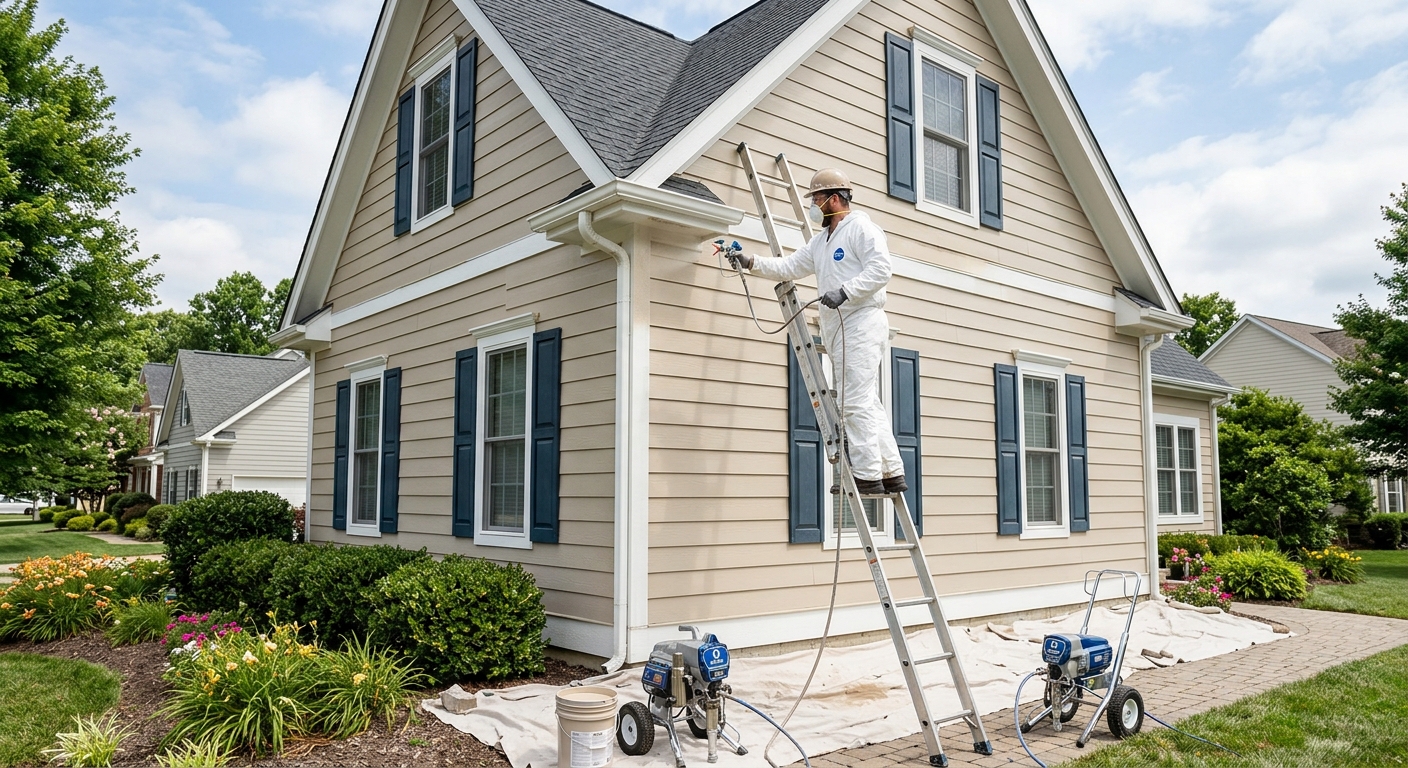
Painting options and costs in Ladysmith
Ladysmith homeowners often notice that “the same” painting job can land at very different prices, especially when you’re comparing older houses to newer builds. In Ladysmith, 44.7% of dwellings were built before 1981 (Statistics Canada, 2021 Census), which typically means more surface prep—scraping loose paint, patching weathered trim or siding, caulking gaps, and thorough priming. On pre-1978 interiors and exteriors, professional crews may also use lead-safe work practices if paint testing indicates lead is present.
Vancouver Island and the Coast shapes cost because exterior work is tightly tied to weather windows. Crews aim for a stretch with temperatures around 10°C to 30°C and manageable humidity so paint has time to dry properly and cure over at least a full day. Coastal conditions also bring morning dew and frequent rain, so contractors plan around forecasts and often recommend mildew-resistant, high-quality coatings designed for damp environments.
Demand is steady in established areas where older housing stock is common—many homeowners call for repainting around the city’s downtown and nearby residential streets, where siding, trim, and fences take a beating from wind-driven moisture. If you’re comparing options, it helps to anchor your expectations in typical local price bands for interiors, exteriors, and specialty work.
Use the table below to quickly compare service levels and realistic ranges in Ladysmith, then we’ll break down the key factors that move a quote up or down.
| Service |
What's Included |
Typical Duration |
Price Range |
| Interior — whole home (walls, ceilings, trim) |
Move/cover basics, patching where noted, sanding as needed, caulking, primer where required, walls/ceilings paint, trim/fascia touch-ups as scoped, cleanup |
5–10 business days |
$4,000 – $6,500 |
| Interior — per room (standard bedroom or living room) |
Patch/sand/caulk minor defects, prime spots, 2-coat walls, ceiling paint as applicable, basic trim prep and coat where requested |
1–3 business days |
$2,000 – $4,000 |
| Exterior — full house (siding, trim, soffits) |
Wash, scrape/sand, caulk, repair minor defects as scoped, prime bare spots, 2-coat exterior system, protect landscaping/hardware, cleanup |
6–15 business days |
$6,500 – $12,000 |
| Exterior — trim and accent colours only |
Spot prep to exposed areas, caulk, prime as needed, 2-coat on trim/specified accents, masking and cleanup |
2–8 business days |
$3,500 – $7,500 |
| Kitchen cabinet painting (doors, frames, spray finish) |
Degrease/clean, light scuff-sand, degloss and prime (as needed), spray finish on doors and frames, hardware masking, reassembly |
5–12 business days |
$1,800 – $4,500 |
| Specialty / faux finish (accent wall, texture) |
Surface prep tailored to finish, basecoat system, specialized application, protective topcoat where required, cleanup |
2–6 business days |
$800 – $4,500 |
Prices are estimates only and vary by project scope, site access and material selection.
What affects the price of painting in Ladysmith
Even on Vancouver Island and the Coast, you’ll often see quotes for the same painting scope vary by roughly 30% to 50%. The biggest reasons are (1) how much prep is actually required once crews inspect the surface, and (2) how the short exterior weather window affects scheduling. In Ontario and Alberta, exterior work often fits a later May to early October rhythm—temperatures generally need to stay above 10°C and rising during application. In coastal BC, contractors can have a longer calendar than some inland regions, but higher humidity, rain frequency, and morning dew mean more careful timing and more emphasis on mildew-resistant systems.
Prep on older homes is frequently the cost driver. On repainting jobs in Ladysmith, scraping, sanding, caulking, and priming can be 50% to 70% of total labour when siding, trim, or patch zones are failing or chalking. With 44.7% of dwellings built before 1981 (Statistics Canada, 2021 Census), many projects start with questions like “How much is loose paint?” and “How much bare wood is exposed?” Those answers swing pricing fast.
Two concrete examples you’ll feel in Ladysmith: first, a full exterior repaint in tight downtown/older residential areas can cost closer to the top of the $6,500 – $12,000 range when there’s extensive trim repair and heavy sanding. Second, trim-and-accent work only can land near $3,500 – $7,500 if surfaces are stable and masking is straightforward—fewer damaged sections typically means less primer and less time. That’s also why a “premium” paint line doesn’t automatically guarantee a cheaper job: the best results come from correct prep and system matching.
| Price Factor |
Why It Matters |
Cost Impact |
| Surface prep — scraping, sanding, patching drywall or wood |
Loose paint, cracks, and stains must be removed or stabilized so topcoat bonds |
Often +20% to +60% depending on condition |
| Number of coats — 2-coat system over primer vs. 1 coat over existing |
Coastal moisture exposure and colour changes usually require a full 2-coat finish |
Can add ~10% to 25% |
| Paint quality tier — contractor-grade vs. premium (Benjamin Moore, Sherwin) |
Higher quality typically improves coverage, durability, and mildew resistance |
Materials +5% to +20%; labour may drop if coverage is better |
| Ceilings and trim — adds significant time vs. walls-only |
Detail work needs careful masking, cutting-in, and longer drying discipline |
Commonly +10% to +40% |
| Exterior season window — short season raises summer rates |
Scheduling pressure compresses availability during dry, workable weeks |
Can swing quotes by 10% to 30% around peak demand |
| Lead-safe precautions — required for pre-1978 homes with lead paint |
If testing indicates lead, containment/HEPA cleanup increases time and materials |
Often +10% to +35% for affected areas |
| Surface material — drywall vs. plaster vs. wood vs. stucco |
Each substrate needs different primers and prep methods |
Typically +10% to +25% |
| Height and access — multi-storey exterior requires scaffolding or lifts |
More setup time, safety planning, and protected work zones |
Often +15% to +45% |
Permits & regulations in British Columbia
In British Columbia, painting generally requires no permit for typical residential painting work. That said, health guidelines matter: for homes built before 1978, testing for lead paint before sanding, scraping, or abrasive prep is standard practice for professional contractors. If lead is present, professionals typically use lead-safe work practices such as wet methods to reduce dust, HEPA-filtered vacuuming, careful containment, and proper disposal. This is not something homeowners are usually “legally required” to do for DIY work, but it is the normal, responsible approach when lead is a possibility.
Some work that may require a permit is usually not “painting” itself—it’s tied to other building activities (like structural repairs, major renovations, or window/door replacements) that go beyond surface coatings. Painting-only jobs—interior coatings, exterior repainting, trim painting, and cabinet painting—typically do not need permits.
Before signing for a Ladysmith project, confirm your contractor carries liability insurance and has workers’ compensation coverage (commonly WCB coverage for employees). Then insist on a written contract that spells out paint brand and sheen, number of coats, the exact surface prep included, and how repairs/caulking are handled.
To verify coverage step-by-step: (1) check licensing/registration details on the relevant BC contractor registry/lookup page if applicable to their work type; (2) request a current certificate of insurance showing your contractor name, jobsite, and liability limits; (3) ask for proof of workers’ compensation coverage (clearance letter or equivalent document); and (4) keep copies with your contract so dates match your start window.
Interior vs exterior painting — getting the best result in Ladysmith
In Ladysmith, the difference between a job that looks great for a few years and one that holds up for longer usually comes down to prep discipline and correct system choices—not just the paint brand. For interiors, surface prep is the foundation: filling nail holes, sanding glossy patches, priming stains, and properly caulking where surfaces meet. Sheen selection also matters by room and use. Flat/eggshell is common for walls, but higher-traffic areas often perform better with washable sheens like satin or semi-gloss on trim. Two coats over a proper primer almost always outlast one thick coat, because adhesion and even film build matter.
For exteriors in Vancouver Island’s coastal climate, prep is even more critical. Scraping loose paint, addressing chalking, and caulking before painting helps prevent water ingress behind trim and siding—especially where gaps form around windows and fascia. Primer type matters too: matching primer to substrate (wood, fibre cement, previously painted surfaces) improves bonding through damp cycles. Many BC crews prioritize mildew-resistant, temperature-stable coatings, while inland regions (like parts of Alberta) may emphasize different temperature behavior during application. If your goal is long-lasting results, the right exterior system is usually worth paying for; the “cheapest” option is often the one that skips steps.
Cabinet painting is a smart budget alternative to replacement. A spray finish typically costs more than basic roll-and-brush, but it can be far less than new cabinetry when your frames are sound. For example, if full cabinet replacement plus new hardware is out of reach, a properly prepped cabinet repaint can stay within the $1,800 – $4,500 band—provided you accept the time required for curing and handling.
For pre-1978 homes, lead-safe precautions during sanding/scraping are essential to protect your home and the crew; it’s one of the reasons contractors may price “older house” work higher than a modern rebuild.
| Project Type |
Key Prep Step |
Recommended Coats |
Price Band |
| Interior — fresh drywall (new construction) |
Prime to seal the surface and hide uneven absorption before finish paint |
1 primer + 2 finish coats (total 3) |
$2,000 – $5,500 |
| Interior — repaint (good condition, no repairs) |
Clean/degloss lightly, caulk seams, and spot-prime as needed |
1–2 finish coats (often 2) |
$2,000 – $4,000 |
| Interior — repaint (patching and priming needed) |
Patch, sand flush, then prime repaired areas to prevent flashing |
2 finish coats over spot primer (often 2–3 total coats in practice) |
$3,000 – $6,500 |
| Exterior siding (wood or fibre cement) |
Scrape loose material, sand edges, caulk joints, and use correct primer system |
1 primer (where required) + 2 finish coats |
$6,500 – $12,000 |
| Exterior trim and accents only |
Mask accurately and spot-prime bare or repaired sections |
Spot primer + 2 finish coats on trimmed areas |
$3,500 – $7,500 |
| Kitchen cabinets (spray finish) |
Degrease thoroughly, scuff-sand, and prime for adhesion before spraying |
Primer + 2 finish coats (system-dependent) |
$1,800 – $4,500 |
How to choose a painting contractor in Ladysmith
Start by verifying the contractor you’re hiring is properly insured. In British Columbia, ask for (1) liability insurance—request a certificate of insurance that names the contractor and shows the policy is current; (2) workers’ compensation coverage for employees (WCB coverage, or proof of equivalent coverage); and (3) if the contractor is required to hold a relevant licence/registration for their work type, confirm their registration and status through the appropriate BC lookup pathway. For homeowner confidence, don’t accept “I’m covered” verbally—get the documents.
Next, insist on 2–3 itemised written quotes. You want labour and materials separated, and you want prep called out: washing/stripping steps, sanding/scraping scope, caulking included or excluded, priming rules (for bare wood, stains, or patched areas), number of coats, and whether trim removal is included. If disposal of paint chips or damaged caulking debris is excluded, ask for that in writing. Also confirm whether the quote includes a proper protection plan for landscaping, windows, and hardware.
Warranty matters. Ask for a workmanship warranty length and what it covers (often limited to peeling/blistering within a defined period when prep was done correctly), plus whether the manufacturer product warranty is supported and transferable at the time of purchase. For payment, keep it safe: never pay more than 10% to 15% upfront, then hold back a portion until the job is complete and you’ve done a walkthrough.
Finally, lock the timeline into the contract: request a written start date and an estimated completion window, and ask how they handle rain delays for exterior work in Ladysmith’s coastal conditions.
- Confirm liability insurance expiry date is after your planned start date
- Confirm workers’ compensation coverage (clearance letter/proof)
- Get 2–3 itemised quotes (labour vs. materials line items)
- Check that surface prep is explicitly listed (wash, scrape/sand, patch, caulk)
- Make sure priming rules are written (bare wood, stains, repairs)
- Confirm coat count (e.g., 2-coat system) and sheens for each area
- Ask what’s excluded: lead-safe procedures, repairs beyond patching, scaffolding vs. ladders
- Clarify disposal responsibility for paint debris and masking materials
- Ask whether they protect plants, decks, and exterior lights
- Confirm prep/paint sequencing respects drying time between coats
- Get a written warranty and confirm if it’s transferable
- Verify payment schedule (10%–15% max upfront; holdback after final walkthrough)
Red flags I see in Ladysmith: quotes that “skip” prep or don’t mention priming/caulking; refusing to provide insurance/WCB proof; offering only a lowball lump sum without a scope breakdown; pressure to take large upfront payments; and vague timelines that ignore weather windows for exterior painting on Vancouver Island.
Frequently asked questions — painting in Ladysmith
What paint is best for Ladysmith's climate?
For Ladysmith and the Vancouver Island coast, “best” usually means the right coating system plus the right prep—not just a premium brand. For exterior surfaces, look for mildew-resistant, high-quality paints designed to handle coastal humidity and occasional marine exposure. In practice, we prioritize a proper primer matched to your substrate (wood, fibre cement, or previously painted surfaces) and then a durable exterior finish with a proven exterior formulation. Interior choices can focus on cleanability: satin or semi-gloss on trim and moisture-prone rooms (bathrooms/basements) tends to hold up better than flat coatings. If your home is older—many are pre-1981—expect that additional priming and stabilization may be needed because aged surfaces often bond differently than new drywall. (Statistics Canada, 2021 Census)
How long does exterior paint last here?
In Ladysmith’s coastal conditions, exterior paint life depends heavily on what happens before the first coat. A properly prepped and primed job can reasonably last longer, while shortcuts around scraping, caulking, or priming lead to faster failures like bubbling, peeling at edges, or mildew staining. On weather-exposed areas (trim edges, soffits, window casings), the coating system is constantly challenged by rain cycles and morning dew. That’s why exteriors in this region are scheduled around workable stretches (typically aiming for about 10°C and above with manageable humidity). A well-managed exterior repaint in the $6,500 – $12,000 range often reflects more prep and a more complete system, which is where longevity is won. If your quote is much lower, check if it includes scrape/sand/prime rules and full caulking.
Should I paint or replace my cabinets?
If your cabinet frames and boxes are solid but the finish is worn, painting is usually the better value. In Ladysmith homes, cabinet repainting can refresh the whole kitchen without the disruption of replacement, and it’s often a more realistic budget choice. The key is proper degreasing, sanding/scuffing, priming for adhesion, and a smooth finish. Many homeowners choose spray finishing for a more factory-like look, which is reflected in pricing—typically within the $1,800 – $4,500 range depending on scope and finish level. Replace cabinets when boxes are damaged, warped, or structurally failing, or when layout changes are part of the goal. If you’re seeing peeling at joints or moisture-related damage, have a contractor assess whether repainting will bond or if repairs are needed first.
How do I prep walls before painting?
Good prep is what makes paint last, and homeowners can do the easy steps safely. In a Ladysmith interior, start by removing dust and grease: wash walls lightly with a suitable cleaner (especially kitchens), then let them dry fully. Fill small holes or cracks with a patching compound, sand smooth once cured, and remove all sanding dust. Caulk minor gaps where trim meets walls if you can do it neatly, but don’t over-caulk large structural cracks—those need assessment. Spot-prime stained or high-absorption patches so you don’t get flashing or stains bleeding through. If your home has older paint layers, avoid aggressive sanding in dusty conditions; if you suspect lead is present (pre-1978 homes are the usual concern), professionals may use testing and lead-safe practices. For most residents, the biggest value is choosing a contractor that includes the prep steps in writing.
Do I need to worry about lead paint in an older Ladysmith home?
It’s a sensible concern. Many Ladysmith dwellings are older—44.7% were built before 1981 (Statistics Canada, 2021 Census)—which means some homes likely contain older paint systems where lead could be present. For homeowners, British Columbia typically doesn’t require a permit for painting, but health guidelines recommend testing for lead paint before sanding or scraping if the home is built before 1978, and then following lead-safe practices if lead is detected. Professional contractors commonly use wet methods, HEPA vacuuming, and proper containment/disposal to reduce dust exposure. You don’t have to treat every repaint as lead-positive, but you should ask your contractor whether they test, how they protect occupants if lead is found, and whether their prep method is appropriate for the house age and paint condition.
How long does it take to paint a house?
Timelines vary in Ladysmith based on interior size, the amount of prep, and whether it’s an exterior job affected by weather windows. For interiors, a single room can take roughly 1–3 business days depending on repairs, drying discipline, and trim work; a whole home typically runs longer—often several days up to a week or more for full walls/ceilings/trim. For exteriors, plan for delays: crews concentrate work during drier late-spring to early-fall stretches when temperatures are roughly above 10°C and humidity is manageable, because paints need multiple dry hours and a full day to cure properly. A full exterior repaint often takes about 6–15 business days depending on scaffolding/access and prep load. If you’re targeting a summer start, book early and ask for a written schedule that includes weather contingency.