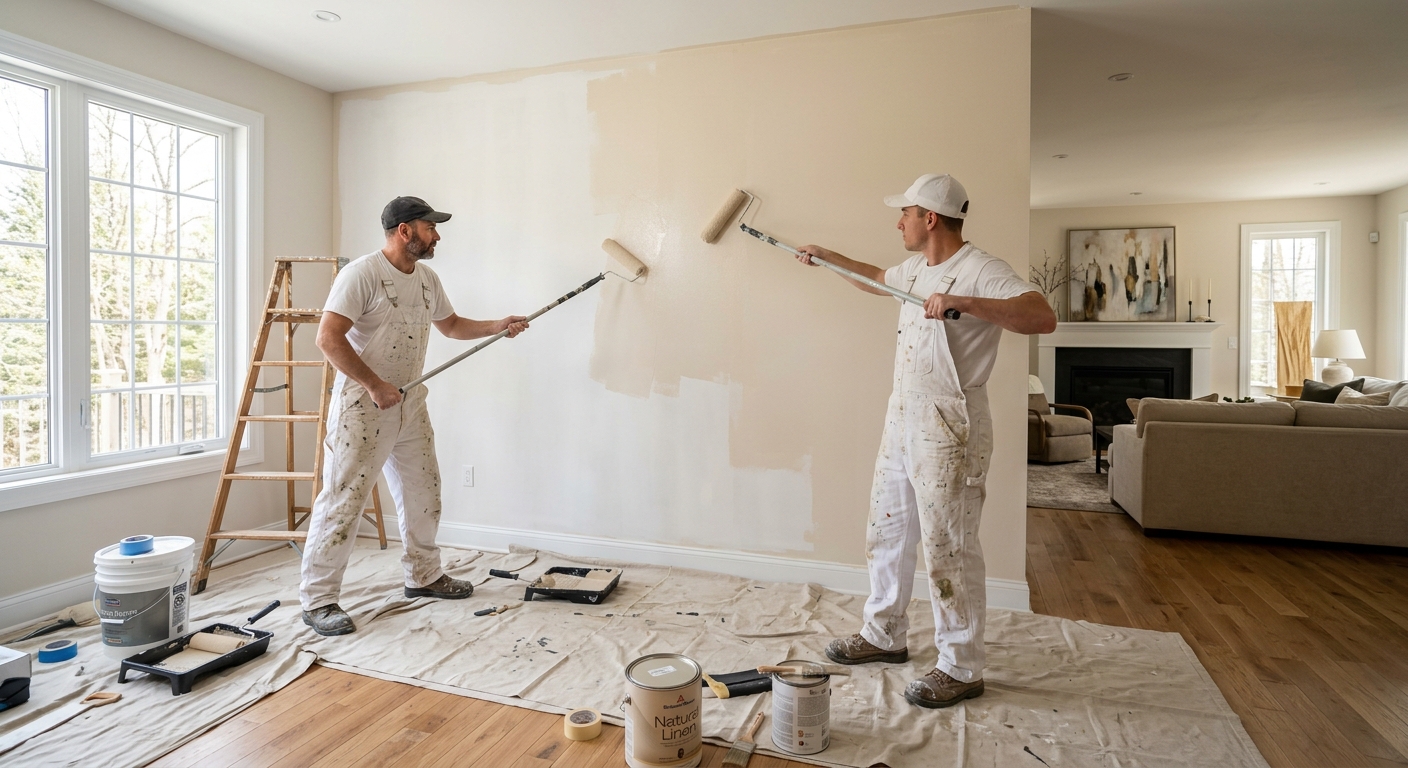
Painting options and costs in Hope
Painting options in Hope, British Columbia range from simple room refreshes to full interior and exterior repaints, and the costs usually track how much preparation the job needs. Nearly half of the local housing stock in Hope is older—about 48.0% of homes were built before 1981 (Statistics Canada, 2021 Census). In practice, that often means more scraping and sanding, more patching for cracks and nail pops, and careful priming to block stains (nicotine, water marks, or wood tannins). If a home is pre-1978, professionals commonly plan for lead-paint–safe practices even when the project is “just painting,” because containment, cleanup, and disposal add time.
The Lower Mainland–Southwest market also shapes pricing. Contractors in Hope can see tighter scheduling pressure for exteriors because rain and humidity slow drying and increase mildew risk; in other words, painters don’t just “pick a date,” they pick a dry window. That’s especially noticeable in areas with higher trade demand, including the town’s older-core streets and the nearby residential pockets off the main routes where repaints come up often as homeowners maintain older single-detached homes (74.0% of dwellings).
Below are realistic budget ranges to help you compare bids from different contractors, then you can refine the scope for your exact surfaces, access, and product choices.
| Service |
What's Included |
Typical Duration |
Price Range |
| Interior — whole home (walls, ceilings, trim) |
Preparation (patching/sanding), caulking, primer as needed, 2-coat finish for walls/ceilings; detailed trim prep and 2-coat trim finish; protection and cleanup |
5–12 days |
$2,800–$8,000 |
| Interior — per room (standard bedroom or living room) |
Move-light prep, patch/sand spots, prime as needed, 2-coat wall finish; optional ceiling coat; basic trim touch-ups or 2-coat trim where specified |
1–3 days |
$600–$2,500 |
| Exterior — full house (siding, trim, soffits) |
Power-wash and scrape/spot-sand as needed, caulking, mildew treatment where required, stain-blocking primer for problem areas, exterior primer and 2-coat system; protection and disposal |
1.5–3.5 weeks |
$3,800–$12,500 |
| Exterior — trim and accent colours only |
Surface prep for trim, caulking and spot priming, prime+finish 2-coat on trim details and accent areas; masking and cleanup |
5–10 days |
$1,200–$5,500 |
| Kitchen cabinet painting (doors, frames, spray finish) |
Degrease and bond primer, sanding and de-glossing, spray finish for doors/drawer fronts, 2 topcoats; masking hardware as feasible and onsite protection |
5–10 working days |
$2,000–$6,500 |
| Specialty / faux finish (accent wall, texture) |
Surface prep, base coat, finish system (faux/texture), multiple passes where required; clear coat or protective topcoat if specified |
2–7 days |
$800–$10,000 |
Prices are estimates only and vary by project scope, site access and material selection.
What affects the price of painting in Hope
It’s common to see the same painting job come in 30–50% apart in the Lower Mainland–Southwest versus other parts of British Columbia, because labour availability, weather-risk management, and surface prep requirements differ. For exteriors, the season is tightly climate-bound in coastal BC: the goal is consistent dry conditions for application and curing, and that often means re-scheduling around rain and humidity. Compared to provinces with more predictable temperature windows, coastal jobs cost more when a crew has to “wait for weather” and remobilize with fresh materials. Shorter usable dry stretches also concentrate demand, which pushes summer pricing upward.
Interior work is steadier in fall and winter because it’s less exposed to outdoor rain and drying delays, so interior quotes can be more stable. Still, prep is the main driver: in Hope, many homes are older (48.0% built before 1981; Statistics Canada, 2021 Census), and scraping failing coatings, patching settlement cracks, and priming properly can represent 50–70% of total labour on a repainting job. A good quote will spell out what is being primed and why.
Concrete examples: if your exterior has peeling paint near the eaves, you may pay toward a full scrape/prime area—worth it to avoid blistering again. If your interior includes ceilings and detailed trim, expect meaningful time (and cost) for cutting-in and multiple coats. For budget planning, a basic per-room interior refresh can land near the $600–$2,500 range, while a full exterior repoint-and-repaint approach often moves into the $3,800–$12,500 band depending on how much substrate repair and primer is required.
| Price Factor |
Why It Matters |
Cost Impact |
| Surface prep — scraping, sanding, patching drywall or wood |
Prep determines adhesion; inadequate prep causes peeling, flaking, and shadowing through |
Often 50–70% of labour on repaints; can swing totals by thousands |
| Number of coats — 2-coat system over primer vs. 1 coat over existing |
Coverage and durability depend on a proper base and consistent film build |
Choosing a true 2-coat system typically increases cost but reduces callbacks |
| Paint quality tier — contractor-grade vs. premium (Benjamin Moore, Sherwin) |
Better solids/resin and pigmentation improve hiding and stain resistance |
Higher tier can add material cost; can reduce labour if fewer re-coats |
| Ceilings and trim — adds significant time vs. walls-only |
Ceilings require careful cutting and coverage; trim needs detail work and slower pacing |
Can add 20–40% to an interior job depending on finish complexity |
| Exterior season window — short season raises summer rates |
Rain/humidity delays drying; crews often wait for workable stretches |
May push exterior labour rates up during peak scheduling periods |
| Lead-safe precautions — required for pre-1978 homes with lead paint |
Containment, HEPA cleanup, and disposal take additional labour and time |
Can add noticeable cost on older repaints; protects workers and occupants |
| Surface material — drywall vs. plaster vs. wood vs. stucco |
Porosity and flexibility change primer selection and how paint bonds |
Switching substrate prep can change both materials and labour time |
| Height and access — multi-storey exterior requires scaffolding or lifts |
Safe access increases setup time and sometimes rental costs |
Often a major add-on for two-storey homes and hard-to-reach soffits |
Permits & regulations in British Columbia
In British Columbia, painting typically does not require a permit. For homeowners, there usually isn’t a “get a permit first” step for interior or exterior painting. However, health guidelines recommend lead-paint testing on homes built before 1978 before sanding or scraping. If lead is present, lead-safe work practices are expected for safe handling—methods like wet techniques to reduce dust, HEPA vacuuming, careful containment, and proper disposal. This isn’t commonly mandated for homeowners, but it’s standard practice for professional contractors when they’re dealing with older coatings.
What DOES require permitting in most typical cases is not the paint itself—it’s related trades and building systems (for example, when painting is part of a permitted renovation that changes structural elements, electrical, or plumbing). Pure painting and coating work is usually the type of project that proceeds without a municipal permit in BC.
To verify a painting contractor in Hope, British Columbia, homeowners should check: (1) liability insurance—request a certificate showing the policy is active and includes their work; (2) workers’ compensation coverage—ask for proof of WCB coverage for their workers (or equivalent coverage where applicable); and (3) a written contract with clear scope items like paint brand/line, sheen, number of coats, and surface prep inclusions. Step-by-step, start by asking for insurance documents before work begins, then confirm they match the company name on the quote and contract, and retain copies for your records.
Interior vs exterior painting — getting the best result in Hope
The difference between a long-lasting paint job and an early failure in Hope is almost always preparation, not just brand. For interiors, surface prep matters more than the topcoat choice: fill and sand properly, prime repaired areas, and address water stains or drywall issues before painting. Sheen selection is also practical. Flat paint hides minor imperfections but scuffs more easily—often best for low-traffic ceilings. Eggshell is a common all-rounder for living rooms and bedrooms, while satin or semi-gloss on trim and doors stands up better to cleaning. In a correctly prepped repaint, two coats over a primer will generally outlast one thick coat because coverage and film build are more consistent.
For exteriors in Lower Mainland–Southwest conditions, prep is even more critical. Coastal BC’s rain and humidity mean you need proper cleaning, scrape/sand where coatings are failing, and correct caulking before paint so water doesn’t migrate behind trim. Primer choice matters: certain substrates benefit from adhesion primers or stain-blocking primers (for knots, tannins, or persistent marks). Product selection should also be mildew-resistant and formulated for stable curing. Lead-safe precautions may be required for pre-1978 homes—especially when scraping existing coatings.
Cabinet painting is a realistic alternative to replacement, but the “prep-to-finish” chain is non-negotiable: degreasing, de-glossing, proper primer, spray-capable finish, and curing time. For a dollar example, upgrading from a “paint-only” plan to full prep and stain-blocking primer on troublesome exterior areas can look like a higher ticket—yet it’s usually far cheaper than dealing with repeat peeling and re-scheduling during wet weather. Interior touch-ups can start closer to the $600–$2,500 per-room range, while a full exterior repaints often lands in the $3,800–$12,500 band because prep and weather management scale up.
| Project Type |
Key Prep Step |
Recommended Coats |
Price Band |
| Interior — fresh drywall (new construction) |
Prime all drywall, sand nibs, fill joints and imperfections |
Primer + 2 finish coats |
$1,200–$4,500 |
| Interior — repaint (good condition, no repairs) |
Clean/de-gloss lightly and address any minor marks; spot-prime only if needed |
Spot primer + 2 finish coats (walls) |
$600–$2,800 |
| Interior — repaint (patching and priming needed) |
Patch, sand, feather edges, then prime repairs and stain-prone areas |
Prime repairs + 2 finish coats |
$900–$3,800 |
| Exterior siding (wood or fibre cement) |
Scrape/sand failing paint, clean, caulk, and prime bare/porous areas |
Primer + 2 exterior finish coats (as required) |
$3,800–$12,500 |
| Exterior trim and accents only |
Mask carefully, scrape loose areas, caulk gaps, prime bare wood/trim |
Prime spots + 2 finish coats |
$1,200–$5,500 |
| Kitchen cabinets (spray finish) |
Degrease thoroughly, sand/de-gloss, bond prime, mask interiors |
Primer + 2 topcoats (spray) |
$2,000–$6,500 |
How to choose a painting contractor in Hope
Choosing a painting contractor in Hope is about verification and clarity. Start with British Columbia checks: request proof of liability insurance and confirm the certificate lists the correct company name and jobsite coverage. Ask for workers’ compensation coverage documents (WCB). A reputable contractor should provide these without pressure, because painting crews can be on ladders, lifts, and tight access points where falls and property damage are real risks.
Next, get 2–3 itemised written quotes. You want a breakdown that separates labour and materials and lists preparation steps (scraping, sanding, patching, priming, caulking), paint brands/lines, number of coats, and surface types. Avoid “lump sum only” proposals—those make it harder to compare whether one bid is doing real prep or simply painting over problems. Make sure disposal is included (especially for exterior scrape waste) and that the contract states whether permits, if needed for any related work, are included—painting itself generally isn’t permit-driven in BC, but other trades sometimes are if the job becomes more than coating work.
For warranty, ask what workmanship warranty length is offered and whether it covers peeling or adhesion failures. Also confirm product/manufacturer warranty details and whether they apply to your specific paint system. On payment schedule, never pay more than 10–15% upfront; hold back a portion until the job is complete and cleaned. Lastly, insist on a written timeline with a start date and completion estimate, and confirm they’ll schedule within dry windows for exterior work in Lower Mainland–Southwest conditions.
- Ask for insurance certificate and confirm dates and policy holder match the quote
- Verify WCB/coverage paperwork for their workers before work starts
- Require an itemised estimate (prep steps, labour hours, materials, coats)
- Confirm paint brand/line and sheen selections are written in the contract
- Ensure surface prep is defined: scraping/ sanding extent, priming rules, caulking
- Check what’s included in cleanup and disposal (scrape waste, drop sheets, vacuuming)
- Clarify protection for floors, stairs, and landscaping during exterior work
- Ask how they handle weather delays for exterior work (re-scheduling process)
- Get a workmanship warranty in writing (length and what it covers)
- Confirm a realistic cure/dry timeline for cabinets and trim so you can plan use
- Review payment milestones: small deposit, then payments tied to completed stages
- Require start date and completion estimate in writing, plus a contact plan for changes
Red flags in Hope to watch for: a quote that skips priming “to save money” without explaining why; no written scope for caulking/surface repair on exterior jobs; refusing to provide insurance or WCB proof; large upfront payments (more than 10–15%); and vague warranty wording like “warranty not included” or “depends” without specifics.
Frequently asked questions — painting in Hope
How do I compare painting quotes?
In Hope and across British Columbia, the best way to compare quotes is to line up the scope, not just the totals. Ask each contractor to list surface prep (scraping/sanding/patching), priming decisions, caulking coverage, and the exact paint lines plus sheen. Confirm the number of coats for the base and finish, and whether trim/ceilings are included. If one bid is dramatically lower, it’s often because it assumes fewer prep steps or fewer coats. For budgeting, a per-room interior job may be in the $600–$2,500 range, while a full exterior repaint often lands in the $3,800–$12,500 band depending on repairs and weather-risk handling.
What paint sheen should I use in different rooms?
Sheen is about durability and how much wall imperfections show. In Hope interiors, ceilings are commonly flat to hide texture, but they scuff more, so avoid flat on high-traffic areas. Eggshell is a popular choice for living rooms and bedrooms because it cleans better than flat while still looking smooth. Kitchens and hallways often benefit from satin on walls for washability. Trim, doors, and baseboards are frequently semi-gloss or satin so you can wipe scuffs. If your home is older (48.0% built before 1981; Statistics Canada, 2021 Census), proper patching and priming will matter as much as sheen because uneven repairs can become more visible with higher-gloss paints.
Can I paint my house exterior in spring or fall in Hope?
You can paint in spring or fall in Hope, but success depends on weather windows rather than the calendar. In the Lower Mainland–Southwest, coastal rain and humidity affect drying and curing, so contractors usually schedule around stretches of dry conditions. Spring can work if temperatures stay workable and surfaces are not wet, while fall can be viable for interiors and for exteriors only when the weather cooperates long enough for the film to cure. A good contractor will plan around dry stretches, use mildew-resistant coatings, and avoid painting when rain is likely soon after application. If your exterior paint job needs heavy prep (common on older single-detached homes), the timeline can shift based on how quickly dry days arrive.
How do I choose a painting contractor in Hope?
Choose contractors who verify coverage and provide a written, itemised scope. In British Columbia, ask for liability insurance proof and workers’ compensation coverage documents (WCB) before work begins. Then compare quotes that clearly state prep steps, caulking and primer decisions, paint brand/line, sheen, and the number of coats. A reliable contractor should also describe how they manage exterior scheduling around rain and humidity. Make sure the written contract includes cleanup/disposal and a workmanship warranty. If you’re painting an older home, ask how they handle lead-safe work practices for pre-1978 coatings. Clarity and documentation usually matter more than brand names alone.
How many coats does an exterior repaint need in Hope?
Most exterior repaints in Hope follow a primer + 2 finish coat approach, but the exact number depends on how much bare or problem substrate is exposed. Areas with sanding through, new caulking, or stains often require primer first. After priming, contractors typically apply two exterior finish coats to reach consistent hiding, durability, and uniform sheen. In coastal BC humidity, rushing coats increases failure risk because coatings may not cure properly between steps. If your siding has failing coatings, the real question becomes how extensive the prep is—scraping and priming can be a bigger driver than the “coat count” alone.
What is the best primer for older Hope homes?
For older Hope homes, the “best” primer depends on what you’re priming: bare wood, repaired drywall/patches on exterior soffits, stained areas, or substrate that previously held coatings that can bleed or peel. In general, pro contractors select bond primers for adhesion on problem surfaces and stain-blocking primers where tannins or water marks are present. If the home is pre-1978, professional lead-safe practices are also standard when scraping or sanding is required. Because Hope’s housing stock includes many older builds (48.0% built before 1981; Statistics Canada, 2021 Census), proper primer selection and application are a major reason painters’ scopes vary—and why a slightly higher quote may actually cost less over time.