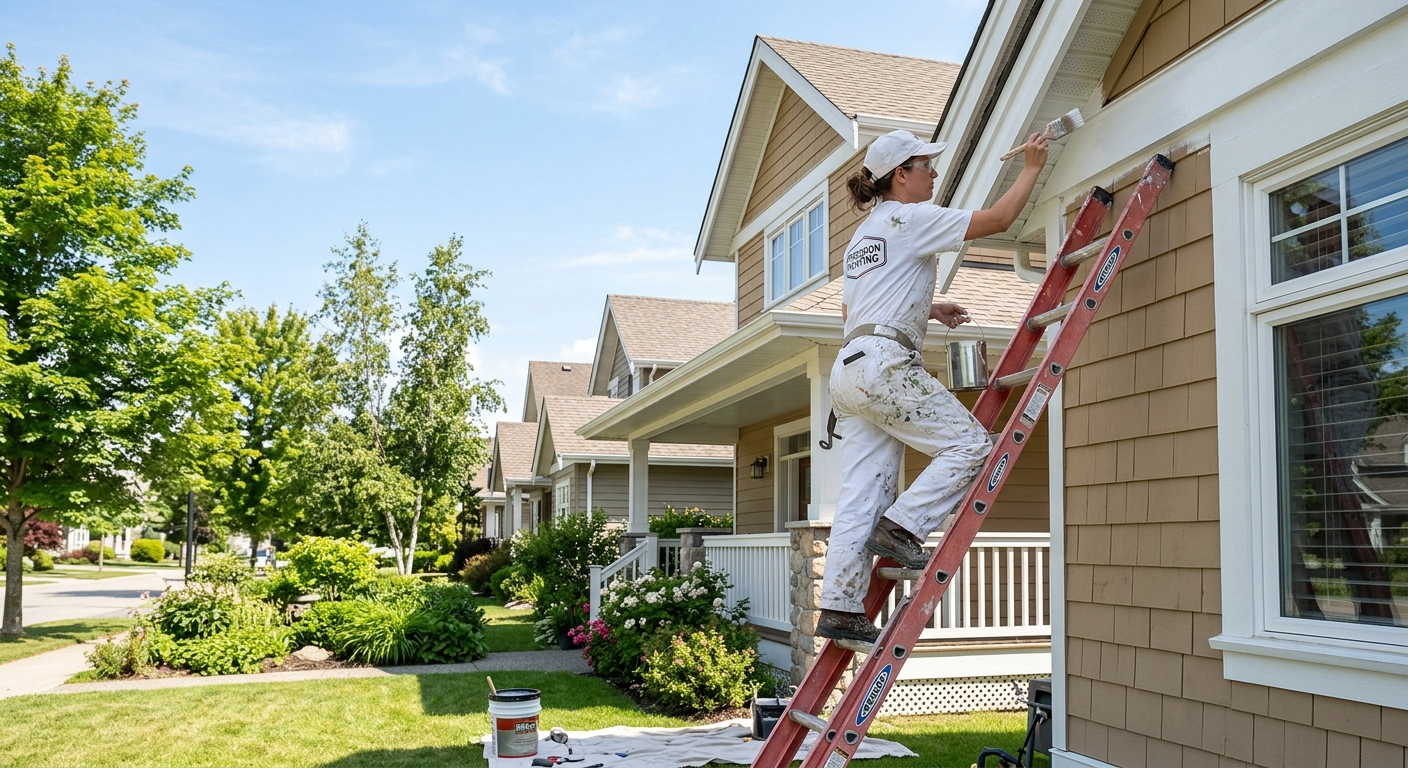
Painting options and costs in St. Andrews Heights
Painting options in St. Andrews Heights come with real differences in prep time and scheduling—often more than most homeowners expect. In a community of about 1,345 residents (Statistics Canada, 2021 Census), many properties reflect the broader Calgary-area housing profile, including older builds that can mean tougher surface prep before any top-coat goes down. If your home is pre‑1978, extra caution is sometimes required around lead-safe practices during sanding or scraping, and that can add time to what looks like a simple repaint.
In Calgary’s climate, the exterior portion of the job is strongly weather-driven. Our workable season typically runs from mid‑May to late September, when daytime temperatures reliably stay above 10°C and surfaces dry properly after rain and overnight cool-downs. That shorter window affects availability: high-quality exterior contractors book early, so peak-season dates often cost more and move faster. Interiors are less season-sensitive, but labour intensity still varies with ceiling height, access, how much patching and priming is needed, and whether you’re working around active daily living.
In St. Andrews Heights, demand tends to be especially high for repaint work in the busier residential pockets near local connector roads and older infill areas where homeowners refresh siding and trim more frequently. From first walk-through to final caulking and trim detail, the scope drives the price—so comparing options side-by-side is the best next step.
Below are typical ranges you’ll see for common projects in the Calgary market. Use them as a planning guide before you request an itemised quote.
| Service |
What's Included |
Typical Duration |
Price Range |
| Interior — whole home (walls, ceilings, trim) |
Move-protected prep, dust control, caulking as needed, patching minor holes, sanding, priming where required, 2-coat finish on walls/ceilings, standard trim/door touch-ups or full trim repaint (based on condition) |
5–12 working days |
$2,000 – $8,000 |
| Interior — per room (standard bedroom or living room) |
Prep and protection, patching/sanding, primer where needed, 2-coat finish on walls, ceiling paint if included, standard trim/door repaint (based on your selected scope) |
1–3 working days |
$400 – $1,400 |
| Exterior — full house (siding, trim, soffits) |
Scrape/sand/spot prime, caulking and sealing cracks/edges, cleaning, primer system for substrate, 2-coat exterior finish, detail work at trim/soffits/eaves as specified |
7–20 working days (weather dependent) |
$2,500 – $9,000 |
| Exterior — trim and accent colours only |
Mask/protect, targeted prep on trim edges, caulking, primer as required, 2-coat finish on trim/accent surfaces |
3–10 working days |
$1,200 – $4,500 |
| Kitchen cabinet painting (doors, frames, spray finish) |
Degrease/clean, sanding and deglossing, bonding primer where needed, spray-applied cabinet finish, hardware removal/covering, re-install and touch-ups |
5–15 working days (including dry/cure time) |
$800 – $7,000 |
| Specialty / faux finish (accent wall, texture) |
Surface prep specific to the effect, base coat(s), specialized application, sealing/topcoat for durability |
2–8 working days |
$600 – $6,000 |
Prices are estimates only and vary by project scope, site access and material selection.
What affects the price of painting in St. Andrews Heights
It’s common to see the “same” painting job come in 30–50% apart across Calgary and the wider Alberta market. The difference is usually prep complexity, product system quality, and how much time the contractor budgets for drying, masking and fine detail work—not just labour hours. Two bidders may quote the same number of coats, but one may plan for more scraping, sanding and patching because the substrate is older or because previous DIY work created adhesion issues.
Exterior painting is tightly climate-bound in the Calgary region. In practice, we need a workable season roughly late May to early October, with daytime temperatures above 10°C and rising during application so coatings can flow and dry correctly. Unlike coastal BC (where humidity and rain management can dominate), Calgary’s bigger enemy is freeze–thaw stress paired with strong UV and occasional hail. That’s why we typically specify higher-quality acrylic systems and elastomeric or flexible coatings for exterior surfaces and edges, which can raise material costs compared to economy paint.
Older homes across Alberta often need substantial surface prep. On repaint projects, scraping, patching, caulking and stain-blocking can account for 50–70% of total labour when the existing coating is failing or when stains bleed through. In St. Andrews Heights, if the exterior is coming apart (flaking at caulk lines, bubbling near joints, or chalking on trim), the job can shift from a lower end range toward the middle of the exterior band—say, moving from a baseline near $2,500 – $9,000 toward the upper half depending on amount of repair and priming.
Concrete examples: a multi-storey home usually requires scaffolding or a lift plan (more setup time and careful edge work), while switching from walls-only interior work to full trim and ceilings can push interior projects from the $400 – $8,000 span because ceilings and trim are slower to mask, prep, and coat cleanly.
| Price Factor |
Why It Matters |
Cost Impact |
| Surface prep — scraping, sanding, patching drywall or wood |
Creates adhesion; failing paint and loose edges must be removed so new coatings don’t lift. |
Can add 20–60% of labour on repaints |
| Number of coats — 2-coat system over primer vs. 1 coat over existing |
Proper hiding and durability often require primer + two finish coats on problem areas. |
Typically changes total by 10–25% |
| Paint quality tier — contractor-grade vs. premium (Benjamin Moore, Sherwin) |
Higher solids and better coverage reduce re-coats and improve long-term washability and UV resistance. |
Often shifts materials cost 5–20% |
| Ceilings and trim — adds significant time vs. walls-only |
Ceilings need careful edging; trim requires masking, sanding and crisp brush/spray control. |
Commonly adds 15–40% to interiors |
| Exterior season window — short season raises summer rates |
Weather-tight scheduling concentrates demand into a limited application period. |
May increase labour by 10–30% in peak months |
| Lead-safe precautions — required for pre-1978 homes with lead paint |
When lead is present, contractors follow wet methods, HEPA vacuuming and proper disposal to reduce exposure. |
Can add 5–25% depending on test results and scope |
| Surface material — drywall vs. plaster vs. wood vs. stucco |
Different materials need different primers, sealing steps and film build for bonding. |
Can change prep time by 15–50% |
| Height and access — multi-storey exterior requires scaffolding or lifts |
More equipment, more safety time, and more careful edge protection. |
Often adds 10–35% on exterior |
Permits & regulations in Alberta
In Alberta, painting typically does not require a permit for residential work. That said, there are scenarios where additional oversight can apply—most commonly when work overlaps with regulated hazards (like lead) or when a strata/HOA imposes paint-colour or documentation requirements. For straightforward interior repainting and standard exterior coating on your own home, permits are usually not part of the process.
For homes built before 1978, health guidelines strongly recommend testing for lead paint before sanding or scraping, and using lead-safe work practices if lead is present. For professionals, that usually means wet methods to minimize dust, HEPA vacuuming during dust-generating prep, containment where needed, and proper disposal of debris. It isn’t a “homeowner permit” requirement, but it is standard practice for contractors who want the job done safely and responsibly.
What you should confirm in your contract: clear paint brand and product line, sheen levels, number of coats, and exactly which prep items are included (scraping, patching, priming, caulking, and cleaning). Also verify your contractor has liability insurance and WSIB/WCB coverage—this protects you if a worker is injured or if there’s jobsite damage.
To verify coverage step-by-step in St. Andrews Heights: (1) ask for their proof of Alberta business registration/licence (where applicable for their business setup), (2) request a current certificate of insurance showing liability coverage, (3) request WSIB/WCB clearance or account proof for workers doing the work, and (4) keep a signed written agreement stating prep scope and coatings.
Interior vs exterior painting — getting the best result in St. Andrews Heights
In St. Andrews Heights, the difference between a long-lasting paint job and a premature failure is usually prep discipline and coating selection—not simply buying a more expensive brand. For interiors, start with repairs: filling and sanding, then priming areas with fresh drywall, water stains, or patched spots. The surface matters more than sheen brand. Choosing sheen by room use is also key: flat is common on low-traffic ceilings, eggshell on living rooms/bedrooms for washability without heavy glare, satin or semi-gloss on higher-traffic areas where cleaning matters. Two coats over proper primer almost always outlasts one thick coat because it builds consistent film and hides uneven absorption.
For exteriors, Alberta weather makes edges and joints do the heavy lifting. Caulking before painting (and using the correct exterior-grade sealant) helps prevent water ingress at cracks and gaps—those small openings become peeling lines later. Primer type matters: different substrates (wood, fibre cement, masonry) need the right primer chemistry for adhesion and stain-blocking. While mildew-resistant additives are especially critical in damp coastal climates, Calgary still benefits from coatings formulated for outdoor durability and temperature swings. Products must be able to handle UV exposure and freeze–thaw stress, especially on trim, soffits and corners.
Kitchens are a special case: cabinet painting is often the smartest “upgrade without replacement” option, particularly when frames and doors are structurally sound. It’s also where labour and preparation time can swing your quote. For pre‑1978 homes, lead-safe precautions during any sanding are not optional if you want to work safely.
Here’s where cost differences are justified: if an interior repaint quote is lower but excludes patching and priming, you may pay again sooner. On the other hand, paying in line with the interior band (for example, moving from a basic wall repaint toward the $400 – $8,000 range for full prep and trim) is often what prevents “flashing” and peeling at repaired areas.
| Project Type |
Key Prep Step |
Recommended Coats |
Price Band |
| Interior — fresh drywall (new construction) |
Prime bare drywall and level sheen/absorption before finish paint |
Primer + 2 finish coats |
$1,000 – $4,500 |
| Interior — repaint (good condition, no repairs) |
Clean, degloss where needed, spot-prime scuffs/stains |
Spot primer (as needed) + 2 finish coats |
$400 – $2,500 |
| Interior — repaint (patching and priming needed) |
Patch, sand smooth, caulk gaps, and prime repairs for uniform hiding |
Primer on repairs + 2 finish coats |
$800 – $6,000 |
| Exterior siding (wood or fibre cement) |
Scrape failing edges, clean, caulk joints, and apply adhesion primer system |
2-coat exterior system (primer + 2 finish coats depending on substrate) |
$2,500 – $9,000 |
| Exterior trim and accents only |
Targeted prep at trim edges + proper caulk lines for water control |
2 finish coats with primer where bare/unstable coating exists |
$1,200 – $4,500 |
| Kitchen cabinets (spray finish) |
Degrease thoroughly, degloss, and use a bonding primer for adhesion |
Primer + 2 sprayed coats (system dependent) |
$800 – $7,000 |
How to choose a painting contractor in St. Andrews Heights
Start by verifying Alberta coverage before you sign anything. Ask for a current certificate of liability insurance (showing the insured contractor and active dates) and proof of WSIB/WCB workers’ compensation coverage for the painters doing the work. If they can’t provide it promptly, treat that as a major “no.” Next, request quotes that are itemised—not lump sums—so you can compare labour, preparation steps and coating choices line by line.
When you ask for 2–3 written quotes, insist on details like: surface prep included (scraping, sanding, patching, caulking, stain-blocking), the paint product line and sheen, the number of coats, whether ceilings/trim are included (or excluded), and how disposal is handled. Also confirm whether they schedule around the Calgary exterior window and what they do if rain or overnight cold delays application.
Warranty matters in Alberta because coatings fail most often at weak prep or edge joints. A credible contractor will spell out a workmanship warranty length (and what triggers it) and separate that from manufacturer product warranties. Ask if any manufacturer warranty is transferable to you if you sell your home.
For payment, never pay more than 10–15% upfront. Hold back a portion until the job is complete, cleaned, and touch-ups are done. Finally, get the timeline in writing: start date, expected duration, and a completion estimate that accounts for weather-dependent exterior drying.
- Verify liability insurance is current and request the certificate number.
- Verify WSIB/WCB clearance or coverage for all workers on site.
- Ask for an itemised quote: labour, prep, materials, coatings, and disposal.
- Confirm exactly what prep is included (scrape/sand/prime/caulk/patched drywall).
- Make sure the quote states paint brand/product line and sheen.
- Require the number of coats for each surface type (walls, trim, exterior siding).
- Confirm masking/protection and dust control steps for interior work.
- Ask how they handle rotten wood, large cracks, or major drywall damage (quote adjustments vs included).
- Check that jobsite cleanup and debris disposal are included.
- Review the warranty terms in writing (workmanship vs product warranty).
- Agree on a payment schedule with a holdback until completion.
- Get start date and completion window in writing, including weather contingencies for exteriors.
Red flags in St. Andrews Heights: quotes that skip primer details, vague “two coats” promises without prep scope, unwillingness to provide proof of insurance/WSIB/WCB, demanding a large upfront payment (beyond 10–15%), and no written warranty or unclear contract language about colour changes and disposal.
Frequently asked questions — painting in St. Andrews Heights
How do I fix peeling exterior paint in St. Andrews Heights?
Peeling exterior paint usually isn’t fixed by “spot paint over it” in St. Andrews Heights—it’s a prep and adhesion problem. The reliable fix is to scrape back loose coating to solid edges, sand feathered boundaries, then clean and prime with an exterior-appropriate primer system before applying a full 2-coat finish. Also address the cause: cracked caulking at trim joints, trapped moisture, or failed adhesion from prior coatings. Because Calgary’s exterior work is weather-window dependent (mid‑May to late September is typically workable), plan repairs for a time when surfaces can dry properly after prep and when daytime temperatures stay above about 10°C.
What colours add the most resale value in St. Andrews Heights?
For resale in Alberta, the “safe” approach is to choose timeless neutrals with the right trim contrast—think warm whites/creams for trim and soft greiges or light beiges for siding, with a darker accent (like charcoal, deep green, or muted navy) on doors or select trim lines. This tends to photograph well, reads clean in strong UV, and is easier for future buyers to personalize. If you’re refreshing older homes, matching existing trim values (light/dark contrast) often looks more cohesive than making large colour jumps. For budgeting, you can often stay in the exterior trim/accent band of $1,200 – $4,500 if the siding colour is still serviceable and only the trim/facades need work.
How much does it cost to paint a house in St. Andrews Heights?
The cost to paint a house in St. Andrews Heights depends heavily on whether you mean interior, exterior, or both, and how much prep is required. For many homes, an interior whole-home repaint commonly lands somewhere in the broader interior range of $400 – $8,000 when you include walls, ceilings and trim (with higher end values for lots of repairs or full detail work). For exteriors, a full house paint (siding, trim, soffits) is typically in the exterior band of $2,500 – $9,000, especially because Calgary’s freeze–thaw cycles and UV mean prep and appropriate elastomeric/flexible coatings at edges are not optional if you want longevity.
How much does interior painting cost per room in St. Andrews Heights?
In St. Andrews Heights, interior painting per room (like a standard bedroom or living room) typically falls within the “per room” portion of the interior range—often around $400 – $1,400, depending on ceiling height, how much patching is needed, and whether trim/doors are included. A repaint in good condition with minimal repairs can stay near the lower end, while a room needing sanding, caulking, priming of repairs, and more detailed trim work pushes closer to the middle. Two coats are usually budgeted as standard over proper primer; skipping primer or reducing coats may save money short-term but often leads to uneven sheen, flashing, or faster wear.
When is the best time for exterior painting in St. Andrews Heights?
The best time for exterior painting in St. Andrews Heights is when daytime temperatures can reliably support proper application and drying. In Calgary’s market, that usually means planning work from mid‑May into late September, when temperatures are above about 10°C and weather windows allow coatings to set between rain and overnight cool-downs. Peak summer weeks book quickly, so if you want prime dates, secure your contractor early. If your home requires significant scraping and caulking, those prep steps also need workable drying time—so a flexible schedule is helpful if Alberta weather shifts.
How many coats of paint do I need?
In most Alberta residential scenarios, a durable finish is achieved with 2 finish coats, but what happens in between depends on the substrate. For interiors, we typically use prime + 2 coats over fresh drywall or repairs, and we use spot-primer plus 2 finish coats for repaints in decent condition where scuffs/stains may exist. For exteriors, coatings generally follow a system approach: proper cleaning and scraping, primer where adhesion is compromised (or where bare/unstable surfaces exist), then 2 coats exterior finish. If someone promises “1 coat only,” you’re usually trading away coverage uniformity and long-term hiding—especially noticeable on trim and previously weathered siding.