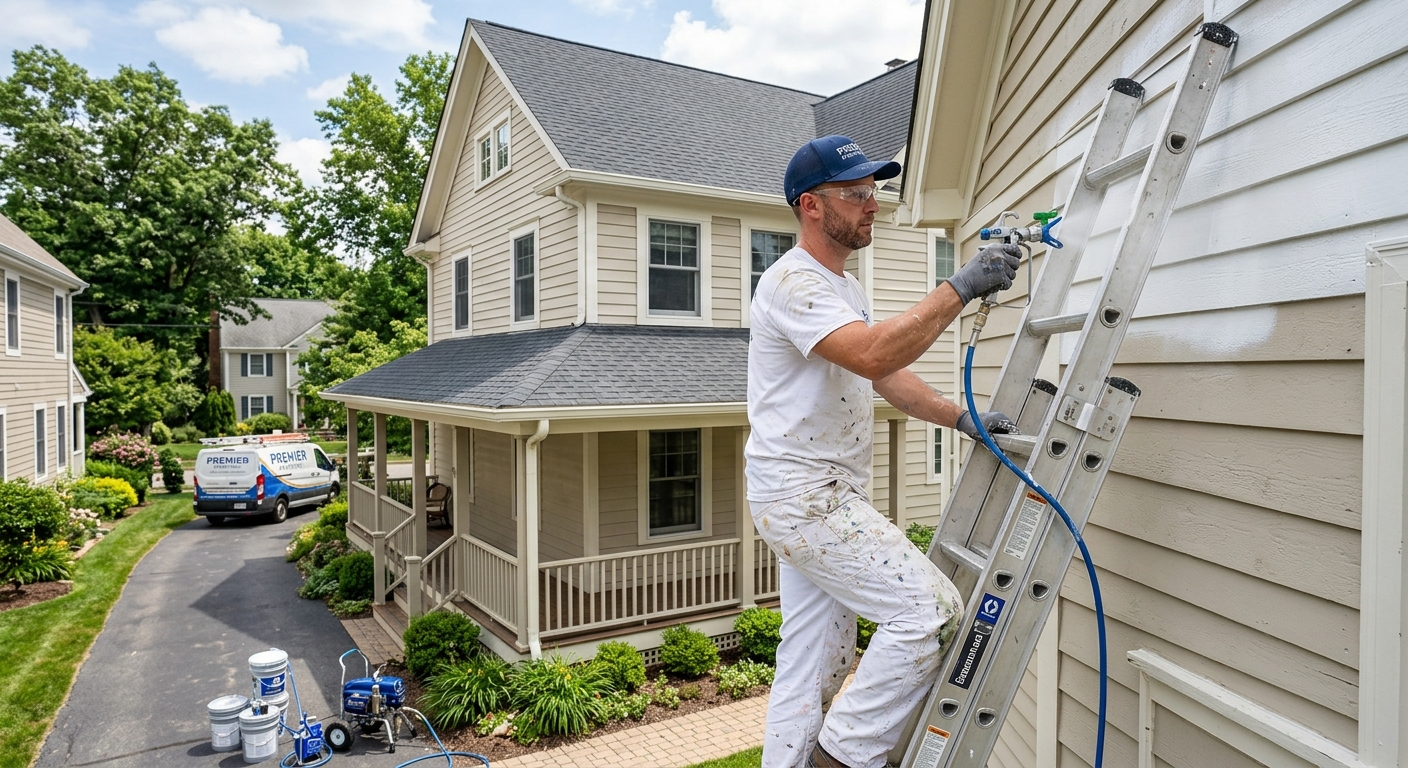
Painting options and costs in Drumheller
Drumheller homeowners usually start thinking about paint when the schedule opens up for outdoor work, and that’s a real factor here. In 2021, Drumheller had 7,909 residents, and about 70.9% of households were owner-occupied (Statistics Canada, 2021 Census). Most homes are single-detached (76.4% of dwellings), and a lot of that housing stock is older: 62.6% of homes were built before 1981. That age matters because older exteriors often need heavier prep—scraping, patching, caulking, and priming—and some properties may also need lead-safe containment if old coatings contain lead.
In the Lethbridge–Medicine Hat region, exterior painting is tightly seasonal. Contractors aim for late spring through early fall, when daytime temperatures are reliably above about 10°C and nights stay well above freezing—similar timing principles used for Alberta exteriors. That compressed window concentrates demand into a few months, so schedules book early and exterior pricing commonly lands on the higher end of the provincial range. By contrast, interior painting is not as weather-limited, so turnaround can be faster, especially when walls are in good condition.
One area where we consistently see steady interior and exterior demand is the Drumheller area around the East Coulee–Carbon side of the community and older residential pockets near the downtown core—typically because those homes are older and require more prep attention. Once you’re ready to compare apples-to-apples, the table below breaks out common options, what’s included, and realistic price bands for a typical Drumheller project.
| Service |
What's Included |
Typical Duration |
Price Range |
| Interior — whole home (walls, ceilings, trim) |
Move & protect furnishings, caulking, patching, sand where needed, primer as required, wall/ceiling painting, shop/paintable trim prep, clean-up and light touch-ups |
5–10 working days |
$2,500–$5,000 |
| Interior — per room (standard bedroom or living room) |
Protect floors/fixtures, patch & sand, caulk, prime as needed, paint walls and finish one ceiling if requested |
1–3 working days |
$800–$1,800 |
| Exterior — full house (siding, trim, soffits) |
Pressure wash (as required), scrape/sand, patch cracks, caulk transitions, prime bare spots, paint siding + trim/soffits, site protection and clean-up |
6–12 working days |
$2,500–$9,000 |
| Exterior — trim and accent colours only |
Spot scrape/sand, caulking, prime spot areas, paint trim/accents/doors as specified, protect landscaping and glass |
2–5 working days |
$1,500–$3,500 |
| Kitchen cabinet painting (doors, frames, spray finish) |
Hardware set aside, thorough cleaning/degloating, sanding/scuffing, primer, spray-applied finish, reinstall hardware, light touch-ups |
3–7 working days (plus dry time) |
$1,200–$4,000 |
| Specialty / faux finish (accent wall, texture) |
Surface prep to an even base, custom application, sealing/topcoat where needed, final clean and protective cover removal |
2–5 working days |
$500–$6,000 |
Prices are estimates only and vary by project scope, site access and material selection.
What affects the price of painting in Drumheller
It’s common to see quotes for what looks like the “same” painting job vary by 30–50% across Lethbridge–Medicine Hat communities and within Alberta. The difference usually isn’t the paint alone—it’s labour and prep quality. Exterior work is the biggest driver: in this region, the exterior painting season is narrowly tied to workable weather (roughly late May to early October, with daytime temperatures staying above about 10°C and nights well above freezing). When the season compresses, contractors can’t spread work out, so summer rates and scheduling premiums rise. In BC’s wetter coastal climates, crews plan for damp conditions and mildew risk, often adding more careful timing and mildew-resistant products; southern Alberta is drier, but sun intensity, wind, and fast curing still change how paint must be applied and protected.
Another major cost driver is older housing. With 62.6% of homes in the area built before 1981 (Statistics Canada, 2021 Census), more properties need scraping, patching, caulking, and primer—prep can be 50–70% of labour on a repaint. For example, if a two-storey exterior needs extensive patching and primer for blistered areas, it can push a job from the lower exterior band (closer to the $2,500–$3,500 range) toward the mid-range (often $4,500+) because time multiplies on ladder/scaffold access and drying cycles.
On interiors, the “per room” price can shift a lot depending on ceilings and trim. Adding ceilings and detailed trim can add as much time as the walls. And if you have patchwork or water-damage repairs, primer and sanding increase—turning what might have been closer to $800–$1,800 per room into a higher end repaint within the interior whole-home band ($2,500–$5,000). In Drumheller, even small differences—like stubborn chalky paint on older siding or a tight drive with limited staging space—can change how long the crew needs.
| Price Factor |
Why It Matters |
Cost Impact |
| Surface prep — scraping, sanding, patching drywall or wood |
Determines adhesion and smoothness; older surfaces often need more repair |
+$200 to +$1,500 per typical scope |
| Number of coats — 2-coat system over primer vs. 1 coat over existing |
Coverage and durability; thin coats increase rework and premature failure |
+$150 to +$1,000 |
| Paint quality tier — contractor-grade vs. premium (Benjamin Moore, Sherwin) |
Better hiding and film build often reduce total coats and touch-ups |
+/- $100 to +$800 |
| Ceilings and trim — adds significant time vs. walls-only |
Trim detail, masking, and cutting-in take longer; ceilings add ladder time |
+$300 to +$2,000 |
| Exterior season window — short season raises summer rates |
Demand concentration affects crew availability and scheduling |
+$250 to +$1,500 |
| Lead-safe precautions — required for pre-1978 homes with lead paint |
Wet methods, HEPA vacuuming, containment and disposal add steps |
+$300 to +$2,500 |
| Surface material — drywall vs. plaster vs. wood vs. stucco |
Different substrates need different primers and sanding approach |
+$200 to +$1,200 |
| Height and access — multi-storey exterior requires scaffolding or lifts |
More setup, safety measures, and time on hard-to-reach areas |
+$400 to +$2,500 |
Permits & regulations in Alberta
In Alberta, painting typically does not require a permit for homeowners or contractors to repaint existing walls and surfaces. What changes the situation is usually hazardous materials and certain building-scope work—not whether you’re putting paint on. For homes built before 1978, health guidelines recommend testing for lead paint before sanding or scraping, and using lead-safe work practices if lead is present. This is not generally a homeowner “permit” requirement, but it is standard professional practice: wet methods to reduce dust, HEPA vacuuming, proper containment, and compliant disposal.
Work that generally does not require a permit:
- Interior repainting (walls/ceilings/trim) in existing spaces
- Exterior repainting of siding/trim on an existing house (no structural or envelope alterations)
- Kitchen cabinet painting or refinishing
Work that may require additional steps (not always a painting permit, but often triggers compliance planning) includes:
- Any sanding/scraping that may create lead dust in pre-1978 coatings
- Renovation-adjacent work that changes assemblies (for example, removing hazardous cladding materials) or requires other approvals
To verify your contractor in Drumheller, ask for (1) their certificate of liability insurance, (2) proof of WSIB/WCB coverage for their workers (or the applicable coverage documentation), and (3) their written contract details. In the contract, ensure you get the paint brand/sheen, surface prep steps, number of coats, and what’s included for cleanup and disposal. For Alberta licence verification, confirm the contractor’s registration through the appropriate online listing used in the province for business trade credentials, and request the clearance/coverage documents directly.
Interior vs exterior painting — getting the best result in Drumheller
In Drumheller’s climate, the difference between a long-lasting paint job and a premature failure comes down to prep discipline, correct coating choices, and doing enough coats over the right base. For interiors, prep is more important than chasing the most expensive topcoat. Filling, sanding, and priming stains or patch areas often decide whether you’ll see flashing or peeling later. Sheen choice matters too: flat hides wall imperfections but scuffs more; eggshell and satin balance washability for living areas; semi-gloss on trim helps it clean up well. A real-world truth from Alberta job sites: two coats over a proper primer almost always outlast one thick coat because the film forms more evenly and cures more consistently.
For exteriors, Alberta rewards the basics done thoroughly. Surface prep is the foundation—scraping loose paint, sanding gloss, patching cracks, and priming bare spots so the topcoat bonds. Caulking should be addressed before painting to prevent water ingress into siding seams and trim edges. Primer choice matters because different substrates (wood, fibre cement, older aluminum/steel, or patched stucco areas) don’t bond the same way; using the right primer prevents peeling and blistering. In Alberta, mildew-resistance is still helpful, but the bigger exterior risks are sun, wind-driven overspray, and temperature swings that affect drying time and adhesion.
Cabinet painting is often a smart budget alternative to replacement. If your kitchen is dated but structurally sound, repainting can deliver a “new kitchen” look at a fraction of replacement. For instance, cabinet spray refinishing commonly fits within the $1,200–$4,000 band depending on box condition and finish complexity—often far less than a full cabinet replacement. In pre-1978 homes, lead-safe precautions should be planned for any aggressive scraping that generates dust, regardless of whether you’re painting interiors or exteriors.
| Project Type |
Key Prep Step |
Recommended Coats |
Price Band |
| Interior — fresh drywall (new construction) |
Prime and seal drywall compound inconsistencies; sand for a uniform surface |
2 coats over a drywall primer/sealer |
$900–$2,200 |
| Interior — repaint (good condition, no repairs) |
Light sanding/scuff, degrease where needed, spot prime as required |
1–2 coats depending on sheen change and colour coverage |
$800–$1,800 |
| Interior — repaint (patching and priming needed) |
Patch, sand, and spot-prime repairs to eliminate flashing |
2 coats over primer to match finish colour |
$1,100–$2,500 |
| Exterior siding (wood or fibre cement) |
Scrape loose coating, sand glossy areas, caulk and prime bare spots |
2 coats over correct primer (spot prime + full topcoat) |
$4,500–$9,000 |
| Exterior trim and accents only |
Detail scraping and caulking at joints; prime transition points |
2 coats on trim for durability |
$1,500–$3,500 |
| Kitchen cabinets (spray finish) |
Clean/degloss, scuff-sand, prime correctly for adhesion |
Primer + 2 finish coats |
$1,200–$4,000 |
How to choose a painting contractor in Drumheller
Choosing the right painting contractor in Drumheller comes down to proof and clarity, not just the lowest line on the estimate. Start by confirming Alberta coverage documentation: request a current certificate of liability insurance (it should list your address/project or be valid for their operations), and ask for proof they carry WSIB/WCB workers’ compensation coverage for their employees. If a contractor can’t provide certificates or they look expired or mismatched to your project dates, that’s a major problem.
Next, ask for 2–3 itemised written quotes broken into labour and materials. You want line items that show prep time (scrape/sand/caulk/prime), number of coats, surface readiness requirements, and surface protection. Also confirm whether a permit pull is included if any special hazard planning is needed for your home’s age or surface condition, and whether disposal (old paint chips, masking waste, etc.) is included or billed separately.
Then look at warranty: ask for a workmanship warranty length and whether it’s in writing. Separate the manufacturer warranty on paint from the contractor warranty on application. Make sure it’s clear whether the warranty is transferable if you sell.
For payment schedule, avoid large upfront amounts. A reasonable approach is 10–15% upfront for materials and scheduling, then hold back payment until the job is complete and the final walkthrough is done. Finally, insist on a written timeline with a start date and completion estimate, especially for exterior work where the short warm-season window affects everything.
- Ask for proof of liability insurance and confirm it’s current (no expired dates).
- Request WSIB/WCB coverage documentation for workers.
- Get an itemised scope: prep steps, number of coats, primers used, and sheen selections.
- Confirm site protection details (drop sheets, masking, floor protection) and cleanup responsibilities.
- Ask who does caulking and whether it’s done before primer/topcoat.
- Verify disposal is included for paint chips, filters, and masking waste.
- Clarify how colour changes are handled (primer needed? 2 coats guaranteed?).
- Ask for paint brand and product line in the contract, not just “premium paint.”
- Request a schedule that aligns with Alberta temperature ranges for drying/curing.
- Confirm lead-safe approach for pre-1978 homes if scraping/sanding is required.
- Get a written warranty on workmanship and clarify what “touch-ups” cover.
- Use milestone payments: hold back until punch-list items are finished.
Red flags we see in Drumheller include: quotes that only say “paint everything” without listing prep steps; contractors who won’t put insurance/coverage and warranty terms in writing; very lowball exterior bids that ignore scraping/priming realities on older siding; rushing to start without weather/curing planning; and asking for large upfront payments (beyond roughly 10–15%) before prep work begins.
Frequently asked questions — painting in Drumheller
What colours add the most resale value in Drumheller?
In Drumheller and across Alberta, resale tends to favour brighter, neutral tones that work with natural light and don’t fight older home features. For interiors, warm whites, soft greiges, and light warm beiges usually feel modern without looking trendy. For exteriors, “clean classic” palettes—white or off-white trim with a mid-tone body colour—tend to appeal to a broad buyer pool, especially in older neighbourhood pockets where siding and trim styles vary. Since many homes built before 1981 need extra prep for adhesion, choosing colours that require heavy colour changes (especially from very dark to very light) can add primer/time, which can push interior projects up toward the higher end of typical ranges like $800–$1,800 per room depending on repairs. (Statistics Canada, 2021 Census)
How much does it cost to paint a house in Drumheller?
The total cost depends heavily on whether you’re painting the interior, exterior, or both, plus how much prep is needed. For interior-only, a typical whole-home scope often lands around $2,500–$5,000 for walls, ceilings, and trim, assuming surfaces are reachable and repairs are manageable. For exterior work, realistic expectations are wider: full-house exteriors (siding plus trim/soffits) commonly fit within $2,500–$9,000, because older homes frequently require more scraping, caulking, and priming. Drumheller’s older housing stock (62.6% built before 1981) can increase prep time, and the short exterior season in the Lethbridge–Medicine Hat region concentrates demand, which can affect scheduling and pricing. (Statistics Canada, 2021 Census)
How much does interior painting cost per room in Drumheller?
For a standard bedroom or living room, interior painting is commonly priced based on prep + coats + finish scope. When walls are in good condition (minimal patching), a per-room repaint often fits around $800–$1,800. If there’s patching, water-damage repairs, or significant sanding and spot-priming, that same room can move higher because primer and additional coats are required to prevent flashing. Ceilings and trim also matter: adding ceilings or detailed trim work increases time for masking and cutting in. In Drumheller, many older homes also have mixed surface conditions, so it’s wise to budget for primer and prep rather than assuming “paint over everything.” (Statistics Canada, 2021 Census)
When is the best time for exterior painting in Drumheller?
The best exterior window in Drumheller aligns with the workable weather patterns for southern Alberta: plan for late spring through early fall when daytime temperatures stay consistently above about 10°C and nights remain well above freezing. This matters because proper drying and film formation depend on both temperature and drying conditions. The Lethbridge–Medicine Hat region is known for a compressed season, so schedules book early—especially for full-house exterior painting. If you’re doing just trim accents, you may have slightly more flexibility, but crews still need weather days that allow cleaning, caulking, primer flash-dry, and topcoat curing. Your contractor should also plan sequencing around wind and sun so products cure evenly and don’t dry too fast during application.
How many coats of paint do I need?
Most quality jobs use a system approach rather than a simple “number of buckets.” In typical Alberta practice, exteriors are usually built as 2 topcoats over the appropriate primer (often primer is applied first to bare or repaired areas, then a full topcoat sequence). Interiors are often 2 coats where a primer is needed, especially with patches or colour changes. If you’re repainting a room in good condition with similar colours and correct sheen, you may sometimes get away with 1 coat plus touch-ups, but many contractors still plan on 2 coats to ensure uniformity and durability. If your quote sounds like “1 coat everywhere,” ask what primer is being used and whether repairs will be spot-primed. That’s typically where performance is won or lost.
What paint is best for Drumheller's climate?
For Drumheller, the “best” paint is the one matched to surface type and the weather demands of Alberta. For interiors, look for durable interior coatings with the right sheen for the room—eggshell or satin for living spaces, and semi-gloss for trim for easy cleaning. For exteriors, the coating should handle strong sun, temperature swings, and freeze-thaw cycles. The key is to pair the right primer with the substrate (wood, fibre cement, patched areas) and use proper caulking and surface prep so the paint can bond. In southern Alberta you don’t usually need the mildew-specific emphasis common in coastal BC, but you still want a system designed for exterior adhesion and weathering. If you’re doing a repaint on an older home, spending a bit more on a proper prep-and-primer approach is often more impactful than chasing the most expensive topcoat.