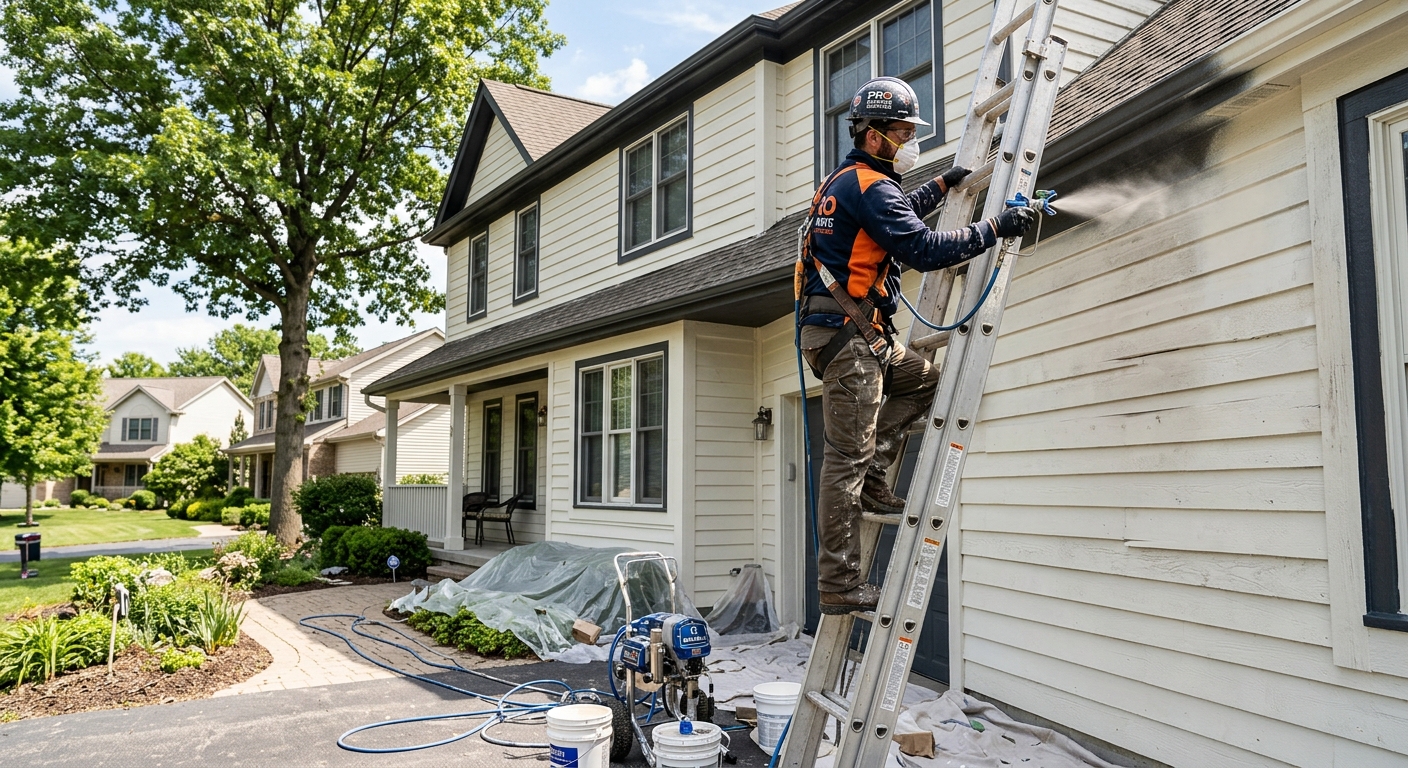
Painting options and costs in Cambrian Heights
Cambrian Heights, Alberta has a big mix of housing styles, and the age of your home matters because it changes how much prep we have to do before any top-coat goes on. In Cambrian Heights specifically, the 2021 Census counted about 2,000 residents (Statistics Canada, 2021 Census), and that size tends to mean fewer crews available on short-notice interior projects. More importantly, many Calgary-area neighbourhoods include older builds—repaints often involve heavier scraping, patching and priming, and in pre-1978 homes we typically plan lead-safe practices if testing shows lead in the paint system. That prep-first reality is a major reason two quotes for “the same colour” can land far apart.
On top of housing age, the Calgary market is driven by weather timing. For exteriors, our workable season usually runs from mid-May to late September, when surfaces can dry properly and the daytime temperatures stay above about 10°C. That compressed window concentrates demand, so exterior scheduling pressure is highest in peak summer weeks, and pricing is firmer than in shoulder months. Areas of Cambrian Heights near established school routes and busier arterial streets (higher visibility) often see more demand for curb-appeal work—so those dates book faster.
Below is a practical comparison of common scopes and typical pricing ranges for Cambrian Heights homeowners, so you can sanity-check proposals before the quote starts.
| Service |
What's Included |
Typical Duration |
Price Range |
| Interior — whole home (walls, ceilings, trim) |
Protect floors/furniture, prep and patch, sand where needed, prime repaired areas, caulk trim/joints, paint walls/ceilings (flat/eggshell/satin as specified) and interior trim; colour consultation optional |
5–10 days |
$2,000–$6,500 |
| Interior — per room (standard bedroom or living room) |
Prep and patch, sand light scuffing, prime repairs, paint walls and one ceiling; includes trim painting if requested (basic masking/protection) |
1–3 days |
$400–$1,500 |
| Exterior — full house (siding, trim, soffits) |
Power wash, scrape loose/failed coatings, caulk gaps, spot prime bare/patch areas, apply elastomeric or flexible exterior system, paint siding/trim/soffits; basic site protection and cleanup |
7–14 days |
$3,500–$8,500 |
| Exterior — trim and accent colours only |
Wash, prep and spot prime, caulk as needed, paint trim and selected accents (no full siding repaint) |
3–7 days |
$2,500–$5,500 |
| Kitchen cabinet painting (doors, frames, spray finish) |
Degrease, degloss/sand, repair/caulk joints, prime bonding system, spray or roll topcoat, hardware masking/handling, reassembly; light finish touch-ups |
5–12 days (including dry/cure time) |
$1,200–$4,800 |
| Specialty / faux finish (accent wall, texture) |
Surface evaluation, patching and sealing, apply specialty finish/texture system, protective clear where appropriate, feathering and final blending |
2–6 days |
$600–$4,200 |
Prices are estimates only and vary by project scope, site access and material selection.
What affects the price of painting in Cambrian Heights
In Cambrian Heights and the broader Calgary market, you’ll often see the same “paint everything” description come in 30–50% different from one contractor to another. The biggest driver is prep. Two crews can quote the same number of rooms, but if one contractor budgets thorough scraping, patching, caulking and priming, the job will cost more—yet it usually lasts longer. Another driver is labour availability during the weather window. Even though interiors are year-round, exteriors are tightly seasonal in this region: workable outside conditions typically run from about late May to early October, with surfaces needing daytime warmth (above roughly 10°C) and enough drying time for proper adhesion. In coastal BC, the season can be longer but humidity and rainfall require mildew-resistant products and very careful scheduling, which can also increase costs. In Calgary, the short window concentrates demand, so peak-season bookings can price up.
Older homes across this region (including pre-1978 trim/siding on some properties) often require extra priming and careful stain-blocking. On repainting jobs, surface prep commonly represents 50–70% of total labour—so even a “simple repaint” can move from the interior band around $400–$8,000 to higher exterior territory like $2,500–$9,000 depending on what we uncover. For example, a siding repaint that includes rotted fascia repair and extensive caulking will push toward the upper end of the exterior range, while a trim-only refresh on a sound surface usually stays closer to the lower-middle of $2,500–$9,000. Likewise, a bedroom repaint in good condition can sit near the $400–$8,000 interior band, but if you have water-damaged drywall requiring full patching and priming, labour climbs quickly.
Below are the most common factors that move your quote up or down in Cambrian Heights.
| Price Factor |
Why It Matters |
Cost Impact |
| Surface prep — scraping, sanding, patching drywall or wood |
Prep determines adhesion and smoothness; older substrates or prior DIY work usually need more correction. |
High (often 20–60% of labour) |
| Number of coats — 2-coat system over primer vs. 1 coat over existing |
Coverage, hide and durability depend on a proper system, not just a thicker application. |
Medium to high (10–25% change) |
| Paint quality tier — contractor-grade vs. premium (Benjamin Moore, Sherwin) |
Higher-tier products often provide better hiding, scuff resistance and UV performance. |
Medium (materials + prep workflow) |
| Ceilings and trim — adds significant time vs. walls-only |
Trim lines and ceiling edges require careful masking and more cutting-in time. |
Medium (can add 15–35% labour) |
| Exterior season window — short season raises summer rates |
Weather constraints compress demand; crews price peak scheduling risk. |
Medium (timing-driven) |
| Lead-safe precautions — required for pre-1978 homes with lead paint |
If lead is present, safe containment, dust control and disposal increase labour and material costs. |
Medium to high (scope-dependent) |
| Surface material — drywall vs. plaster vs. wood vs. stucco |
Different substrates need different primers/sealers for adhesion and moisture control. |
Medium (prime system changes) |
| Height and access — multi-storey exterior requires scaffolding or lifts |
Access equipment and safety procedures add time and overhead. |
High for two-storey+ |
Permits & regulations in Alberta
In Alberta, painting work generally does not require a permit. For homeowners in Cambrian Heights, that means you can usually proceed without municipal paperwork for typical interior wall/ceiling painting or exterior repainting of siding and trim. The key regulatory/health piece is lead-safe work: for homes built before 1978, health guidelines recommend testing for lead paint before sanding or scraping, and using lead-safe work practices if lead is present (wet methods, HEPA vacuuming, proper containment and disposal). This is not usually framed as a permit issue for homeowners, but it is standard practice for professional contractors because airborne dust from scraping and sanding is the main risk.
Before signing a contract, confirm your painter carries liability insurance and WSIB/WCB coverage for workers. Also request a written scope that specifies paint brand and sheen, how many coats are included, what prep is covered (scrape, patch, prime, caulk), and what is excluded (for example: carpentry repairs, stucco crack repairs, or lead abatement beyond standard lead-safe containment).
Step-by-step verification in Cambrian Heights:
- Ask for the contractor’s Alberta licence/registration information (where applicable for their business model) and verify the information matches what’s on the quote.
- Request a current certificate of liability insurance showing the effective dates and policy limits.
- Ask for proof of WSIB/WCB coverage (a clearance letter or equivalent proof) dated within the last 30–90 days.
- Confirm these documents match the company name on the written contract and the invoices you’ll receive.
- Make sure the contract references the exact prep and coating system (primer type, number of topcoats) so changes don’t become extra charges later.
Interior vs exterior painting — getting the best result in Cambrian Heights
The difference between a long-lasting paint job and a premature failure in Cambrian Heights often comes down to prep quality and correct coating systems—not the marketing on the paint can. For interiors, start with what’s underneath: filling, sanding, and priming repaired areas. If you skip primer over patches or stain, you’ll see flashing, peeling at edges, or colour mismatch after drying. Sheen matters too. Flat hides imperfections best on low-use ceilings, but in hallways and higher-touch zones, eggshell or satin typically resists scuffs better. Also, two coats over proper primer outlasts a single thick coat because the paint film cures more evenly and hides more reliably.
For exteriors, Alberta’s freeze–thaw cycles, strong UV, and hail impacts the coating system every year. That’s why we focus heavily on caulking and sealing before paint: caulk gaps properly so water can’t get behind the coating, then paint within the product’s recommended temperature and drying parameters. Primer type matters based on substrate. Bare or repaired wood often needs a specific primer for adhesion, while some existing latex coatings may require deglossing or bonding primer on slick surfaces. While mildew resistance is emphasized in coastal BC due to persistent damp, in Calgary the priority is different—temperature stability and managing rain schedules—yet we still use products that handle Alberta’s seasonal moisture events without premature breakdown.
Cabinet painting is a good budget alternative when boxes/frames are sound, and you want a fresh, durable finish without replacement. It’s labour-intensive, but it can be dramatically less than a full kitchen refresh—often in the $1,200–$4,800 band depending on coverage and finish system.
For a concrete example, if an interior whole-home repaint lands around $2,000–$6,500, investing in correct prep (patching and primer on repairs) is usually the difference between a job that looks great for the first season and one that stays crisp through years of family wear. On exterior work, spending for a proper priming and caulking plan is what keeps the $3,500–$8,500 scope from turning into costly touch-ups.
| Project Type |
Key Prep Step |
Recommended Coats |
Price Band |
| Interior — fresh drywall (new construction) |
Seal/prime bare drywall and joint work; sand feather edges |
1 primer + 2 topcoats |
$1,200–$5,000 |
| Interior — repaint (good condition, no repairs) |
Light scuff, clean, spot-prime if needed; caulk small joints |
2 topcoats (over spot primer as required) |
$400–$3,500 |
| Interior — repaint (patching and priming needed) |
Patch drywall/wood repairs; full adhesion primer on repairs |
1 primer + 2 topcoats on patched areas |
$800–$6,500 |
| Exterior siding (wood or fibre cement) |
Wash, scrape loose coating, caulk, spot prime bare areas |
1 primer + 2 elastomeric/flexible topcoats as system requires |
$3,500–$9,000 |
| Exterior trim and accents only |
Prep and bonding/spot prime; detailed caulking at joints |
1 primer (spot) + 2 topcoats |
$2,500–$5,500 |
| Kitchen cabinets (spray finish) |
Degrease thoroughly; sand for bonding; bonding primer before topcoat |
2 coat spray finish (plus primer system) |
$1,200–$4,800 |
How to choose a painting contractor in Cambrian Heights
Choosing the right contractor in Cambrian Heights is mostly about verifying risk controls and writing down the scope. Start with licensing/coverage: ask how they verify Alberta compliance for their business, then check proof of liability insurance (certificate of insurance) and WSIB/WCB workers’ compensation coverage. Your checklist should include ensuring the documents list the same legal company name as the quote, and that the coverage is active for the period the job will be underway. If anything is missing, ask before they start—professional crews should have these documents ready.
Next, get 2–3 itemised written quotes rather than a single lump sum. The best quotes separate labour and materials and spell out what you’re paying for: priming, patching allowance, sanding level, number of coats, caulking, cleanup, and disposal. Pay attention to exclusions too—sometimes “prep” excludes repairing damaged drywall or replacing failed caulk, and sometimes “painting” excludes moving/remounting fixtures or protecting landscaping. Clarify whether permits or safety requirements are included (in most painting jobs there’s no permit, but disposal and safe work practices still must be addressed).
Warranty matters in Alberta’s climate: ask for workmanship warranty length, whether product/manufacturer warranty is included, and whether it’s transferable if you sell the home. For payment, never pay more than 10–15% upfront; use a holdback until completion and final touch-ups. Insist on a written timeline: start date, estimated duration, and what happens if weather impacts exterior drying.
- Request proof of liability insurance (active dates and policy limits).
- Request WSIB/WCB coverage proof/clearance letter (recent to the job start).
- Get a written scope that lists exact prep tasks (scrape, patch, prime, caulk).
- Confirm paint brand and sheen in writing, including primer type.
- Insist on the number of coats per surface and colour change notes (dark-to-light).
- Ask what’s included for protection: floors, landscaping, windows, hardware.
- Confirm cleanup and disposal (brushes/rollers, paint waste, masking removal timing).
- Check whether repairs beyond painting are quoted separately or included as allowances.
- Verify how they handle lead-safe practices for pre-1978 homes if applicable.
- Review warranty terms in plain language (coverage period and exclusions).
- Use a payment schedule with a holdback; avoid large upfront payments.
- Get a written schedule and weather contingency for exterior work.
Red flags in Cambrian Heights: they won’t provide insurance/WSIB documentation, they quote without a surface-prep breakdown, they promise “one-coat coverage” over unknown existing paint, they ask for most payment upfront, or they avoid putting paint brands/sheens and coat counts in writing.
Frequently asked questions — painting in Cambrian Heights
How many coats of paint do I need?
Most Cambrian Heights interior repaints use a system designed for durability: typically 2 topcoats over proper spot priming. If there’s new drywall or repaired patches, you’ll usually need 1 primer coat plus 2 topcoats so the patched areas don’t flash or peel at the edges. For exteriors, we commonly plan a primer/spot primer approach followed by 2 exterior topcoats using an elastomeric or flexible system that handles Alberta UV and freeze–thaw. The “right” number depends on coverage, substrate condition, and whether you’re changing colours significantly (especially from dark to light). A credible quote should state the coat count by surface, not just “paint everything,” because that’s where costs shift.
What paint is best for Cambrian Heights's climate?
For Alberta’s conditions, the best choice is usually the paint system (primer + topcoat + prep), not just a brand. For exterior siding and trim in the Calgary region, we prioritize products formulated to handle UV and temperature swings and that maintain flexibility through freeze–thaw cycles. Elastomeric or flexible coatings are commonly specified to reduce cracking and help the coating move with minor substrate movement. Interiors should be selected by room use: flat for ceilings, eggshell or satin for walls, and a tougher, easier-to-clean sheen for kitchens and high-traffic areas. If your home has pre-1978 trim and paint is lead-suspect, we build lead-safe practices into prep rather than “skipping steps” because that’s what impacts long-term performance and safety.
How long does exterior paint last here?
In Cambrian Heights and the broader Calgary area, exterior coatings can last many years when the prep is done correctly and the system matches the substrate. A repaint that includes thorough washing, scraping of failing areas, proper caulking, spot priming, and two well-applied topcoats is the strongest predictor of longevity. However, hail impact, sun exposure, and moisture events influence lifespan, and the short exterior season (roughly mid-May to late September) affects how quickly surfaces must dry between coats. If a quote seems too low—for example, trying to keep an exterior full-house project in the lower end of the $3,500–$8,500 range without adequate prep—it can lead to earlier failure like peeling or blistering at seams. The goal is a coating system that stays stable through Alberta winters.
Should I paint or replace my cabinets?
In most Cambrian Heights kitchens where the cabinet boxes and doors are structurally sound, painting is the budget-friendly option compared with replacement. You typically get a fresh look with a properly prepped spray finish and durable primer/topcoat system, without demolition costs. Painting makes the most sense when cabinets are not swollen from chronic moisture, and when hinges/hardware can be cleaned or replaced. If the cabinet boxes are damaged, have major warping, or there’s repeated water infiltration, replacement may be more cost-effective long-term. A professionally painted cabinet job often falls into the $1,200–$4,800 band depending on door count, finish complexity, and whether you need repairs and refinishing. For many homeowners, the savings justify choosing a higher-quality coating system instead of replacing.
How do I prep walls before painting?
For interior painting in Alberta, prep is the foundation. If you’re doing lightweight homeowner prep before the crew arrives, start by clearing the space and protecting floors and fixtures. Walls should be cleaned to remove grease and dust, especially around kitchens, then any loose paint needs to be scraped off so the painter can prep properly. Fill nail holes, patch cracks, and sand smooth—then wipe off dust so primer can bond. If you’re painting over stains or water marks, those areas usually need a stain-blocking primer before topcoats; otherwise, tannins or odours can bleed through. In older Cambrian Heights homes, we may also assess trim and potential lead-risk before sanding or scraping, particularly when pre-1978 layers are suspected.
Do I need to worry about lead paint in an older Cambrian Heights home?
If your Cambrian Heights home is pre-1978, it’s wise to be cautious. Health guidelines recommend testing for lead paint before sanding or scraping, and if lead is present, lead-safe work practices should be used (wet methods, HEPA vacuuming, controlled cleanup and proper disposal). This isn’t usually a homeowner “permit” situation in Alberta, but it’s a safety standard for professional contractors because dust is the main concern. In practice, we build the process into the quote: testing (when required), containment, and dust-control steps before any scraping or sanding. A normal repaint that stays in the interior $400–$8,000 band may increase in cost if lead-safe precautions are required, because labour and materials for dust control and disposal add time.