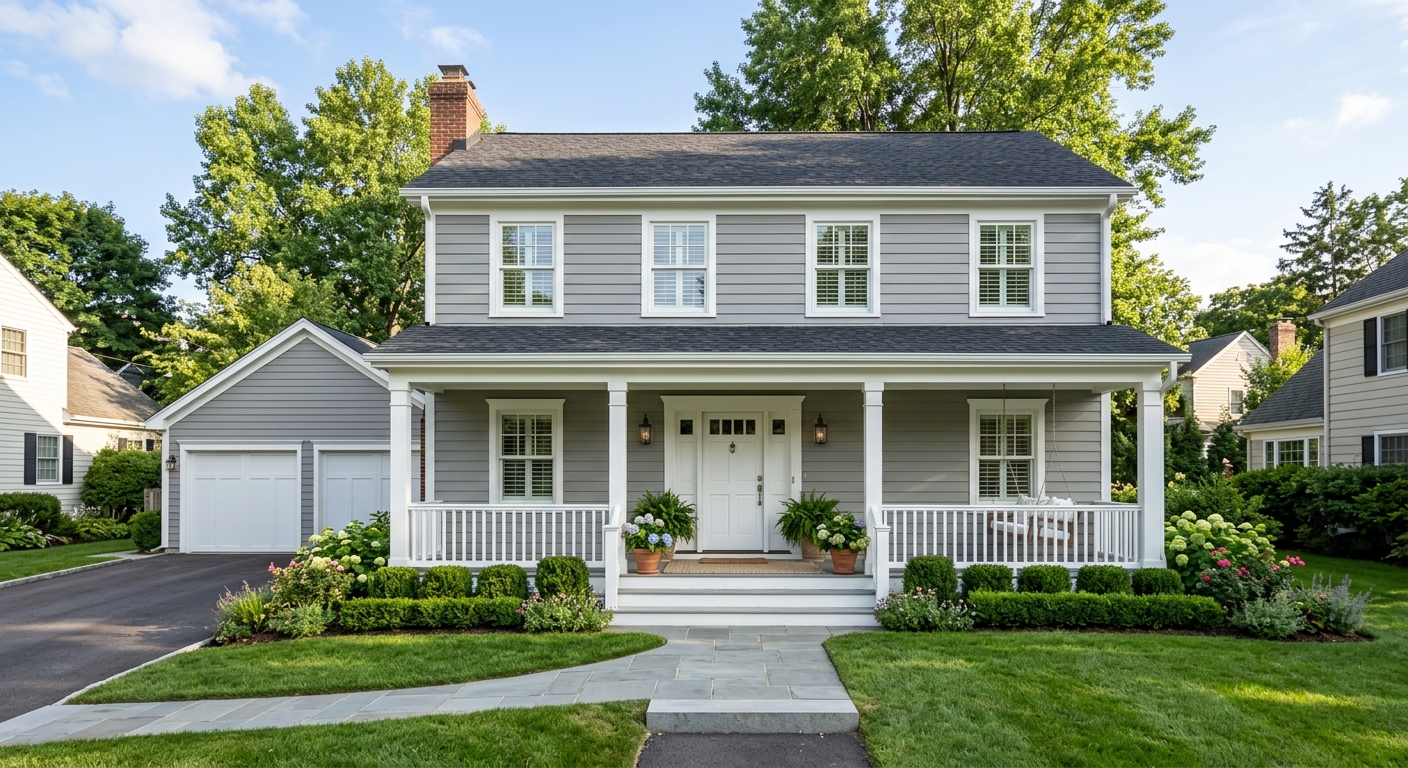
Painting options and costs in Innisfil
Innisfil homeowners often ask what their painting will cost, and the answer comes down to how much prep the surfaces need and how tight the exterior schedule is. With 90.5% of dwellings in the area being single-detached homes and 34.6% of homes built before 1981, many properties start with the “hard part” of repainting: scraping loose paint, sanding edges, patching small defects, and priming everything that won’t accept topcoat cleanly. That extra prep is why two quotes for the “same” exterior can still land 30–50% apart in the Kitchener–Waterloo–Barrie market.
In Kitchener–Waterloo–Barrie, the warm, dry exterior window is short—typically late May through early October—and contractors get booked up as soon as temperatures stabilize. On the interior side, work is steadier year-round, so pricing can be less volatile than exterior repainting. Innisfil’s Lake Simcoe area and surrounding growth corridors can also be particularly busy because homeowners tend to time improvements around spring-to-summer occupancy and cottage-season traffic, which increases scheduling demand for labour and materials.
Below are realistic budgeting ranges you can use when you request quotes. Use them to compare contractors fairly—especially the “what’s included” line items, because prep and number of coats can make the biggest difference in durability.
| Service |
What's Included |
Typical Duration |
Price Range |
| Interior — whole home (walls, ceilings, trim) |
Protect floors and fixtures, patch/sand minor defects, prime where needed, cut-in and roll, repaint walls and ceilings, paint trim/doors as scoped, clean-up and light touch-ups |
5–10 days |
$4,200–$7,800 |
| Interior — per room (standard bedroom or living room) |
Prep and masking, patch/sand minor defects, prime stained/soft spots as needed, 2 coats walls, 1–2 coats trim depending on condition |
1–2 days |
$2,500–$4,200 |
| Exterior — full house (siding, trim, soffits) |
Wash/degrease where required, scrape/sand peeling areas, caulk gaps/penetrations, spot prime bare substrate, 2-coat exterior system, paint trim/soffits, manage weather timing and clean-up |
7–15 days |
$5,500–$9,000 |
| Exterior — trim and accent colours only |
Surface prep focused on trim areas, scrape/sand loose coating, caulk as required, prime bare spots, 2 coats trim/accent, exclude full siding repaint unless noted |
3–7 days |
$2,500–$5,200 |
| Kitchen cabinet painting (doors, frames, spray finish) |
Degrease, remove/label doors as feasible, sand and degloss, prime with cabinet-grade primer, spray doors (and frames if scoped), hardware re-install, light finishing clean-up |
5–12 days (with cure time) |
$2,100–$4,500 |
| Specialty / faux finish (accent wall, texture) |
Surface prep for texture level, basecoat + decorative system, protective topcoat as needed, blending at edges, cleanup |
1–4 days |
$800–$2,800 |
Prices are estimates only and vary by project scope, site access and material selection.
What affects the price of painting in Innisfil
Innisfil painting quotes can vary by 30–50% for the same “room count” or exterior elevation because contractors price for risk: surface condition, weather certainty, and how much labour is actually required to make paint last. In the Kitchener–Waterloo–Barrie region, exterior work is compressed into a late-spring to early-fall window, so pricing tends to rise when temperatures are stable and surfaces stay dry. If your siding or trim is already failing (peeling, chalking, or blistering), the job shifts from “painting” to “restoration,” and prep can consume more time than the finish coats.
Older housing stock affects cost in practical dollars. With 34.6% of homes built before 1981 (Statistics Canada, 2021 Census), it’s common to encounter coatings that need careful scraping and sanding before new paint will bond. In repainting, surface prep is often 50–70% of labour on an exterior job—especially caulking, priming bare wood/fibre cement, and evening out edges where previous layers have failed.
Two concrete Innisfil examples: (1) a two-storey home with eaves and multi-level trim usually requires lifts/scaffolding time; that can push an exterior project from roughly the $2,500–$9,000 band toward the higher end. (2) if you have cedar or previously stained surfaces, primer selection and surface degloss steps can add labour even when the square footage is modest.
On the interior side, adding ceilings and trim can quickly move a whole-home job from the lower end of typical interior ranges up toward the $2,500–$7,000 interior backbone. The “best value” isn’t always the cheapest paint—it’s the right system, applied after the right prep.
| Price Factor |
Why It Matters |
Cost Impact |
| Surface prep — scraping, sanding, patching drywall or wood |
Bond depends on what’s underneath; loose coating and defects must be removed or stabilized |
Adds roughly 20–60% of labour on repaints; can swing total by $1,000s |
| Number of coats — 2-coat system over primer vs. 1 coat over existing |
Sheen and hiding improve durability and uniform appearance; skipping coats usually shortens lifespan |
Typically +$300–$1,200 depending on scope and colour change |
| Paint quality tier — contractor-grade vs. premium (Benjamin Moore, Sherwin) |
Higher-tier coatings often cover better and resist scuffing/fading |
Materials can differ by ~10–25%; labour may also reduce due to coverage |
| Ceilings and trim — adds significant time vs. walls-only |
Ceilings require more setup and careful cutting; trim needs extra masking and crisp edges |
Can add $500–$2,000+ for typical living-area work |
| Exterior season window — short season raises summer rates |
Weather delays and tight scheduling increase overhead during peak months |
Can raise exterior labour by $500–$2,500 when timelines compress |
| Lead-safe precautions — required for pre-1978 homes with lead paint |
Proper containment, wet methods, HEPA vacuuming and disposal reduce exposure risk |
Usually adds $300–$1,500 depending on scope and condition |
| Surface material — drywall vs. plaster vs. wood vs. stucco |
Different surfaces need different primers and abrasion/defect repair approaches |
Can change primer type and prep time; often $200–$1,800+ |
| Height and access — multi-storey exterior requires scaffolding or lifts |
Access equipment increases setup and labour time |
Often $400–$2,000+ depending on elevations and obstacles |
Permits & regulations in Ontario
In Ontario, painting generally does not require a permit for typical interior or exterior repainting. However, homes built before 1978 are where homeowners should be extra cautious: health guidelines recommend testing for lead paint before sanding or scraping, and using lead-safe work practices if lead is present. For professional crews, lead-safe precautions typically include wet methods to reduce dust, HEPA vacuuming, controlled containment where needed, and proper disposal. This is not usually a “permit step,” but it is standard practice for contractors because it protects you, occupants, and workers.
Beyond lead considerations, you should verify insurance and coverage. A reputable painting contractor should carry liability insurance and have workers’ compensation coverage (WSIB/WCB) for their employees. Ask for current proof before work begins—ideally attached to your quote or provided directly on request.
When you sign a contract, make sure it spells out: the paint brand and product line, the sheen (for interiors), number of coats, prep responsibilities (including what gets primed), and any exclusions like major drywall replacement or sealed/treated surfaces. Confirm whether disposal of debris is included and whether there’s a requirement to protect landscaping and outdoor fixtures.
To verify: (1) check the contractor’s online business listing/registry presence, (2) request a certificate of insurance for liability and confirm the policy is current, (3) ask for WSIB/WCB proof or clearance information, (4) ensure the signed scope matches the written quote, including the surface prep plan.
Interior vs exterior painting — getting the best result in Innisfil
In Innisfil, the biggest cause of “early failure” isn’t usually the paint brand—it’s skipping prep, using the wrong sheen, or painting when conditions won’t support proper adhesion and drying. For interiors, surface prep wins. Filling dents and patching, sanding glossy spots dull, and priming repaired areas properly creates a uniform surface so the topcoat can bond and hide. Sheen also matters: flat/eggshell works well on many walls for hiding, while satin or semi-gloss is typically better for higher-touch areas like trim, doors, and kitchens. In practice, two coats over a suitable primer will nearly always outperform one heavy coat over unprepared substrate—because the second coat “locks in” colour and reduces thin spots that show wear.
For exteriors, prep is even more critical in Ontario’s freeze-thaw reality and seasonal drying patterns. Start with thorough cleaning, then scrape peeling areas, sand edges feather-smooth, and caulk before paint where gaps and penetrations allow water ingress. Primer choice matters: different substrates (wood, fibre cement, previously stained surfaces) call for different primers so the topcoat can grip and remain flexible. During Ontario’s short warm weather painting window (late May to early October), contractors time application so surfaces are dry and temperatures support curing; this reduces the risk of early blistering or adhesion issues.
Cabinet painting is a solid alternative to replacement when the boxes and hinges are in good shape. For example, if your kitchen refresh is purely aesthetic, cabinet painting commonly lands in the cabinet band (about $1,200–$4,500). If cabinets are structurally damaged or sagging, replacement may be the only true fix—even if it’s pricier.
For pre-1978 homes, lead-safe precautions should be part of the plan before sanding/scraping. That’s both a safety decision and a quality decision: the right containment and dust control helps keep surfaces clean and ready for primer.
| Project Type |
Key Prep Step |
Recommended Coats |
Price Band |
| Interior — fresh drywall (new construction) |
Prime bare drywall evenly and spot-seal patches before finish |
2 coats finish over primer |
$2,500–$5,200 |
| Interior — repaint (good condition, no repairs) |
Wash/degloss lightly and touch up minor scuffs; full-room masking |
2 coats finish (typically no heavy primer beyond problem spots) |
$2,500–$4,200 |
| Interior — repaint (patching and priming needed) |
Sand feather edges and prime repairs so they match the surrounding wall |
2 coats finish plus primer on all repairs/stains |
$3,000–$6,500 |
| Exterior siding (wood or fibre cement) |
Scrape peeling areas, caulk gaps, and prime bare substrate before topcoats |
2 coats exterior system over primer |
$5,500–$9,000 |
| Exterior trim and accents only |
Feather-sand and prime exposed edges; caulk trim joints |
2 coats trim over spot primer |
$2,500–$5,200 |
| Kitchen cabinets (spray finish) |
Degrease thoroughly, degloss, prime for adhesion, and spray doors for an even film |
Primer + 2 coats (per finish system) |
$2,100–$4,500 |
How to choose a painting contractor in Innisfil
Choosing the right contractor in Innisfil is mostly about verification and clarity. Start with Ontario compliance and protection: ask for the contractor’s WSIB/WCB coverage proof (for employees) and their liability insurance certificate. To check each, request the certificate of insurance directly—verify the policy is active, the coverage amount is appropriate, and the business name matches the quote. For WSIB/WCB, ask for the clearance documentation or proof they’re registered and covered for the work. If they can’t provide either, treat that as a stop sign.
Next, get 2–3 itemised written quotes—not one lump-sum number. You want a breakdown of labour hours, prep steps (scraping/sanding/priming/caulking), number of coats, and line items for materials. Ask whether window/door caulking, sealing of eaves/trim seams, and disposal are included. Confirm whether the quote assumes a permit (normally not for standard painting in Ontario) or if any special exclusions apply.
Warranty matters too. Look for a workmanship warranty length in writing and clarify whether product/manufacturer warranties are included or only apply under certain conditions. Also ask whether any warranty is transferable if you sell the home.
For payment schedule, never accept heavy upfront payments. In practical terms, keep deposits to around 10–15%, and hold back the remainder until completion and clean-up are verified. Get a start date and completion estimate in writing, especially for exterior work where weather can affect scheduling.
- Request proof of liability insurance (certificate) before work starts.
- Request WSIB/WCB coverage proof for employees.
- Confirm the quote includes surface prep (scrape/sand/prime/caulk) and not just paint supply.
- Ask for the exact paint line/brand and sheen level for interiors.
- Confirm number of coats and primer responsibilities by surface type.
- Check whether disposal of peeling paint and sanding debris is included.
- Ask how they protect landscaping, walkways and windows during exterior work.
- Confirm lead-safe approach for pre-1978 homes if sanding/scraping is required.
- Verify warranty terms: workmanship duration and what it covers.
- Require an itemised quote with labour + materials, not only a final total.
- Set a clear payment schedule: keep upfront to 10–15% and hold back until completion.
- Get the start date and an estimated completion window in writing.
In my experience in Innisfil, common red flags include: (1) “We’ll just do one coat” after minimal prep, (2) no proof of WSIB/WCB and liability insurance, (3) a quote that omits caulking and priming responsibilities, (4) vague warranty language (no duration/coverage details), and (5) asking for large deposits upfront or refusing a written scope.
Frequently asked questions — painting in Innisfil
How long does exterior paint last here?
In Innisfil and the broader Kitchener–Waterloo–Barrie area, exterior paint longevity is strongly tied to prep and weather timing. When prep is thorough (scraping loose coating, feather-sanding edges, caulking gaps, and priming bare substrate), many homeowners see roughly 5–10 years before noticeable failure. If a repaint skips those steps—or if surfaces are coated right before a wet spell—adhesion problems can appear sooner, especially on trim and areas that trap moisture. With older housing stock (Statistics Canada, 2021 Census), you’ll often have more peeling history and more edge conditions, which is why durable systems often cost more up front but reduce repeat work. If your quote is in the exterior range (for example, $5,500–$9,000 for a full house), the higher end typically reflects that extra prep.
Should I paint or replace my cabinets?
For many Innisfil kitchens, painting is the better first move when cabinet boxes are solid and doors/drawers align properly. Cabinet painting focuses on cost-effective refresh: doors are degreased, sanded/deglossed, primed for adhesion, and finished with a sprayed system for a smoother look than brushing. If the boxes are warped, hinges are loose beyond adjustment, or the wood is swollen from long-term moisture, replacement may be more cost-efficient than repainting because the paint won’t fix structural problems. A typical cabinet paint budget often lands in the cabinet painting band (about $1,200–$4,500 depending on size, prep needs, and whether frames are included). For pre-1978 homes, ask whether your contractor uses lead-safe practices if any sanding/scraping disturbs suspect coating.
How do I prep walls before painting?
Good wall prep in Ontario is mostly about making the surface stable and uniform. If you’re doing light prep yourself in Innisfil, start by cleaning: remove grease and dust with a degreaser or mild cleaner, then let it dry fully. Patch holes and cracks with a proper filler, and sand until smooth and flush; wipe away dust after sanding. If you have shiny spots from previous paint, lightly scuff-sand so new paint can grip. Prime only what needs it—stains, repaired areas, and problem spots usually require primer for adhesion and stain blocking. Many “cheap” repaints fail because primer wasn’t used where it mattered, or because sanding dust remained. In most repaint scopes, we plan on at least minor patching and priming where needed, then 2 coats for even coverage.
Do I need to worry about lead paint in an older Innisfil home?
If your Innisfil home was built before 1978, it’s wise to take lead risk seriously. Ontario doesn’t typically require a permit for painting, but lead-safe work practices are recommended when sanding or scraping could create dust if lead-based paint is present. A responsible contractor will test or assume risk and use controls such as wet methods to reduce dust, HEPA vacuuming, containment practices when appropriate, and correct disposal. Even though lead-safety is not usually a “homeowner permit” requirement, it’s a standard quality and safety approach. With 34.6% of homes built before 1981 (Statistics Canada, 2021 Census), you’re not alone—many repaint projects in this area include the extra time/cost for lead-safe precautions. That added step may move your job upward within typical exterior or interior bands.
How long does it take to paint a house?
Timelines vary by prep complexity, coat count, and access, and in Innisfil exterior work is more weather-dependent than interior. For interior, a single room repaint is often 1–2 days of active work, while whole-home projects usually take 5–10 days depending on how many repairs are needed and whether ceilings and trim are included. Exterior full-house work often takes 7–15 days of labour time, but the calendar can stretch due to rain risk and temperature needs for proper drying and curing. In Ontario, contractors typically plan application during the late May to early October window when surfaces can dry well. Your quote’s “schedule” should include prep days, coat days, and dry/cure time. If someone promises a one-week exterior repaint regardless of prep, ask what’s excluded.
What's the difference between paint quality tiers?
Paint quality tiers mostly affect coverage, durability, and how the coating performs on real surfaces. Higher-tier coatings often hide better, resist scuffs and colour fade longer, and can be easier to apply evenly—so you’re less likely to need extra touch-ups or to see patch lines after curing. In practical terms for Innisfil homes, the difference is usually felt in prep-to-finish transitions: if prep is solid, better materials help the finish look uniform and stay that way. For homeowners comparing quotes, the same scope might land at different totals in the interior band (for example, $2,500–$7,000) because one includes premium coatings while another uses a lower tier that may require more coats or more careful blending. A strong contractor should explain the product line, sheen choices, and how the system matches your substrate and traffic level (walls vs. trim vs. kitchens).