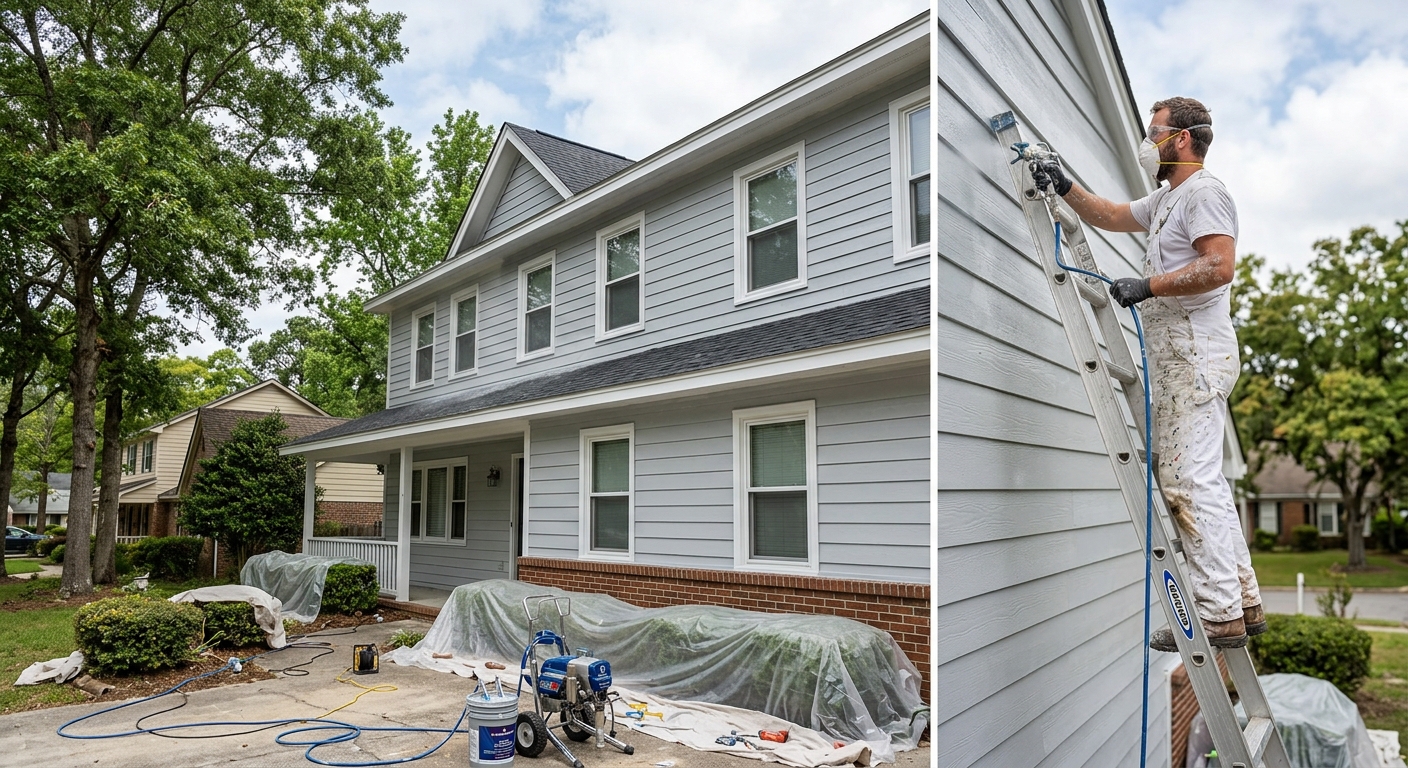
Painting options and costs in Burford
Burford homeowners typically have a few proven paths for both interior and exterior work, but the “right” option depends on how much prep your home needs and how soon you can schedule. Burford’s population is small (1,615 residents), which means local crews can be booked quickly when the season window opens. Many neighbourhoods also include older housing stock—when a home has seen multiple decades of paint layers, expect more scraping, caulking and priming, and in pre-1978 homes, professionals often follow lead-safe work practices before sanding.
In the Greater Toronto Area, exterior painting is tightly climate-dependent. Contractors generally target late May through June and again September to mid-October when temperatures stay above about 10°C for 24–48 hours and humidity is moderate enough for proper adhesion and curing. During peak June–August demand, pricing commonly rises about 10–15% due to scheduling pressure. That’s why two quotes that look similar on paper can land far apart—one may assume “ideal” weather access, while another includes extra labour for prep, patching and rework around rain or humid spikes.
In Burford’s Silver Springs area and surrounding residential pockets, exterior refresh jobs are especially common because homeowners often aim to get curb appeal back ahead of summer use. For many households, the best starting point is to compare typical scopes and budgets, then confirm what’s included in surface prep before you choose a contractor. Use the ranges below as your baseline when you move into the comparison table.
| Service |
What's Included |
Typical Duration |
Price Range |
| Interior — whole home (walls, ceilings, trim) |
Masking, patching and sanding as needed, prime where required, 2-coat paint system, caulking around trim, basic clean-up and dust control |
5–10 days |
$2,000 – $6,000 |
| Interior — per room (standard bedroom or living room) |
Preparation, 2-coat coverage on walls, light trim touch-ups (not full re-trim unless stated), ceiling spot work as needed |
1–3 days |
$400 – $1,200 |
| Exterior — full house (siding, trim, soffits) |
Power wash, scrape/sand failing coating, caulking, stain/primer where needed, 2-coat exterior system, spot repairs and final clean-up |
1.5–3 weeks |
$4,000 – $8,000 |
| Exterior — trim and accent colours only |
Surface prep on trim areas, caulking at seams, primer where required, 2-coat finish, protective coverings for lower elevations |
5–10 days |
$1,500 – $3,500 |
| Kitchen cabinet painting (doors, frames, spray finish) |
Hardware removal, deep degrease, sanding/deglossing, bonding primer, spray finish coats, re-install and light touch-up |
6–12 days |
$1,200 – $4,000 |
| Specialty / faux finish (accent wall, texture) |
Surface smoothing/patching to acceptance level, primer, base colour and specialty application, protective topcoat |
2–6 days |
$600 – $2,500 |
Prices are estimates only and vary by project scope, site access and material selection.
What affects the price of painting in Burford
In Burford and across the Toronto employment corridor, it’s common to see the “same” painting job priced 30–50% apart. The difference usually isn’t the paint itself—it’s prep time, coating system decisions, access constraints and how weather impacts scheduling on exteriors. Two crews can both say “two coats,” but one may include proper primer bonding on bare spots and thoroughly caulked transitions, while another assumes existing surfaces will behave the same after washing and drying.
Exterior work is where the biggest swings happen. In Ontario’s GTA region, the exterior painting season typically runs late May to early October, when temperatures are above about 10°C and rising during application. That short ideal window creates labour bottlenecks; when crews are fully booked in June–August, pricing often moves into the upper end of the exterior band (around $1,500 – $8,000) to secure dates. Unlike coastal BC—where mildew resistance and prolonged dampness drive product choices—the GTA’s main constraints are rain, frost risk and humidity spikes. Those conditions translate to more drying time, more rescheduling and sometimes additional coats if adhesion is compromised.
Older homes in the area (including many pre-1980 properties) increase labour: more scraping, caulking, patching, and priming. Preparation can be 50–70% of total labour on a repaint. In practical terms, a trim-and-accent project can land closer to $1,500 – $3,500 when surfaces are mostly sound, but it can jump toward the higher exterior band if rot repair, extensive sanding, or lead-safe handling is required on older trim details.
In Burford, cost may rise when a home has hard-to-reach soffits, multiple paint layers, or previous failing coatings that need full removal. Costs can lower when your siding is newer, caulk lines are intact, and your home sits in a straightforward access layout with minimal scaffolding needs.
| Price Factor |
Why It Matters |
Cost Impact |
| Surface prep — scraping, sanding, patching drywall or wood |
Adhesion depends on stable, clean surfaces; failing coatings and damaged areas must be addressed before priming |
High (often the biggest driver) |
| Number of coats — 2-coat system over primer vs. 1 coat over existing |
True coverage and colour uniformity typically require a full 2-coat schedule, especially over repairs or dark-to-light changes |
Medium to high |
| Paint quality tier — contractor-grade vs. premium (Benjamin Moore, Sherwin) |
Premium lines often spread and level better and may improve hide and durability; cheap paint can increase recoat risk |
Low to medium |
| Ceilings and trim — adds significant time vs. walls-only |
Ceilings require cutting-in, protection, and careful prep; trim needs masking, sanding and caulking for crisp lines |
Medium |
| Exterior season window — short season raises summer rates |
More demand during late spring and early summer increases scheduling costs and may compress drying time buffers |
Medium to high |
| Lead-safe precautions — required for pre-1978 homes with lead paint |
Proper containment, wet methods, HEPA vacuuming and disposal procedures add labour and materials |
Medium to high (project-dependent) |
| Surface material — drywall vs. plaster vs. wood vs. stucco |
Different substrates need different primers and surface smoothing approaches for long-term adhesion |
Medium |
| Height and access — multi-storey exterior requires scaffolding or lifts |
Access tools, safety measures and protected staging add setup time |
Medium to high |
Permits & regulations in Ontario
For typical painting in Ontario, you generally do not need a permit. Painting work itself is not like structural modifications, electrical or plumbing. The main “regulatory” considerations for homeowners are safety practices and contractor credentials—not approvals. That said, if you plan to do sanding or scraping on a home built before 1978, health guidelines strongly recommend testing for lead paint and, if lead is present, following lead-safe work practices such as wet methods, HEPA vacuuming, and proper disposal of dust and debris. This is not automatically legally mandated for homeowners, but it’s standard professional practice because lead exposure risk is serious and can spread through fine dust.
Work that typically requires permits is not painting-related; it’s usually tied to changes like window/door replacement, structural repairs, or certain renovations that affect building systems. Painting remains “no-permit” in most residential scenarios.
For Burford, confirm your contractor is properly insured before they start. Here’s a homeowner-friendly sequence: (1) verify the contractor licence status using Ontario’s contractor registry tools available online, if applicable to their trade/business; (2) ask for a certificate of liability insurance showing adequate coverage for your project; and (3) request proof of WSIB (or WCB-equivalent workers’ compensation coverage for their workers). Then require a written contract that specifies the paint brand/line, sheen, number of coats, and the surface prep that’s included (scrape/sand extent, caulking, priming and clean-up).
Interior vs exterior painting — getting the best result in Burford
The difference between a long-lasting finish and a premature failure in Burford is usually prep quality and coating choices—not just the topcoat brand. For interiors, start with the substrate: filling dents, sanding properly, removing loose paint and priming patches is what prevents flashing or peeling later. Sheen selection matters for daily wear; for example, satin or eggshell is typically better in hallways and living rooms than flat paint, while flat can be appropriate for low-touch ceilings. In most cases, two coats over a proper primer lasts longer than one heavy coat because it reduces pinholes and improves uniform film build.
For exteriors, Ontario’s climate makes surface prep the non-negotiable step. Wash thoroughly, scrape and sand anything failing, and caulk before painting so water ingress points are sealed. Primer choice depends on substrate condition: oil-based or bonding primers may be needed for problematic areas, glossy surfaces, or stains bleeding through. The product system should also respect local conditions—while mildew-resistant formulations are essential in persistently damp climates like coastal BC, GTA projects focus more on durability through humidity spikes and rain, plus frost avoidance during curing. That’s why timing in late May–June and again September is so important.
Kitchen cabinets are a practical budget alternative to replacement: painting can refresh your kitchen without the disruption of new cabinetry. If your boxes and hardware are solid, cabinet painting often costs far less than replacement, but you still pay for preparation—degreasing, sanding/deglossing, priming and spray-quality finish steps. For pre-1978 homes, lead-safe precautions should be considered if trim work involves older paint systems.
Example: if full exterior painting is near the upper exterior range (up to about $8,000), an “accents only” approach might look like savings (often closer to $1,500 – $3,500), but it’s only justified when main surfaces are sound and caulking doesn’t show failure. When prep is already needed everywhere, doing the whole system usually delivers better long-term value.
| Project Type |
Key Prep Step |
Recommended Coats |
Price Band |
| Interior — fresh drywall (new construction) |
Seal and prime drywall to ensure uniform absorbency before colour |
2 coats colour (after primer), typically |
$1,200 – $4,500 |
| Interior — repaint (good condition, no repairs) |
Clean, lightly scuff-sand, caulk small gaps, spot-prime if needed |
2 coats |
$400 – $2,500 |
| Interior — repaint (patching and priming needed) |
Sand patches flush, spot-prime repaired areas to prevent flashing |
2 coats (with primer on repairs) |
$800 – $6,000 |
| Exterior siding (wood or fibre cement) |
Scrape failing coating, sand smooth, prime bare spots, caulk seams |
Primer where required + 2 coats exterior finish |
$4,000 – $8,000 |
| Exterior trim and accents only |
Remove loose paint, prep edges, caulk transition lines |
Primer where required + 2 coats finish |
$1,500 – $3,500 |
| Kitchen cabinets (spray finish) |
Deep degrease, sand/degloss, bonding primer for adhesion |
2–3 coats total system (primer + finish coats) |
$1,200 – $4,000 |
How to choose a painting contractor in Burford
Start by verifying the basics: licensing/registration (if your contractor is required to be registered for their business activity), liability insurance, and workers’ compensation coverage. In Ontario, you should ask for a certificate of liability insurance (proof the contractor has coverage for accidental damage to your property). Then request proof of WSIB coverage for workers who are paid to do the job—this protects you as a homeowner if there’s an on-site incident. For the paperwork, don’t accept screenshots; ask for current documents and confirm the names on the insurance match the company doing the work.
Next, get 2–3 itemised written quotes. You want a line-by-line scope that separates labour from materials where possible, and clearly lists prep tasks (scraping extent, sanding, patching, caulking, priming) rather than lumping it into a single “labour” number. Scope gaps are where cost surprises come from—ask: what’s excluded (window trim removal, rot repair, drywall patching beyond small holes, furniture moving), and what’s included (disposal, masking, power washing)? Ask whether permit pulls are included—painting usually doesn’t require one, but some related repairs or building envelope work may.
Confirm warranty terms: workmanship length, what defects are covered, and whether it’s tied to the job documentation. Product/manufacturer warranty is often different from workmanship warranty—make sure you understand which one you’re getting and whether it transfers if you sell the home.
Payment schedule matters. In Burford, a fair approach is no more than 10–15% upfront. Hold back the remainder until the job is complete and cleaned. Finally, require a written timeline with a start date and realistic completion estimate, especially for exterior work dependent on late-May to June weather.
- Request current certificate of liability insurance.
- Verify WSIB coverage for their workers (ask for proof).
- Ensure the quote lists prep steps: scraping/sanding, caulking, priming.
- Confirm number of coats and the paint line/sheens used.
- Ask about masking and protection for floors, landscaping and fixtures.
- Clarify disposal: paint waste, caulk tubes, sanding debris.
- Check how they handle repair work (drywall patching, wood rot/soft spots).
- Get the schedule in writing, including weather contingencies for exteriors.
- Confirm surface testing/lead-safe approach for pre-1978 homes if sanding is planned.
- Ask for a workmanship warranty and what “failure” means (peeling, blistering, flashing).
- Review the payment plan—limit deposits to 10–15% and hold back until completion.
- Ask for references from nearby Burford or nearby GTA neighbourhoods with similar scope.
Red flags to watch for in Burford: (1) quotes that skip prep details and only list “paint and labour,” (2) refusal to provide insurance/WSIB proof, (3) promises of guaranteed exterior results regardless of rain/humidity timing, (4) no written contract specifying coats/brands/prep, and (5) asking for large upfront payments (well above 10–15%) or demanding final payment before touch-ups.
Frequently asked questions — painting in Burford
What paint is best for Burford's climate?
For Burford (Ontario/GTA), the “best” choice depends on whether you’re painting interior or exterior and what you’re painting over. For exteriors, homeowners typically benefit from a dedicated exterior acrylic/latex system designed to handle humidity spikes and occasional rain during the late May–June and September–mid October window. The priority is a compatible primer plus proper caulking and adhesion on prepared surfaces—paint alone won’t overcome poor prep. For interiors, choose sheen based on room use: eggshell or satin in living areas tends to stand up better to cleaning than flat finishes. If you’re repainting and want a realistic budget, a standard interior repaint commonly lands in the $400 – $6,000 range depending on repairs and scope. (Statistics Canada, 2021 Census) also shows Burford’s small size, which can affect how quickly preferred product colours and timelines can be scheduled with local crews.
How long does exterior paint last here?
In Burford’s Ontario climate, exterior paint life depends heavily on surface prep, caulking, and timing during the curing window. When a contractor properly scrapes and primes bare or failing areas and you’re painting within late May–June or again September–mid October, a well-maintained repaint can often perform well for years—typically in the mid-range homeowners expect for quality systems. Premature failure usually comes from skipping bonding primer, painting over chalky/poor adhesion surfaces, or leaving gaps uncaulked where water can enter. Humidity and rain days in the GTA can also interrupt proper drying and adhesion, so crews sometimes adjust schedules when temperatures don’t stay above roughly 10°C for the application period. If your home needs major prep, the project may sit toward the higher exterior budget band (up to $1,500 – $8,000), but that’s often what justifies longevity rather than “saving” on topcoat-only work.
Should I paint or replace my cabinets?
If your cabinet boxes are structurally solid and the doors/frames are only dated or discoloured, painting is often the better value in Burford. Replacing cabinets is usually much more expensive because it involves demolition, new units, installation time, and often countertop adjustments. Cabinet painting, especially spray-style finishing, can dramatically refresh the look while keeping your existing layout. The deciding factor is condition: if your cabinets are sagging, swollen from moisture, or have major damage, replacement may be more cost-effective. If they’re in good shape, painting is a practical alternative that also avoids kitchen downtime beyond what’s needed for prep and curing. Expect pricing to land in the cabinet band of roughly $600 – $4,000, with the final number depending on door count, prep level (degrease, sanding/degloss, primer bonding) and whether hardware is updated. For pre-1978 homes, discuss lead-safe precautions if older coatings are being sanded or scraped.
How do I prep walls before painting?
For homeowners in Burford, good wall prep is mostly about quick cleaning and protecting your space—while the deeper prep (sanding and priming repairs) is where paint performance is won or lost. Before painting, remove wall decor, patch small holes with appropriate filler, and sand smooth once dry. Any glossy or flaking areas should be scuffed or scraped and then re-coated with primer on the repaired spots to prevent flashing. Clean surfaces to remove grease, dust and residue; wipe with a suitable degreaser where needed, then allow to dry fully. Caulking small gaps around trim improves the look and helps prevent future edge failures. If you’re dealing with older homes, especially those built before 1978, don’t assume you can dry-sand old trim paint safely—proceed cautiously and ask about lead-safe practices before sanding or scraping. A properly prepared interior repaint typically falls within the interior band (starting around $400 – $6,000), and the biggest differences between quotes come from how thoroughly repairs and priming are handled.
Do I need to worry about lead paint in an older Burford home?
If your Burford home is from the pre-1978 era, lead paint is a legitimate concern, particularly around trim, windows, railings and older painted surfaces that might be sanded or scraped during repainting. Ontario guidance and professional best practice recommend testing for lead paint before sanding and using lead-safe work practices if lead is present—wet methods to reduce dust, HEPA vacuuming, and proper disposal of materials. This is not automatically “homeowner mandatory” in the same way building permits work, but it’s standard for professional contractors because the exposure risk can be high. For homeowners, the practical approach is to ask your contractor whether they’ll test or assume precautions, how they’ll contain dust, and what cleanup method they use before work begins. The preparation requirements can change labour and budget, and that’s one reason exterior and trim projects on older homes can move toward the higher end of the price bands (for example, exterior work commonly ranges up to $1,500 – $8,000).
How long does it take to paint a house?
The timeline depends on interior vs exterior, the number of rooms or the façade size, access, and how much prep is needed. In Burford, interior projects can usually be scheduled year-round, and a typical room repaint may take 1–3 days, while a whole-home interior repaint often takes about 5–10 days depending on patching, ceilings, and trim detail. Exterior work is more weather-sensitive in the Toronto region. Contractors often aim for late May–June or September–mid October when temperatures stay above about 10°C and surfaces can cure after application. For a full exterior house repaint, expect roughly 1.5–3 weeks when you factor in prep, drying time, and coordination around rain/humidity. If you’re also dealing with peeling coatings or significant caulking work, it can extend longer. Budgeting matters too—many homeowners land in the middle of the exterior band (for example within $1,500 – $8,000) when scheduling and prep volume are realistic.