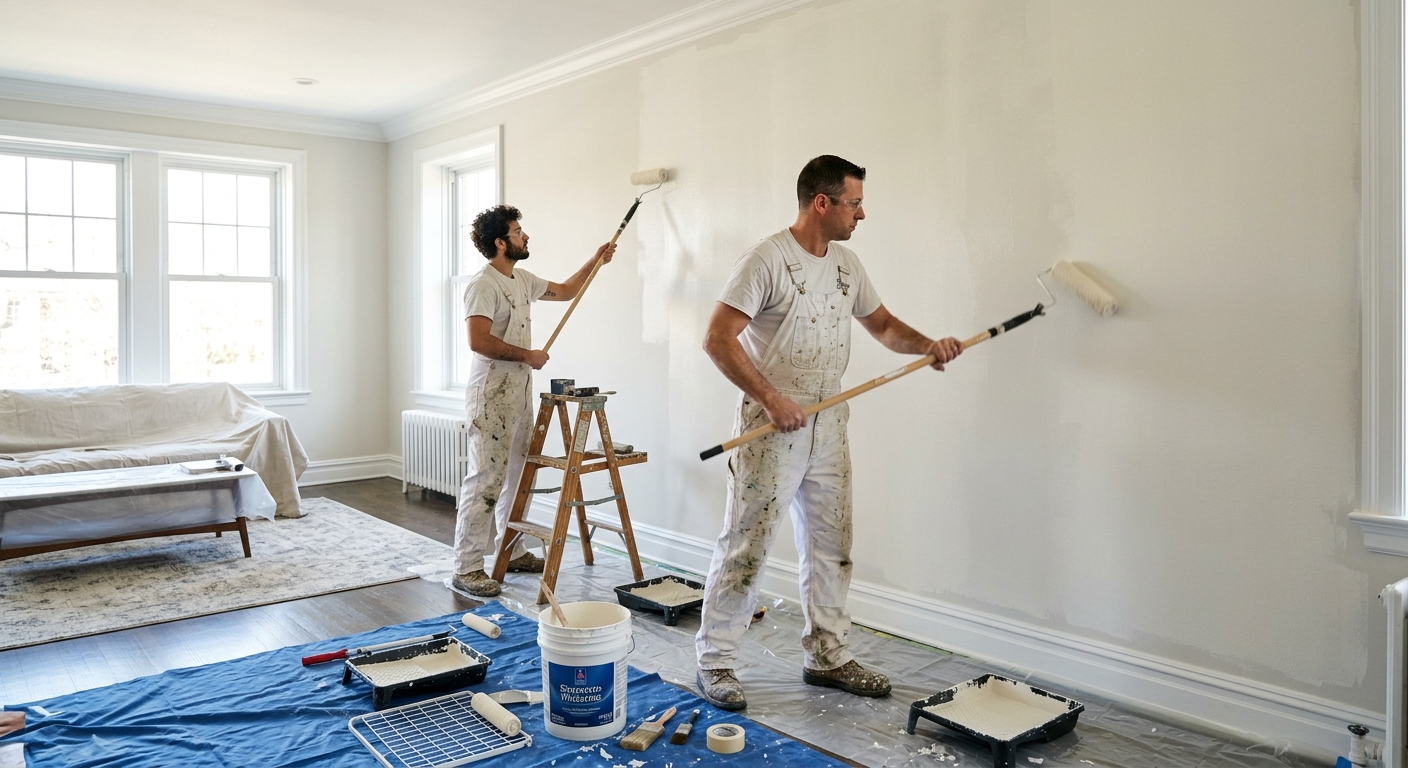
Painting options and costs in Brampton
Brampton homeowners often ask the same question: “What will painting cost here?” The answer depends on surface prep and the amount of time we can safely spend outdoors. In Brampton, a significant share of the housing stock is older—about 23.4% of homes were built before 1981 (Statistics Canada, 2021 Census). That matters because older trim, railings, windows and siding usually have multiple paint layers and more aged caulking to scrape out, re-caulk, sand and prime. On top of that, many of these homes are set up with more detailed edges and profiles, which increases labour time before we ever open a paint bucket.
Cost is also shaped by Toronto-area scheduling. In the GTA, exterior painting is tightly climate-dependent: most contractors can realistically work late May through June and again September to mid-October, when temperatures stay above about 10°C for proper adhesion and curing. Demand spikes during June to August because there are fewer truly “ideal” windows, so exterior quotes commonly land 10–15% higher than shoulder-season timing. Interiors are less weather-sensitive and can be scheduled year-round, but pricing still rises with ceiling height, stairwells, occupancy, and premium colour/finish choices.
In Brampton, I see especially strong repeat demand in older, mature pockets like the Brampton North / Steeles corridor, where many homes are due for refresh every 7–10 years. Once you know the options and what’s usually included, comparing bids becomes much easier—use the table below as your baseline.
| Service |
What's Included |
Typical Duration |
Price Range |
| Interior — whole home (walls, ceilings, trim) |
Prep, patching, sanding as needed, primer where required, two finish coats, basic protection/masking, caulking touch-ups |
3–10 days |
$1,800 – $6,000 |
| Interior — per room (standard bedroom or living room) |
Move/cover light items, prep and sand, spot prime, two finish coats, cut-in at ceilings/trim |
1–3 days |
$400 – $1,500 |
| Exterior — full house (siding, trim, soffits) |
Scrape/sand, caulk and prime where needed, two-coat exterior system on siding/trim, protection, surface cleaning |
5–14 days |
$3,500 – $8,000 |
| Exterior — trim and accent colours only |
Focused prep on trim lines, caulking touch-ups, spot priming, two coats on designated areas |
2–7 days |
$1,500 – $4,500 |
| Kitchen cabinet painting (doors, frames, spray finish) |
Detailed hardware removal, degreasing, sanding profile, primer and spray finish, new hinges/handles handling as needed |
5–12 days (including dry/cure time) |
$1,400 – $4,000 |
| Specialty / faux finish (accent wall, texture) |
Surface smoothing where required, primer compatible with texture, specialized application, topcoat/seal where needed |
1–5 days |
$600 – $5,000 |
Prices are estimates only and vary by project scope, site access and material selection.
What affects the price of painting in Brampton
In Brampton and the wider Toronto market, two bids for what sounds like the same job can differ by 30–50%. That gap usually comes down to preparation quality, coating systems, and how contractors price risk around weather and access—especially for exteriors. Interior work is more flexible, but labour still swings with how much patching, sanding, and trim detailing is required. For exteriors, the season itself is a pricing lever: in the Toronto region, exterior work is commonly scheduled from late May to early October when temperatures are above about 10°C and rising during application. Toronto-area summers don’t have the coastal “always damp” problem BC homeowners see, but we do get rain and humidity spikes that can slow drying and increase rework risk. Because the ideal window is short, peak summer demand often pushes exterior rates roughly 10–15% higher during June to August, compared to shoulder periods.
Older homes throughout the region—about 23.4% built before 1981 (Statistics Canada, 2021 Census)—also raise prep costs. On repaints, surface prep can run 50–70% of total labour: scraping failing areas, sanding glossy surfaces, removing loose material, patching failing wood/patchwork, caulking, and priming spots that need adhesion help. In Brampton, even a “trim-only” job can become labour-heavy if caulking is cracked along window frames or if prior layers are thick and uneven.
Here are a few concrete ways local conditions raise or lower your final number. Example one: if the siding has peeling paint, exterior prep can push a job from the interior-like “refresh” mentality into full exterior-system pricing, commonly in the $1,500 – $8,000 band depending on scope. Example two: good accessibility (no scaffolding and easy driveway access) can keep you closer to the lower end of exterior trim jobs; difficult access tends to add lift/scaffold time.
Finally, paint tier matters, but prep matters more. Upgrading coatings can be worth it when you’re spanning the higher end of the $400 – $6,000 interior range, especially in high-traffic areas, but cutting corners on caulking and primer is the quickest route to premature failures.
| Price Factor |
Why It Matters |
Cost Impact |
| Surface prep — scraping, sanding, patching drywall or wood |
Adhesion depends on clean, sound substrate; failures here show through fast. |
Often 20%–50% of total labour cost |
| Number of coats — 2-coat system over primer vs. 1 coat over existing |
Coverage and durability depend on uniform film build. |
Can change price by 10%–25% |
| Paint quality tier — contractor-grade vs. premium (Benjamin Moore, Sherwin) |
Premium lines typically cover better and hold colour/cleanability longer. |
Materials may shift 5%–20% of total |
| Ceilings and trim — adds significant time vs. walls-only |
Cut-ins, masking, and detailed work require more labour and slower pacing. |
Commonly adds 15%–35% |
| Exterior season window — short season raises summer rates |
Scheduling pressure reduces “flex time” for rain delays and curing gaps. |
Often 10%–15% higher in peak weeks |
| Lead-safe precautions — required for pre-1978 homes with lead paint |
Professional contractors use containment and HEPA cleanup if lead is present. |
Can add 5%–25% depending on conditions |
| Surface material — drywall vs. plaster vs. wood vs. stucco |
Different substrates need different primers and repair approach. |
Can add 10%–30% |
| Height and access — multi-storey exterior requires scaffolding or lifts |
Access equipment increases labour time, safety setup and protection. |
Often 10%–40% for larger/complex exteriors |
Permits & regulations in Ontario
In Ontario, painting typically does not require a permit for normal residential interior or exterior work—wall/trim repainting is generally treated as a maintenance activity. Where regulation matters is in health and safety practices, not “permit paperwork.” For homes built before 1978, health guidelines recommend testing for lead paint before sanding or scraping, and using lead-safe work practices if lead is present. Professional teams may use wet methods to control dust, HEPA vacuuming, and proper bagging/disposal procedures to reduce risk. While this isn’t automatically mandated for homeowners, it’s standard practice for professional contractors because older Brampton properties often contain lead in trim, windows and railings.
Before you sign, confirm the contractor carries liability insurance and WSIB/WCB workers’ compensation coverage. Then request a written contract that clearly states the paint brand/line (or equivalent approved product), sheen selections, the number of coats, and the exact surface prep that’s included (for example: caulking, scraping to sound material, spot-priming, drywall patching). Also confirm how disposal is handled.
How to verify coverage step-by-step: (1) look for a WSIB/WCB clearance confirmation or coverage document in their proposal package; (2) request a certificate of insurance showing the contractor’s liability coverage; (3) ask who will be on site (not subcontractors without coverage); and (4) make sure the contract includes the prep/paint scope so you’re not paying later for “discovered” repairs.
Note: the specific Ontario licensing requirements vary by trade and scope, so if the contractor is performing work beyond painting (for example, structural repair or specialized remediation), ask for the appropriate licensing and documentation before they start.
Interior vs exterior painting — getting the best result in Brampton
Brampton’s climate is why “looks good on day one” isn’t enough. For interior work, the biggest drivers of long-lasting results are surface prep, correct sanding, and priming where needed—not just paint brand. Patch properly, sand smooth, remove dust, then prime stains, watermarks, and new repairs before topcoating. Sheen selection matters too: flat/eggshell styles can work for lower-traffic ceiling areas, while satin or eggshell on walls tends to clean better in family rooms and hallways. In practical terms, two coats over a proper primer system usually outlasts a single heavy coat because it builds an even film and improves stain resistance and colour consistency.
For exteriors, prep is even more critical because Ontario weather cycles stress coatings. Scrape and clean to a sound surface, caulk cracks before painting (so you’re sealing water paths first), and use primer appropriate for the substrate—latex primers for many modern substrates, and oil-based or specialty primers when adhesion requires it. In the GTA, we don’t need mildew-first formulations like coastal BC, but we still manage humidity and rain risk with better timing. The coatings need to cure while temperatures remain suitable (above about 10°C for application conditions and adequate drying time).
Cabinet painting is a common budget alternative to replacement. In many Brampton kitchens, a spray-finish cabinet job in the $1,400 – $4,000 range can be worth it when boxes are solid and doors/frames are structurally sound. If your cabinets have chronic moisture damage or delamination, replacement can cost more upfront but save money in the long run. For pre-1978 homes, use lead-safe precautions before scraping—this is a prep-and-safety cost, but it prevents hazardous dust handling issues.
Dollar example: If your living/dining repaint is priced near the lower part of the $400 – $6,000 interior band, spending extra on primer for stained patches can save you from a repeat coat later. For exteriors, skipping caulking and primer to “get it done faster” is exactly the kind of short-term saving that leads to peeling and repainting sooner, especially through Ontario’s freeze–thaw season.
| Project Type |
Key Prep Step |
Recommended Coats |
Price Band |
| Interior — fresh drywall (new construction) |
Sealer/primer for drywall absorption + sanding between coats |
1 primer + 2 finish coats |
$600 – $3,000 |
| Interior — repaint (good condition, no repairs) |
Light scuff-sand/clean + spot-prime as needed |
1–2 finish coats (often 2) over spot primer |
$400 – $1,800 |
| Interior — repaint (patching and priming needed) |
Patch + sand smooth, then prime repairs and any stains |
1 primer + 2 finish coats |
$800 – $2,800 |
| Exterior siding (wood or fibre cement) |
Scrape to sound material, caulk, clean, prime bare/spot areas |
1 primer system + 2 exterior finish coats |
$3,500 – $8,000 |
| Exterior trim and accents only |
Detail prep along trim edges + caulking and spot priming |
Spot prime + 2 finish coats |
$1,500 – $4,500 |
| Kitchen cabinets (spray finish) |
Degrease + sand for adhesion, prime compatible with topcoat |
1 primer + 2 topcoats (or system-equivalent) |
$1,400 – $4,000 |
How to choose a painting contractor in Brampton
Choosing a painter in Brampton is mostly about verifying risk control: coverage, scope clarity, and quality systems. Start with insurance and workers’ compensation documentation. Ask for a certificate of insurance showing liability coverage, and proof of WSIB/WCB coverage (or a clearance confirmation) for the individuals working on your site. If they cannot provide documents, don’t proceed—Ontario homeowners shouldn’t be the backstop for workplace injuries.
Next, collect 2–3 itemised written quotes. You want line items that separate labour, materials, and allowances, not a single lump sum. The best quotes list surface prep activities (scraping/sanding/patching), caulking scope, primer inclusion, the number of coats, paint brands/lines or equivalent approved products, and how they protect landscaping/windows/floors. For exterior projects, ask whether the quote includes cleaning and disposal, and whether they’ll adjust scheduling around rain/humidity windows.
Warranty matters, too: confirm the workmanship warranty length (and what it covers—peeling, adhesion failures, prep deficiencies) and whether product/manufacturer warranties require specific application procedures. Payment schedules should be modest: never pay more than 10–15% upfront, and hold back a portion until the job is complete and touch-ups are done. Finally, get a start date and completion estimate in writing, with weather-related contingency language for exterior work.
- Ask for proof of liability insurance and WSIB/WCB coverage before booking.
- Request an itemised quote (labour, materials, primer, caulking, disposal) not a lump sum.
- Confirm the exact paint line/brand and sheen for walls, ceilings, and trim.
- Make sure the scope lists prep: sanding level, scraping to sound surfaces, patching method.
- For exteriors, confirm caulking is included along window/trim joints before painting.
- Ask whether they do surface cleaning (and what they use) before coating.
- Check how they handle lead-safe precautions for pre-1978 trim/railings.
- Clarify protection: drop cloths, masking, and cleanup standards at end of each day.
- Confirm number of coats and whether a primer is included where required.
- Review warranty: workmanship length, exclusions, and claim process.
- Verify payment schedule (10–15% max upfront; holdback until completion).
- Get an in-writing timeline with weather contingencies for exterior painting.
Red flags I see with some Brampton painting contractors: vague scope (“includes painting only” with no prep detail), refusal to provide insurance/WSIB documentation, quotes priced far below typical bands (often signalling reduced prep or fewer coats), asking for large upfront payments, and no written warranty or no clear paint system (primer/coats) listed in the contract.
Frequently asked questions — painting in Brampton
Should I paint or replace my cabinets?
In Brampton, painting cabinets is usually the better choice when the cabinet boxes are solid (no sagging, delamination, or widespread water damage). If the doors/frames are structurally fine, a professionally prepared spray-finish can deliver a major refresh for a fraction of replacement costs—commonly in the $1,400 – $4,000 range depending on door count, finish level, and prep needs. Replacement becomes more cost-effective if your existing cabinets have persistent moisture issues, heavy structural warping, or if you want to change layout/box sizes. Also consider downtime: cabinet painting means a working kitchen setup for about a week or so, while replacement can be longer. For pre-1978 homes, painters should plan for lead-safe precautions if sanding/scraping is needed on older trim near cabinets.
How do I prep walls before painting?
For homeowner prep, the goal is to reduce prep labour time, not “skip the work.” Remove wall items, patch obvious holes, and wash areas that feel greasy (kitchen/dining) so paint can adhere. After patching, let compound fully cure, then lightly sand until smooth and wipe dust clean. If you’re repainting over glossy paint, a scuff-sand helps—otherwise adhesion can fail. For stained areas or water marks, don’t just paint over; stains often bleed through unless primed. In Brampton, especially with older homes (23.4% built before 1981, Statistics Canada, 2021 Census), prep can be more complicated due to layered paint and caulk lines. A professional contractor typically includes cleaning, sanding/patching, spot-priming, and two finish coats based on what’s discovered during prep.
Do I need to worry about lead paint in an older Brampton home?
If your Brampton home was built before 1978, you should treat sanding and scraping as a lead-safety question. Health guidelines recommend testing for lead before disturbing surfaces and using lead-safe methods if lead is present—wet methods to control dust, HEPA vacuuming, and proper disposal procedures are common professional practices. Homeowners aren’t always legally required to follow the same lead-safe protocols, but professional contractors do because the risk is real. Practically, you’ll see this reflected in the quote if lead is confirmed or strongly suspected: more containment time, specialized cleanup, and careful handling of debris. Don’t accept a contractor who wants to “just scrape and paint quickly” without discussing lead-safe precautions. If you’re unsure, ask what precautions they plan for your specific trim, railings, or window areas.
How long does it take to paint a house?
Timing depends on interior vs exterior and how much prep is required. For interior painting, a single room may take 1–3 days, while a whole-home interior repaint is commonly 3–10 days based on room count, ceiling height, and how much patching is needed. Exterior projects are more weather-driven in the GTA; even when a crew is ready, rain and humidity can interrupt progress. Exterior full-house painting often lands around 5–14 days across multiple passes because surfaces need cleaning, scraping, caulking, primer, then finish coats with adequate drying/curing time. The good news: interiors in Ontario are largely year-round, while exteriors typically run from late May/June through to mid-October when temperatures support proper curing (above about 10°C). A contractor should provide a written schedule with weather contingencies.
What's the difference between paint quality tiers?
Paint quality tier affects coverage, durability, colour stability and how easily the finish cleans. Premium contractor lines (commonly carried by brands like Benjamin Moore or Sherwin) often hide better, which can reduce how many coats you truly need for full uniform coverage—especially over patches or darker colours. Lower-tier paints may still work, but you may see higher requirements for coats, more touch-ups, and earlier scuffing in high-traffic areas like hallways. That said, quality paint can’t compensate for poor prep—surface cleaning, sanding, priming where needed, and correct sheen application are what prevent failures. In Brampton, if you’re budgeting near the middle of the $400 – $6,000 interior range, we’ll usually recommend premium where it’s most visible (trim/walls prone to marks) while keeping prep thorough. For cabinets and exteriors, using the right system matters even more than the label.
How do I compare painting quotes?
To compare quotes fairly in Brampton, don’t just look at the total. Ask each contractor for the same scope: surface prep steps, primer inclusion, number of coats, paint brand/line (or equivalent), and what’s excluded (repairs beyond patching, disposal, furniture moving, lead-safe precautions, etc.). Confirm protection measures and cleanup expectations at the end of each day. For exteriors, verify they’re pricing within the realistic GTA season constraints—because scheduling pressure in June–August can affect availability and cost. Look at what’s included in the price bands: for example, exterior trim work might land around $1,500 – $4,500, while a full exterior project often fits in the $3,500 – $8,000 range depending on prep and access. Finally, check warranty terms and the payment schedule (10–15% max upfront). A good quote is itemised and defensible.