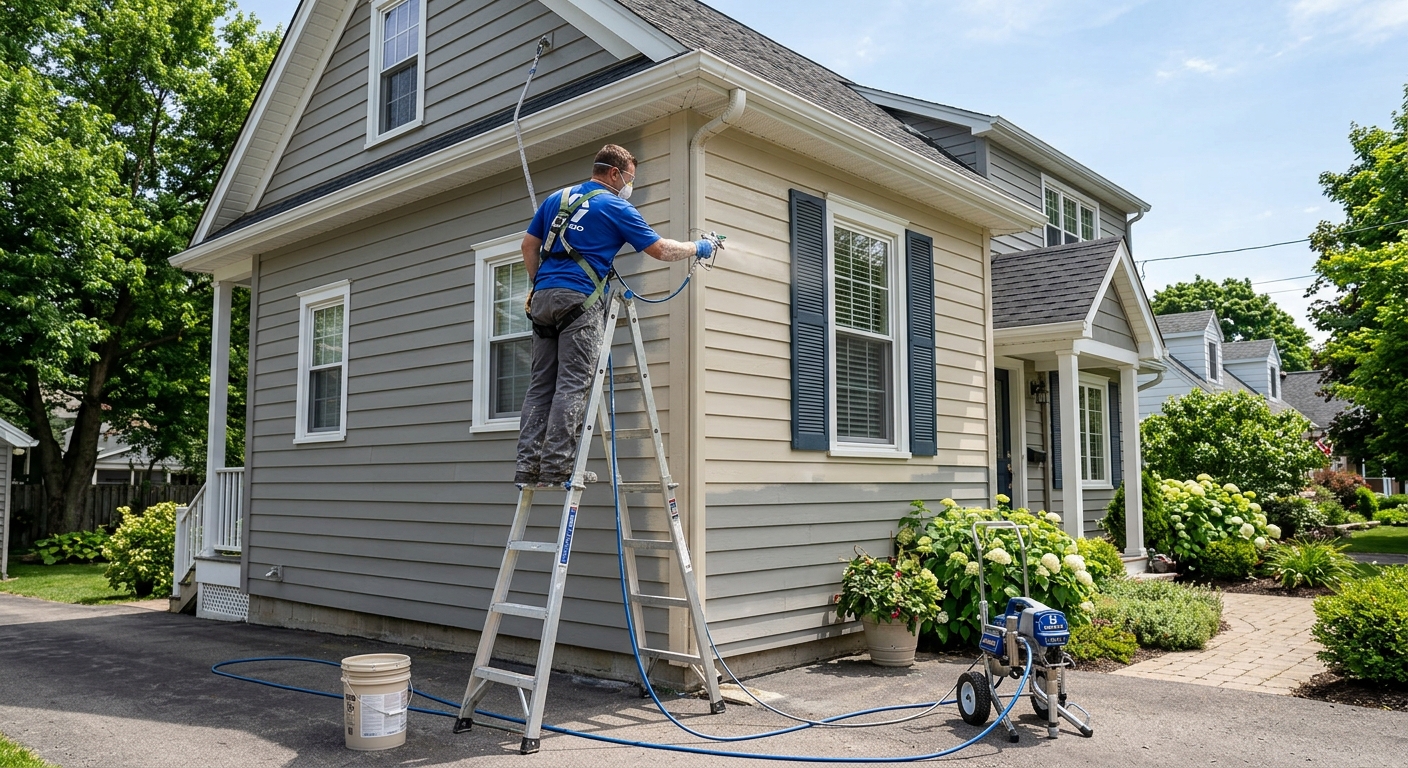
Painting options and costs in Terra Nova
Terra Nova is a great place to paint, but the bill is driven by prep quality and by how well the job is scheduled around Lower Mainland–Southwest weather. In a community of 5,447 residents (Statistics Canada, 2021 Census), many homes reflect mid-century to more recent housing stock—meaning older surfaces are common, and most repaints need more than just rolling a new topcoat. On pre-1978 homes, contractors may use lead-paint–safe work methods (containment, wet scraping, HEPA cleanup, and proper disposal) if lead is suspected or identified, which adds time but protects your home.
In Terra Nova, exterior work is mainly constrained by rain and humidity rather than deep cold. That changes when painters can mobilize, how quickly coats can dry, and which mildew-resistant, high-adhesion systems are chosen for coastal siding and trim. Interior projects are steadier through fall and winter, so pricing is often less sensitive to the seasons.
We also see steady demand in the Peninsula and the broader Terra Nova “village” areas where condo-towns and family homes cluster—exact access and surface condition can vary from street to street, which is why quotes can swing. To compare proposals fairly, start with the scope: the best-priced bid is often the one that budgets for scraping failing coatings, patching settlement cracks, stain/tannin blocking, and thorough priming. Use the ranges below as a baseline, then we’ll narrow it to your exact rooms, siding type, and finish level.
| Service |
What's Included |
Typical Duration |
Price Range |
| Interior — whole home (walls, ceilings, trim) |
Surface prep (patching/sanding), caulking where needed, primer on repaired/stained areas, 2-coat finish, protect floors & fixtures, basic trim touch-ups |
4–10 days |
$1,200–$6,500 |
| Interior — per room (standard bedroom or living room) |
Prep, spot-prime repairs/stains, 2-coat walls, edge work around trim, clean-up and dust containment as required |
1–3 days |
$300–$1,800 |
| Exterior — full house (siding, trim, soffits) |
Wash/degrease, scrape failing coatings, caulk, prime bare/repairs, mildew-resistant exterior system, paint siding & trim, protect landscaping and exterior openings |
1–3 weeks (weather-dependent) |
$1,800–$14,000 |
| Exterior — trim and accent colours only |
Targeted prep on trim/soffits, spot-prime, caulk repairs, 2-coat finish on designated exterior elements |
3–8 days |
$1,200–$6,500 |
| Kitchen cabinet painting (doors, frames, spray finish) |
In-shop or masked prep, degrease, sanding/scuffing, bonding primer, sprayed finish coats, hardware masking or light reinstalling guidance |
5–12 days (including cure time) |
$2,200–$6,800 |
| Specialty / faux finish (accent wall, texture) |
Surface leveling as needed, primer, specialty system application, multiple coats/technique layers, final protective topcoat where required |
2–7 days |
$600–$9,500 |
Prices are estimates only and vary by project scope, site access and material selection.
What affects the price of painting in Terra Nova
In Terra Nova and the wider Lower Mainland–Southwest, two quotes for the “same colour” can vary by 30–50% because the difference is rarely the paint—it’s the prep, the schedule risk, and the labour intensity of getting a durable film in a coastal climate. In British Columbia, the exterior season is more weather-dependent than in many inland markets: there are fewer fully rain-free stretches, so crews may spend extra time re-mobilizing, masking longer, and working with slower drying conditions. Across Ontario and Alberta, the exterior window can be more temperature-tied (roughly late May to early October in many areas), while in coastal BC humidity and rainfall can force careful timing even when temperatures are acceptable.
Prep drives cost in older homes across the region. Scraping failing coatings, patching settlement cracks, and priming stains can represent 50–70% of labour on a repainting job. For a typical exterior repaint, that’s part of why the “low” end might land near the lower part of the exterior band, while a fully upgraded job—including extensive scrape/caulk/prime and a high-adhesion system—can push toward the mid-to-upper range. For interiors, ceilings and trim add time quickly, which is why a whole-home scope can climb from the interior $300–$8,000 band into the higher end when finishes are more detailed.
Concrete examples from Terra Nova: (1) If your siding has peeling paint spots, budget for more scraping and spot-priming before coating—skipping it will cost more later. (2) If you have pre-1978 trim and contractors need lead-safe practices, containment and HEPA cleanup can add several days to a larger job. (3) If your home is multi-storey and requires lifts or scaffold, height and access increase labour even when the surface area doesn’t look huge.
| Price Factor |
Why It Matters |
Cost Impact |
| Surface prep — scraping, sanding, patching drywall or wood |
Determines adhesion and longevity; poor prep causes peeling, flashing, and patch “ghosting.” |
Often 50–70% of repaint labour (higher on older homes) |
| Number of coats — 2-coat system over primer vs. 1 coat over existing |
Ensures even coverage and hides repairs; 1-coat approaches can fail sooner on stains/colour change. |
Can swing interior/exterior totals by ~10–25% |
| Paint quality tier — contractor-grade vs. premium (Benjamin Moore, Sherwin) |
Better films can resist mildew, scuffing, and wash-down impacts—especially on trim and kitchens. |
Materials may add ~5–20%, but can reduce rework risk |
| Ceilings and trim — adds significant time vs. walls-only |
Trim requires careful masking/edge control; ceilings need more material handling and protection. |
Frequently adds 15–35% to interior labour |
| Exterior season window — short season raises summer rates |
Weather delays increase crew downtime and resequencing, especially with coastal rain and humidity. |
May increase exterior labour cost by ~10–30% |
| Lead-safe precautions — required for pre-1978 homes with lead paint |
Containment, HEPA vacuuming, and disposal steps add time and specialized handling. |
Can add several hundred to multiple thousand dollars |
| Surface material — drywall vs. plaster vs. wood vs. stucco |
Different porosity and adhesion needs determine primer choice and patching methods. |
Can shift prep and primer from “spot” to “system” level |
| Height and access — multi-storey exterior requires scaffolding or lifts |
More rigging/mobilization, safer work positioning, and slower application tempo. |
Often adds 10–25% on multi-storey exteriors |
Permits & regulations in British Columbia
In British Columbia, painting typically does not require a municipal permit, and you generally don’t need to apply for approvals to repaint or to apply new paint systems to existing surfaces. The key “regulatory” reality for professional work is health and safety: for homes built before 1978, health guidelines recommend testing for lead paint before sanding or scraping. If lead is present or likely, lead-safe work practices are the standard approach for contractors—wet methods, HEPA vacuuming, proper containment, and compliant disposal. These practices aren’t usually a permit requirement for homeowners, but they are what you should expect from a responsible crew on older Terra Nova homes.
What usually DOES require a permit is not painting itself but other types of work on buildings (for example, structural changes, major mechanical/plumbing electrical alterations, or exterior changes that affect building envelopes through regulated renovations). For a painting scope—interior walls/trim, exterior siding/trim, and cabinet refinishing—permits are generally not part of the process.
To verify your contractor in Terra Nova, ask for (1) a certificate of insurance for liability, (2) workers’ compensation coverage documentation (WSBC/WCB), and (3) a written contract outlining paint brand, sheen, number of coats, and the exact prep included. When checking licensing, use the provincial registry or the contractor’s posted business details, then compare the certificate dates and company name on the insurance documents. If they can’t provide current proof promptly, that’s a red flag.
Interior vs exterior painting — getting the best result in Terra Nova
In Terra Nova and the Lower Mainland–Southwest, the difference between a long-lasting paint job and a premature failure usually comes down to prep, product selection, and how the job is sequenced for local moisture behaviour. Interiors are generally more forgiving on drying conditions, so you can choose paint colours with confidence—but you still need the right build-up. For walls and ceilings, proper filling, sanding, and priming repaired areas matters more than chasing the most expensive topcoat. Sheen selection is also practical: flat/eggshell is common for ceilings and low-traffic walls, while eggshell or satin often suits living areas because it cleans better without showing every scuff. Two coats over a properly primed surface almost always outlast one thick coat, especially when you’re covering patched drywall or colour changes.
Exteriors have less tolerance for shortcutting. Coastal BC weather makes thorough caulking and surface prep non-negotiable—fill and caulk before paint so water can’t get behind coatings. Primer type matters by substrate; wood and fibre cement may need specific primers for adhesion and stain blocking. In damp conditions, mildew-resistant systems and good re-coat timing protect the film. On pre-1978 homes, the same cautious approach applies if lead-safe methods are needed during scraping or sanding.
Cabinet painting is a budget alternative to replacement, but it only works when you’re set up for a clean finish and stable cure time. For example, moving from basic interior refresh pricing to kitchen cabinet spray work often shifts budgets into the cabinet/trim band—typically around $2,200–$6,800 for standard-sized projects. That added cost is justified if you want a factory-like look without replacing cabinets, and if prep and primer are treated as the main event, not an afterthought.
| Project Type |
Key Prep Step |
Recommended Coats |
Price Band |
| Interior — fresh drywall (new construction) |
Prime entire new drywall for uniform absorption, then fill/sand feathered joints |
1 primer + 2 finish coats |
$1,200–$6,000 |
| Interior — repaint (good condition, no repairs) |
Clean/degloss where needed and spot-prime nothing or minimal areas |
1–2 finish coats (commonly 2 for evenness) |
$300–$5,000 |
| Interior — repaint (patching and priming needed) |
Patch, sand, and spot-prime repaired areas; address stains/tannin/previous odours |
Primer spots + 2 finish coats |
$800–$8,000 |
| Exterior siding (wood or fibre cement) |
Scrape failing areas, caulk, prime bare spots, and apply a mildew-resistant exterior system |
1 primer + 2 finish coats (system-dependent) |
$1,800–$14,000 |
| Exterior trim and accents only |
Surface prep on trim edges and corners; caulk before coating |
Spot-prime where needed + 2 finish coats |
$1,200–$6,500 |
| Kitchen cabinets (spray finish) |
Degrease thoroughly, scuff/sand, and use a bonding primer for clean adhesion |
Primer + 2 topcoats (sprayed); cure time respected |
$2,200–$6,800 |
How to choose a painting contractor in Terra Nova
Choosing the right painter matters more in Terra Nova than many places because coastal humidity magnifies the cost of poor prep. Start with documentation. In British Columbia, ask every contractor for (1) liability insurance showing your address/project, (2) proof of workers’ compensation coverage (WSBC/WCB), and (3) their business details so you can confirm they’re operating under the correct entity. How to check: request certificates by email, verify the policy is current and the insured party matches the company name, and ensure the certificate lists a coverage amount appropriate for residential work. If they can’t produce documents before you sign, don’t “assume they’re covered.”
Next, request 2–3 itemised written quotes. You want a labour and materials breakdown (prep labour, priming labour, paint systems, number of coats, masking/protection, and disposal). Avoid lump-sum-only proposals that don’t explain prep and coatings. Read exclusions carefully: ask whether pressure washing is included, whether repainting includes scraping failing coatings, how repairs are handled, whether disposal is included, and whether any permits are required for your scope (usually painting does not).
Warranty and payment schedule are also practical. Look for a workmanship warranty length in writing, and clarify whether the product/manufacturer warranty applies based on the applied system. Payment should be staged—never pay more than 10–15% upfront; hold back until the final walkthrough. Finally, get the start date and completion estimate in writing so you can plan around weather windows for exterior work.
- Ask for insurance and WSBC/WCB proof before scheduling.
- Verify the quote includes specific surface prep steps (scrape, sand, patch, caulk).
- Confirm the paint system: primer type, number of coats, and sheen.
- Require dust control/protection details (floors, vents, landscaping).
- Make sure exclusions are written (what’s “not included”).
- Check whether pressure washing is included for exterior prep.
- Confirm lead-safe approach for pre-1978 surfaces if applicable.
- Ask how they handle rain delays and re-scheduling on exteriors.
- Confirm disposal of paint debris and sanding dust containment.
- Request a written workmanship warranty and what it covers.
- Use a payment schedule with a final holdback until completion.
- Get a written start date and completion timeframe for both interiors and exteriors.
In Terra Nova, concrete red flags include: (1) “We’ll just roll it over” without scraping/priming failing areas, (2) no written scope that states coat counts and primer requirements, (3) inability or refusal to provide current liability and WSBC/WCB coverage, (4) asking for large upfront deposits beyond 10–15%, and (5) vague exterior timelines that ignore rain windows and drying/re-coat requirements.
Frequently asked questions — painting in Terra Nova
How much does interior painting cost per room in Terra Nova?
For a typical bedroom or living room in Terra Nova, interior pricing often lands in the interior “per room” range of about $300–$1,800, depending on whether trim/doors are included, whether there are wall repairs, and how much priming/stain blocking is required. If it’s a straight repaint with good condition surfaces, cost is usually closer to the lower end; if patching and primer work are needed (common in older homes), expect to budget toward the higher end. In the Lower Mainland–Southwest, interior schedules are steadier through fall and winter, so you’re usually paying more for prep and finish scope than for seasonality. (Statistics Canada, 2021 Census) shows the area’s population base is relatively stable, which contributes to consistent contractor availability year-round.
When is the best time for exterior painting in Terra Nova?
The best time is when you can consistently get rain-free drying windows. In coastal British Columbia, painters plan around humidity and rainfall rather than just temperature, so the practical window is late spring through summer when dry stretches are more common. Expect scheduling sensitivity in shoulder periods—light rain or fog can slow drying and affect re-coat timing. Even when daytime temperatures are reasonable, exterior work needs correct humidity conditions to help primer and topcoats cure. A well-prepared exterior job also includes caulking and proper surface prep, so contractors often prefer to start when they can complete scraping/priming and get paint on before weather turns wet again.
How many coats of paint do I need?
Most residential jobs in Terra Nova use a system approach: primer when required, then two finish coats. For repainting, if the existing surface is sound and you’re not changing colours drastically, you may sometimes get away with 1–2 finish coats, but two coats is the reliable route for uniform coverage and a cleaner, more durable film. For patched drywall, stained areas, or any spot where bare substrate shows, priming is usually essential before the finish coats. For exterior work, the common expectation is primer + 2 coats over a mildew-resistant exterior system, because coastal moisture behaviour can expose weak adhesion or thin coverage over time.
What paint is best for Terra Nova's climate?
In Terra Nova and the Lower Mainland–Southwest, “best” usually means high-adhesion primers and coatings designed for damp coastal conditions. For exterior siding and trim, choose a mildew-resistant exterior paint system that can handle humidity and weather cycling. For interiors, use washable interior paints with the correct sheen by room—eggshell or satin in higher-touch areas for easier cleaning. If your home has older wood trim or any staining/tannin bleed, a bonding/stain-blocking primer matters as much as the topcoat. A responsible contractor will match primer and sheen to substrate and use-case, not just pick a colour based on appearance.
How long does exterior paint last here?
With correct prep and a proper exterior system, many homeowners see exterior paint performance in the multi-year range, but exact longevity depends on how much failing coating was scraped back, how well caulking was done, and whether the job was timed for dry re-coat windows in British Columbia’s coastal humidity. If prep is rushed—skipping scrape/prime on failing areas—peeling can return quickly, often within a few seasons. If the contractor uses mildew-resistant coatings, primers suited to the substrate (wood/fibre cement/stucco), and manages weather timing carefully, coatings generally perform better through wet shoulder seasons. Your housing-stock condition in Terra Nova can also affect longevity: older surfaces often need more remediation before coating.
Should I paint or replace my cabinets?
Painting cabinets is usually the better move when the box/structure is solid and you mainly want updated colour and finish. In Terra Nova, cabinet painting can be a strong budget alternative, with typical professional ranges around $2,200–$6,800 for many standard kitchen sizes using prep and sprayed/finish coats. Replacement may make sense if cabinets are damaged, warped, or structurally failing, or if you want a full layout change. Painting can still look “new” when prep is thorough (degrease, scuff/sand, bonding primer) and when cure time is respected. If you choose to paint, ask for an itemised plan for sanding, primer, coat count, hardware handling, and disposal/masking details.