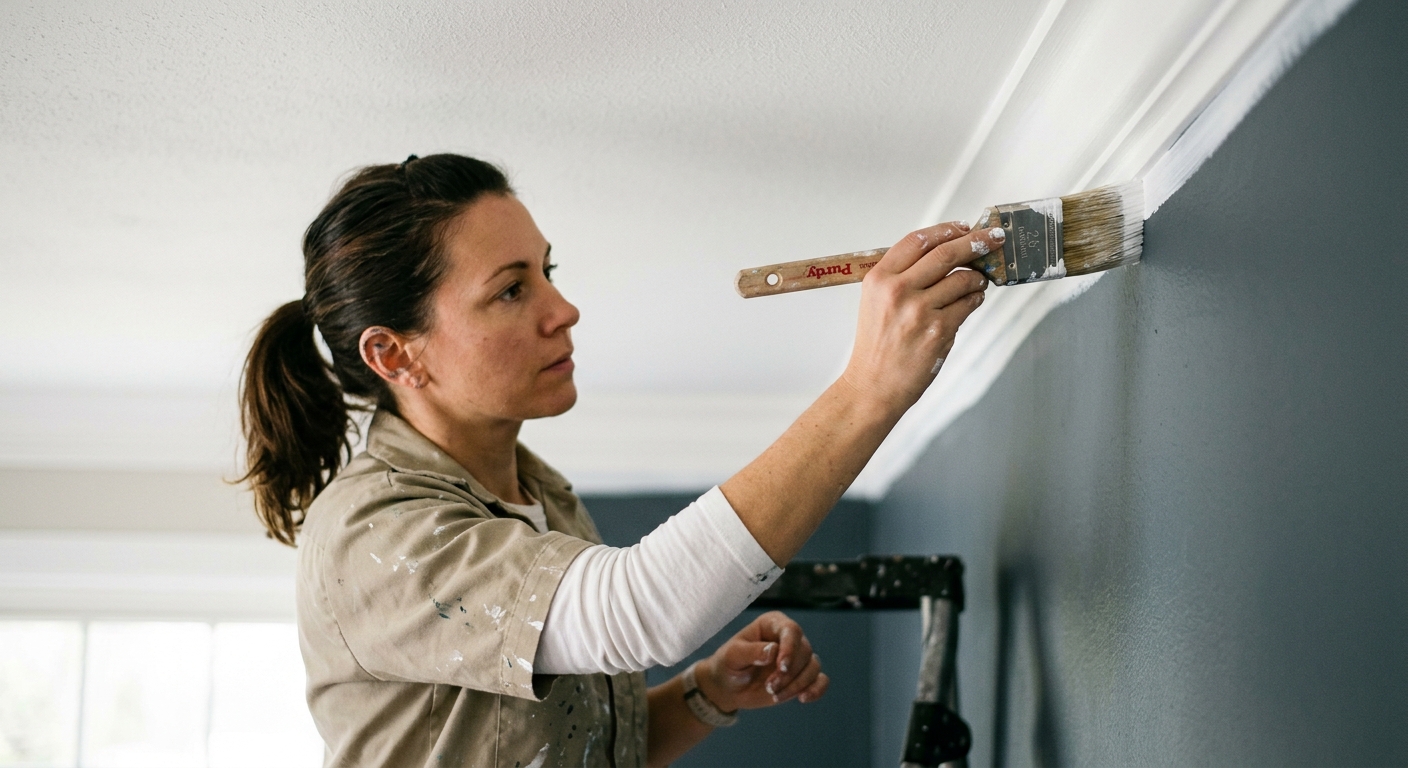
Painting options and costs in Central Coquitlam
Central Coquitlam homeowners typically start with the same question: “What will it cost to paint?” The honest answer is that price swings are driven less by the labour itself and more by prep and environmental conditions. Central Coquitlam has a large base of mid- to late-20th-century housing stock; in fact, the Lower Mainland profile includes a total population of 15,480 (Statistics Canada, 2021 Census), and that steady homeowner demand keeps crews booked for both interior and exterior work. Many repaint jobs involve extensive prep—scraping failing coatings, patching settlement cracks, stain-blocking nicotine or wood tannins, and upgrading to modern primers—especially on older surfaces that no longer hold paint the way they used to. For pre-1978 homes, contractors may also use lead-paint–safe practices (containment, HEPA vacuuming, and proper disposal), which can meaningfully add time to an estimate.
In the Lower Mainland–Southwest, exterior pricing is shaped by coastal rain and humidity rather than extreme cold. We build in risk management: scheduling around dry windows, using mildew-resistant, high-adhesion products, and allowing for slower drying times. Interiors are often easier to schedule year-round, which is why you’ll see many painters “level” the year by shifting crews indoors in fall and winter. Demand is especially strong around the Central Coquitlam Town Centre/Coquitlam Centre area, where condos and townhomes turn over faster and where homeowners commonly refresh both interiors and building-facing trim.
Below are realistic typical ranges to help you compare apples-to-apples before you request an itemised quote.
| Service |
What's Included |
Typical Duration |
Price Range |
| Interior — whole home (walls, ceilings, trim) |
Prep (patch/sand), prime where needed, 2-coat finish, caulking touch-ups, protect floors and fixtures |
4–10 days |
$3,200–$7,800 |
| Interior — per room (standard bedroom or living room) |
Prep, prime affected areas, 2-coat walls, finish to ceiling where requested, basic trim touch-up |
1–3 days |
$600–$2,500 |
| Exterior — full house (siding, trim, soffits) |
Power-wash/scrape as needed, patch and caulk, primer system, 2-coat exterior finish, weather-window scheduling |
1–3 weeks (including weather holds) |
$6,500–$14,500 |
| Exterior — trim and accent colours only |
Surface prep and bonding primer as needed, caulking touch-ups, 2-coat on trim/accents, protection and clean-up |
3–7 days |
$1,200–$4,800 |
| Kitchen cabinet painting (doors, frames, spray finish) |
Removal/labeling, degrease, sand, bonding primer, spray finish, hardware re-install (if provided), clean-up |
7–15 days (including dry/cure time) |
$2,400–$6,800 |
| Specialty / faux finish (accent wall, texture) |
Surface prep, base coat system, faux/texture application, protective topcoat, patching blends |
2–7 days |
$800–$5,500 |
Prices are estimates only and vary by project scope, site access and material selection.
What affects the price of painting in Central Coquitlam
Even when two homeowners describe the “same” painting job in Central Coquitlam, quotes can differ by 30–50% across the Lower Mainland–Southwest and other parts of British Columbia because prep standards, product choices, and weather constraints vary. On paper, paint is paint; in practice, the cost drivers are scraping time, drywall repairs, primer type, ventilation/masking, and how often crews must return between rain windows. In Ontario and Alberta, exterior work is typically easier to schedule because the temperature window is more predictable; in coastal BC, humidity and rainfall dominate. In the Lower Mainland–Southwest, exterior work is constrained by dry-stretch windows and slower drying, so contractors price in scheduling risk and use mildew-resistant, high-adhesion systems.
Older homes throughout the region often mean extra surface prep—failing coating removal, patching, caulking, and stain-blocking. Prep can be 50–70% of total labour on a repainting job, which is why a “fresh coat” promise rarely holds true once we see the walls and trim up close. For example, an exterior full-house repaint can fall in the $1,200–$15,000 range depending on whether we’re doing trim-only versus full siding and soffits; the $6,500–$14,500 band is common when weather windows and extensive bonding primer are involved. On interiors, whole-home projects typically sit in the $300–$8,000 range, and the spread is usually driven by ceiling height, number of repair areas, and whether trim needs more than touch-ups.
Concrete Central Coquitlam examples: (1) north-facing siding often holds moisture longer, increasing dry time and product selection; (2) older plaster/drywall transitions may require additional priming to stop flashing; (3) multi-storey access can add scaffold or lift days, and those costs show up quickly.
| Price Factor |
Why It Matters |
Cost Impact |
| Surface prep — scraping, sanding, patching drywall or wood |
Determines adhesion and how smoothly coats lay |
Can add roughly 25–60% of labour depending on condition |
| Number of coats — 2-coat system over primer vs. 1 coat over existing |
Coverage and durability depend on a proper base and film build |
Moving to a true 2-coat system commonly increases cost by 10–25% |
| Paint quality tier — contractor-grade vs. premium (Benjamin Moore, Sherwin) |
Premium lines often offer better hiding, stain resistance, and longer wear |
Materials may increase 5–20%, but can reduce touch-ups |
| Ceilings and trim — adds significant time vs. walls-only |
Fine edge work, cutting, and masking increase labour |
Often adds 15–40% on interior projects |
| Exterior season window — short season raises summer rates |
Weather holds and re-mobilization between dry stretches |
Can swing a job by 10–30% in peak periods |
| Lead-safe precautions — required for pre-1978 homes with lead paint |
Containment, HEPA methods, and disposal take additional time |
Commonly adds 15–40% when lead-risk is confirmed |
| Surface material — drywall vs. plaster vs. wood vs. stucco |
Different substrates demand different primers and patch methods |
Can change coating prep costs by 10–35% |
| Height and access — multi-storey exterior requires scaffolding or lifts |
Safety, setup time, and productivity change with access needs |
Often adds 10–25% on exterior |
Permits & regulations in British Columbia
In British Columbia, painting itself generally does not require a permit for typical residential projects. For homes built before 1978 in Central Coquitlam, health guidelines recommend testing for lead paint before sanding or scraping, and contractors follow lead-safe work practices if lead is present—wet methods to suppress dust, HEPA vacuuming, proper cleanup, and correct disposal. This is not typically “a homeowner permit” requirement, but it is standard professional practice and it’s especially important because exterior scraping and interior sanding can create hazardous dust. If your contractor proposes dry-sanding without containment on an older home, that’s a serious red flag.
What is often required instead is proof of insurance and proper contracting practices. Before work starts, confirm your contractor carries liability insurance and has workers’ compensation coverage (WCB/WorkSafeBC). You should also insist on a written contract that specifies the paint brand and sheen, number of coats, primer system (if included), and which surface prep tasks are part of the scope (patching, caulking, stain blocking, and cleanup).
Step-by-step checks for Central Coquitlam: (1) request a Certificate of Insurance for liability and verify it covers the address/project; (2) request proof of workers’ compensation coverage and confirm the correct business name; (3) ask for their work plan for pre-1978 surfaces and whether they’ll test or treat as lead-risk; (4) ensure the contract lists prep and coating details rather than vague wording like “prep as needed.”
Interior vs exterior painting — getting the best result in Central Coquitlam
The difference between a long-lasting paint job and a premature failure in Central Coquitlam is mostly preparation and product compatibility with our coastal climate. For interiors, surface prep is more important than the brand of topcoat: filling and sanding ridges, caulking small gaps, priming stains, and sealing patch compounds so sheen doesn’t “telegraph.” Sheen choice matters too. Typically, flat or matte is best for low-traffic wall areas; eggshell or satin works well in family rooms and bedrooms; kitchens and hallways often benefit from a scrubbable finish like satin. No matter the room, two coats over a proper primer almost always outlast one thick coat, because coverage becomes more even and the film dries with the right integrity.
For exteriors, the critical difference is how paint handles repeated moisture exposure. In Lower Mainland–Southwest conditions, exterior prep includes washing, scraping, sanding, and caulking before paint so water doesn’t get trapped behind coatings. Primer selection is substrate-specific: wood and bare areas often need bonding primer, while certain stains require stain-blocking systems. In coastal BC, we prioritize mildew-resistant products and high-adhesion primers that tolerate humidity and slower drying. Lead-safe precautions apply if your home is pre-1978—especially during scraping and sanding.
Cabinet painting can be a smart budget alternative to replacement. If your kitchen facelift is mostly worn doors and frames, professional spray cabinet refinishing in the $2,400–$6,800 range is usually far more economical than full cabinet replacement, while still giving a factory-like finish when prep is done correctly.
A practical dollar example: choosing full exterior prep and a proper primer system (often the reason a full-house job lands closer to $6,500–$14,500) usually prevents bubbling and peeling that can force an early redo—costly compared to doing it right during the weather windows.
| Project Type |
Key Prep Step |
Recommended Coats |
Price Band |
| Interior — fresh drywall (new construction) |
Prime bare drywall and treat joint compound for uniform absorbency |
2 coats over primer |
$2,000–$5,500 |
| Interior — repaint (good condition, no repairs) |
Light scuff/sand and spot-prime any stains or sheen differences |
2 coats |
$800–$3,200 |
| Interior — repaint (patching and priming needed) |
Patch/sand and prime repaired areas to stop flashing |
2 coats with targeted primer |
$1,600–$6,500 |
| Exterior siding (wood or fibre cement) |
Scrape/clean, bond with correct primer, then caulk before topcoat |
2 coats over primer system |
$6,500–$14,500 |
| Exterior trim and accents only |
Bonding primer on bare/spot areas and clean edge caulking |
2 coats |
$1,200–$4,800 |
| Kitchen cabinets (spray finish) |
Degrease thoroughly and prime for adhesion, then spray for uniform film |
Primer + 2 finish coats (typical) |
$2,400–$6,800 |
How to choose a painting contractor in Central Coquitlam
Start with verification. In British Columbia, you want proof of appropriate business licensing/eligibility (if applicable to their contracting setup), plus liability insurance and workers’ compensation (WCB/WorkSafeBC coverage). To check: (1) ask for a Certificate of Insurance for liability and confirm it’s current and includes your address; (2) request proof of workers’ compensation coverage under the same legal business name; (3) if they discuss lead-safe work on a pre-1978 home, ask how they’ll manage containment, HEPA vacuuming, and disposal. A reputable painter won’t be vague here.
Next, get 2–3 itemised written quotes, not a single lump sum. The quote should break out labour and materials and should list prep tasks (scraping, patching, priming, caulking), number of coats, and product tier (including brand and sheen). Confirm what’s excluded: for example, is lead testing included or only “prep as needed”? Is power washing included? Is disposal included? If the scope is unclear, so is the warranty.
Warranty matters for both workmanship and product performance. Ask for the workmanship warranty length, whether it covers peeling/failure due to prep, and whether any manufacturer warranty is part of the claim process. Payment schedule should be conservative: never pay more than 10–15% upfront; hold a portion until the job is complete and cleaned. Get a start date and an estimated completion window in writing, especially for exterior jobs where dry weather windows can shift.
- Confirm liability insurance and workers’ compensation coverage before signing.
- Ask for an itemised quote with labour + materials (paint, primer, caulk, sanding supplies).
- Require a detailed scope: prep steps, surface repairs, and which areas are primed.
- Make sure the quote lists paint brand and sheen, not just “interior/exterior paint.”
- Check whether power washing and debris disposal are included.
- Clarify prep level on exteriors: scraping to sound substrate and bonding primer where needed.
- Confirm lead-safe approach for pre-1978 homes (testing plan and dust control methods).
- Ask who moves/protects furniture, flooring, and fixtures.
- Get the schedule approach for rain windows (how they rebook between weather holds).
- Require a written workmanship warranty (and what triggers a claim).
- Use a payment schedule with a holdback until final inspection and touch-ups.
- Insist on a written completion estimate, especially for cabinet projects with cure/dry time.
Red flags in Central Coquitlam: (1) “We don’t need to prime” on stained/patch areas; (2) dry-sanding or no containment language on pre-1978 surfaces; (3) no Certificate of Insurance or vague “we’re insured” statements; (4) quotes that omit coat counts or sheen; (5) large upfront deposits (more than 10–15%) or no written timeline.
Frequently asked questions — painting in Central Coquitlam
What's the difference between paint quality tiers?
Paint tiers mainly affect hiding power, durability, stain resistance, and how smoothly the coating applies. Premium lines typically cover better with fewer visible patch transitions, which matters in Central Coquitlam where older walls and repairs can “flash” through if prep or primer isn’t matched. Contractor-grade paints can be fine when the surface is properly prepped, but you may need more careful rolling and additional coats to achieve uniformity. In interiors, the difference is often visible around patched drywall seams, especially in satin or semi-gloss trim where light catches imperfections. For budgeting, you can still plan around typical interior whole-home ranges (often $3,200–$7,800), but the real question is whether the quote includes correct primer and the 2-coat system over that base.
How do I compare painting quotes?
Compare quotes line-by-line, not by the final number. Ask each contractor to break down labour and materials and to specify paint brand, sheen, primer system, and the number of coats. For example, an exterior “trim only” job versus a full house can look similar in conversation but land in very different bands: trim-only commonly runs $1,200–$4,800, while full exterior work often sits around $6,500–$14,500 depending on prep and weather windows. Also verify whether prep tasks are included (scraping, patching, caulking, stain blocking) and whether disposal and power washing are part of the scope. In British Columbia’s coastal conditions, confirm they have a plan for dry-stretch scheduling and re-mobilization if rain interrupts application.
What paint sheen should I use in different rooms?
Sheen selection is about cleanability and how much surface imperfections show. In living rooms and bedrooms, eggshell is often a practical balance—washable enough for everyday scuffs but not too reflective. Bathrooms and kitchens usually benefit from satin or a scrub-capable finish because splashes and grease require cleaning. Ceiling finishes are typically flat to reduce glare and highlight less of the texture. Trim often uses semi-gloss or satin for easier wipe-down and a crisp look. If your walls have patched or sanded areas, the sheen choice can make differences more noticeable, so always ask that primer and prep be included to prevent flashing. In Central Coquitlam interiors, sticking to a proper 2-coat approach over a matching primer is usually more important than chasing a higher sheen.
Can I paint my house exterior in spring or fall in Central Coquitlam?
Yes, but in Central Coquitlam you must plan around rain and humidity. Coastal BC generally offers more usable exterior time than cold provinces, yet the practical limiter is dry weather windows and drying/curing conditions. Spring can work if surfaces are dry and temperatures support proper film formation; fall can work similarly, but you may need to stop earlier than you’d expect if weather shifts quickly. A good contractor schedules based on local forecasts and uses mildew-resistant, high-adhesion products to handle coastal damp. If a contractor guarantees an exterior finish “no matter the weather,” ask how they protect partially cured surfaces and how they adjust timelines. For accurate scheduling, expect start dates and completion estimates to account for re-mobilization between rain breaks.
How do I choose a painting contractor in Central Coquitlam?
Choose based on verification, clarity of scope, and quality controls—not just price. In British Columbia, confirm they carry liability insurance and have workers’ compensation coverage (WCB/WorkSafeBC). Ask for itemised written quotes that specify paint brand and sheen, number of coats, primer system, and what prep tasks are included (scraping, patching, priming, caulking, stain blocking). For older homes, ask about lead-safe work practices for pre-1978 surfaces, including dust control methods. Payment terms should be conservative: never more than 10–15% upfront, with a holdback until touch-ups and final cleanup. Finally, request a written start date and completion window that accounts for coastal weather holds.
How many coats does an exterior repaint need in Central Coquitlam?
For most exterior repaints in Central Coquitlam, the standard is a primer system plus two finish coats on sound, properly prepped surfaces. If you’re dealing with bare patches, staining, or different substrates (wood, fibre cement, previously repaired areas), primer choice becomes as important as coat count. In humid coastal conditions, using only one finish coat is where you often see premature issues like uneven sheen, poor coverage, and early adhesion failure. That’s why credible full exterior estimates typically track the broader $6,500–$14,500 band when prep is extensive, while trim-only can be closer to $1,200–$4,800. Your contractor should be explicit in writing about: what gets primed, how many total coats, and what product line is being used.