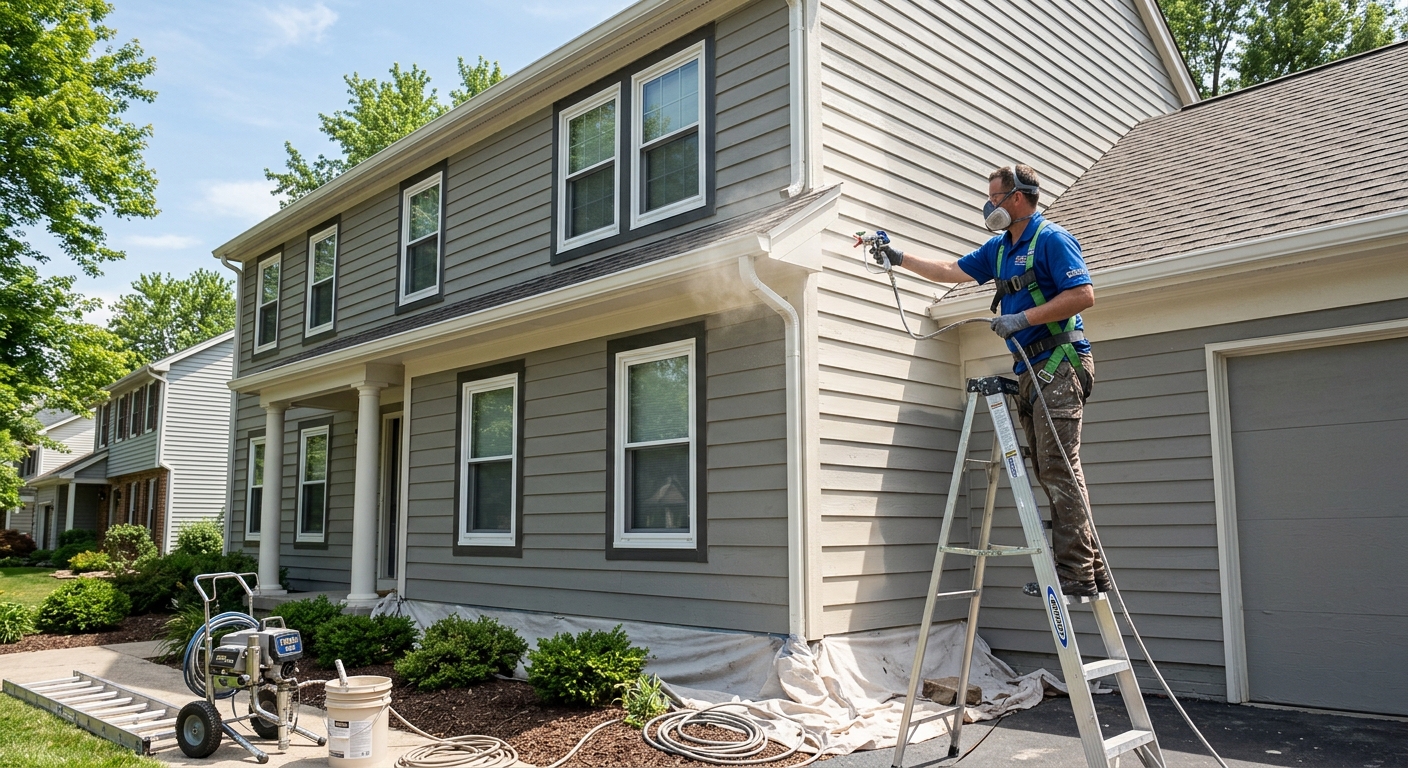
Painting options and costs in Capilano
In Capilano, the most common reason painting quotes swing is not the paint colour—it’s the prep workload and weather scheduling that comes with coastal Lower Mainland–Southwest conditions. Capilano’s small local population (3,177 people in the 2021 Census) also means there are fewer crews available at peak demand, which can tighten timelines for ready-to-start projects. And because many nearby homes were built in mid-century through the 1990s, repaints often involve more than a “cover and roll” approach: scraping failing coatings, patching settlement cracks, stain-blocking nicotine or wood tannins, and upgrading to modern primers for adhesion and longevity. On pre-1978 properties, contractors may use lead-paint–safe practices, adding containment, HEPA vacuuming, and disposal time to the estimate.
Lower Mainland–Southwest interiors are usually easier to schedule because you can move crews indoors through fall and winter. Exteriors, though, are constrained by rain and humidity—painters must apply and dry coatings in workable dry windows, often using mildew-resistant, high-adhesion systems to manage mould risk on siding and trim. In practice, that means an exterior repaint is priced with risk management and re-mobilizing time if the weather shifts. In Capilano, demand is especially steady around Capilano Road and the North Shore-facing neighbourhood pockets where older trim details and fibre-cement/wood siding drive longer surface-prep runs.
Below are realistic local ranges for common scopes, so you can compare quotes line-by-line before you choose.
| Service |
What's Included |
Typical Duration |
Price Range |
| Interior — whole home (walls, ceilings, trim) |
Protect floors, tape/caulk, patch and sand, prime where needed, paint walls/ceilings, paint interior trim/doors, clean-up and post-job touch-ups |
5–14 days |
$3,000–$8,000 |
| Interior — per room (standard bedroom or living room) |
Protect surfaces, patch and sand, prime spots, paint walls and ceiling, include baseboards/standard trim (light prep) |
1–3 days |
$500–$2,500 |
| Exterior — full house (siding, trim, soffits) |
Pressure wash (as needed), scrape/sand, caulk where required, prime bare/failed areas, paint siding and trim/soffits, weather-window scheduling allowance |
2–4 weeks |
$5,500–$15,000 |
| Exterior — trim and accent colours only |
Mask/protect, spot-scrape and patch, prime bare areas, paint trim/selected accents, limited siding work |
4–10 days |
$1,200–$4,500 |
| Kitchen cabinet painting (doors, frames, spray finish) |
Hardware masking or removal, degrease/clean, repair scuffs, prime (adhesion-focused), spray doors for a smooth finish, paint frames, final re-install/touch-ups |
5–15 days (typical) |
$2,000–$7,500 |
| Specialty / faux finish (accent wall, texture) |
Surface preparation specific to texture system, base coat + finish coats, pattern/texture execution, protective topcoat where needed |
2–8 days |
$500–$12,000 |
Prices are estimates only and vary by project scope, site access and material selection.
What affects the price of painting in Capilano
In Capilano and across the Lower Mainland–Southwest, two quotes for the “same” job can differ by 30–50% because the scope is rarely identical: one contractor prices minimal prep and fewer coats, while another includes stain blocking, deeper patching, full priming, and weather-window rework allowances. Those differences are amplified in British Columbia because coastal humidity and long shoulder seasons raise the importance of drying time, mildew resistance, and adhesion-focused primer systems.
For exteriors, the season is climate-bound in the region. While coastal BC can be workable for longer stretches than many inland areas, rainfall and humidity still force scheduling around dry periods, and coatings may dry slower—so painters plan for remobilization if a weather system moves in. That scheduling pressure is one reason exterior repaint pricing can land anywhere from the low-to-mid exterior bands (around “trim and accents only” at $1,200–$4,500) up to full-house ranges (commonly $5,500–$15,000) when prep is extensive.
Surface preparation on older homes is another major driver. In repaints, scraping failing coatings, caulking, patching drywall or wood, and priming problem areas can represent 50–70% of total labour. Two concrete local examples: (1) homes with tobacco smoke or older interior surfaces often require dedicated stain-blocking primer, which adds time and material; (2) fibre-cement or wood trim with micro-cracking typically needs careful scraping and caulking before paint, otherwise the new system can fail prematurely.
Finally, contractor availability affects labour rates. Capilano’s tight local crew capacity means summer demand can push rates higher, especially for exterior work, while interiors can be shifted through fall and winter to manage cost.
| Price Factor |
Why It Matters |
Cost Impact |
| Surface prep — scraping, sanding, patching drywall or wood |
Determines how well new paint bonds and whether cracks/holes telegraph through |
Usually the biggest swing; commonly 20–70% of labour |
| Number of coats — 2-coat system over primer vs. 1 coat over existing |
Coverage and durability improve when coverage is achieved evenly over a proper base |
Can add 10–30% depending on colour change and substrate |
| Paint quality tier — contractor-grade vs. premium (Benjamin Moore, Sherwin) |
Higher-grade paint often hides better, resists scuffing, and improves fade/mildew performance |
Often 5–20% difference in total project cost |
| Ceilings and trim — adds significant time vs. walls-only |
Ceilings require careful edge work; trim needs more detail passes and masking |
Interior jobs can rise 15–40% when trim/doors are included |
| Exterior season window — short season raises summer rates |
Dry, workable conditions are needed for application and proper cure |
Can add 10–25% for weather-risk management |
| Lead-safe precautions — required for pre-1978 homes with lead paint |
Containment, HEPA vacuuming, and disposal increase labour time and materials |
Often adds 5–20% depending on condition and scope |
| Surface material — drywall vs. plaster vs. wood vs. stucco |
Different substrates need different primers and prep methods for adhesion |
Can add 10–30% due to primer and labour changes |
| Height and access — multi-storey exterior requires scaffolding or lifts |
Safety setup and reach time directly affects man-hours |
Often increases exterior costs by 15–40% on higher elevations |
Permits & regulations in British Columbia
In British Columbia, painting typically requires no permit for the work itself. The main regulation-like requirement is not a “permit,” but safe practices—especially for older homes. For homes built before 1978, health guidelines recommend testing for lead paint before sanding or scraping. If lead is present, contractors generally follow lead-safe work practices such as wet methods to reduce dust, HEPA vacuuming, proper containment, and correct disposal procedures. This is not mandated for homeowners the same way it is for professional contractors, but it’s standard practice when we’re protecting occupants and crews on pre-1978 properties in the Lower Mainland.
What does typically require a permit is not common for painting—however, related items like structural changes, certain window replacements, or exterior work that involves larger envelope modifications may fall outside “painting only.” For painting jobs, most homeowners can proceed without permits, as long as the project stays within coating and cosmetic repair scope.
Before hiring in Capilano, verify three things step-by-step. First, confirm the contractor’s business is registered and that they are properly licensed where applicable in BC. Second, request a current certificate of liability insurance (and check the coverage dates and address). Third, ask for workers’ compensation coverage (WSIB/WCB) documentation—contractors should be able to provide a clearance/coverage letter or equivalent proof. Finally, insist on a written contract that specifies paint brand/line, sheen level, number of coats, and the exact prep included (caulking, priming, scrape/sand level, and disposal).
Interior vs exterior painting — getting the best result in Capilano
The difference between a long-lasting paint job and premature failure in Capilano usually comes down to prep discipline and correct product selection for our coastal climate. Indoors, the “brand” matters less than the prep. A durable interior finish starts with filling and sanding, removing dust, and priming any repaired or stained areas. Sheen is also practical: ceilings are typically flat to hide imperfections; living areas often use eggshell or satin for washability; trim and doors are commonly semi-gloss for scuff resistance. Most importantly, two coats over a proper primer system outlast a one-coat shortcut, especially when you’re changing colours or painting over repairs.
For exteriors, British Columbia’s rain-and-humidity reality makes correct prep the deciding factor. That includes thorough cleaning, scraping loose failing coatings, sanding edges, and caulking before painting to prevent water ingress behind trim. Primer selection is substrate-dependent—some acrylic/latex systems are better on drywall-like surfaces, while certain oil-alkyd bonding primers are used on tricky adhesion scenarios or when correcting previously painted surfaces. In Capilano, we favour mildew-resistant, high-adhesion products for siding and trim, because moisture cycles can promote surface growth if the system isn’t built correctly.
Cabinet painting is a good budget alternative to replacement when the existing boxes and layout are sound. The labour is still detailed—degreasing, sanding, primer, and a multi-coat spray finish—but it can be far less disruptive than full replacement. If your home is pre-1978, lead-safe precautions should be included in exterior scraping and aggressive interior prep where dust would be created.
Dollar example: for an exterior repaint, paying for full prep in the $5,500–$15,000 range is often justified versus “trim only” touch-ups in the $1,200–$4,500 range when the siding coating is failing. If the underlying paint is loose or chalking, patching the problem section only can cause edge lines to reappear in the next season.
| Project Type |
Key Prep Step |
Recommended Coats |
Price Band |
| Interior — fresh drywall (new construction) |
Prime all drywall and spot-prime joints/repairs; sand smooth and dust off |
Primer + 2 finish coats |
$3,000–$7,500 |
| Interior — repaint (good condition, no repairs) |
Clean/scuff-sand and caulk minor gaps; patch only if needed |
Spot-prime as required + 2 finish coats |
$1,200–$4,500 |
| Interior — repaint (patching and priming needed) |
Patch and sand repairs; stain-block or prime repaired areas before topcoat |
Primer + 2 finish coats (or primer + 1 plus a third coat where coverage demands it) |
$2,000–$6,500 |
| Exterior siding (wood or fibre cement) |
Scrape failing coatings, caulk, clean, prime bare areas before topcoat |
Primer + 2 topcoats (system-dependent) |
$5,500–$15,000 |
| Exterior trim and accents only |
Spot scrape and prep edges; caulk joints; prime bare spots |
1 primer spot + 2 finish coats where coverage requires |
$1,200–$4,500 |
| Kitchen cabinets (spray finish) |
Degrease, sand and prime for adhesion; mask thoroughly for crisp edges |
Primer + 2 finish coats (spray) with cure time between coats |
$2,000–$7,500 |
How to choose a painting contractor in Capilano
Start with the basics: verify British Columbia compliance signals and risk coverage. Ask for their insurance certificate of liability (current dates, correct legal name, and coverage limits). Then confirm workers’ compensation coverage (WSIB/WCB clearance documentation or equivalent proof). In Capilano, painting projects often involve ladders, lifts, and sometimes lead-safe prep on older homes; you want an insured crew before anyone starts sanding.
Next, get 2–3 itemised written quotes—not one lump-sum number. A real quote breaks down labour and materials and lists the exact scope: what surfaces are prepped, what is scraped/sanded, which areas are primed, and the number of topcoats. Check whether disposal is included, whether patching is included up to a defined level, and whether the contractor includes weather-delay scheduling risk for exterior work. Permits are usually not required for painting in BC, but the scope should still state what happens if containment, test kits, or specialty procedures are needed for pre-1978 lead risks.
Warranty matters too. Look for a workmanship warranty period for labour and prep (not just a general “we’ll fix it”). Ask whether manufacturer paint warranties apply and whether they’re transferable if you sell the house. For payment schedule, never pay more than 10–15% upfront; hold back a portion until the job is complete and inspected. Also require a start date and completion estimate in writing so you can plan around your life while crews move through weather windows.
- Request proof of liability insurance and confirm coverage dates before work starts.
- Confirm workers’ compensation/WSIB-WCB coverage clearance documentation.
- Ask for licence/registration details relevant to their business and work type in BC.
- Insist on an itemised scope: prep steps, number of coats, primer type, and sheens.
- Verify whether caulking and patching are included, and to what extent.
- For exteriors, ask how they handle rain/humidity and scheduling windows.
- Check disposal and cleanup: waste handling, masking removal, and final sweep.
- Ask how they protect landscaping, driveways, and railings.
- Confirm primer and paint brands/lines; avoid “builder’s grade” substitutions without notice.
- Review warranty length and what it covers (peeling, cracking, adhesion issues).
- Set payment milestones tied to measurable progress, not “all materials delivered.”
- Get a written timeline with a realistic work sequence for the area (indoors/exterior).
In Capilano, red flags include: vague quotes that don’t list coats or prep steps; refusal to provide insurance/coverage proof; pressure to pay a large deposit upfront; claiming “one coat” over unprimed repairs; and disappearing after the first delivery of materials without a signed scope and start date.
Frequently asked questions — painting in Capilano
How do I choose a painting contractor in Capilano?
Choose a contractor who prices the prep, not just the colour. In Capilano and the Lower Mainland–Southwest, surface preparation and weather-window planning make the difference between a job that looks great today and one that still looks good next season. Ask for an itemised quote that states scraping/sanding level, caulking included, primer type, and the number of coats. Confirm liability insurance and workers’ compensation clearance (WSIB/WCB coverage) before work begins. For budgeting, use the local bands as a reality check: for example, interior whole-home work often falls in the $3,000–$8,000 range, while cabinet painting commonly sits around $2,000–$7,500 depending on kitchen size and finish requirements (Statistics Canada, 2021 Census).
How many coats does an exterior repaint need in Capilano?
Most exterior repaints in Capilano use a system approach: prime where required and apply two finish coats over stable, properly prepped substrate. If bare spots appear after scraping, primer is used to restore adhesion and reduce flash/colour variation; then the contractor applies two topcoats to balance coverage and durability under coastal moisture cycles. Because rain and humidity can slow drying, crews may slightly adjust timing between coats to meet cure needs—this affects scheduling rather than reducing total coating count. If a contractor is proposing fewer coats than expected, ask where the coverage is achieved and what primer is specified. For a full house, local ranges commonly sit within $5,500–$15,000 when extensive prep and full system application are included.
What is the best primer for older Capilano homes?
The best primer depends on what you’re covering: repaired drywall, stained surfaces, or bare/failed exterior coatings. In older Capilano homes, two common primer categories come up—stain-blocking primer for interior discolouration (nicotine or wood tannins) and adhesion/bonding primer for areas where existing paint has chalked, failed, or been scraped back to substrate. For pre-1978 homes, contractors should consider lead-safe practices before sanding or scraping, even though homeowners aren’t typically “permit-controlled” for painting in BC. Practically, that means correct containment and cleanup while preparing surfaces for the primer system. A good contractor will specify primer type in writing and explain why it’s being used rather than choosing primer solely for cost.
Should I paint or wallpaper my Capilano home?
For most Capilano homeowners, paint is the lower-risk choice when walls have patching history, hairline cracks, or varying moisture exposure. Wallpaper can look stunning, but it’s less forgiving if the wall prep isn’t perfect; seams and texture differences become more visible in coastal humidity, especially around exterior-facing rooms. Paint also allows you to match sheen to room function—eggshell or satin for living spaces and more durable finishes where scuffs happen. If you’re considering a feature wall, a textured or specialty paint option can deliver a similar effect without the seam management. Budget-wise, a whole-room paint refresh is often more controllable than wallpaper, and it typically fits the interior per-room band (often $500–$2,500), while specialty work can range up depending on labour and systems.
How do I fix peeling exterior paint in Capilano?
Peeling exterior paint usually isn’t fixed by repainting over it. In Capilano’s damp shoulder seasons, the correct repair is: remove loose coating (scrape until edges are sound), sand remaining edges smooth, clean the surface, repair any cracks/open joints, caulk where appropriate, and then prime before applying a full exterior coating system. If peeling started because of moisture ingress behind trim, you must address that pathway—otherwise the new paint will peel again. Also check substrate condition (wood versus fibre cement versus stucco) because primer choice differs. Because scraping can create dust in pre-1978 homes, professional lead-safe practices and containment are recommended where lead risk is present. When full system prep is done, many full-house exteriors land in the $5,500–$15,000 range.
What colours add the most resale value in Capilano?
In Capilano and the Lower Mainland–Southwest, resale-friendly colour choices are typically those that look clean, bright, and timeless in both daylight and the region’s often overcast conditions. On exteriors, updated neutrals (warm whites, soft greys, or muted greiges) and consistent trim colours tend to appeal broadly. For interiors, eggshell or satin off-whites and light warm greys usually photograph well for showings and are easier to match with flooring and cabinetry. The key is less about chasing a “trend” and more about avoiding strong undertones that can make a home feel dark in winter. If you’re updating cabinets, neutral tones often complement countertops without overpowering the kitchen. If you’re planning exterior or cabinet work, confirm the quote includes proper priming and multiple coats, since colour change impacts labour and materials.