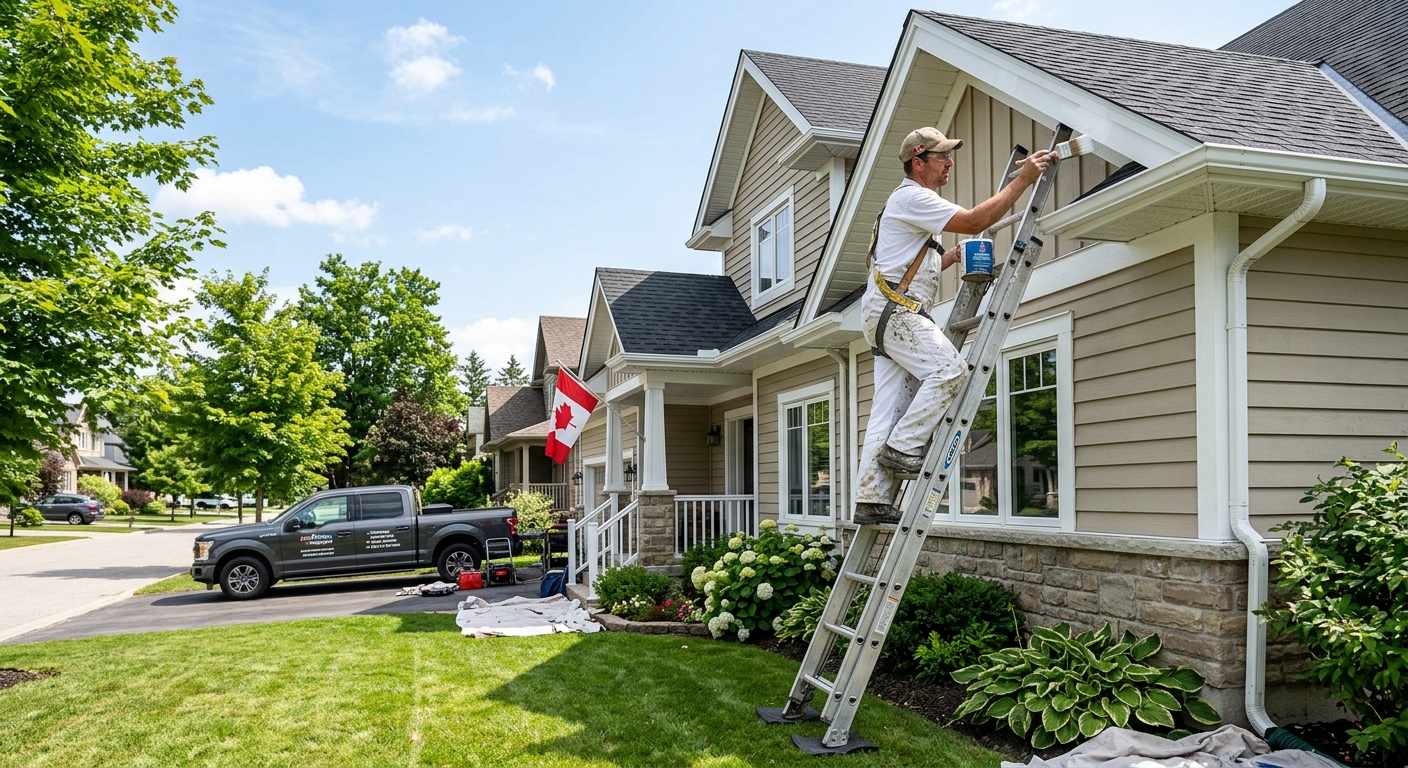
Painting options and costs in Scarboro
Scarboro, Alberta homeowners typically choose between interior refreshes and exterior updates based on timing, access, and how much prep your home needs. With a small local population of 1,010 residents (Statistics Canada, 2021 Census), the contractor pool can feel tighter than in larger Calgary-area communities, so scheduling often depends on availability. Your home’s age also matters: a large share of Calgary-area housing dates back to the 1960s–2000s, and repainting those older surfaces usually involves more than “just a coat” because of adhesion issues, weathered trim, and patch-heavy drywall or aged wood—especially when lead-safe prep protocols are required for pre-1978 buildings.
In the Calgary region, exterior work is tightly climate-bound. Our workable season is roughly mid-May to late September, when daytime highs reliably stay above 10°C and surfaces can dry properly. That shorter window concentrates demand, so peak-season slots book fast and pricing firms up. Rain events and overnight lows also influence daily production, and strong UV plus hail risk means we specify higher-quality acrylics and flexible exterior coatings when warranted.
In Scarboro, trades are often in especially high demand around main corridors and older residential pockets where many homes have never been fully repainted in years—commonly seen in the central/established parts of the community where residents tend to prioritize curb appeal and weatherproofing. If you’re comparing options, the best starting point is understanding what’s included at each scope level—then checking your quote against the factors that typically move price up or down. Use the table below as a realistic baseline for your project type.
| Service |
What's Included |
Typical Duration |
Price Range |
| Interior — whole home (walls, ceilings, trim) |
Protect floors & fixtures, patch & sand as needed, prime bare/spot areas, 2-coat finish system, caulking, clean-up; trim included |
5–12 days |
$3,200 – $8,000 |
| Interior — per room (standard bedroom or living room) |
Protect area, patch & sand, prime spots, 2-coat wall finish; single ceiling coat; basic trim touch-ups |
1–3 days |
$400 – $1,900 |
| Exterior — full house (siding, trim, soffits) |
Power wash, scrape/sand, patch & caulk, stain-block where needed, prime bare/failed areas, 2-coat exterior topcoat; include trim/soffits |
1.5–3.5 weeks |
$2,500 – $9,000 |
| Exterior — trim and accent colours only |
Spot prep, scrape/sand trim, caulk, prime as required, 2-coat finish on trim accents; includes soffit/edge work if specified |
4–10 days |
$1,200 – $4,800 |
| Kitchen cabinet painting (doors, frames, spray finish) |
Degrease, bonding prep, remove/label where practical, prime suitable surfaces, spray finish, re-install hardware; light sanding between coats |
3–7 days |
$800 – $4,500 |
| Specialty / faux finish (accent wall, texture) |
Surface prep for texture/feature, base coat(s), specialty technique layers, topcoat sealer where required |
1–5 days |
$600 – $6,000 |
Prices are estimates only and vary by project scope, site access and material selection.
What affects the price of painting in Scarboro
Even when homeowners describe the “same” job in Scarboro, quotes can differ by 30–50% across the Calgary region because prep complexity, access, product selection, and scheduling constraints vary from one street to the next. Exterior costs, in particular, react to timing: in our region the exterior painting season typically runs mid-May through late September, and application needs daytime temperatures above 10°C with enough drying time. That short, weather-dependent window concentrates demand and raises summer scheduling pressure, so labour rates and crew availability can tighten at peak weeks. By contrast, coastal BC often has a longer season but uses more mildew-resistant systems and more careful moisture management due to humidity and rainfall.
Older homes throughout the Calgary region often require more surface preparation—scraping peeling paint, patching drywall or wood, caulking gaps, and priming failing substrates. On repainting projects, that prep work can be 50–70% of total labour when the previous coating system is inconsistent or when trim has been painted over stained or chalking wood.
In Scarboro, three practical examples commonly move the needle: (1) homes with previously DIY-painted railings or eaves often need extra stain-blocking and adhesion primer, pushing an exterior job toward the upper end of the $2,500 – $9,000 band; (2) multi-storey access can require lifts or scaffolding, adding labour and scheduling time; and (3) choosing premium acrylic systems or flexible coatings for hail-prone trim can increase material cost, but usually reduces early peeling—an issue that otherwise can shorten the life of a cheaper coating. For interiors, the same principle applies: adding ceilings and full trim coverage moves projects from entry pricing toward the $400 – $8,000 range depending on how much patching and primer work is needed.
| Price Factor |
Why It Matters |
Cost Impact |
| Surface prep — scraping, sanding, patching drywall or wood |
Determines adhesion and smoothness; older coatings often require more labour |
Can add 20–60% to labour portion |
| Number of coats — 2-coat system over primer vs. 1 coat over existing |
Coverage and durability depend on primer/topcoat build |
Typically +10–30% for additional coats |
| Paint quality tier — contractor-grade vs. premium (Benjamin Moore, Sherwin) |
Better hiding, stain resistance, and longer-lasting film build |
Often +5–25% materials and labour efficiency |
| Ceilings and trim — adds significant time vs. walls-only |
Ceilings require careful masking and extra time; trim needs more cutting and detail |
Can shift project up one tier (+15–40%) |
| Exterior season window — short season raises summer rates |
Weather limits production; peak slots sell out faster |
Scheduling pressure can add 10–25% |
| Lead-safe precautions — required for pre-1978 homes with lead paint |
Safer containment, HEPA methods, and proper disposal increase prep time |
Can add 15–45% on affected areas |
| Surface material — drywall vs. plaster vs. wood vs. stucco |
Different primers and prep are needed for bond and crack-bridging |
Can swing total by 10–30% |
| Height and access — multi-storey exterior requires scaffolding or lifts |
Safer work at elevation increases time and equipment rental |
Often +10–35% depending on complexity |
Permits & regulations in Alberta
In Alberta, painting typically does not require a permit. There are, however, important compliance steps for professional work—especially on older homes. For houses built before 1978, health guidelines recommend testing for lead paint before sanding or scraping. If lead is present, contractors should follow lead-safe work practices such as wet methods to reduce dust, HEPA vacuuming, careful containment, and proper disposal of waste. This is not generally a homeowner “legal mandate,” but it’s standard practice for professional contractors because it protects your household and the crew.
What does require permits or approvals usually isn’t the paint itself—it’s related work like plumbing/electrical or major structural changes, and sometimes strata/HOA approvals for colour or exterior appearance in managed communities. For painting, homeowners should focus on paperwork: confirm the contractor carries liability insurance and has WSIB/WCB workers’ compensation coverage.
To verify coverage in Scarboro, follow a simple step-by-step check: (1) ask for a current certificate of insurance naming you as an interested party where possible; (2) request their WCB/WSIB account details or clearance documentation that shows coverage for the workers assigned; (3) check their Alberta business credentials/licensing information through the province’s public resources or their registration details; and (4) ensure your written contract clearly lists the paint brand and sheen, the number of coats, and the surface prep included (scraping, patching, priming, caulking). A strong contract prevents “scope creep” during the busy Calgary exterior season.
Interior vs exterior painting — getting the best result in Scarboro
In Scarboro’s Calgary market, the difference between a long-lasting paint job and a premature failure is usually not the brand—it’s the prep, the coat system, and timing. For interiors, surface prep is king: filling and sanding drywall imperfections, properly priming repaired areas and stains, and re-establishing a uniform surface are what control “flashing,” peeling at patches, and rough texture. Sheen selection then matters by room. Flat or matte can work on low-wear areas like ceilings, but eggshell or satin is usually the better choice for living areas and hallways where scuffs are common; semi-gloss on trim is often easier to wipe and holds up to cleaning. In practice, two coats over the right primer consistently outlast one thick coat because coverage and film build are more even.
For exteriors, Alberta conditions raise the stakes. Caulking before painting helps prevent water ingress at joints and trim edges, and it reduces early failure where movement occurs. Primer choice also matters: oil-based primers are sometimes used for stubborn stained wood or specific substrate issues, while latex primers can be appropriate for many sound, cleaned surfaces. In Calgary’s freeze–thaw cycles, UV exposure, and hail-prone weather, contractors should use temperature-stable, exterior-grade coatings suited to your substrate and application conditions; the film must stay flexible enough to handle small movements without cracking.
Cabinet painting is a smart budget alternative to replacement when the boxes and frames are sound. For example, if cabinet replacement lands closer to several thousand dollars, a spray-finish cabinet paint scope often sits in the $800 – $4,500 band, and the value holds when hinges and surfaces are properly degreased and primed. For pre-1978 homes, lead-safe precautions during scraping or sanding keep the job safer while preserving the quality of the prep for the topcoat.
| Project Type |
Key Prep Step |
Recommended Coats |
Price Band |
| Interior — fresh drywall (new construction) |
Seal/prime to unify porosity, then sand for smoothness |
1 coat primer + 2 coats finish |
$1,000 – $3,500 |
| Interior — repaint (good condition, no repairs) |
Light sanding, degrease if needed, spot-prime only |
1 primer spot + 2 finish coats (often) |
$400 – $2,500 |
| Interior — repaint (patching and priming needed) |
Patch/feather, sand smooth, prime repairs and stain areas |
Spot primer + 2 finish coats |
$900 – $6,000 |
| Exterior siding (wood or fibre cement) |
Scrape failing paint, wash, repair, caulk, prime bare areas |
Primer where required + 2 exterior topcoats |
$2,500 – $9,000 |
| Exterior trim and accents only |
Thorough edge cleaning and caulking before cutting-in |
Primer as needed + 2 trim topcoats |
$1,200 – $4,800 |
| Kitchen cabinets (spray finish) |
Degrease, bond-prime, and fine-sand between build coats |
Bond primer + 2–3 sprayed finish coats |
$800 – $4,500 |
How to choose a painting contractor in Scarboro
Choosing the right painter in Scarboro starts with verification. In Alberta, confirm they carry liability insurance and that workers assigned to your job are covered through WSIB/WCB. How to check: request a current certificate of insurance (date-valid) and review the coverage limits; ask for WCB/WSIB clearance documentation or proof tied to the company and the workers who will be on site. Next, get 2–3 itemised written quotes that break down labour and materials rather than a single lump sum—this is the only way to compare apples to apples when prep is included.
Read the scope carefully. Ask what’s excluded: window caulking, pressure washing method, disposal, removal of hardware, lead-safe testing/containment, and how damaged surfaces are handled. Confirm whether any permits are pulled if your home is in a governed setting that requires colour approval (painting itself usually doesn’t need a permit).
Warranty is also practical: ask for the workmanship warranty length and what it covers (peeling, adhesion failure, coverage issues from prep) and whether it’s transferable if you sell your home. For payment schedule, never pay more than 10–15% upfront; hold back a portion until the job is complete and cleaned up. Finally, get a written start date and completion estimate, especially for exterior work where the short Calgary season can shift your timeline if rain delays drying.
- Ask for insurance and WCB/WSIB proof before signing.
- Confirm who will do the work (named crew) and subcontracting policy.
- Get the quote in writing with exact prep items listed (scrape, sand, prime, caulk).
- Request paint brand and sheen on the contract, plus number of coats.
- Clarify whether power washing is included and with what approach.
- Check whether disposal and job-site clean-up are included.
- For exteriors, ask how they handle rain/overnight lows and drying windows.
- For pre-1978 homes, ask whether lead-safe prep will be used if testing shows lead.
- Confirm surface repairs: drywall patching, wood repair, caulk types, stain-blocking.
- Review warranty terms in plain language and get them on the contract.
- Verify payment milestones match progress and final inspection.
- Ask for references from similar Scarboro/Cadalestock-area conditions (older trim, repainting).
Red flags in the Scarboro market include: quoting “no prep required,” refusing to provide insurance/WCB details, offering only a lump-sum without listing coats or brands, pushing for large upfront payments, or changing the scope after starting (for example, adding “extra prep” without a written change order).
Frequently asked questions — painting in Scarboro
When is the best time for exterior painting in Scarboro?
The best time for exterior painting in Scarboro is during the stretch when drying is reliable—roughly mid-May through late September in the Calgary region. Contractors typically need daytime temperatures above 10°C and enough warm hours for surfaces to dry after washing and during application. If rain is in the forecast or overnight lows drop, application and cure time can slow down and increase the risk of adhesion problems. Planning early helps because the short exterior season compresses demand, and peak weeks book quickly. If your home has older siding or trim, build extra time for scraping, patching, caulking, and primer coverage, since those steps must be dry and fully set before topcoats go on. (Statistics Canada, 2021 Census)
How many coats of paint do I need?
Most exterior systems aim for two topcoats, but the primer layer depends on substrate condition. If you have a sound, properly prepped surface, you may still get 2 finish coats for uniform colour and better film build. For repainting older trim or areas with stains, you should expect spot-priming and then two topcoats. Interiors are similar: ceilings and walls usually receive 2 finish coats over an appropriate primer, and repaired areas often require extra priming to prevent flashing. The job can land anywhere from the interior $400 – $8,000 band or the exterior $2,500 – $9,000 band depending on how much priming and repair work is required. In practice, two consistent coats over proper primer is what prevents early peeling and patchy sheen differences.
What paint is best for Scarboro's climate?
For Scarboro and the wider Calgary area, the “best” paint is the one matched to your substrate and capable of handling UV, freeze–thaw cycles, and occasional hail impact. That usually means using high-quality exterior acrylic systems and, where appropriate, flexible or elastomeric coatings for trim and areas prone to movement. Products also need to tolerate temperature changes during application; contractors plan around daily conditions rather than applying if surfaces are too cold or not drying well. For older homes, it’s also common to use stain-blocking primer on stained wood or previously failed areas so the finish topcoat doesn’t lift or bleed. If you’re planning the work for peak summer weeks, confirm the contractor’s material choices and application schedule are designed for Calgary’s shorter exterior season.
How long does exterior paint last here?
Exterior paint longevity in the Calgary region depends heavily on prep and coating system compatibility, not just the brand. With thorough scraping, sanding, caulking, correct primer for the substrate, and two proper topcoats, many homeowners see improved durability over a decade, but failure can happen sooner when peeling/oxidation isn’t addressed or when application happens during poor drying conditions. Freeze–thaw cycles and UV accelerate wear at edges, around trim joints, and on areas with water exposure. If your home has hail-prone areas or older trim that moves, using more flexible coatings in those zones can help delay cracking and peeling. A repaint on older surfaces often costs more up front (often within the exterior $2,500 – $9,000 band) because the prep is what drives the lifespan.
Should I paint or replace my cabinets?
If the cabinet boxes and frames are structurally sound, painting cabinets is often a better value than replacement in Scarboro. Cabinet replacement can be costly and disruptive (long lead times, demolition, and refinishing needs throughout the kitchen). A professional spray-finish paint job can deliver a fresh, durable look when surfaces are properly degreased, bond-primed, and coated in multiple layers with careful sanding between coats. Many cabinet paint scopes land in the $800 – $4,500 band, and the final result tends to be excellent when you address hardware removal, label-and-reinstall accuracy, and moisture/grease prep. Consider replacement if boxes are warped, water-damaged, or the hardware/hinge systems are failing—otherwise painting is typically the smart budget alternative.
How do I prep walls before painting?
For interior prep, homeowners can help by clearing the space and protecting valuables, but most surface prep should be handled by the painter for consistent results. The key prep steps are patching (filling holes and cracks), sanding smooth so repairs don’t show through the finish, cleaning/degreasing to remove residues, and priming repaired or stained areas to prevent flashing. If you’re painting over existing colour, the walls typically require light abrasion and spot-priming rather than skipping straight to topcoat. If the home is pre-1978 and you’re planning to scrape or sand anything that may disturb old paint, follow lead-safe practices as recommended in Alberta health guidance—professionals often test first and use HEPA methods when lead is present. A well-prepped wall is what makes the job look even and last.