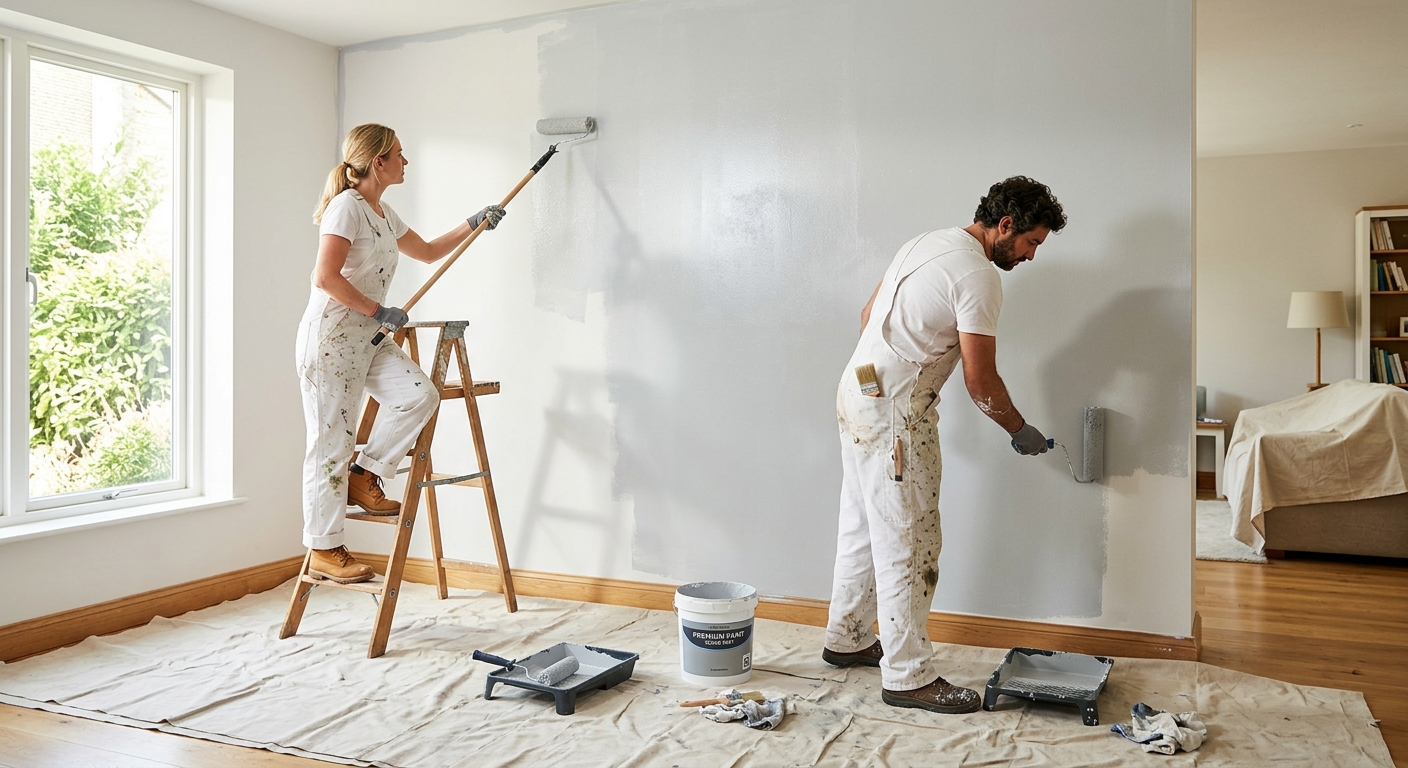
Painting options and costs in Rocky Mountain House
In Rocky Mountain House, choosing the right painting option usually comes down to how much prep your home needs and how tight the weather window is for exterior work. With 44.5% of dwellings built before 1981 (Statistics Canada, 2021 Census), many homeowners deal with older coatings, hairline cracks, and uneven surfaces that demand more scraping, caulking, patching, and spot-priming before finish coats go on. That extra labour can materially shift the price even when the square footage looks similar on paper.
In the Banff–Jasper–Rocky Mountain House region, exterior painting is heavily schedule-dependent. Inland mountain and foothill conditions mean crews typically focus on short stretches of warm, dry weather, so when the season is busy, availability tightens and rates can firm up. Interiors are steadier year-round, but older trim profiles and repainted surfaces still require careful sanding and bonding primers to prevent peeling. You’ll also see strong demand around residential pockets like the downtown/core and surrounding neighbourhoods where older detached homes and rentals turn over more frequently, bringing repainting needs forward.
Below are realistic budget bands you can use to compare proposals. After the table, you’ll find a quick note on what makes these ranges move up or down for your exact project.
| Service |
What's Included |
Typical Duration |
Price Range |
| Interior — whole home (walls, ceilings, trim) |
Prep, patching as needed, sanding/scuffing, caulking, primer where required, 2-coat finish plan, masking, basic cleanup |
5–10 working days |
$3,500–$8,500 |
| Interior — per room (standard bedroom or living room) |
Prep, fill/sand, caulk trim, spot-prime stains/repairs, 2-coat walls/ceiling, light trim painting (as specified) |
1–3 working days |
$3,000–$6,000 |
| Exterior — full house (siding, trim, soffits) |
Surface inspection, power-wash, scrape/sand loose paint, caulk, prime bare spots, 2-coat exterior finish, masking, cleanup |
7–14 working days (weather-dependent) |
$4,500–$14,000 |
| Exterior — trim and accent colours only |
Prep and spot-priming on trim, 2-coat colour work, masking edges, basic cleanup |
3–7 working days |
$2,500–$7,500 |
| Kitchen cabinet painting (doors, frames, spray finish) |
Degrease, sand/scuff, bonding primer where needed, spray-ready prep, 2-coat finish, hardware masking (as applicable) |
5–12 working days (including dry times) |
$5,000–$18,000 |
| Specialty / faux finish (accent wall, texture) |
Surface prep for the effect, base coat and topcoats for longevity, protection, detail work |
2–5 working days |
$1,500–$6,000 |
Prices are estimates only and vary by project scope, site access and material selection.
What affects the price of painting in Rocky Mountain House
In Rocky Mountain House and the wider Banff–Jasper–Rocky Mountain House region, you can easily see 30–50% quote swings for what looks like the “same” job. The usual drivers are exterior timing, surface condition, access, and whether the contractor is pricing true prep and proper primer versus just rolling finish coats. Two homes with identical rooms can land far apart if one has stained ceilings, older wallpaper residue, or lots of patching, while the other is ready to sand and coat.
For exteriors, Alberta’s inland climate makes the season tightly weather-bound. In practice, exterior work is concentrated into short warm, dry windows when application temperatures are stable (roughly late spring through early fall). That compression is different from coastal BC, where rain and humidity require different product choices (like mildew-resistant systems) and careful moisture management—though for us, the scheduling pressure is often the bigger cost lever. When the window is short and crews are booked, rates can firm up within the exterior painting band of $4,500–$14,000.
Older homes throughout the region—nearly half built before 1981 (Statistics Canada, 2021 Census)—also push labour into prep. On repainting jobs, scraping and caulking can be 50–70% of labour before finish coats. A pre-1980 stucco edge, for example, often needs extra sanding and sealing at transitions; older detached houses with rough wood siding may need more priming and spot treatments. If you’re painting interior living space where the walls are already smooth, you might stay nearer the interior whole-home band of $3,000–$8,000; if ceilings are stained and trim needs crack repair, costs move toward the top end because bonding primer and extra coats are doing the heavy lifting.
| Price Factor |
Why It Matters |
Cost Impact |
| Surface prep — scraping, sanding, patching drywall or wood |
Adhesion depends on removing loose/failed coatings and smoothing repairs |
Often +15% to +40% on repainting due to labour time |
| Number of coats — 2-coat system over primer vs. 1 coat over existing |
Coverage and durability improve with primer where required and full 2-coat finish |
Can shift total cost by 10% to 25% |
| Paint quality tier — contractor-grade vs. premium (Benjamin Moore, Sherwin) |
Better pigments/resins can improve hide, washability and long-term colour stability |
Commonly +5% to +20% depending on coverage needs |
| Ceilings and trim — adds significant time vs. walls-only |
Ceilings require more masking, edging and cutting-in; trim needs careful prep |
Can add 15% to 35% to interior totals |
| Exterior season window — short season raises summer rates |
Weather limits application days; scheduling pressure increases crew cost |
Can move exterior projects by 20% to 45% |
| Lead-safe precautions — required for pre-1978 homes with lead paint |
Safe containment/disposal reduces risk when sanding/scraping older coatings |
Often +5% to +25% depending on testing and condition |
| Surface material — drywall vs. plaster vs. wood vs. stucco |
Different substrates need different primers and repair approaches |
Can add 10% to 30% if substrate is uneven or porous |
| Height and access — multi-storey exterior requires scaffolding or lifts |
Safe access adds labour, time and equipment costs |
Often +10% to +35% on larger profiles |
Permits & regulations in Alberta
In Alberta, painting typically does not require a permit for homeowners. What does change is how contractors handle health-and-safety practices on older surfaces. For homes built before 1978, health guidelines recommend testing for lead paint before sanding or scraping, and if lead is present, following lead-safe work practices (wet methods to limit dust, HEPA vacuuming, proper bagging and disposal, and controlling work areas). This is not usually a homeowner permit requirement, but it’s standard professional practice because older Rocky Mountain House coatings can fail during aggressive prep, creating higher dust risk.
Also, ensure your contractor is properly insured and compliant: they should carry liability insurance and workers’ compensation coverage (WSIB/WCB) for their employees. Before work starts, ask for a written contract that clearly specifies the paint brand and sheen, number of coats, which surface prep steps are included (scrape/sand, caulk, primer on bare spots, stain blocking if needed), and what’s excluded (for example, inaccessible repairs behind fixtures).
To verify coverage step-by-step in Rocky Mountain House:
- Search the contractor’s information through Alberta’s public business/contractor listing channels and confirm the legal entity matches your contract.
- Request a current certificate of insurance (liability) and confirm it’s active for the job dates.
- Ask for proof of WSIB/WCB coverage (or equivalent account confirmation) and verify it matches the employer listed on the quote.
- Look for a lead-safe plan in the scope if your house is pre-1978 (containment, wet methods, HEPA vac, disposal).
- Require a written scope: paint system details beat vague “2 coats” promises.
Interior vs exterior painting — getting the best result in Rocky Mountain House
The difference between a long-lasting paint job and a premature failure in Rocky Mountain House is mostly prep discipline and system choice for the local conditions. For interior work, it’s less about finding the “most expensive” topcoat and more about getting the surface right: filling and sanding, removing contaminants, priming repaired or stained areas, and using caulking to smooth transitions. In daily life here, interiors see scuffs and washing from boots at entrances and everyday kitchen steam, so sheen matters. Flat hides imperfections but is harder to clean; eggshell and satin are usually more forgiving in living spaces, while semi-gloss on trim gives crisp edges and handles frequent wipe-downs.
For exteriors, Alberta’s freeze–thaw cycles and wind-driven drying make surface preparation and sealing non-negotiable. Loose paint must be scraped, chalky residue removed, and caulking applied before painting so water pathways are blocked at joints, fascia edges, and around trim. Primer selection depends on substrate: wood and patched areas often need a proper bonding primer, and different conditions may call for stain-blocking where tannins or old water marks bleed. While mildew-resistant products are more dominant in coastal BC, the practical takeaway for Rocky Mountain House is still the same—use a product system rated for the conditions and apply only when temperatures are in-range and surfaces are dry.
Cabinet painting is a smart budget alternative to replacement when boxes and hardware are sound; it often costs less than new cabinetry, but the finish quality depends on prep and spray-ready materials. For pre-1978 homes, lead-safe precautions can add time, but that’s what prevents dust and contamination during scraping.
In terms of dollars, a repainting interior project might land around $3,000–$8,000 for whole-home work, while an exterior full-house repaint is commonly $4,500–$14,000. The price gap is justified because exteriors combine weather-dependent scheduling, higher prep demands, and more material consumption—especially if older coatings require extensive scraping and priming.
| Project Type |
Key Prep Step |
Recommended Coats |
Price Band |
| Interior — fresh drywall (new construction) |
Prime properly and tape/compound sanding smoothness checks |
Primer + 2 finish coats |
$3,000–$7,500 |
| Interior — repaint (good condition, no repairs) |
Degloss/scuff-sand and caulk touch-ups, stain control only if needed |
1–2 finish coats depending on coverage; typically 2 |
$3,000–$6,500 |
| Interior — repaint (patching and priming needed) |
Patch sanding + bonding/stain-block primer on repairs |
Primer + 2 finish coats on repaired areas (full 2-coat finish commonly) |
$3,500–$8,000 |
| Exterior siding (wood or fibre cement) |
Scrape/sand loose paint, caulk, and prime bare/porous sections |
Primer + 2 exterior finish coats (system-dependent) |
$4,500–$14,000 |
| Exterior trim and accents only |
Edge prep and spot-prime where adhesion is compromised |
2 finish coats over primer on affected areas |
$2,500–$7,500 |
| Kitchen cabinets (spray finish) |
Degrease + scuff/sand + bonding primer for durable adhesion |
Primer + 2 finish coats (plus optional topcoat depending on system) |
$5,000–$18,000 |
How to choose a painting contractor in Rocky Mountain House
Choosing the right painter in Rocky Mountain House is mostly about proof: insurance, clear scope, and transparent quote details. Start by verifying liability insurance—ask for a current certificate of insurance and confirm the coverage is active for your project dates. Next, confirm WSIB/WCB workers’ compensation coverage by asking for documentation that matches the employer name on the quote. If you can’t get proof, that’s a major warning sign because your homeowner risk increases if something goes wrong on site.
Then get 2–3 itemised written quotes. The best quotes separate labour from materials and list what’s included in prep and coatings (for example: scrape loose paint, sand, caulk, prime bare wood, stain-blocking, and number of finish coats). Avoid quotes that only provide a single lump sum with “paint as needed” language—those are where scope gaps hide.
Read exclusions carefully: does the price include disposal, protect-and-mask requirements, and prep for hard-to-reach areas? For exterior jobs, ask whether the contractor includes the necessary wash/cleaning step and whether they’ll pause if weather conditions aren’t in-range for proper adhesion and curing. Warranty matters too: ask for workmanship warranty length and whether the product/manufacturer warranty is tied to proper surface prep and application.
Finally, payment schedule: never pay more than 10–15% upfront. Use a holdback until the job is complete and touch-ups are done, then request the final inspection. Ask for a written start date and an estimated completion window based on the forecast and prep time.
- Verify liability insurance with an active certificate covering your job dates.
- Confirm WSIB/WCB coverage for the contractor’s employees.
- Request an itemised quote: labour hours, prep tasks, number of coats, and product lines.
- Make sure surface prep is written in the scope, not implied.
- Ask what they do if they uncover failing coatings or hidden moisture damage.
- Confirm disposal/mess cleanup is included (brushes, masking, debris, caulking waste).
- Get a written paint system: brand, sheen, and where primer/stain blocker is used.
- Require caulking details (which joints/edges are caulked before painting).
- Ask how they protect landscaping, windows, and entryways during exterior work.
- Insist on a clear schedule: start date, duration estimate, and weather contingencies.
- Use a payment schedule with a holdback until punch-list items are finished.
- Confirm warranty: workmanship duration, how defects are handled, and product warranty conditions.
Red flags I commonly see with low bids in Rocky Mountain House: (1) “two coats” without stating what primer or stain-block is used, (2) no proof of WSIB/WCB coverage or liability insurance, (3) vague scope that skips scraping/caulking/power washing on exteriors, (4) requests for large upfront payments, and (5) refusal to put the warranty and paint brands in writing.
Frequently asked questions — painting in Rocky Mountain House
Do I need to worry about lead paint in an older Rocky Mountain House home?
In Rocky Mountain House and across Alberta, the concern is real mainly for homes built before 1978, because older coatings may contain lead. While a permit usually isn’t required for painting, health guidelines recommend lead testing before sanding/scraping and lead-safe procedures if lead is present. For example, professional contractors typically use wet methods to control dust, HEPA vacuuming, sealed containment of the work area, and proper disposal of sanding debris. This is why two quotes can differ: lead-safe prep often costs more upfront, but it reduces risk during work. If your home is in the older housing stock group (44.5% built before 1981 in the area; Statistics Canada, 2021 Census), ask for the contractor’s lead-safe plan and confirm it’s written into the scope.
How long does it take to paint a house?
Timing depends on whether you’re doing interior or exterior and how much prep your home needs. Interior whole-home painting in Rocky Mountain House often takes about 5–10 working days because crews still need to move through patching, sanding, priming, cutting-in and then full dry/coat schedules. Exterior work is more weather-dependent in the Banff–Jasper–Rocky Mountain House region, so even if the crew can paint quickly, application only happens during warm, dry conditions. As a budget reference, exterior full-house painting commonly falls in the $4,500–$14,000 band, and the duration (often 7–14 working days) can stretch when the season is short or humidity/wind isn’t cooperative. Good contractors plan for cure times and don’t rush coats to beat the forecast.
What's the difference between paint quality tiers?
Paint “tiers” usually reflect pigment quality, resin technology, and how consistently the paint covers. Higher-tier contractor-grade or premium lines tend to offer better hide (so fewer coats), smoother leveling, and improved durability in real conditions—like wall scuffs from daily life or more frequent cleaning around kitchens. In Alberta, where temperature swings and freeze–thaw affect exteriors, using a system designed for the substrate and conditions matters more than chasing the cheapest can. That’s why exterior quotes—often $4,500–$14,000—can vary even when the house size is similar: prep level, primer choice, and product tier all change the amount of paint needed and the likelihood of long-term adhesion and colour stability.
How do I compare painting quotes?
Start by comparing scope, not just total price. Ask each contractor for an itemised breakdown (labour and materials) and written confirmation of surface prep tasks: scraping loose paint, sanding, patching, caulking, power washing for exteriors, and where primer/stain blocker is included. Make sure the number of coats is spelled out (a true 2-coat finish system over proper primer usually outperforms “one thick coat”). Also check materials: paint brand and sheen, and whether they’re using appropriate primers for your siding/drywall/plaster. For budgeting, you can sanity-check against typical ranges like interior whole-home work at $3,000–$8,000 and exterior full houses at $4,500–$14,000. If one quote is dramatically lower, it’s often skipping prep or excluding something like disposal or weather-related allowances.
What paint sheen should I use in different rooms?
Sheen is mainly about cleanliness and how much surface imperfection you can see. In Rocky Mountain House homes, living rooms and bedrooms often work well with eggshell for walls because it balances washability with a softer look. Kitchens and bathrooms typically benefit from a higher washability sheen (often satin or a kitchen/bath-ready coating), especially where you wipe down grease or moisture. Trim and doors generally use semi-gloss or similar enamel-like sheen because it cleans well and highlights sharp edges. Ceilings often look best with flat or ceiling-rated matte to minimize roller marks, but the key is matching sheen to the surface and ensuring you’re using primer correctly—especially over patches. If your contractor’s sheen choices aren’t written into the contract, ask for them.
Can I paint my house exterior in spring or fall in Rocky Mountain House?
You can sometimes paint in spring or early fall, but in Rocky Mountain House the deciding factor is surface and air temperature plus dryness—not the calendar date. Exterior painting in the Banff–Jasper–Rocky Mountain House region is tightly weather-bound, and contractors need warm, dry conditions so the paint can cure and bond properly. If it’s too cold, damp, or wind-chilled, you can get poor adhesion, longer dry times, or uneven finish. Late spring/early fall can work when daytime conditions are stable, but a responsible contractor will pause if weather isn’t suitable. If you’re comparing bids for exterior work, ask how they handle short weather windows and whether the quote assumes full-day dry conditions for application and recoat timing. That’s one reason exterior projects often fall within $4,500–$14,000.