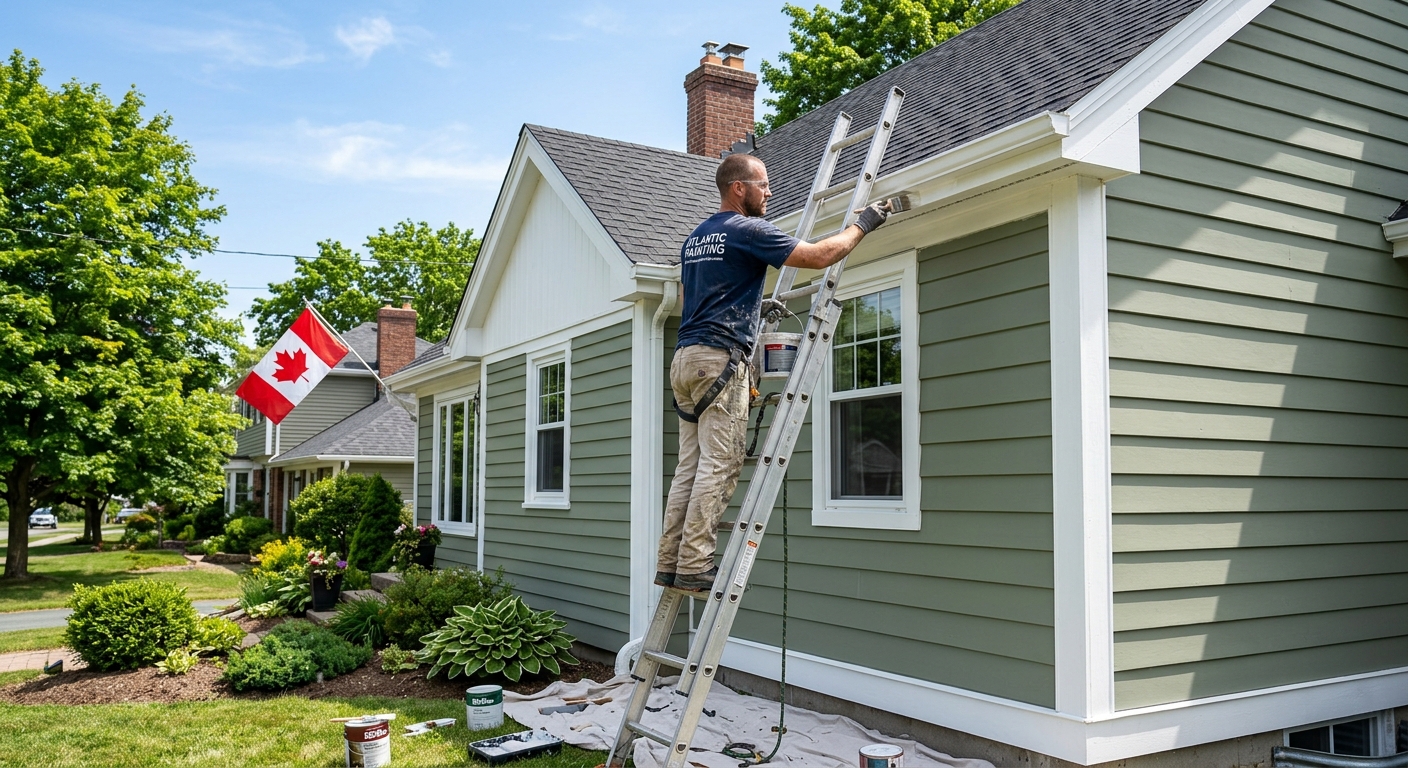
Painting options and costs in Royal Oak
Painting in Royal Oak is all about timing, prep quality, and matching the right products to Alberta’s freeze–thaw swings and strong UV. With Royal Oak’s population at 11,580 (Statistics Canada, 2021 Census), there’s solid year-to-year demand, especially from homeowners in established pockets where repainting cycles are due. A key cost driver is housing age: across the Calgary economic region, many homes were built between the 1960s and 2000s, which usually means older substrates, past DIY touch-ups, and more time spent on scraping, patching, caulking, and priming before any top-coat goes on. In pre-1978 homes, lead-safe precautions may also be needed during prep (testing is recommended when lead risk is suspected).
In Calgary-area conditions, our exterior painting window is typically mid-May to late September, when daytime temperatures reliably stay above 10°C and surfaces can dry properly. That short, weather-dependent season compresses demand and makes summer scheduling firmer than shoulder months. Interiors are less seasonal, but labour costs still swing based on access, ceiling heights, prep complexity, and how much trim work is included. Trades are often especially busy in and around the Royal Oak community core, where many homes are owner-occupied and repaints are planned for curb appeal ahead of winter.
Below are realistic budget ranges you can use to compare quotes—then we can tighten the numbers after a site visit and a quick assessment of your surface condition and access constraints.
| Service |
What's Included |
Typical Duration |
Price Range |
| Interior — whole home (walls, ceilings, trim) |
Protect floors and fixtures, patch/sand, prime as needed, paint walls and ceilings, caulk where appropriate, paint baseboards/trim; one colour change set-up |
5–10 business days |
$3,500 – $8,000 |
| Interior — per room (standard bedroom or living room) |
Protect surfaces, prep minor holes and scuffs, prime as needed, paint walls; optional trim touch-ups depending on scope |
1–3 business days |
$400 – $1,800 |
| Exterior — full house (siding, trim, soffits) |
Wash and prep, scrape/sand peeling areas, caulking, spot-priming, full exterior top-coats; includes coordination around weather |
1–3 weeks (weather-dependent) |
$2,500 – $9,000 |
| Exterior — trim and accent colours only |
Masking, prep localized areas, spot-prime, paint trim/accents; siding wash typically included if required by adhesion |
3–7 business days |
$900 – $4,500 |
| Kitchen cabinet painting (doors, frames, spray finish) |
Degrease, remove/label doors, light sanding, bonding primer as needed, spray finish system for durability, re-install and hardware alignment |
5–12 business days (includes cure/turnaround) |
$800 – $7,000 |
| Specialty / faux finish (accent wall, texture) |
Surface preparation for the finish system, specialty application, protective top-coat as required |
2–6 business days |
$600 – $3,500 |
Prices are estimates only and vary by project scope, site access and material selection.
What affects the price of painting in Royal Oak
In Calgary and across Alberta, two quotes for the “same” paint job can differ by 30–50% because the labour math changes with prep, access, and product specification—not just the colour. Exterior work is the biggest swing: our workable season is tightly climate-bound in the Calgary region, typically mid-May to late September, with reliable drying when daytime highs stay above 10°C. Short seasons concentrate demand, so summer rates are firmer and gaps can mean rescheduling pressure. Coastal BC can look attractive for flexibility, but high humidity and rainfall require mildew-resistant product choices and more wait-time, which also affects labour.
Prep is where cost is often won or lost in Royal Oak. With many homes dating from the 1960s–2000s, surface condition is frequently mixed: peeling edges, chalky old paint, filled nail pops, and caulk failures. On a repaint, scraping, sanding, patching, caulking, and stain-blocking can represent 50–70% of total labour. That’s why a “basic exterior repaint” can land near the lower end, while a home with multiple failed coatings and trim rot treatment can push toward the upper end of the $2,500 – $9,000 exterior band.
Concrete local examples: (1) A two-storey home near the Royal Oak area with difficult ladder access often adds scaffolding or lift time, moving labour toward the top of interior ranges like $400 – $8,000 for full homes. (2) If your stucco or fibre cement shows hairline cracks, caulking and re-sealing details become non-negotiable—small areas can still take longer than homeowners expect. (3) If you need cabinet repainting, grease management and a durable spray finish system are labour-intensive; that’s why the cabinet range can climb quickly toward the higher end when prep is extensive.
| Price Factor |
Why It Matters |
Cost Impact |
| Surface prep — scraping, sanding, patching drywall or wood |
Determines adhesion and smoothness; older or previously painted surfaces often need more work |
Can be 50–70% of exterior repaint labour |
| Number of coats — 2-coat system over primer vs. 1 coat over existing |
Proper systems hide better and resist Alberta UV and temperature cycling |
Often adds 10–25% labour/material cost |
| Paint quality tier — contractor-grade vs. premium (Benjamin Moore, Sherwin) |
Higher-quality products typically offer better coverage, durability, and washability |
May shift total by 5–20% depending on house size |
| Ceilings and trim — adds significant time vs. walls-only |
Cutting-in, masking, and detailed brushing/spraying take longer than wall coverage |
Commonly increases interior costs by 15–35% |
| Exterior season window — short season raises summer rates |
Weather and drying requirements affect scheduling and daily throughput |
Can add firming premium during peak weeks |
| Lead-safe precautions — required for pre-1978 homes with lead paint |
Safety procedures can increase prep time and require containment/HEPA cleanup |
Typically adds 10–30% when lead risk is confirmed or likely |
| Surface material — drywall vs. plaster vs. wood vs. stucco |
Each substrate needs a different prep and primer approach for adhesion |
Can swing labour by 10–25% |
| Height and access — multi-storey exterior requires scaffolding or lifts |
Setup time and safety requirements increase labour and equipment days |
May add several hundred to over $1,500 depending on scope |
Permits & regulations in Alberta
In Alberta, painting typically does not require a permit. For homes built before 1978, health guidelines recommend testing for lead paint before sanding or scraping, and using lead-safe work practices if lead is present (for example: wet methods to reduce dust, HEPA vacuuming, and proper disposal). This isn’t generally enforced as a “homeowner permit” requirement, but it is standard professional practice because the cleanup and containment are what protect your family and the jobsite.
What DOES require permits is usually not “painting” itself but related work that can trigger permits—such as structural alterations, electrical/plumbing changes, or HVAC modifications, depending on scope. For a straight paint-and-repaint project, you generally do not need a permit, and the critical compliance item becomes worker coverage and safe prep.
For a Royal Oak homeowner, verify your contractor step-by-step:
- Alberta licence/registration: confirm the contractor is in good standing on the appropriate provincial business/contractor listings (search the contractor name and verify status).
- Liability insurance: request a current certificate of insurance and confirm coverage limits and effective dates.
- WSIB/WCB coverage: ask for proof of workers’ compensation coverage (for employment-related coverage, confirm it applies to the workers on your site).
- Written contract: ensure it specifies paint brand and sheen, the number of coats, and surface prep inclusions (patching, caulking, priming types, and what “spot prime” means on your surfaces).
- Lead-safe process: if your home is pre-1978, have the contractor outline dust control and cleanup steps, plus how they’ll handle disposal if lead is found or likely.
Interior vs exterior painting — getting the best result in Royal Oak
The difference between a long-lasting paint job and a premature failure in Royal Oak usually comes down to prep discipline and correct systems—not colour. For interiors, surface prep is more important than the brand of topcoat. That means filling and sanding properly, removing contaminants (especially kitchens and hallways), priming repaired areas, and using caulk where movement is expected. Sheen matters too: flat is forgiving for ceilings, eggshell is common on low-traffic walls, satin/eggshell are better for family rooms, and semi-gloss is often used on trim for wipeability. Two proper coats over a primer consistently outlasts “one thick coat” because film build and coverage are uniform.
For exteriors in Alberta, the failure points are more about water ingress and adhesion under temperature cycling. Caulking should be done before painting so seals cure properly and you don’t trap water behind old failure lines. Primer selection depends on substrate and condition—oil-based primers may be needed for certain staining or adhesion issues, while latex primers are common when adhesion and compatibility are confirmed. Products also must handle local conditions: Alberta’s UV and freeze–thaw demand elastomeric or flexible coatings for appropriate exterior details when needed, plus mildew-resistant options for any shaded or moisture-exposed areas.
Cabinet painting is a solid budget alternative to replacement when the box is square and the existing surface is sound. If your cabinets are peeling or heavily greased, prep time rises—so the “cheap option” can backfire. For pre-1978 homes, lead-safe precautions should be integrated into drywall/trim prep before sanding or scraping begins.
Example: if a full exterior repaint is quoted near $2,500 – $9,000, choosing a contractor who invests in caulking and correct priming can be worth the extra cost because it protects the investment over multiple seasons. Skipping prep might look less expensive today but often shows up as peeling or flashing within the next year or two in a climate that cycles temperatures and drives moisture into cracks.
| Project Type |
Key Prep Step |
Recommended Coats |
Price Band |
| Interior — fresh drywall (new construction) |
Prime bare drywall thoroughly and fill/sand seams for smooth finish |
1 primer coat + 2 top-coats |
$1,200 – $6,500 |
| Interior — repaint (good condition, no repairs) |
Clean lightly, scuff-sand where needed, spot-prime trouble areas |
1–2 top-coats (often 2 for consistent colour) |
$400 – $3,500 |
| Interior — repaint (patching and priming needed) |
Patch, sand, and prime repairs to prevent flashing and uneven sheen |
1 primer (spot/full as needed) + 2 top-coats |
$800 – $8,000 |
| Exterior siding (wood or fibre cement) |
Scrape peeling areas, sand edges, caulk cracks, and prime properly for adhesion |
2 top-coats (with primer as required) |
$2,500 – $9,000 |
| Exterior trim and accents only |
Masking and localized prep (spot-prime bare spots, fix failed caulk) |
2 top-coats for even sheen and coverage |
$900 – $4,500 |
| Kitchen cabinets (spray finish) |
Degrease thoroughly and use bonding primer for adhesion |
Primer + 2 spray top-coats (system dependent) |
$800 – $7,000 |
How to choose a painting contractor in Royal Oak
Start with verification. In Alberta, you should be able to confirm the contractor’s standing and collect proof of coverage before any work begins. Ask for: (1) an up-to-date certificate of insurance for liability (confirm effective dates and that it covers work at your address), and (2) proof of workers’ compensation coverage (WSIB/WCB) for the crew doing your job. If they can’t provide these documents quickly, that’s a serious process risk.
Next, get 2–3 itemised quotes. You want a breakdown that separates labour and materials, and clearly lists prep tasks (scraping, sanding, patching, priming), coatings (brand and sheen), and how many coats are included. Avoid lump-sum quotes that don’t specify what’s actually being done—especially for older homes where prep can be extensive.
Read the scope line-by-line: what’s excluded (existing mould, severe rot, major carpentry, furniture moving), what disposal is included, and whether masking/protection is comprehensive. Confirm whether permits are handled if any related work requires one (painting itself usually doesn’t, but contractors should clarify responsibility if something adjacent is discovered).
Finally, review warranty and schedule. Ask for a workmanship warranty length, whether product/manufacturer warranties apply, and if the warranty is transferable to the next homeowner. For payment, don’t agree to pay more than 10–15% upfront; use a holdback until the job is complete and cleaned. Get a start date and completion estimate in writing—especially for exterior work where the weather window in the Calgary region can tighten scheduling.
- Ask for liability insurance certificate and verify the address/jobsite coverage.
- Request proof of WSIB/WCB coverage for the crew who will be on site.
- Confirm paint brand, sheen, and product line in writing (not just “premium paint”).
- Make sure prep scope includes scraping, sanding, patching, and priming criteria.
- Check how caulking is handled around trim and exterior seams (when it’s applied and how it’s rated).
- Confirm how colours are selected and who verifies samples on-site.
- Look for detailed protection: floors, landscaping, eaves/soffit areas, and hardware handling.
- Verify disposal and cleanup responsibilities (especially dust control for any older materials).
- Ask how they manage weather interruptions for exteriors (rain stops, cure times, re-scheduling fees).
- Review the warranty wording—workmanship length and what qualifies as a defect.
- Use a staged payment plan with a holdback until punch list is complete.
- Get a written timeline with estimated start date and weather contingencies for exterior work.
Red flags in Royal Oak include: quotes that don’t specify coat counts or primer requirements, contractors who won’t provide insurance/WSIB/WCB proof, “one-coat” promises over repaired or previously failed areas, no written protection plan for floors and landscaping, and a payment demand that’s too high upfront (beyond 10–15%).
Frequently asked questions — painting in Royal Oak
How long does exterior paint last here?
In Royal Oak and the broader Calgary area, exterior paint longevity is strongly tied to prep and the details around seams. With proper scraping, caulking, and priming, a well-done repaint commonly holds up for several years, but failures often start at cracks and poorly prepped edges where moisture can creep in during freeze–thaw cycles. The usable exterior window (mid-May to late September, with reliable drying above 10°C) also affects application quality—rushing coats due to weather can shorten service life. If you’re considering pricing, a full house exterior often falls within $2,500 – $9,000, and the spread typically reflects how much surface failure needs treatment before top-coats go on.
Should I paint or replace my cabinets?
In many Royal Oak homes, cabinet painting is the more cost-effective option when the cabinet boxes are solid, the doors are not warped, and the finish isn’t heavily failing over large areas. Painting (usually a spray-finish system) can restore the look without demolition, but it requires thorough degreasing, sanding, and bonding primer to ensure adhesion and prevent peeling. If your cabinets are structurally worn, missing hardware components, or have deep water damage, replacement may be better. A cabinet repaint commonly sits in the $800 – $7,000 range depending on door count, condition, and finish level; the key is whether prep is straightforward or whether you’re paying for extensive repairs and specialized primers.
How do I prep walls before painting?
Good prep is mostly about creating a clean, stable surface for bonding. For homeowners, start by removing dust and grease (especially near kitchens), and fixing loose paint—if paint is flaking, it needs to be scraped back and sanded before priming. Fill small holes and scuffs with spackle, sand smooth, and wipe residue so it doesn’t show through the finish. For patching, the critical step is spot-priming repaired areas; skipping primer commonly causes flashing. In Royal Oak, where temperature shifts and interior humidity can vary seasonally, prepping properly helps the two-coat system perform. If the scope is larger, pros handle the detailed prep and primer selection as part of the interior range that can run up to $400 – $8,000 depending on the number of rooms and trim work.
Do I need to worry about lead paint in an older Royal Oak home?
If your home is pre-1978, lead-safe precautions should be treated as the responsible baseline. Alberta doesn’t generally require permits for painting, but health guidelines recommend testing for lead before sanding or scraping where risk is suspected. If lead is present, professional lead-safe work practices typically include wet methods to reduce dust, HEPA vacuuming, and proper disposal procedures. Homeowners aren’t usually required to follow these exact protocols as a legal mandate, but contractors should—especially when sanding or scraping older trim and siding. In a quote, ensure the contractor explains dust control and cleanup steps. That preparation can affect pricing and timelines, and it may move the project toward the higher end of relevant bands such as $2,500 – $9,000 for exterior repainting.
How long does it take to paint a house?
For Royal Oak, interior timelines are usually more predictable than exterior because Alberta weather mainly affects drying and scheduling outdoors. A whole interior repaint (walls, ceilings, and trim) commonly takes about 5–10 business days, depending on room count, ceiling heights, and how much patching/priming is required. Exteriors are more weather-dependent; even with a strong crew, a full exterior repaint can take 1–3 weeks because we must coordinate around rain and overnight lows to ensure surfaces can dry properly. Cabinet painting tends to be schedule-heavy as well—expect roughly 5–12 business days for prep, spray application, cure time, and re-install. If you’re getting quotes, use the stated timeframes as estimates and confirm how weather delays are handled.
What's the difference between paint quality tiers?
Paint quality tiers generally differ in coverage, durability, resistance to scuffing and washing, and how evenly the product lays down. Contractor-grade paints can be suitable for some interiors, but premium lines (commonly brands like Benjamin Moore or Sherwin in many markets) often provide better hide, smoother application, and longer-lasting performance—especially in high-touch areas and on exterior details exposed to UV and temperature cycling. The tier also affects how many coats are needed to achieve uniform colour and sheen. In Calgary-area projects, skipping proper primer or reducing coat count to save money can cost more later. Budget accordingly using the local bands—interiors can range from $400 – $8,000, while exteriors typically land in $2,500 – $9,000—and choose quality where it matters most: prep, adhesion, and correct film build.