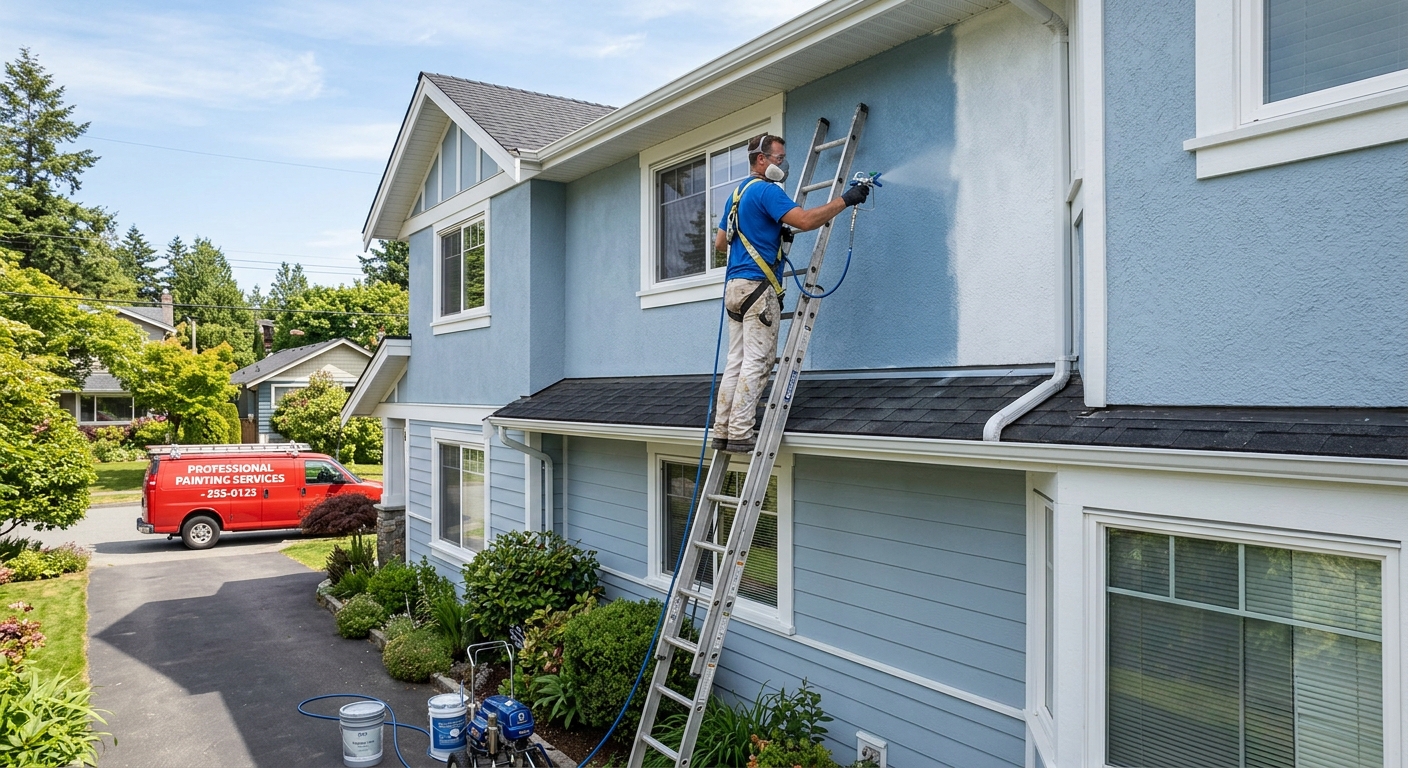
Painting options and costs in Victoria-Downtown
In Victoria-Downtown, your painting options typically come down to interior refreshes, exterior repaints, and specialty updates like trim accents or kitchen cabinets. Many older buildings sit in the core neighbourhoods—Victoria-Downtown’s housing stock includes a meaningful share built before 1980—so homeowners often face more prep than they expect: scraping weathered surfaces, repairing trim and siding, caulking gaps, and priming where the original coating has failed. If your home dates back to pre-1978 construction, professional crews also plan for lead-safe work methods during sanding or scraping, even though it’s not something most owners think about until the prep stage.
On Vancouver Island and the Coast, exterior work is tightly tied to weather windows. Crews aim for the drier late-spring to early-fall period when temperatures are roughly between 10°C and 30°C and humidity is manageable, because coatings need several dry hours and at least a full day above 10°C to cure properly. Coastal BC’s frequent rain, morning dew, and higher humidity can create scheduling pressure, which is one reason exterior pricing stays higher in peak season. In areas like Cook Street Village and adjacent downtown blocks, demand concentrates around summer access and resident-friendly scheduling, pushing labour and materials planning to the front.
Below is a practical cost comparison to help you benchmark quotes before you ask contractors for an itemised breakdown by surface prep, labour, and coating system.
| Service |
What's Included |
Typical Duration |
Price Range |
| Interior — whole home (walls, ceilings, trim) |
Protect floors/fixtures, patch minor drywall issues, sand/scuff where needed, prime, paint walls/ceilings, caulk where required, basic trim prep and coat(s) |
5–10 days |
$3,800–$6,500 |
| Interior — per room (standard bedroom or living room) |
Cut-in and roll walls, prep/scuff as needed, prime where required, paint 1–2 colours, include trim caulking; excludes major repairs and extensive plaster work |
1–3 days |
$2,000–$4,200 |
| Exterior — full house (siding, trim, soffits) |
Pressure wash (as needed), scrape/sand failing paint, caulk joints, repair minor damaged areas, prime bare/bleeding spots, paint siding/trim/soffits |
2–4 weeks (weather-dependent) |
$5,500–$12,000 |
| Exterior — trim and accent colours only |
Mask/prepare carefully, spot scrape/sand, prime bare areas, caulk where required, paint trim rails/bands and accent zones; excludes full-surface repaint |
5–12 days |
$3,500–$7,800 |
| Kitchen cabinet painting (doors, frames, spray finish) |
Degrease, remove/label hardware, sand and spot-prime, spray or brush-finish with clear/protective topcoat, reinstall and re-hardware as needed |
5–12 business days |
$1,800–$5,000 |
| Specialty / faux finish (accent wall, texture) |
Surface prep for texture base, layout and application of finish, protective topcoat; includes consultation and sample/colour matching |
2–7 days |
$800–$4,500 |
Prices are estimates only and vary by project scope, site access and material selection.
What affects the price of painting in Victoria-Downtown
In Victoria-Downtown and across Vancouver Island and the Coast, it’s common to see quotes for what sounds like the “same” job land 30–50% apart. That gap usually comes from preparation scope, coating system quality, and how well a contractor can schedule around coastal conditions. In British Columbia, exterior pricing can jump when the season is busy: crews want the drier late-spring to early-fall window, with application temperatures roughly 10°C to 30°C and humidity that won’t trap moisture under the coating. Coastal rain, morning dew, and higher humidity also mean more careful timing and more emphasis on mildew-resistant, high-quality products—so the right paint system costs more, but it typically prevents early blistering or dark staining.
Interior quotes vary too, especially when the home has older finishes, textured walls, or detailed trim. Pre-1980 and pre-1978 properties in the region often require more surface prep—scraping, patching, sanding, caulking, and thorough priming—and prep can represent about 50–70% of labour on a repainting job. If your home is one of the many occupied dwellings where crews must work around residents and parking/access restrictions (Victoria-Downtown’s population is 46,309 as of the 2021 Census (Statistics Canada, 2021 Census)), the project also needs more protection and staging, which adds time.
Here are concrete examples of local cost drivers: a full exterior repaint can sit in the $5,500–$12,000 band when weather timing forces longer site coverage and the crew must do extra scraping and priming due to peeling at trim edges. Conversely, “trim and accent only” can remain in the $3,500–$7,800 range when the siding is sound and the prep stays limited. Interior projects can also swing: adding ceilings and trim pushes you toward the upper end of interior whole-home pricing in the $3,800–$6,500 range because masking, cut-in time, and sanding/caulking multiply.
| Price Factor |
Why It Matters |
Cost Impact |
| Surface prep — scraping, sanding, patching drywall or wood |
Prep determines adhesion; older/coastal substrates often need more repair and priming. |
High: can be 50–70% of labour on repaints. |
| Number of coats — 2-coat system over primer vs. 1 coat over existing |
Coverage varies by colour change and surface condition; proper systems prevent flashing. |
Medium to high: increases material and labour time. |
| Paint quality tier — contractor-grade vs. premium (Benjamin Moore, Sherwin) |
Higher-end coatings often cover better, resist mildew/staining, and last longer. |
Low to medium: more per gallon but may reduce rework. |
| Ceilings and trim — adds significant time vs. walls-only |
Masking, cutting-in, and detail work are time-intensive, especially with crown/rounded trim. |
Medium to high depending on complexity. |
| Exterior season window — short season raises summer rates |
When crews have fewer dry-weather days, scheduling pressure increases. |
Medium to high in peak months. |
| Lead-safe precautions — required for pre-1978 homes with lead paint |
Professionals use containment, wet methods/HEPA cleanup, and proper disposal if lead is present. |
Medium: extra time for controls and cleanup. |
| Surface material — drywall vs. plaster vs. wood vs. stucco |
Different substrates require different primers and sanding/patching approaches. |
Medium: material-specific labour and products. |
| Height and access — multi-storey exterior requires scaffolding or lifts |
Access systems add rigging time, safety checks, and sometimes permit/road-use coordination. |
High for tall or complex façades. |
Permits & regulations in British Columbia
In British Columbia, painting generally does not require a permit for typical interior or exterior coatings. That said, the “rules that matter” for Victoria-Downtown projects are health and safety practices, and good contracting documentation. For homes built before 1978, health guidelines recommend testing for lead paint before sanding or scraping, and using lead-safe work practices if lead is present—wet methods, HEPA vacuuming, proper containment/cleanup, and correct disposal. While homeowners are not usually required to do lead testing, professional contractors commonly plan for this to keep the job safe and to avoid contaminated dust.
What typically DOES require a permit: major structural work, exterior changes that alter building envelope elements (for example, replacing windows/doors under certain conditions), or work that triggers local permit processes tied to structural or envelope modifications. What typically does NOT: applying paint to existing surfaces, repainting trim/siding, patching small damaged areas, or repainting cabinets—these are typically normal trade work without painting-only permits.
To verify a contractor in Victoria-Downtown, check three things step-by-step. First, confirm their British Columbia business information using the relevant online registry for contractor status (look for the exact legal name matching their invoice). Second, ask for a current certificate of liability insurance and verify the coverage dates align with your project window. Third, request proof of workers’ compensation coverage (WSBC/WCB). Then, insist on a written contract listing the paint brand/line and sheen, number of coats, primer type, prep scope (scrape/sand/caulk/repair included or excluded), and disposal details.
Interior vs exterior painting — getting the best result in Victoria-Downtown
For long-lasting results in Victoria-Downtown, the difference between “great for a season” and “still looks good next year” is almost always preparation and correct product selection for our Vancouver Island climate. Inside, surface prep beats brand every time: patching, sanding, degreasing, and priming any stains or repaired areas. Choose sheen based on how the room is used—flat hides imperfections but marks easier; eggshell and satin handle scuffs better, while semi-gloss is common on trim and doors because it’s easier to clean. A proper primer plus two coats of topcoat almost always outlasts one thick coat, because the first coat binds the surface and the second evens sheen and colour.
Outside, coastal BC adds the extra challenge: you need the right approach to moisture management. Scrape back to stable coating (or to bare where required), caulk before painting so joints are water-sealed, and use the correct primer for the substrate (wood, fibre cement, stucco). Oil-based primer may be used selectively where adhesion or staining control demands it, while latex systems are common in many repaint situations when compatible. For our damp conditions, mildew-resistant, high-quality coatings help prevent dark staining and early mildew growth—especially on shaded elevations.
Cabinet painting is a good budget alternative to replacement when you’re ready for the prep—degreaasing, sanding, priming, and a durable finish. If you have pre-1978 materials and you’re sanding or scraping, treat lead-safe precautions as a standard part of prep planning.
As a reality check: upgrading from an interior repaint that’s closer to $2,000–$4,200 for a room to a whole-home scope near $3,800–$6,500 is usually justified when you’re matching sheen/colour consistency across multiple spaces and want ceilings and trim done properly with the same crew and coating system.
| Project Type |
Key Prep Step |
Recommended Coats |
Price Band |
| Interior — fresh drywall (new construction) |
Seal/prime for uniform absorption before topcoat |
Primer + 2 topcoats |
$3,500–$6,500 |
| Interior — repaint (good condition, no repairs) |
Degrease, scuff-sand, spot-prime any marks or sheen changes |
Spot primer as needed + 2 topcoats (1 sometimes for minor touch-ups) |
$2,000–$4,600 |
| Interior — repaint (patching and priming needed) |
Patch, sand flush, prime repaired zones to avoid flashing |
Primer on patches + 2 topcoats |
$2,800–$5,500 |
| Exterior siding (wood or fibre cement) |
Scrape failing paint, caulk joints, prime bare areas and repaired sections |
Primer + 2 topcoats (as required by substrate/condition) |
$5,500–$12,000 |
| Exterior trim and accents only |
Spot scrape/sand, caulk, prime bare or weathered edges |
Primer on exposed spots + 2 topcoats |
$3,500–$7,800 |
| Kitchen cabinets (spray finish) |
Degrease, sand, and fully prime to prevent peeling/adhesion failures |
Primer + 2 coats (plus optional clear/protective topcoat depending on system) |
$1,800–$5,000 |
How to choose a painting contractor in Victoria-Downtown
Choosing a contractor in Victoria-Downtown is about verification and clarity. Start with licensing/business status in British Columbia: use the online registry tools to confirm the contractor’s name matches their invoice and that they’re in good standing. Next, verify liability insurance—ask for a current certificate of insurance and check coverage dates and that it lists you as an interested party where possible. Then confirm workers’ compensation coverage through WSBC/WCB documentation (you want to see proof they’re insured for their workers).
When you request quotes, get 2–3 itemised written estimates—not lump-sum only. Ask for a labour + materials breakdown so you can compare prep (scraping/sanding/patching), primer type, caulking and disposal, plus the number of coats included. Read the scope line-by-line: confirm whether pressure washing is included, whether protection/masking is included for your floors and landscaping, and whether waste disposal and recycling are part of the price. For warranties, look for workmanship duration (how long they stand behind adhesion/peeling problems) and whether the manufacturer warranty applies to the product actually installed. Also ask if warranties are transferable if you sell.
Finally, protect your cash flow. Avoid large upfront payments; a payment schedule with no more than 10–15% up front is typical, and you should hold back until key completion items are finished. Get a start date and an estimated completion window in writing—especially for exteriors where coastal weather affects drying and curing.
- Confirm the exact legal business name on the quote matches the certificate/contract paperwork.
- Request and review a certificate of liability insurance before work begins.
- Verify WSBC/WCB coverage with documentation for the crew doing the work.
- Insist on itemised scope: prep, priming, caulking, coats, and material brands/lines.
- Ask what’s excluded (lead testing, major carpentry, stucco repairs, window work).
- Confirm disposal/recycling practices for old coatings and packaging.
- Require a written paint system: primer type, number of coats, and sheen selections.
- Check that ceilings and trim are included if you expect them—don’t assume.
- Ask how they handle colour matching and sample approval before coating.
- Review warranty details in writing: workmanship length and product coverage.
- Confirm access protections (floor coverings, masking, plant protection, cleanup).
- Set a payment schedule with a holdback and a written completion checklist.
Red flags I commonly see around Victoria-Downtown include: quoting without a detailed prep plan (especially for peeling exterior paint), vague wording like “one coat where needed” without primer details, refusal to provide insurance/WSBC/WCB documentation, demanding a large upfront payment, and delaying scope approval or gloss/colour decisions until after coating starts.
Frequently asked questions — painting in Victoria-Downtown
Should I paint or wallpaper my Victoria-Downtown home?
In Victoria-Downtown and across British Columbia, painting is usually the lower-risk option when your walls have patchwork, hairline cracks, or older texture variations. Paint allows you to control sheen and colour consistency room to room, and it’s easier to touch up after daily scuffs—especially with coastal humidity affecting bathroom/basement surfaces. Wallpaper can look fantastic, but it’s more sensitive to substrate condition; if the wall prep isn’t solid, seams can lift and patterns can misalign. If you’re debating costs, compare a typical interior room range of $2,000–$4,200 (paint) against wallpaper that often requires intensive labour for paste prep, alignment, and trimming. If you want a feature wall, a specialty paint finish can deliver a similar impact with less long-term maintenance.
How do I fix peeling exterior paint in Victoria-Downtown?
Peeling exterior paint is a “fix the system, not just the flakes” situation in Victoria-Downtown. Coastal moisture and failing prep often cause adhesion loss, so you want contractors to scrape back to stable coating (or to bare areas where necessary), then sand smooth, caulk where joints are opening, and prime any exposed substrate before applying the finish coats. A contractor should also address the reason the paint failed—such as moisture intrusion at trim edges—because repainting over loose coating leads to repeat peeling. Expect that prep can be a large cost driver; that’s why full exterior jobs commonly fall into the $5,500–$12,000 range depending on repairs and coating system. In pre-1978 homes, professional lead-safe practices are standard during sanding/scraping.
What colours add the most resale value in Victoria-Downtown?
For resale in Victoria-Downtown, buyers generally gravitate to clean, light-reflective neutrals that photograph well and feel bright in our coastal light. On exteriors, classic tones—soft whites, warm creams, muted greiges, and natural earth-inspired accents—tend to help homes look maintained without being overly trendy. For interiors, eggshell or satin on walls in off-whites and greiges pairs well with both modern and heritage features commonly found in older downtown housing. If you’re choosing a bolder colour, use it as an accent (doors, a single feature wall, or trim) to avoid limiting buyer appeal. The “best” colour choice matters less than consistent sheen and even coverage, which is why proper prep and a 2-coat system are so important.
How much does it cost to paint a house in Victoria-Downtown?
Costs in Victoria-Downtown depend mainly on whether you’re painting the full exterior, just trim/accents, or doing a whole interior. For a typical interior whole-home scope (walls and ceilings plus trim work), you’ll often see estimates in the $3,800–$6,500 range depending on repair needs and how much ceiling/trim detail is included. For full exterior painting (siding, trim, and soffits), coastal prep and weather-dependent scheduling commonly place projects in the $5,500–$12,000 band. If you’re only refreshing trim and accent colours, budgets are frequently lower, often around $3,500–$7,800. Because Vancouver Island’s exterior season is weather-dependent, booking early can help you avoid peak-season scheduling premiums.
How much does interior painting cost per room in Victoria-Downtown?
Per-room interior painting in Victoria-Downtown usually lands in the $2,000–$4,200 range for a standard bedroom or living room, assuming typical prep and good accessibility. Final cost changes if there are repairs, heavy patching, water stains that require stain-blocking primer, or extensive trim work (crown moulding, detailed built-ins, lots of doors). Two practical examples: repainting a room in good condition with minimal patching stays closer to the lower half of the range, while a room needing patching and priming generally moves upward because labour increases more than the paint material does. If you’re changing colour dramatically or switching from glossy to flatter surfaces, primer and extra coats may also increase the estimate.
When is the best time for exterior painting in Victoria-Downtown?
The best time for exterior painting on Vancouver Island is the late-spring to early-fall window when crews can reliably hit temperature and humidity needs. Contractors usually aim for periods roughly between 10°C and 30°C and plan around morning dew and forecasted rain, because coatings need dry time to apply and at least a full day above 10°C to cure properly. That weather reality makes scheduling tighter in summer—especially in downtown areas where access and resident coordination are more complex. Booking early is smart because demand compresses into a few months. If you’re dealing with peeling paint or pre-1978 surfaces, plan for additional prep and lead-safe practices so the crew doesn’t lose days waiting for drying conditions.