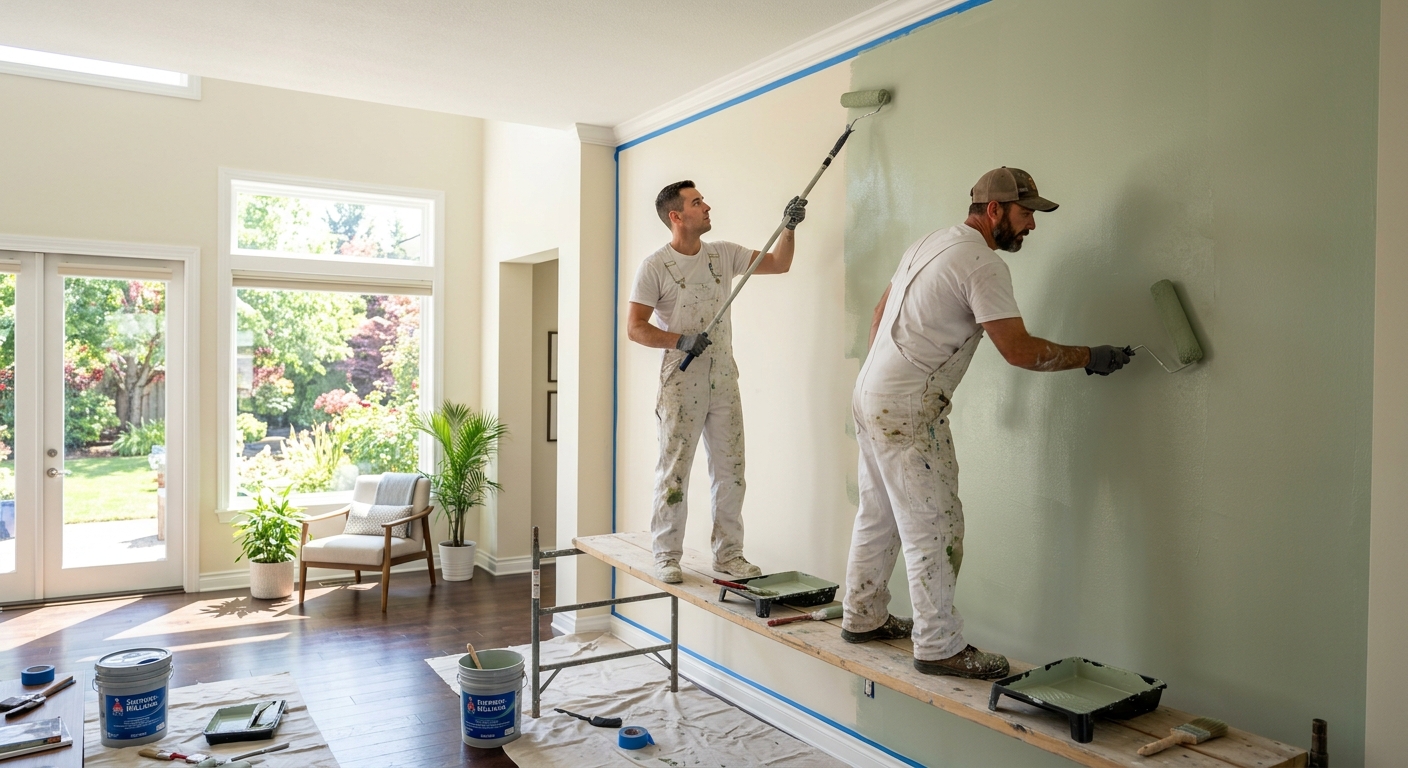
Painting options and costs in East Clayton
East Clayton homeowners typically have a lot of choice when it comes to paint type, finish, and project scope—and the cost swings mainly because prep time changes from house to house. In our area, many properties fall into the “repaint, not just repaint” category: older finishes often require scraping, patching settlement cracks, and stain-blocking before the first coat. In a city of about 15,000 people (Statistics Canada, 2021 Census), painting demand stays steady, and that keeps most contractors busy year-round, with crews shifting indoors during the wetter months. (Older housing stock also means pre-1978 lead-safe practices may be required on many exterior repaint jobs; that adds containment, cleanup, and disposal time.)
In the Lower Mainland–Southwest, exterior painting isn’t limited by deep cold as much as it is by rain, humidity, and mildew risk in coastal seasons. Painters must schedule around dry windows, use high-adhesion, mildew-resistant products, and often plan extra drying time—so weather “re-mobilization” is built into exterior pricing. Interior work is less weather-dependent, so fall and winter are commonly used for bedrooms, living areas, ceilings, and trim.
Where it’s especially busy in East Clayton is the central residential pockets along the main through-routes (where turn-over, renovations, and exterior curb appeal projects are frequent). If you’re comparing bids, use the table below to align scope first—then price.
| Service |
What's Included |
Typical Duration |
Price Range |
| Interior — whole home (walls, ceilings, trim) |
Protection, surface prep (minor patching), prime as needed, 2 coats on walls/ceilings, paint trim/enamel |
5–12 days |
$2,800–$8,500 |
| Interior — per room (standard bedroom or living room) |
Prep, patching (as needed), prime where required, 2 coats walls, 1 coat trim/enamel |
1–3 days |
$600–$1,800 |
| Exterior — full house (siding, trim, soffits) |
Wash, scrape loose coatings, caulking as required, prime bare spots, 2-coat system, cleanup |
2–6 weeks (weather-dependent) |
$3,900–$12,500 |
| Exterior — trim and accent colours only |
Prep and prime bare areas, caulk where needed, 2 coats on painted trim/accents |
1–3 weeks (weather-dependent) |
$1,200–$4,800 |
| Kitchen cabinet painting (doors, frames, spray finish) |
Degrease and degloss, sanding, bonding primer, spray-applied enamel, hardware masking |
5–15 working days |
$2,500–$6,500 |
| Specialty / faux finish (accent wall, texture) |
Surface prep, specialty base/texture coats, topcoat, colour matching and detailing |
2–7 days |
$900–$5,500 |
Prices are estimates only and vary by project scope, site access and material selection.
What affects the price of painting in East Clayton
In East Clayton and across the Lower Mainland–Southwest, two quotes for the same “room colour change” can differ by 30–50% because the scope often isn’t equivalent: one contractor may be including full bonding primer, extra sanding/patching, and proper stain-blocking, while another counts those as extras. That gap can be even wider compared with other provinces because labour costs, product availability, and weather constraints all affect how many days a crew can work and how much material goes into prep.
Exterior pricing is especially influenced by coastal BC scheduling. While Ontario and Alberta often plan exterior work around a clearer late May to early October application window (with temperatures safely above 10°C and rising), coastal conditions in British Columbia mean long shoulder seasons with rain and humidity. The season may be operationally “longer,” but higher mildew risk and frequent wet spells increase downtime and slow drying. In practice, crews spend more time re-checking moisture levels, selecting mildew-resistant, high-adhesion systems, and returning to finish when surfaces are properly dry.
Older homes across the Lower Mainland also raise costs because prep can be 50–70% of labour on a repaint. If your exterior has failing coatings, settlement cracks, or tannin bleed from wood trim, you’re paying for scraping, caulking, priming, and sometimes lead-safe containment on pre-1978 surfaces. For example, a repaint that lands near the exterior band of $1,200–$4,800 often stays trim-focused; once siding and soffits are included, projects commonly move toward the full-house band of $3,900–$12,500, because the crew’s time increases dramatically with access, repairs, and primer coverage.
In East Clayton specifically, two common cost swings are (1) whether you have peeling or chalking that needs fuller scraping, and (2) whether there are multiple paint failures that require more than one bonding step. Those differences are why itemized quotes matter as much as the final number.
| Price Factor |
Why It Matters |
Cost Impact |
| Surface prep — scraping, sanding, patching drywall or wood |
Prep controls adhesion and reduces early peeling and flaking |
Often 30–60% of labour |
| Number of coats — 2-coat system over primer vs. 1 coat over existing |
Proper coverage prevents patchy sheen and early colour burn-through |
Can change pricing by 10–25% |
| Paint quality tier — contractor-grade vs. premium (Benjamin Moore, Sherwin) |
Coverage, washability, and colour consistency affect total time/material use |
Typically 5–20% difference |
| Ceilings and trim — adds significant time vs. walls-only |
Ceilings and trim require masking, careful cutting, and higher attention |
Often +10–40% depending on detail |
| Exterior season window — short season raises summer rates |
Dry days are valuable; weather delays increase overhead |
Can raise exterior pricing 15–35% |
| Lead-safe precautions — required for pre-1978 homes with lead paint |
Containment, HEPA vacuuming methods, and disposal add time and materials |
Can add 10–30% for affected surfaces |
| Surface material — drywall vs. plaster vs. wood vs. stucco |
Different substrates need different primers and sanding approach |
Can swing labour by 10–25% |
| Height and access — multi-storey exterior requires scaffolding or lifts |
Safety setup affects schedule and crew efficiency |
Often +15–50% for tall homes |
Permits & regulations in British Columbia
In British Columbia, painting generally does not require a permit for typical interior or exterior repainting. Where regulation most often shows up is health and safety practice—not municipal permitting. For homes built before 1978, health guidelines recommend testing for lead paint before sanding or scraping, and using lead-safe work practices if lead is present. That means wet methods to reduce dust, HEPA vacuuming, containment where needed, and proper disposal. This isn’t legally mandated in the same way for homeowners, but it is standard professional practice for contractors because it protects you and their crew.
What typically does not require a permit: painting walls and ceilings, repainting siding and trim, staining a deck (unless part of a larger regulated work scope), and applying normal coatings. What can require extra approvals (not common for standard painting): any work that involves structural changes or covered building-envelope alterations beyond repainting scope—those are usually handled through separate permits/design requirements.
To verify your East Clayton contractor in BC, take three steps. First, confirm provincial registration/licensing where applicable through the public online tools provided by the province. Second, ask for a current certificate of liability insurance and ensure it matches your address and dates. Third, confirm workers’ compensation coverage (WCB/WSBC). Then require a written contract that specifies paint brand, sheen, number of coats, and exactly what prep steps are included (scrape, caulk, prime coverage, and disposal).
Interior vs exterior painting — getting the best result in East Clayton
The difference between a long-lasting paint job and a premature failure in East Clayton is usually prep and system choice, not just colour. For interiors, the #1 determinant is surface preparation: filling small dents, sanding for smoothness, and priming stains or patches. Sheen selection matters for durability and cleanability—flats in low-traffic areas, eggshell for many living rooms and bedrooms, and satin or semi-gloss on trim and higher-touch zones. Also, two coats over a proper primer almost always outperform one “thick” coat because the coverage and binder distribution are consistent.
For exteriors in the Lower Mainland–Southwest, prep is even more decisive. Moisture-related failures can start under failing coatings, so caulking before painting is critical to reduce water ingress at joints and trim lines. Primer selection matters too: different substrates (wood, fibre cement, old latex over old oil, and chalky surfaces) need different bonding primers to prevent peeling. And product choice should reflect local mildew risk—mildew-resistant, high-adhesion coatings designed for coastal humidity are the practical standard here.
Cabinet painting is a smart alternative to replacement when the box is solid. It typically costs less than a full kitchen refresh and delivers the biggest “new home” feel for the money—especially when spray technique is used for an even finish. If you’re dealing with pre-1978 exterior surfaces, remember lead-safe precautions can add cost and time, but they reduce dust exposure risk and improve cleanup quality.
To see where the price difference is justified: if a full interior repaint is quoted near the upper interior range (up to around $8,000 for a whole home), that’s often because ceilings/trim and more extensive priming are included. A lower quote may be walls-only or may skip bonding/stain-blocking—leading to faster rework in BC’s humid indoor climate and variable ventilation.
| Project Type |
Key Prep Step |
Recommended Coats |
Price Band |
| Interior — fresh drywall (new construction) |
Drywall dust removal, prime for uniform absorption, caulk gaps |
Prime + 2 coats walls/ceiling; trim as required |
$1,200–$3,800 |
| Interior — repaint (good condition, no repairs) |
Clean/degloss, light sanding, spot-prime if needed |
2 coats on walls; 1–2 on trim depending sheen |
$600–$2,600 |
| Interior — repaint (patching and priming needed) |
Patch and sand, feather edges, prime repairs and stains |
Prime repairs + 2 coats finish |
$900–$3,700 |
| Exterior siding (wood or fibre cement) |
Wash, scrape failing paint, prime bare spots, caulk seams |
Prime/bond + 2 finish coats |
$3,900–$12,500 |
| Exterior trim and accents only |
Mask carefully, scrape/prime bare trim, caulk joints |
Prime where needed + 2 finish coats |
$1,200–$4,800 |
| Kitchen cabinets (spray finish) |
Degrease, degloss, bonding primer, precise masking |
Primer + 2 finish coats (spray); glaze/topcoat if chosen |
$2,500–$6,500 |
How to choose a painting contractor in East Clayton
Start by verifying the three essentials for any contractor you’re hiring in British Columbia: licensing/eligibility where applicable, liability insurance, and workers’ compensation coverage. Ask for a copy of their certificate of liability insurance (ensure it’s current, not expired, and the coverage amount is appropriate for residential work). Then confirm workers’ compensation coverage (WCB/WSBC) by requesting evidence they’re registered and insured to work in BC. For licensing, use the province’s online registry tools to confirm status, business name, and any limitations—don’t rely on social media claims or verbal assurances.
Next, require 2–3 written, itemised quotes. For painting, I recommend they break costs into labour and materials and list prep scope clearly: scraping loose coatings, priming type, caulking included, disposal included, and whether ceiling work and trim are included. Scope clarity is what prevents surprises—especially on exteriors where weather windows affect schedule and cleanup.
Also check warranty terms. You should receive a workmanship warranty (often tied to proper surface prep and application conditions) and understand whether product/manufacturer coverage is separate. Confirm if any warranty is transferable if you sell your home. Payment matters too: never pay more than 10–15% upfront, and hold back a portion until the job is fully complete and cleaned.
Finally, ask for a written timeline with a start date target and an estimated completion window, especially for exterior work that depends on dry stretches.
- Insist on itemised labour/material breakdown, not a lump-sum only.
- Ask what prep is included (wash, scrape, sand, patch, prime, caulk, stain-block).
- Confirm paint brand, sheen, and system (primer + topcoat) are specified in writing.
- Verify disposal/cleanup responsibilities (paint debris, masking waste).
- Ask who handles moisture checks and weather-related scheduling for exteriors.
- Request proof of liability insurance and confirm policy dates.
- Request proof of workers’ compensation coverage (WCB/WSBC).
- Confirm any lead-safe procedures will be followed on pre-1978 surfaces if needed.
- Review warranty length for workmanship and whether it applies to exterior mildew issues.
- Confirm payment schedule: keep upfront to 10–15% max and use a completion holdback.
- Ask for a written start date and estimated completion range.
- Confirm how floors, landscaping, and belongings are protected and restored.
In East Clayton, a few red flags I see often: quotes that don’t specify primer brand/type or number of coats, “we’ll scrape only if we feel like it” language, no proof of insurance/WCB, a large upfront deposit (beyond 10–15%), and a vague warranty that doesn’t clearly cover prep-and-application workmanship.
Frequently asked questions — painting in East Clayton
Should I paint or wallpaper my East Clayton home?
For most East Clayton homes, painting is the safer, more predictable choice because you control prep and sheen—and updates are easier when you need touch-ups. Wallpaper can look great, but it’s less forgiving when there are hairline cracks or moisture issues in exterior-facing walls. In the Lower Mainland–Southwest, humidity swings can make surface conditions matter more, so the prep quality is the deciding factor either way. If you want a straightforward refresh budget, interior painting commonly lands in the $600–$1,800 per room band for typical bedrooms or living rooms, and it’s usually faster to schedule indoors during fall and winter.
How do I fix peeling exterior paint in East Clayton?
Peeling usually means adhesion has failed—so the fix is not “paint over it.” In East Clayton, the proper approach is to scrape loose and flaking coating back to sound material, sand feathered edges, then clean and prime bare spots with a bonding primer suited to the substrate. Caulking at joints and trim edges should be handled before topcoat so water can’t track behind the paint. Because BC’s rain and humidity can slow drying, contractors should only apply finish coats after surfaces are fully dry and stable. If your home is pre-1978, expect lead-safe practices (like containment and HEPA vacuuming) if testing indicates lead. That can affect cost and schedule compared with a simple refresh.
What colours add the most resale value in East Clayton?
In East Clayton, resale-friendly colours tend to be bright neutrals with warm or neutral undertones, plus crisp trim whites. This helps rooms feel larger and keeps lighting consistent through the year, which is useful in a coastal climate with shifting daylight. Avoid overly saturated colours on large wall areas if you want broad appeal—deep colours can be great as accents (e.g., an entry feature wall) if prep and sheen are done well. If you’re budgeting, interior painting for a single room often falls in the $600–$1,800 range, so it’s easier to do a conservative base colour across the home and treat personality with accent paint you can change later. For exteriors, maintaining siding/trim colour harmony and good contrast usually improves curb appeal.
How much does it cost to paint a house in East Clayton?
The total cost depends on whether you’re doing interiors, exteriors, or both, and how much prep is needed. For interiors, whole-home painting (walls, ceilings, and trim) commonly falls somewhere between the low-to-mid $2,800–$8,500 estimate range, with higher costs when there’s more patching, stain-blocking, and detailed trim work. For exterior full-house painting, expect wider variation because weather windows and prep intensity in the Lower Mainland–Southwest matter—typical estimates commonly sit in the $3,900–$12,500 band. Pre-1978 homes may also require lead-safe procedures on affected surfaces, which adds time for containment and disposal.
How much does interior painting cost per room in East Clayton?
Per-room interior painting in East Clayton typically lands in the $600–$1,800 band for a standard bedroom or living room when prep is normal (cleaning, minor patching, spot priming if needed) and you’re painting walls plus trim. Costs climb when you’re adding ceilings, dealing with heavy patching, or require more stain-blocking (nicotine, water marks, or patch transitions). If you want a whole-home interior refresh, that’s often more efficient to plan as a scope package, but the per-room pricing still helps you compare quotes. A good contractor will itemise whether primer, caulking, and trim painting are included, rather than burying those costs in a single number.
When is the best time for exterior painting in East Clayton?
The best time for exterior painting in East Clayton is during stretches of dry weather with stable temperatures—your contractor should schedule around weather windows rather than rely on the calendar alone. In the Lower Mainland–Southwest, rain and humidity can interrupt progress, and slower drying can increase the risk of mildew or poor adhesion if coats are applied too soon. While coastal BC can have a longer workable season than deep-winter regions, the practical reality is that crews need days that stay dry long enough for proper cure. That’s why you’ll often see exterior work planned in late spring and summer dry spells, with contingency for shoulder-season setbacks. If your home is pre-1978, planning earlier helps because lead-safe prep can add additional steps to the schedule.