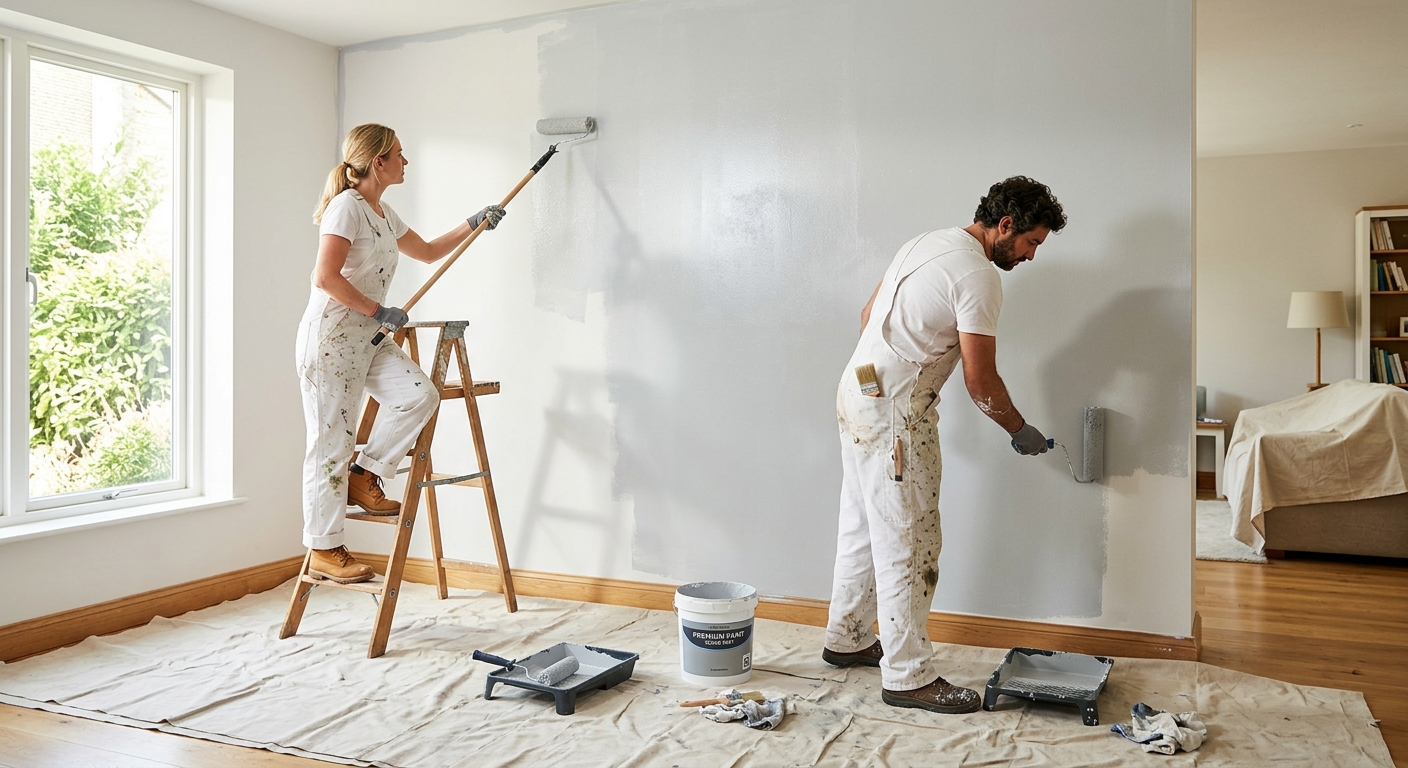
Painting options and costs in Strathearn
In Strathearn, Alberta, the “right” painting plan usually comes down to how much prep your surfaces need and how quickly weather allows the work to dry. Strathearn is a small community—2,622 residents as of the 2021 Census (Statistics Canada, 2021 Census)—and that can mean fewer available crews during peak weeks. Just as important, many nearby Calgary-area homes were built in earlier decades; when a repaint involves older trim and siding, you often see more scraping, patching, caulking, and priming before any finish coat goes on. In pre-1978 homes, contractors typically follow lead-safe practices if lead paint is suspected.
Calgary’s climate shapes the schedule and the price. For exteriors, crews generally need a workable window from mid-May to late September when daytime temperatures reliably stay above 10°C and surfaces can dry properly; freeze–thaw, strong UV, and hail risk also drive product selection and careful application. That shorter, weather-dependent window compresses demand, so summer bookings tend to be firmer than shoulder months.
We also see higher demand in and around the rural pockets connected to the Calgary commuting corridor—areas where homeowners prioritize curb appeal before listing or moving in. Once we confirm your surface condition and access, we can place your project into a clear cost range, shown in the comparison table below.
| Service |
What's Included |
Typical Duration |
Price Range |
| Interior — whole home (walls, ceilings, trim) |
Protect floors/furniture (as possible), prep and patch, caulk where needed, prime repaired spots, paint walls and ceilings, paint baseboards/door trim, cleanup and light touch-ups |
5–12 days |
$2,000–$6,500 |
| Interior — per room (standard bedroom or living room) |
Prep and patch, prime repairs, paint walls, paint ceiling, prep and paint trim (baseboards, window/door trim as accessible) |
1–3 days |
$400–$1,500 |
| Exterior — full house (siding, trim, soffits) |
Wash, scrape/sand, patch and caulk, spot-prime, prime where required, paint siding/brick components (per substrate), paint trim/soffits, and final cleanup |
3–7+ days (weather-dependent) |
$4,000–$9,000 |
| Exterior — trim and accent colours only |
Targeted prep of trim areas, caulk and spot-prime, paint accent trim and select details; excludes full siding repaint |
1–4 days (weather-dependent) |
$2,500–$6,000 |
| Kitchen cabinet painting (doors, frames, spray finish) |
Degrease, remove/label doors (if applicable), sand/abrade, bond primer (as needed), spray or brush finish for doors, repaint frames, reinstall and final hardware touch-up |
4–10 days |
$2,000–$7,000 |
| Specialty / faux finish (accent wall, texture) |
Surface prep and sealing, base coating, specialty system application (glaze/texture/technique), protection and cleanup |
1–5 days |
$600–$3,800 |
Prices are estimates only and vary by project scope, site access and material selection.
What affects the price of painting in Strathearn
In the Calgary region, you can see quotes for the “same” room or the same house exterior vary by about 30% to 50% once the real prep work is included. Contractors price for what they find: wall and trim condition, how many repairs are required, how much masking and protection is needed, and which coating system performs best on your exact substrate. Even the product line can shift the total—premium coatings cost more, but they can reduce repainting risk when UV and winter cycles are hard on finishes.
The exterior painting season is tightly climate-bound in Alberta. In the Calgary region, workable conditions are roughly late May to early October: daytime temps should stay above 10°C and surfaces must dry between coats. Coastal BC often has a longer period, but high humidity and rainfall complicate drying and mildew control. Here, that short season concentrates demand, so summer labour rates can firm up quickly.
Older homes across the broader area (including Strathearn-area properties) typically mean more surface prep—scraping loose paint, sanding, caulking cracks, patching wood rot or drywall damage, and priming stains. Prep can make up 50% to 70% of total labour on a repaint, which is why two quotes might look different even when the paint brand is the same. For example, a basic repaint might sit in the interior range near $400–$8,000 depending on how many rooms and repairs are needed, while a full exterior in good access conditions often starts around the lower end near $2,500 and climbs as substrate condition worsens.
In Strathearn specifically, expect cost increases when your exterior shows hail pitting, peeling around joints, or older caulk lines—each requires careful scraping and re-sealing before topcoat. If you have multi-storey access or heavy privacy landscaping around the walls, allow extra time for lifts/scaffolding and more protection.
| Price Factor |
Why It Matters |
Cost Impact |
| Surface prep — scraping, sanding, patching drywall or wood |
Loose coatings and damaged areas must be stabilized for adhesion; patching dictates sanding and feathering |
Often adds 20%–60% of the job cost depending on condition |
| Number of coats — 2-coat system over primer vs. 1 coat over existing |
Coverage and durability depend on proper build; stains and repairs usually require primer and extra passes |
Can swing totals by 10%–25% |
| Paint quality tier — contractor-grade vs. premium (Benjamin Moore, Sherwin) |
Higher solids and better pigments can reduce number of coats and improve UV resistance |
Typically 5%–20% difference, sometimes more on large exteriors |
| Ceilings and trim — adds significant time vs. walls-only |
Trim requires cutting/edge work and careful masking; ceilings increase setup and time |
Often 15%–40% depending on rooms and complexity |
| Exterior season window — short season raises summer rates |
Weather-dependent scheduling increases urgency and crew availability constraints |
Can raise exterior pricing several hundred to over a thousand on peak dates |
| Lead-safe precautions — required for pre-1978 homes with lead paint |
Testing and lead-safe controls change prep methods, cleanup time, and disposal requirements |
Often adds 10%–30% when lead-safe protocols are required |
| Surface material — drywall vs. plaster vs. wood vs. stucco |
Different materials absorb paint differently and need the right primer/finish compatibility |
Can add 10%–35% based on primer and prep needs |
| Height and access — multi-storey exterior requires scaffolding or lifts |
Access determines safety, productivity, and protection measures |
Often adds 15%–50% if lifts/scaffolding are needed |
Permits & regulations in Alberta
In Alberta, painting typically does not require a permit. For most homeowner interior and exterior painting, what matters is following safe work practices and using the correct coating system for the surface. That said, there are situations where lead-safe precautions become critical: for homes built before 1978 (common in older neighbourhood pockets across the Calgary region), health guidelines recommend testing for lead paint before sanding, scraping, or abrasive prep, and then using lead-safe work practices if lead is present. For professional crews, that usually includes wet methods, HEPA vacuuming, proper containment, and disposal procedures. While this is not something Alberta homeowners typically get a “permit” for, it’s standard due diligence for contractors.
What does require a permit in Alberta is generally not painting itself—it’s usually the underlying work that triggers permits (for example, major structural changes, electrical/plumbing work, or certain renovations). Painting-only scopes are normally permit-free.
To protect yourself in Strathearn, verify three things step-by-step:
- Alberta licence/registration: check the contractor’s business details on provincial online listings or their official documentation; confirm they operate as a legitimate painting business.
- Liability insurance: ask for a current certificate of insurance naming you (or confirming coverage) and confirm the policy is active for the work date range.
- WSIB/WCB coverage: request confirmation of workers’ compensation coverage so you’re not left exposed if someone is injured on site.
- Written contract: ensure it specifies paint brand (or equivalent), sheen, number of coats, prep inclusions/exclusions, and cleanup/disposal approach.
- Clear scope: confirm whether the contract includes any testing/lead-safe controls if pre-1978 surfaces are involved.
Interior vs exterior painting — getting the best result in Strathearn
Getting a long-lasting paint finish in Strathearn comes down to prep discipline first, then the right coating system for your climate exposure. Alberta winters, strong UV, and freeze–thaw cycles punish weak adhesion and poor sealing. When that happens, you don’t just get cosmetic issues—peeling and blistering can start at seams, caulking lines, and any spot where primer was skipped.
For interiors, surface prep is usually more important than the topcoat brand. That means filling and sanding until repairs are flat, then priming repairs and any stained areas so the finish colour doesn’t flash. Sheen choice also matters: flat looks best on low-traffic ceilings, eggshell/satin typically work well on walls, and semi-gloss on trim is easier to clean. A key durability rule is that two coats over the proper primer generally outlast a single “thick” coat—especially where repairs or patching were done.
For exteriors, Alberta’s weather makes caulking and priming non-negotiable. Proper caulking before paint helps prevent water ingress behind siding and trim. Primer choice matters by substrate; old oil-based coatings, raw wood, and fibre cement each need the right bonding primer. While mildew-resistant products are essential in humid climates like coastal BC, here the bigger enemy is freeze–thaw and UV degradation—so we still choose coatings engineered for exterior durability and temperature-stable application.
Cabinet painting is often a smart alternative to replacement because it focuses budget on visible surfaces. For example, if replacement quotes are far beyond your comfort range, cabinet refinishing typically fits within specialty/trim budgets; spending the extra on prep and a proper spray finish can be the difference between a cabinet door that looks great for years versus one that peels at edges.
| Project Type |
Key Prep Step |
Recommended Coats |
Price Band |
| Interior — fresh drywall (new construction) |
Seal and prime properly to control suction; caulk seams and corners before finishing |
Prime + 2 finish coats |
$1,000–$4,000 |
| Interior — repaint (good condition, no repairs) |
Clean and lightly scuff; spot-prime any patched areas (if they exist) |
1–2 finish coats depending on coverage; prime selectively |
$400–$2,500 |
| Interior — repaint (patching and priming needed) |
Sand and feather repairs; spot-prime to stop flashing |
Prime patches + 2 finish coats |
$1,000–$4,800 |
| Exterior siding (wood or fibre cement) |
Scrape loose edges, caulk joints, and prime bare or stained areas |
2 coats over primer system |
$4,000–$9,000 |
| Exterior trim and accents only |
Remove peeling paint, caulk carefully, spot-prime to match substrate |
2 coats for uniform colour; primer where required |
$2,500–$6,000 |
| Kitchen cabinets (spray finish) |
Degrease and bond prime; sand/abrade for coating adhesion |
Bond primer + 2 finish coats (typical) |
$2,000–$7,000 |
How to choose a painting contractor in Strathearn
Choosing a contractor in Strathearn (and the wider Calgary area) starts with proof, not promises. In Alberta, verify licensing/registration details for the business (where applicable), then confirm two coverage items: liability insurance and WSIB/WCB workers’ compensation. How to check each: request a current certificate of insurance and confirm coverage dates and scope; for WSIB/WCB, ask for confirmation of account coverage for the employer doing the work. If they can’t provide documents, treat that as a serious gap.
Next, get 2–3 itemised written quotes. The best quotes break labour and materials down separately (prep, priming, coats, trim work, caulking, disposal, and cleanup). Ask what’s excluded: does the price include repairs to damaged siding, wall patching, sanding details, or lead-safe controls for pre-1978 surfaces? Also confirm whether permit pull is included—painting-only scopes in Alberta generally don’t require permits, but major renovations might—and whether waste disposal is part of the job.
Warranty matters. Ask for the workmanship warranty length and what it covers if adhesion fails or peeling appears due to coating system issues. Understand the difference between product/manufacturer warranty and workmanship coverage, and whether it’s transferable if you sell your home. For payment scheduling, never pay more than 10%–15% upfront; hold back a portion until the job is complete and touch-ups are done. Finally, request a start date and completion estimate in writing, tied to weather for exterior work.
- Ask for proof of current liability insurance and WCB/WSIB coverage.
- Confirm who will be on site (company employees vs. subcontractors) and their coverage.
- Use an itemised quote with line items for prep, primer, coats, trim, and disposal.
- Require a written scope of what surfaces are included (soffits, doors, window trim, etc.).
- Check whether caulking and spot-priming are included, not “extra.”
- Ask for the paint brand and sheen levels (and whether primer is required everywhere or selectively).
- Confirm the prep standard: sanding/fill level, cleaning/wash for exteriors, crack repairs.
- Clarify protection and cleanup: floor coverings, masking quality, and debris removal.
- Request a written schedule with weather-dependent exterior milestones.
- Verify warranty terms in writing, including workmanship and product coverage coordination.
- Keep payment terms conservative (10%–15% max upfront) and hold back until wrap-up.
- Meet the crew lead or estimator to confirm understanding of your house’s substrate and condition.
Red flags in Strathearn: (1) quotes that skip surface prep details or treat caulking as optional, (2) no written contract stating coats and materials, (3) refusal to provide insurance/WSIB/WCB proof, (4) demanding large upfront payments, and (5) vague timelines that don’t account for Alberta weather drying and exterior scheduling constraints.
Frequently asked questions — painting in Strathearn
How many coats of paint do I need?
In most Strathearn (Alberta) projects, the safe default is a two-coat finish system over the right primer. If walls are in good shape and the existing coating matches, some rooms may only need two finish coats total (often one thin-to-medium coat isn’t enough for uniform colour). If you have patching, stains, or new drywall, you should expect prime first, then two finish coats to avoid flashing. For exteriors, two finish coats over a primer system is typical because UV and freeze–thaw cycles punish thin coverage. If your contractor only talks about “one coat,” ask what primer and prep they include and whether coverage will be guaranteed. Interior repainting often falls within the $400–$8,000 range depending on room count and repair level.
What paint is best for Strathearn's climate?
For Strathearn’s Alberta climate, “best” means the right product for exterior UV and temperature swings, plus correct primers for the substrate. On exteriors, we typically specify high-quality acrylics and systems with elastomeric or flexible capability where appropriate, especially on joints and trim areas that move through freeze–thaw. That helps reduce cracking and premature peeling. Interiors need good washability and adhesion—sheen selection matters as much as brand (eggshell/satin for walls, semi-gloss for trim). While coastal BC coatings often emphasize mildew resistance due to damp conditions, in Alberta the bigger risk is weather cycling and sun exposure, so we choose durability for UV and temperature-stable application. For interior-only scopes, pricing often sits in the $400–$2,500 band for single rooms up to much larger totals for whole-home work.
How long does exterior paint last here?
Exterior paint life in the Calgary region (including Strathearn-area properties) commonly ranges from about 5 to 10+ years, depending on prep quality, substrate condition, and coating system. The biggest driver is prep: scraping loose material, caulking correctly before paint, and priming bare or stained areas all affect adhesion. Hail pitting and siding joints that weren’t properly sealed can shorten lifespan, while well-prepared wood/fibre cement and a correct primer/finish combination help coatings hold up longer under UV and freeze–thaw cycles. Also note that Alberta’s shorter weather window for exterior work affects scheduling—if coats are applied when surfaces can’t dry fully, durability drops. That’s one reason exteriors typically start around $2,500 and climb quickly into $4,000–$9,000+ for full-house prep and coating systems.
Should I paint or replace my cabinets?
Painting cabinets is often the better option in Alberta homes when the cabinet boxes are solid and the main issue is appearance or surface wear. Replacement usually costs more and increases disruption. A good repaint (or refinishing) focuses on degreasing thoroughly, sanding/abrading for adhesion, and using bonding primer where needed, followed by an appropriate sprayed or carefully finished topcoat. This is also where budgeting pays off: if your quote is low but the prep steps are missing, cabinet doors can peel or show edge wear sooner. If doors are warped, there’s structural damage, or hardware and layout aren’t working for you, replacement may make sense. For cabinet painting, costs often align with the $800–$7,000 cabinet/trim band, and many Strathearn homeowners choose it as a cost-effective alternative to full replacement.
How do I prep walls before painting?
If you’re preparing to have a contractor paint your Strathearn home, the goal is to reduce surprises. Ideally, remove wall-mounted items, protect furniture and floors, and ensure the rooms are dry and ventilated. If you see nail pops, cracking, or stains, don’t just paint over them—identify the areas and let your painter handle the proper patching and priming. For light DIY prep: wipe off dust and grease, remove loose flaking paint, and patch small holes only if they’re within your comfort level and the surface is clean. The key prep work—sanding repairs smooth, spot-priming repairs, and achieving proper adhesion—is usually best handled by the painting crew. Remember, interior job pricing varies widely; a single well-maintained room might land closer to the lower end of the $400–$8,000 interior band, while repairs and priming raise costs.
Do I need to worry about lead paint in an older Strathearn home?
If your Strathearn or surrounding Calgary-area home was built before 1978, you should treat lead paint as a possibility, especially before sanding, scraping, or using abrasive prep tools. In Alberta, painting itself doesn’t require a permit, but professional lead-safe practices are widely used when lead is suspected: testing first, using wet methods, HEPA vacuuming, and proper containment and disposal if lead is present. For homeowners, it’s not always “legally mandated,” but it’s strongly recommended by health guidance and is part of standard contractor due diligence. A reputable contractor will explain whether they plan to test, what controls they’ll use, and how they’ll protect occupants and workers. This can affect labour time and cost—often adding 10%–30% when lead-safe precautions are required—so get it clearly stated in the contract.