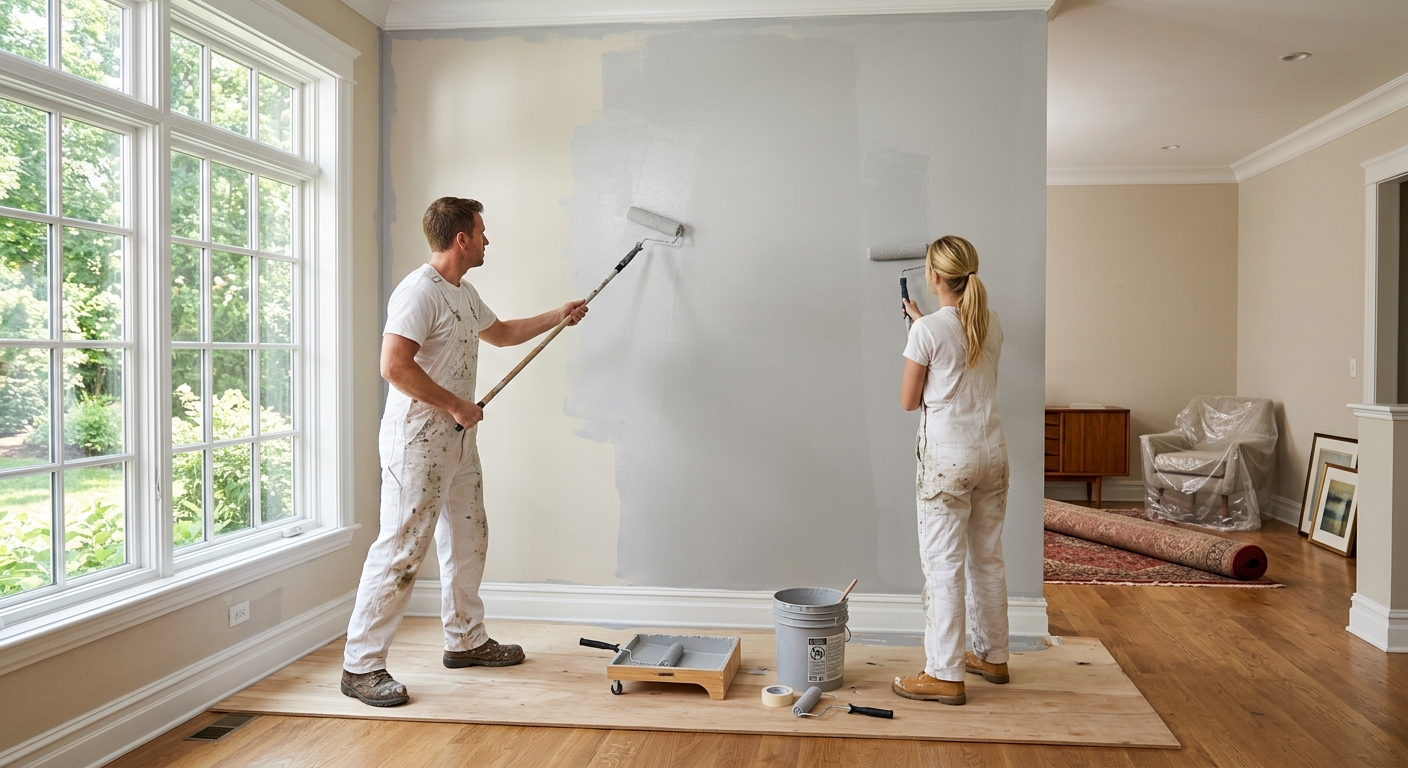
Painting options and costs in Sandstone Valley
Sandstone Valley homeowners usually have a clear idea of the “look” they want, but the cost comes down to what the walls and siding are actually doing under the paint. With a population of 5,795 (Statistics Canada, 2021 Census), our local contractor availability can feel tight when multiple neighbours book at once—especially for exterior work. Many homes in the Calgary area were built in earlier decades, so repaints often include more than a simple roll-and-smooth: we commonly see scraping, patching, caulking and stain-blocking before any top-coat goes on. That kind of preparation is a big reason exterior pricing tends to land closer to the upper end of the bands when surfaces are weathered or when there’s evidence of previous DIY paint jobs.
In the Calgary region, our workable exterior window is typically about mid-May to late September, when daytime highs stay above 10°C and surfaces can dry properly between rain and overnight cool-downs. That short, weather-dependent period compresses demand and can make summer scheduling firmer than shoulder months. Interiors are more flexible, but labour still varies with ceiling heights, access (stairs, lifts), and how much repair work is needed before painting. If you’re in a community like the newer subdivisions near the edges of the Calgary growth corridor, demand spikes because many homeowners coordinate exterior updates at the same time.
Below is a practical comparison of common options, typical durations, and what you can expect to budget so you can compare quotes apples-to-apples before we talk materials and site conditions.
| Service |
What's Included |
Typical Duration |
Price Range |
| Interior — whole home (walls, ceilings, trim) |
Prep (protect floors, tape, fill/spot prime as needed), 2-coat system on walls/ceilings, full trim paint, caulking where required, cleanup and waste handling |
5–10 days |
$2,200 – $8,000 |
| Interior — per room (standard bedroom or living room) |
Prep and protection, patch/sand/spot prime as needed, 2-coat wall system, basic trim paint (where included in scope) |
1–2 days |
$400 – $1,800 |
| Exterior — full house (siding, trim, soffits) |
Scrape/sand/patch as needed, caulking, primer system for substrate, exterior-grade acrylic/solid colour or elastomeric where appropriate, trim/soffit coatings, final detail touch-ups |
7–14 days |
$2,500 – $9,000 |
| Exterior — trim and accent colours only |
Surface prep for trim, caulking, primer spot-treatment, 2-coat exterior trim system, masking for clean edges, cleanup |
3–7 days |
$900 – $4,500 |
| Kitchen cabinet painting (doors, frames, spray finish) |
Degrease/clean, sanding + degloss, bonding primer where needed, spray application for doors and frames, top-coat (durable cabinet sheen), hardware protection and re-install options |
5–12 days (including dry time) |
$800 – $7,000 |
| Specialty / faux finish (accent wall, texture) |
Surface prep, base-coat, application of specialty effect, protective top-coat, blending/edge finishing |
1–4 days |
$600 – $6,000 |
Prices are estimates only and vary by project scope, site access and material selection.
What affects the price of painting in Sandstone Valley
Even for the same “colour and number of coats,” painting quotes in Sandstone Valley can differ by 30–50% across Calgary and Alberta because contractors price the unseen work: surface prep, coating system compatibility, access, and how much repair is needed to make the paint last. In Calgary, the exterior season is tightly climate-bound in the Calgary region: daytime temperatures must be above about 10°C and surfaces must dry properly between rain and overnight lows. That narrow window compresses demand, so summer rates are typically firmer than shoulder-season work. Coastal BC can stay workable longer, but higher humidity and rainfall increase product requirements and timing controls. The takeaway for homeowners is simple: fewer weather days means the labour plan is less flexible—cost goes up.
Older housing stock around the Calgary region also changes the math. More scraping, caulking and priming can be 50–70% of total labour on a repainting job. For example, a “mid-band” exterior repaint might start near the interior-to-exterior jump, but if we discover failing caulk lines and chalky siding, the scope often moves toward the higher end of the exterior band—e.g., budgeting closer to $2,500 – $9,000 instead of $900 – $4,500 for trim-only. On the interior side, a clean repaint can land toward $400 – $1,800 per room, but once patching and priming are needed, timelines lengthen and whole-home pricing can move toward $2,200 – $8,000.
In Sandstone Valley specifically, freeze–thaw cycles, strong UV, and occasional hail impacts can leave surfaces uneven, so smooth-looking results require more prep and higher-build coatings on exterior areas that take the most beating.
| Price Factor |
Why It Matters |
Cost Impact |
| Surface prep — scraping, sanding, patching drywall or wood |
Paint only performs as well as what’s underneath; loose material and dents cause premature peeling and flashing |
Often the biggest swing (can add hundreds to thousands) |
| Number of coats — 2-coat system over primer vs. 1 coat over existing |
Coverage, sheen uniformity and durability depend on the correct total film build |
Fewer coats may save now, but failure risk rises and may cost more later |
| Paint quality tier — contractor-grade vs. premium (Benjamin Moore, Sherwin) |
Better pigments and solids can improve coverage and fade resistance in Alberta UV |
Can move material cost meaningfully, especially for full exteriors |
| Ceilings and trim — adds significant time vs. walls-only |
Cut-in time, ladder/lift work, masking and fine detail finishing are labour-intensive |
Often increases total by 10–30% on typical projects |
| Exterior season window — short season raises summer rates |
Weather limits workdays; contractors schedule more conservatively in peak months |
More demand for fewer days can raise labour rates |
| Lead-safe precautions — required for pre-1978 homes with lead paint |
Special cleaning, controlled dust methods and disposal add time and materials if lead is present |
May add cost on repaints in older neighbourhoods |
| Surface material — drywall vs. plaster vs. wood vs. stucco |
Different substrates need specific adhesion primers and correct top-coat systems |
Wrong primer can cause bubbling or adhesion failure |
| Height and access — multi-storey exterior requires scaffolding or lifts |
Safety setup, travel time, and protection of landscaping affect labour and scheduling |
Commonly adds hundreds to thousands on exterior work |
Permits & regulations in Alberta
In Alberta, painting work does not typically require a permit for homeowners or contractors. The “rules” are more about safe work practices and product compatibility than approvals. For homes built before 1978, health guidelines recommend testing for lead paint before sanding or scraping, and using lead-safe work practices if lead is present. In practice, that means controlled dust methods (e.g., wet methods), HEPA vacuuming, proper containment and careful disposal. It isn’t usually legally mandated for homeowners in the same way that major renovations can be, but it is standard for professional contractors because lead hazard management protects your family and the workers.
Concrete work that DOES generally need permits or approvals is not painting itself—it’s things like structural changes, removal/replacement of certain building elements, or work that triggers other municipal or building requirements. Typical painting tasks—priming, caulking, sanding, applying coatings, painting trim, and repainting interiors—usually do not require permits.
For your Sandstone Valley job, verify three things step-by-step: (1) Alberta licence status—use the contractor licensing/registration resources available online for the trade; (2) liability insurance—ask for a certificate of insurance showing coverage amount and effective dates; (3) WSIB/WCB coverage—confirm the certificate lists workers’ compensation coverage. Then request a written contract that spells out paint brand, sheen, number of coats, and the surface prep that’s included (scrape/patch/prime/caulk scope). A clear contract prevents the “we thought it was included” surprises.
Interior vs exterior painting — getting the best result in Sandstone Valley
In Sandstone Valley, the difference between a long-lasting paint job and a premature failure comes down to prep and coating system choices—not just the colour. For interiors, surface prep is king: filling dents, sanding, and priming stained or repaired areas matters more than chasing the most expensive topcoat. Sheen selection also affects durability and cleaning. Flat paint hides wall imperfections but marks more easily; eggshell or satin is usually better for living areas and hallways. If you want the job to last, remember that two proper coats over a correctly primed surface outlast one thick coat—especially when patched areas have different absorbency.
For exteriors, Alberta’s freeze–thaw cycles, UV intensity, and hail exposure make the prep stage critical. Caulking before painting isn’t optional if you want water ingress prevention at joints and trim lines. Primer choice matters by substrate: wood, fibre cement, stucco, and previously painted surfaces each behave differently. In Calgary, we also plan around rain and overnight lows—application and dry time must be right so coatings cure properly. If your home has older trim or siding with unknown DIY history, we may need stain-blocking, adhesion primers or extra sanding for a uniform finish.
Kitchen cabinet painting is a budget alternative to replacement, but it’s only “good value” when the job includes proper degreasing and bonding primer. For example, cabinet painting in the $800 – $7,000 range can be justified versus replacing cabinets when boxes are sound; however, if the existing boxes are damaged and you skip prep, failure can cost close to redoing the entire project.
For pre-1978 homes, lead-safe precautions should be part of the plan before aggressive scraping—this protects the household and keeps the workflow controlled so we can reach a clean, durable finish.
| Project Type |
Key Prep Step |
Recommended Coats |
Price Band |
| Interior — fresh drywall (new construction) |
Prime to seal new drywall and control absorbency before finish coats |
2 coats (typically wall primer + 2 topcoats, depending on product and sheen) |
$1,200 – $4,800 |
| Interior — repaint (good condition, no repairs) |
Clean/degloss and light scuff-sand for adhesion, minimal patching |
2 coats topcoat over appropriate primer as needed |
$400 – $2,500 |
| Interior — repaint (patching and priming needed) |
Fill/sand repairs and spot-prime to balance sheen and prevent flashing |
2 coats with spot-priming as required |
$800 – $8,000 |
| Exterior siding (wood or fibre cement) |
Scrape loose material, caulk properly, use adhesion/bonding primer where needed |
Primer + 2 coats exterior topcoat (system-based) |
$3,500 – $9,000 |
| Exterior trim and accents only |
Masking + detailed prep on edges; caulk seams for water control |
Primer spot + 2 coats trim topcoat |
$900 – $4,500 |
| Kitchen cabinets (spray finish) |
Degrease, degloss/sand, bonding primer for adhesion, careful masking |
Primer + 2 coats topcoat (often with sanding/tack steps between coats) |
$1,200 – $7,000 |
How to choose a painting contractor in Sandstone Valley
Start by verifying insurance and coverage—this protects you if something goes wrong on your property. In Alberta, ask for proof of liability insurance (certificate of insurance with policy limits), and confirm workers’ compensation coverage (WSIB/WCB) for their employees. Then verify licensing status through the appropriate Alberta registry resources available online for the contractor’s trade category. When you request documents, insist on current dates and make sure the certificate lists your contractor’s legal business name—don’t accept outdated paperwork or “we’ll email it later.”
Next, get 2–3 itemised written quotes instead of a single lump sum. Itemisation should separate labour and materials (prep, primer, topcoat, caulking, patching, cleanup/disposal, and any specialty products). Read the scope carefully: what’s excluded (e.g., rotted wood replacement, lead-safe testing, power washing, scaffolding, ceiling height impacts)? Ask whether the quote includes disposal and protective measures for landscaping and lawn furniture, and whether permits are needed for any related work (painting itself usually isn’t, but adjacent repairs sometimes are).
Finally, check warranty and payment terms. A workmanship warranty should be written with a clear start date and reasonable duration, and product/manufacturer warranty terms should be documented (and confirm whether it’s transferable). For payment schedule, never pay more than 10–15% upfront; hold back a portion until the job is complete and you’ve reviewed the final finish. Get a start date and completion estimate in writing so you’re not guessing once crews mobilize.
- Ask for insurance certificates: liability with limits and workers’ compensation coverage.
- Confirm their business name matches the insurance paperwork.
- Request an itemised quote (labour vs materials, and prep listed line-by-line).
- Ensure the contract states prep scope: scraping, sanding, patching, spot priming, caulking.
- Specify paint brand and product line (not just “premium paint”).
- Confirm sheens by surface (walls, ceilings, trim, doors) and room-by-room plan.
- Ask how they protect floors, landscaping, and vents during work.
- Clarify scaffolding/lift assumptions for exterior height and access.
- Ask whether disposal and leftover materials are included or charged separately.
- Review the warranty: workmanship length, what’s covered, and how to file a claim.
- Agree on a payment schedule that holds a portion until completion.
- Get an in-writing timeline, including weather contingencies for exterior work.
In Sandstone Valley, red flags I see include: quotes that omit surface prep and prime/caulk scope, promises of “one-coat coverage” without bonding/primer, payment demands that exceed 15% upfront, no written warranty or unclear warranty language, and contractors who can’t provide current insurance/WSIB/WCB documentation.
Frequently asked questions — painting in Sandstone Valley
What paint sheen should I use in different rooms?
In Sandstone Valley, sheen choice is mostly about how the surface gets cleaned and how forgiving it needs to be. For ceilings, flat or ceiling paint is typical because it hides imperfections. For most walls, eggshell or satin works well—eggshell is a bit more forgiving on touch-ups, while satin holds up better in higher-traffic areas like hallways. Trim and doors usually do best in a higher sheen (often semi-gloss) because they tolerate scuffs and frequent wiping. If you’re repainting and patched areas are visible, remember that correct primer and two-coat coverage are usually more important than sheen alone. For budgeting, a typical living-room repaint can fall near $400 – $1,800 depending on prep and trim scope.
Can I paint my house exterior in spring or fall in Sandstone Valley?
You can sometimes paint earlier or later in the season, but in Alberta the window is weather-dependent and we plan around it. For exteriors in the Calgary region, workable conditions usually start around mid-May and run to late September, when daytime highs stay above about 10°C and surfaces can dry properly after rain and overnight cool-downs. Spring can be workable if temperatures stay steady for multiple days; fall often becomes risky quickly as nights drop and humidity rises with colder weather. If a contractor is offering “anytime” exterior painting without discussing drying time and forecast planning, ask more questions. The labour market also books up during the reliable summer stretch, so pricing can be firmer when crews are in demand.
How do I choose a painting contractor in Sandstone Valley?
Start with documentation. Ask for liability insurance and workers’ compensation coverage (WSIB/WCB), and verify their Alberta trade licensing status through the appropriate online resources. Then request 2–3 itemised written quotes that separate labour and materials and clearly list prep: scraping, patching, priming, caulking, and disposal. A solid quote also names the paint products and sheens, and it states the number of coats. Be cautious with quotes that treat prep as optional or leave it vague—on Alberta exteriors, prep is what prevents peeling and flashing. Finally, make sure payment is sensible (often no more than 10–15% upfront) and that there’s a written workmanship warranty. If you’re comparing exterior bids, aim for a like-for-like scope within the exterior bands such as $2,500 – $9,000.
How many coats does an exterior repaint need in Sandstone Valley?
Most exterior repaints in Sandstone Valley follow a system approach: typically a primer where bonding is needed, then two coats of exterior topcoat. The exact number depends on what’s already on the surface, substrate condition, and whether there’s chalking, staining, or bare patches. For example, if we’re painting over weathered wood or fibre cement with adhesion risk, skipping primer or going “thin with one coat” is where you see premature failure. When surfaces are in good shape after proper cleaning and prep, you still generally land on a total two-coat top system for uniform colour and durability. In practical terms, exterior pricing often aligns with the full-house range of $2,500 – $9,000, reflecting that primer plus two-coat approach plus caulking and prep are usually included.
What is the best primer for older Sandstone Valley homes?
For older Sandstone Valley homes, “best” primer depends on what the existing coating is doing and what the substrate is (wood, fibre cement, stucco, drywall in sheltered areas, etc.). If there are stains or tannin bleed, we often use a stain-blocking primer to stop discoloration from telegraphing through the finish coat. If there’s poor adhesion, a bonding primer helps the new coating grip the surface. For lead-safe considerations, homes built before 1978 may require lead paint testing and lead-safe work practices before sanding or scraping if lead is suspected or confirmed—this isn’t about the primer type, but it affects how work is carried out. Your contractor should specify the primer product and why it’s chosen, not just “we’ll prime it.”
Should I paint or wallpaper my Sandstone Valley home?
In Sandstone Valley and across Alberta, painting is usually the more practical choice for most rooms because it’s faster to recoat, easier to maintain, and more forgiving when walls have patching or minor imperfections. Wallpaper can look fantastic, but it demands a very uniform wall surface—lumps, spackle ridges, and uneven drywall moisture can cause seams to show. Painting also gives you better control over sheen and washability (important in kitchens, hallways, and family spaces). Wallpaper can be worth it for a single feature wall where you want a distinctive look, but installation and prep are often labour-intensive. If your goal is durability for daily life, a well-prepped repaint is often the better value; interior per-room projects commonly fall in the $400 – $1,800 range depending on repairs and trim. In short: choose wallpaper for the “wow wall,” paint for everything else unless your walls are perfectly ready.