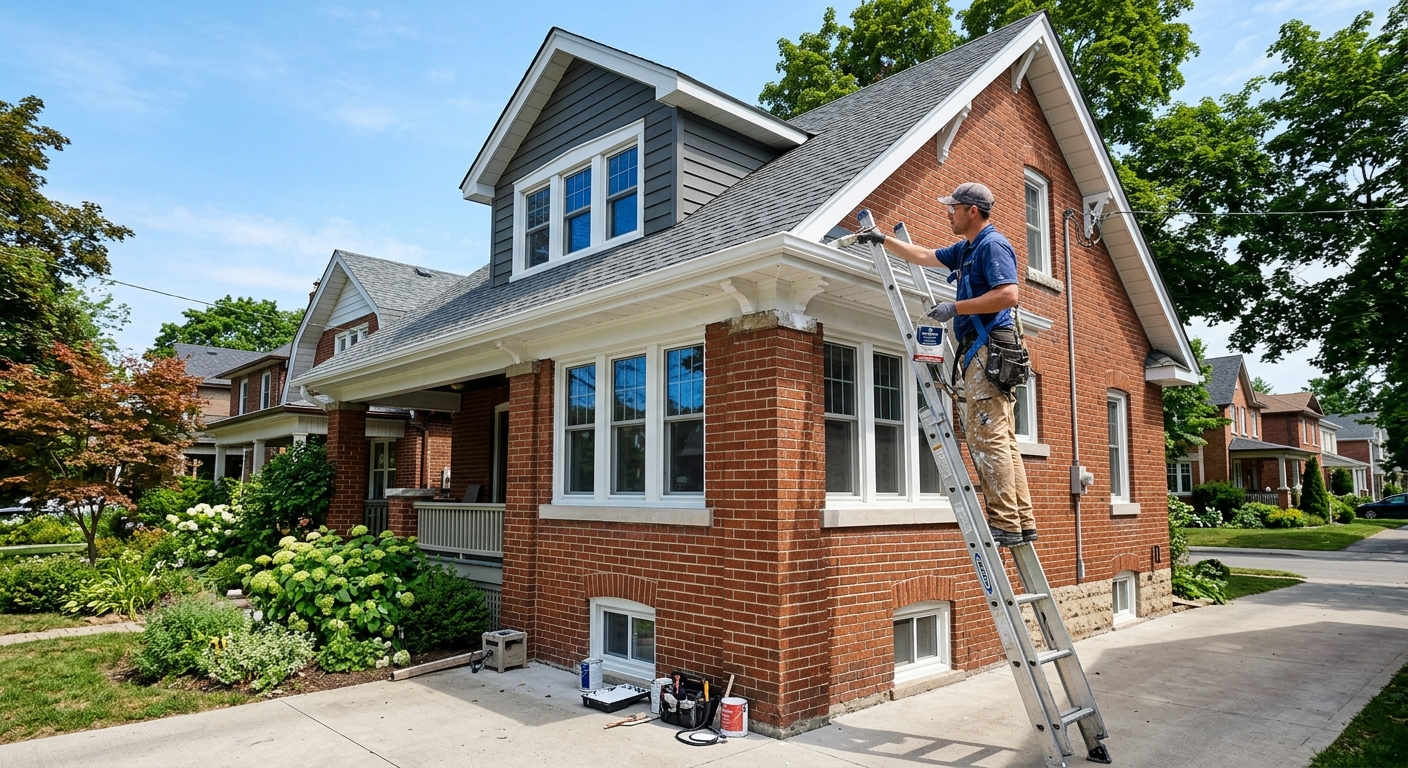
Painting options and costs in Olds
Olds, Alberta is a practical place to paint—when the schedule lines up. With a population of 9,209 (Statistics Canada, 2021 Census) and many single-detached homes (61.2% of dwellings), most neighbours are dealing with the same realities: real weather exposure outdoors and real preparation needs on the surfaces that have seen decades of sun, caulking failures, and repaints. In Olds, the housing age matters because 34.9% of homes were built before 1981 (Statistics Canada, 2021 Census). That typically means more time spent on scraping, patching, and bonding/priming bare or stained areas before a finish coat can last.
In the Calgary region, exterior painting is tightly climate-bound. Our workable season is usually mid-May to late September, when daytime highs stay above about 10°C so materials can apply and dry properly. That short demand window affects availability and can firm up pricing versus shoulder months. Interiors are less season-sensitive, but labour and prep complexity still drive the numbers—especially with older trim profiles, textured ceilings, and accessibility through hallways and stair landings.
In Olds, trade demand is often strongest around the more actively maintained residential pockets near downtown and the newer subdivisions along the main approach routes, where repainting schedules cluster with summer home maintenance. If you’re budgeting now, the comparison table below will help you benchmark realistic ranges for common projects in your area, then we’ll narrow it with an on-site scope.
| Service |
What's Included |
Typical Duration |
Price Range |
| Interior — whole home (walls, ceilings, trim) |
Surface prep, patching/sanding, caulking as needed, primer where required, 2-coat finish system, paint-grade cleanup, and protection of floors and fixtures |
4–10 working days |
$2,000–$6,500 |
| Interior — per room (standard bedroom or living room) |
Prep, patching/sanding, spot-priming, 2-coat finish, basic wall/ceiling protection; trim included unless noted otherwise |
1–3 working days |
$400–$1,600 |
| Exterior — full house (siding, trim, soffits) |
Power washing, scrape/sand prep, caulking, stain/sealer blocking as needed, primer system, 2-coat exterior finish, and final cleanup |
5–12 working days |
$2,500–$7,800 |
| Exterior — trim and accent colours only |
Targeted prep and priming on trim/accents, caulking, 2-coat finish, limited protection, and touch-up blending where required |
2–6 working days |
$1,500–$4,500 |
| Kitchen cabinet painting (doors, frames, spray finish) |
Degrease and bonding prep, light sanding/deglossing, primer, spray-applied topcoats, hardware masking, re-install and finish touch-ups |
4–12 working days (including dry/cure time) |
$800–$5,500 |
| Specialty / faux finish (accent wall, texture) |
Surface prep for the chosen effect, base coat, custom technique (glaze/texture), protective topcoat, and spot repairs for the look |
1–4 working days |
$600–$3,800 |
Prices are estimates only and vary by project scope, site access and material selection.
What affects the price of painting in Olds
In Olds and across the Calgary economic region, two quotes for the “same” paint job can swing by 30–50% because prep and product requirements aren’t equal from house to house. The exterior season is the first driver: in this region, exterior work is usually workable from mid-May to late September, when surfaces can dry properly and temperatures stay above about 10°C. Shorter windows concentrate demand, so contractors price with scheduling pressure in mind. Interior work is less season-sensitive, but higher labour demand still shows up when teams are booked solid for exterior projects.
For older homes throughout Alberta, surface prep is often the hidden variable. In Olds, 34.9% of homes are pre-1981 (Statistics Canada, 2021 Census), and that age profile commonly means failed caulking, chalking paint, and stained or rusted trim that needs sealer blocking. In repainting jobs, prep can be 50–70% of total labour, which is why “a quick repaint” can become a long scrape, patch, and prime job. It’s also why exterior repainting typically lands in the higher bands—often near the $2,500–$9,000 range depending on how much substrate repair is required.
Concrete examples you’ll actually see in Olds: (1) If siding has widespread blistering or peeling around seams, we spend extra time removing loose paint back to sound edges and re-sealing junctions—cost increases even if the colour change is minor. (2) If your house is two-storey with limited access, scaffolding or lifts add labour and time; that pushes you toward the upper end of the $2,500–$7,800 exterior range. (3) On the interior side, ceilings with texture or staining from past leaks usually require more sanding/priming, shifting you from a typical “per-room” repaint into full-home pricing such as $2,000–$6,500.
| Price Factor |
Why It Matters |
Cost Impact |
| Surface prep — scraping, sanding, patching drywall or wood |
Sound adhesion depends on removing loose/chalking material and repairing damaged areas before coating. |
Can add the largest labour share; often increases total cost by 20–60% on repaints. |
| Number of coats — 2-coat system over primer vs. 1 coat over existing |
Paint needs proper coverage and uniform sheen; stains and repairs require priming first. |
Extra coats commonly add 10–25% to material and labour. |
| Paint quality tier — contractor-grade vs. premium (Benjamin Moore, Sherwin) |
Better products cover better, resist UV/hail damage, and reduce rework. |
Material difference can shift totals by ~5–20% depending on house size and repairs. |
| Ceilings and trim — adds significant time vs. walls-only |
Ceilings require careful cutting-in and extra protection; trim needs crisp edges and multiple passes. |
Often adds 15–40% versus walls-only projects. |
| Exterior season window — short season raises summer rates |
Limited weather days mean crews are scheduled tightly and mobilization costs spread over fewer projects. |
Can raise exterior pricing by 10–25% in peak bookings. |
| Lead-safe precautions — required for pre-1978 homes with lead paint |
Professional contractors follow safe work practices when lead paint is present to protect occupants and workers. |
More steps and containment can add 5–15% on affected areas. |
| Surface material — drywall vs. plaster vs. wood vs. stucco |
Porous and irregular substrates need different primers and preparation methods for adhesion. |
Mismatch substrates can add 10–30% due to extra priming/repairs. |
| Height and access — multi-storey exterior requires scaffolding or lifts |
Safety and reach dictate equipment time, protection, and crew productivity. |
Often adds 15–45% on two-storey or hard-access homes. |
Permits & regulations in Alberta
For painting work in Alberta, a permit is typically not required for standard interior or exterior painting at a home. The practical “rule” is not usually municipal approval—it’s safe work practice and proper contracting. For homes built before 1978, health guidelines recommend testing for lead paint before sanding, scraping, or grinding, and using lead-safe methods if lead is present. In Alberta, homeowners are not usually required to follow a formal lead program the way professionals do, but reputable contractors treat it as standard practice: wet methods to reduce dust, HEPA vacuuming, appropriate containment, and proper disposal of debris.
Contractor responsibilities are where you want clarity. Confirm the contractor carries liability insurance and has workers’ compensation coverage (WSIB/WCB) for their workers. Then insist on a written contract that spells out the paint brand/line (if you care), sheen level, number of coats, and exactly what prep is included (for example: patching, caulking, sanding, and stain-blocking/sealer primer where needed).
Step-by-step, homeowners in Olds can verify: (1) ask for a valid certificate of liability insurance—match the insured business name and effective dates; (2) ask for proof of workers’ compensation coverage; (3) verify the contractor’s business registration/licensing information through the appropriate provincial online registry search; and (4) request it in writing before work starts so you have documentation if there’s damage or an injury.
Work that typically does NOT require a permit: painting, caulking, minor repairs, priming and re-coating on existing surfaces. Work that may require separate approvals: things outside normal painting, like structural modifications, window/door replacements, or regulated demolition/abatement tasks. If a quote includes unusual scope (masonry rework, removal/abatement), ask what permits or licensed steps apply.
Interior vs exterior painting — getting the best result in Olds
Long-lasting paint in Olds is less about chasing a “miracle brand” and more about matching prep, primer, and sheen to how your home behaves. Inside, surface prep is the foundation: filling, sanding, and priming repaired spots and stained areas before topcoats goes on. For sheen, choose intentionally. Flat is common on ceilings, but on walls in family rooms and hallways, eggshell or satin is usually more forgiving and easier to clean. Two coats over a proper primer system almost always outlasts one thick coat because coverage and adhesion are more uniform—especially where patching or sanding changes the surface profile.
Outside, Alberta climate cycles make prep non-negotiable. Freeze–thaw stresses caulk joints, UV hardens surfaces, and hail can create micro-damage. That’s why we scrape loose paint, sand edges smooth, prime appropriately, and caulk before painting to prevent water ingress behind coatings. Primer selection matters: porous or bare substrates may need a bonding/adhesion primer, while certain slick coatings require the right sealer or bonding system. Unlike coastal BC (where mildew resistance and long damp periods are bigger concerns), Olds exteriors still need durable exterior acrylics and flexible approaches to handle movement and winter conditions.
Cabinet painting is a budget alternative to replacement when prep is done right. If your cabinets are greasy or have heavy wear, degreasing and bonding primer are what protect the finish; otherwise, new paint can peel or lift. For pre-1978 homes, lead-safe precautions for sanding/scraping are also part of the best-result plan.
Price justification is often simple: spending on prep prevents repeat costs. For example, an exterior full house often sits around $2,500 – $7,800, but if peeling is limited and substrate is sound, you may stay closer to the lower end. If you skip caulking or don’t seal stains correctly, the same paint can fail sooner, and you end up paying again for the same labour.
| Project Type |
Key Prep Step |
Recommended Coats |
Price Band |
| Interior — fresh drywall (new construction) |
Prime all drywall, fill/sand joints, caulk transitions, feather texture if needed |
Primer + 2 finish coats |
$900–$4,000 |
| Interior — repaint (good condition, no repairs) |
Light scuff-sand, degrease where needed, spot-prime minor marks |
2 finish coats (spot primer if required) |
$400–$2,000 |
| Interior — repaint (patching and priming needed) |
Patch and sand, stain/sealer block for repairs, prime repaired areas thoroughly |
Primer (as required) + 2 finish coats |
$900–$3,500 |
| Exterior siding (wood or fibre cement) |
Scrape/sand to sound edges, caulk joints before finish, prime bare/affected areas |
Primer system + 2 exterior finish coats |
$2,500–$9,000 |
| Exterior trim and accents only |
Remove failing paint, sand edges smooth, spot-prime and seal stains, then caulk |
2 finish coats (primer as required) |
$1,500–$4,500 |
| Kitchen cabinets (spray finish) |
Degrease and bond; remove sheen properly; prime for adhesion before spraying |
Primer + 2 topcoats (or multi-step system as specified) |
$800–$5,500 |
How to choose a painting contractor in Olds
Start with proof. In Alberta, you should verify three basics before signing: (1) Alberta business registration/licensing details for the contractor, (2) liability insurance, and (3) workers’ compensation coverage (WSIB/WCB) for their employees. How to check: ask for a current certificate of insurance and confirm it matches the legal name on the quote; request proof of workers’ compensation coverage; then look up the contractor in the appropriate provincial online registry so the information lines up with their paperwork.
Next, get 2–3 itemised written quotes. You want a breakdown that separates labour and materials, and that clearly states what prep is included, what paint system will be used, and whether disposal and site protection are part of the scope. Avoid “lump sum” quotes without scope details—painting costs are heavily driven by prep complexity. Also ask about permits: painting typically does not require a permit, but if the quote includes unusual scope (significant removals, hazardous materials handling), ask what steps or approvals apply.
Warranty should be in writing. Ask for the workmanship warranty length (how long they stand behind adhesion and workmanship), whether product/manufacturer warranties apply, and if warranties are transferable if you sell the home. Payment schedules should be conservative: never pay more than 10–15% upfront; hold back a portion until the job is complete and you’ve done a walkthrough. Finally, ask for a specific start date and a completion estimate in writing—Olds exterior work is often scheduled around the short mid-May to late-September window.
- Request proof of liability insurance (active dates, correct insured name).
- Request proof of workers’ compensation coverage (WSIB/WCB) for employees.
- Verify the contractor’s business details in the provincial online registry.
- Insist on an itemised quote: labour, materials, primer/sealer, and cleanup/disposal.
- Confirm surface prep scope: scraping, sanding, patching, and caulking.
- Ask if lead-safe practices apply for pre-1978 homes before any scraping/sanding.
- Clarify paint line and sheen (flat/eggshell/satin/semi-gloss) in writing.
- Confirm the number of coats and where primer is required.
- Ask how they protect landscaping, windows, and exterior fixtures.
- Confirm equipment and access plan for your lot (ladders vs. lift/scaffold).
- Review warranty terms for workmanship and what triggers a warranty call-back.
- Set payment terms: 10–15% max deposit; holdback until completion walkthrough.
Red flags I see in Olds: (1) “We’ll just paint over it” without addressing peeling/chalking, (2) quotes that don’t specify coats, primer type, or prep steps, (3) missing or outdated insurance/WSIB/WCB documentation, (4) pressure to pay the full amount upfront, and (5) vague timelines that ignore weather dependencies for exterior work.
Frequently asked questions — painting in Olds
How many coats does an exterior repaint need in Olds?
In Olds, an exterior repaint typically uses a 2-coat finish system, but what you add on top depends on the substrate condition. If the old coating is sound and uniformly bonded, you still usually need two finish coats for even sheen and protection. If there’s peeling, bare wood, or stains, you’ll also need a primer system—sometimes sealer blocking—before those two topcoats go on. That matters in our freeze–thaw and strong UV environment because failures often start at unprimed or poorly prepped areas. Most full exterior projects land in the exterior band of $2,500 – $7,800, and the prep/primer needs are usually what moves the job toward the higher end. (Statistics Canada, 2021 Census)
What is the best primer for older Olds homes?
For older homes in Olds (including the substantial share of pre-1981 builds at 34.9%, Statistics Canada, 2021 Census), the “best” primer depends on what you’re covering—chalky surfaces, stained trim, patched areas, or slick coatings from prior DIY paint jobs. Where adhesion is the concern, a bonding/adhesion primer is often the right choice after sanding and scraping. Where stains or wood tannins bleed, a stain-blocking sealer primer is the priority before finish coats. If the existing paint is flaking or the surface is uneven, extra prep and spot-priming can be more valuable than trying to use a different topcoat. Good contractors will specify the primer system in the written contract, not just the final paint colour.
Should I paint or wallpaper my Olds home?
For most Olds homeowners, paint is the safer, more practical choice—especially on walls with small cracks, patchwork history, or older substrate variability. Paint systems are more forgiving when prep is correct (patch, sand, prime), and they’re easier to maintain in Alberta winters when indoor humidity swings can stress older finishes. Wallpaper can look great, but it can hide or trap issues if the wall isn’t properly sealed; removing wallpaper later is also more labour-intensive. If you’re aiming for an accent look, a specialty faux/texture finish or a painted accent wall can deliver a similar effect with easier touch-ups. Budget-wise, an accent wall or faux finish often sits around the specialty band of $600 – $3,800, while whole interior work typically ranges widely depending on trim and prep.
How do I fix peeling exterior paint in Olds?
Peeling exterior paint in Olds is usually a sign of adhesion failure, moisture intrusion at joints, or inadequate prep from a previous job. The fix is not just “scrape and repaint.” First, you remove all loose paint back to sound edges (scrape/sand), then patch and sand smooth. Next, caulking should be addressed at joints and transitions so water can’t creep behind the system. Stain-blocking primer is used if tannins or staining are present. Then the primer system and two exterior finish coats go on. Weather timing matters too—our workable exterior window is typically mid-May to late September, when daytime temps stay above roughly 10°C for proper drying. If you’re budgeting, repairs that increase prep are a common reason exterior work moves toward the upper end of $2,500 – $9,000.
What colours add the most resale value in Olds?
Resale value is less about a “magic colour” and more about buyer comfort: clean neutrals, timeless siding/trim contrast, and avoiding overly personal or high-maintenance choices. In Olds, many homes blend well with warm whites, soft greiges, light greys, and muted warm/earth tones that don’t shout in Alberta sun and winter light. For exterior trims, a crisp light trim with a slightly deeper body colour usually photographs well and can help the house read “well kept.” If you’re doing interior refreshes, eggshell/satin in neutral palettes often appeals to a broad range of buyers. If you want a bold note, keep it to an accent wall or entry details. For projects like trim accents only, the exterior band of $1,500 – $4,500 can be a reasonable way to improve curb appeal without repainting every surface.
How much does it cost to paint a house in Olds?
Pricing in Olds depends heavily on whether you’re painting the interior, the exterior, or both—and how much prep the surfaces need. For interiors, a typical room repaint often lands in the $400 – $1,600 range, while a whole-home interior can be closer to $2,000 – $6,500 when ceilings, trim, and multiple areas are included. For exterior painting, full-house projects commonly fall into $2,500 – $7,800 because prep (scraping, sanding, patching, caulking, and primer) is labour-intensive and weather-dependent. Older homes in the region often require more prep; with 34.9% of homes built before 1981 (Statistics Canada, 2021 Census), it’s a common reason estimates land higher. A site visit is the only way to tighten the range.