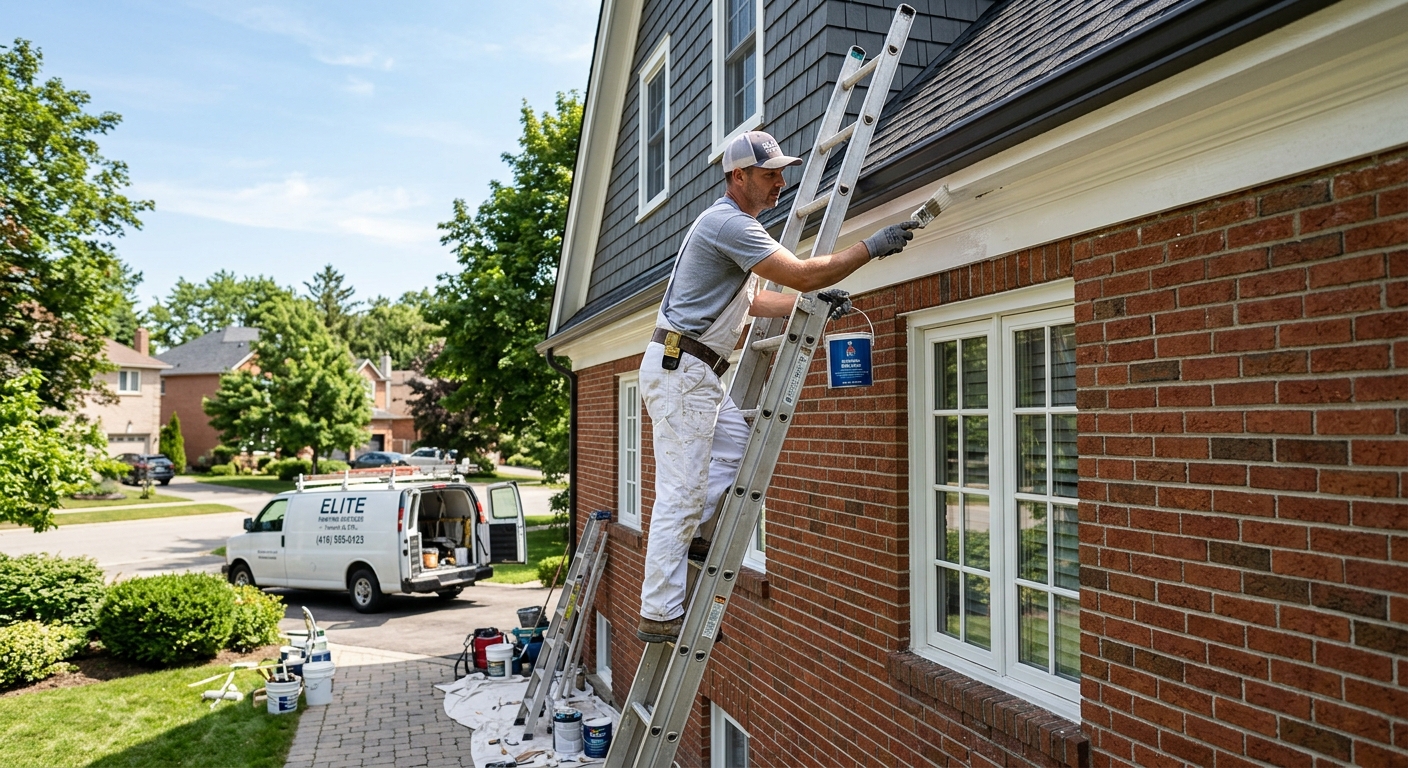
Painting options and costs in Lac La Biche
Lac La Biche is a small community (2,314 people in the 2021 Census), and that shows up in how local painting crews schedule work—especially for exteriors. Many homes in the broader region were built in earlier decades; in pre-1978 properties, contractors often need extra prep and lead-safe protocols before sanding or scraping. That prep—scraping, patching, caulking, stain-blocking and priming—can be the difference between a paint job that looks sharp for a season and one that holds up through Alberta’s freeze–thaw cycles and strong UV.
In Lac La Biche, exterior painting costs tend to land firmly in the mid-to-upper part of typical Alberta ranges because the workable season is weather-dependent. Daytime temperatures generally need to stay above 10°C for proper application and drying, so contractors plan around rain chances and overnight lows. The Calgary-area market context also matters: when demand spikes in summer, skilled labour books faster and pricing firms up. For homeowners, that means you’ll often pay more for late-season changes—but you’ll also see better value when the scope is right the first time.
If you’re around the downtown core and surrounding residential streets, exterior updates are especially common as homeowners refresh siding, trim and soffits during the short warm window. Next, here’s a practical comparison of common services so you can budget with confidence.
| Service |
What's Included |
Typical Duration |
Price Range |
| Interior — whole home (walls, ceilings, trim) |
Protect floors/furnishings, patch & sand, caulk where needed, prime repairs/stains, 2 coats on walls & ceilings, paint trim/baseboards, cleanup and final walk-through |
5–14 days |
$1,200 – $7,500 |
| Interior — per room (standard bedroom or living room) |
Protect work area, minor patching, sand, prime repairs, 2 coats on walls, choice of sheen for walls/ceiling, light trim touch-ups if included in scope |
1–4 days |
$400 – $1,600 |
| Exterior — full house (siding, trim, soffits) |
Power-wash/prep as needed, scrape & sand, caulk gaps, prime bare/repair areas, 2-coat exterior system, cover windows/railings, debris removal and site cleanup |
7–18 days |
$3,500 – $9,000 |
| Exterior — trim and accent colours only |
Surface prep for trim, scrape/sand as needed, prime where required, 2 coats on trim/accent areas, masking and cleanup |
3–10 days |
$2,500 – $6,500 |
| Kitchen cabinet painting (doors, frames, spray finish) |
Degrease/clean, sand & prep, bonding primer as needed, spray/finishing approach, 2–3 coat system depending on sheen, hardware handling/masking, reinstall |
5–15 days |
$800 – $7,000 |
| Specialty / faux finish (accent wall, texture) |
Surface conditioning, base coat, specialty layers, topcoat for durability, limited prep depending on wall condition, cleanup |
2–10 days |
$600 – $6,000 |
Prices are estimates only and vary by project scope, site access and material selection.
What affects the price of painting in Lac La Biche
In Lac La Biche and across the wider Calgary region, the same “paint the walls” job can come in 30–50% apart depending on how much time is spent on prep, how many coats are truly needed, and what product system is being installed. Exterior work is especially variable because Alberta’s temperature swings and weather timing force contractors to plan around application and drying windows. For exteriors, the workable season is typically mid-May to late September, when daytime highs reliably support proper drying and finish performance. In coastal BC, you often get a longer calendar but high humidity and frequent rain/mildew risk demand different products and tighter timing. In Alberta, the season isn’t as long, so demand concentrates into a shorter stretch—summer scheduling pressure pushes rates up, even when the job size is modest.
Older housing stock across the region also increases labour. For repainting jobs, surface prep—scraping, patching, caulking, and priming—can account for roughly 50–70% of total labour, not because painters like prep, but because failed adhesion or flash-peeling is far more expensive to fix later. For example, a basic interior repaint might land in the lower end of interior pricing (from about $400 per room), but if drywall has patched areas that need sanding and stain-blocking, you can quickly move toward the higher end of the interior band. Similarly, a trim-only exterior refresh can feel affordable at the $2,500 range, but if the contractor finds failing caulking at every joint, costs can rise toward full exterior pricing.
Concrete Lac La Biche examples: (1) freeze–thaw and UV can widen exterior cracks, increasing caulking and primer coverage; (2) accessibility—long drives, uneven ground, and multi-storey elevations—can require lifts or scaffolding, adding labour and time; and (3) pre-1978 trim in older homes can require lead-safe handling, which adds time for containment and cleanup. Let’s break down the biggest price factors in a clear way.
| Price Factor |
Why It Matters |
Cost Impact |
| Surface prep — scraping, sanding, patching drywall or wood |
Better adhesion and smoother finishes depend on thorough prep; peeling paint must be removed, and repairs must be feathered. |
High (+25% to +60% on repainting) |
| Number of coats — 2-coat system over primer vs. 1 coat over existing |
Coverage varies with colour change, stains, and substrate; skipping coats increases failure risk. |
Medium (+10% to +30%) |
| Paint quality tier — contractor-grade vs. premium (Benjamin Moore, Sherwin) |
Premium systems often provide better hiding, durability, and washability, reducing rework. |
Medium (+5% to +20%) |
| Ceilings and trim — adds significant time vs. walls-only |
Ceilings need edge work and protection; trim requires more cutting-in, masking, and finishing. |
High (+15% to +40%) |
| Exterior season window — short season raises summer rates |
Contractor availability tightens when temperatures and drying conditions align. |
Medium to High (+10% to +35%) |
| Lead-safe precautions — required for pre-1978 homes with lead paint |
Testing/containment and HEPA cleanup add steps and labour even when paint is “just” chipped. |
Medium (+10% to +25%) |
| Surface material — drywall vs. plaster vs. wood vs. stucco |
Different substrates need different primers and sanding expectations to avoid flashing or peeling. |
High (+15% to +45%) |
| Height and access — multi-storey exterior requires scaffolding or lifts |
Access determines how safely and quickly work can be done. |
High (+20% to +60%) |
Permits & regulations in Alberta
In Alberta, painting generally does not require a permit for typical interior repainting or exterior coating work. Where permits come up, it’s usually because of the building’s specific requirements (for example, coordinated work tied to broader renovations), not because “painting alone” needs approval.
For homes built before 1978, health guidelines recommend testing for lead paint before sanding or scraping, and using lead-safe work practices if lead is present. That usually means wet methods to reduce dust, HEPA vacuuming, proper containment, and disposal of dusty debris in approved handling. Homeowners aren’t typically required to follow the same process themselves, but professional contractors commonly treat this as standard practice to protect occupants and workers.
Before you hire a contractor in Lac La Biche, confirm three things: (1) liability insurance, (2) WSIB/WCB coverage for workers, and (3) clear written scope. A good contract should spell out the paint brand/line, sheen level, number of coats, and which prep steps are included (patching, priming, caulking, and surface cleaning). Ask what’s excluded—especially removal of deteriorated materials beyond “spot” repairs.
How to verify step-by-step: start by requesting their current liability certificate of insurance (COI) showing your address as an additional insured if they offer it. Next, ask for proof of workers’ compensation coverage (WSIB/WCB letter or account verification). Finally, confirm their general trade licensing status through Alberta’s public business/professional listings if they claim specific contractor qualifications. The key point: don’t rely on verbal assurances—request documents and keep copies.
Interior vs exterior painting — getting the best result in Lac La Biche
In Lac La Biche’s Alberta conditions, the biggest difference between a long-lasting paint job and a premature failure is almost never the paint label—it’s the prep and system match. For interiors, start with surface prep: filling, sanding, and priming repairs and any stain-prone spots. A proper primer blocks tannins, water marks, and patch edges so you don’t get “flashing” (lighter/darker areas) after the topcoat. Next is sheen choice. Flat paint can hide wall imperfections, but higher-touch areas often perform better in eggshell or satin. Ceilings generally hold up best with a flatter sheen, while trim and doors typically call for a tougher semi-gloss or satin.
The rule of durability is also practical: two coats over a correct primer system outlast one thick coat. If you’re budgeting, that’s why a clean, well-prepped room often sits in the lower interior ranges (around $400–$1,000 per standard room), but a repaint that needs patching and priming can climb toward the top end of the interior band (and that’s money well spent).
For exteriors, the system matters more. Alberta’s freeze–thaw cycles and UV stress the coating, so caulking before painting helps prevent water ingress behind trim and at joints. Primer type matters too: different primers are required for wood vs. fibre cement vs. previously painted surfaces to secure adhesion. While BC painters focus heavily on mildew resistance due to higher humidity, Alberta crews focus on temperature-stable application, proper cure time, and flexible products that can handle movement.
Cabinet painting is often the best “replacement alternative” when you want a budget refresh: spray finishing can deliver a smooth look, but it requires degreasing and bonding primer to avoid peeling. For pre-1978 homes, lead-safe precautions (testing/containment/HEPA cleanup) are part of achieving a clean, professional finish.
As a concrete example: opting for trim-only exterior painting at about $2,500 – $6,500 can be justified if caulking and siding are solid. If however joints are failing and repairs are needed, moving toward the full exterior approach (often $3,500 – $9,000) is the smarter value because it includes more complete prep and a full system that’s designed to last through Alberta’s weather stress.
| Project Type |
Key Prep Step |
Recommended Coats |
Price Band |
| Interior — fresh drywall (new construction) |
Prime all drywall and seal paper; spot prime stains and flashing areas before topcoat |
2 coats topcoat over primer |
$1,000 – $3,500 |
| Interior — repaint (good condition, no repairs) |
Clean, light sand/feather, caulk minor gaps, spot prime if needed |
2 coats |
$400 – $2,500 |
| Interior — repaint (patching and priming needed) |
Fill, sand, and prime repaired/stain-prone areas to prevent bleed-through and uneven sheen |
2 coats (with primer over repairs) |
$800 – $4,500 |
| Exterior siding (wood or fibre cement) |
Scrape loose paint, patch, caulk, and prime bare/repair areas for adhesion and uniformity |
2-coat exterior system over appropriate primer |
$3,500 – $9,000 |
| Exterior trim and accents only |
Mask carefully, scrape/sand edges, caulk joints, and spot-prime to avoid peeling at transitions |
2 coats on trim/accent |
$2,500 – $6,500 |
| Kitchen cabinets (spray finish) |
Degrease thoroughly, sand for bonding, use bonding primer appropriate to substrate |
2–3 coats (system-based) |
$800 – $7,000 |
How to choose a painting contractor in Lac La Biche
Choosing a painter in Lac La Biche is mostly about verifying risk control and matching the quote to the actual work. Start by requesting proof of Alberta liability insurance (certificate of insurance) and proof of workers’ compensation coverage (WSIB/WCB). Ask them to send the COI showing the job address and the coverage expiry date, then verify the workers’ compensation status through the document they provide. If a contractor can’t produce current paperwork, treat it as a red flag.
Next, get 2–3 written, itemised quotes—not a single lump sum. The best quotes break out labour versus materials, and they list included prep steps (cleaning, scraping, patching, caulking, priming) and the number of coats. Ask whether disposal is included and whether masking/shielding is part of the scope. Confirm if a permit pull is included—while typical painting doesn’t require a permit, your contractor should clarify whether any coordination is needed for your specific building circumstances.
Warranty matters in painting because failures usually come from adhesion and moisture intrusion, not “bad luck.” Ask for a workmanship warranty length and what it covers (peeling, cracking, flaking, workmanship-caused defects). Also ask about the manufacturer product warranty and whether it’s transferable to you.
For payments, don’t sign up for large deposits. A safe guideline is never paying more than 10–15% upfront, with the remainder tied to milestones and a holdback until final completion. Get a written timeline including start date and completion estimate.
- Ask for itemised labour/material pricing, not just one total.
- Confirm exactly which surfaces are included (walls, ceilings, trim, soffits).
- Written scope should specify scraping/sanding extent and patch/prime requirements.
- Confirm caulking is included for exterior joints and around penetrations.
- Ask what paint lines (and sheens) they will use and provide the spec sheet.
- Check that cleanup, debris removal and waste disposal are included.
- Request a detailed schedule: when prep begins, when coats are applied, when cure time is respected.
- Verify liability insurance—get a COI before work starts.
- Verify WSIB/WCB coverage—ask for proof and keep copies.
- Confirm warranty terms in writing, including workmanship coverage.
- Payment should be milestone-based with a holdback (don’t front-load the job).
- For pre-1978 homes, ask whether lead-safe practices apply and what the plan is.
Red flags I see when homeowners in Lac La Biche get burned: (1) no written scope or only a vague “prep and paint,” (2) avoiding proof of insurance/WSIB/WCB, (3) promises of “one coat coverage” without primer/repair details, (4) skipping or minimizing caulking and bonding primer on exterior or cabinets, and (5) asking for a large deposit (well beyond 10–15%) before any work starts.
Frequently asked questions — painting in Lac La Biche
How much does it cost to paint a house in Lac La Biche?
Costs in Lac La Biche usually start with scope and prep, not just “square footage.” For a typical interior whole-home repaint (walls, ceilings and trim), homeowners commonly budget around $1,200 – $7,500 depending on repairs, height, and access. For a full exterior repaint (siding, trim and soffits), the range is more commonly $3,500 – $9,000 because Alberta’s freeze–thaw stress makes surface prep and proper caulking essential. Weather also affects timelines in the Calgary-area market context, since the exterior workable window is shorter (mid-May to late September when surfaces can dry properly). If your home includes older pre-1978 trim, expect additional lead-safe prep steps, which increases labour.
How much does interior painting cost per room in Lac La Biche?
Interior per-room pricing in Lac La Biche depends on whether it’s a repaint in good condition or includes patching and priming. A standard bedroom or living room repaint often falls near $400 – $1,600 when walls are in decent shape. If there are repairs (cracks, water marks, holes), you may need extra sanding and stain-blocking primer, pushing the project toward the higher end of that range. Ceilings and trim are major drivers too: adding crown moulding, baseboards and door finishing usually increases labour even if the room is small. Always ask for an itemised quote so you can confirm whether primer over repairs is included.
When is the best time for exterior painting in Lac La Biche?
The best time for exterior painting in Alberta is when temperatures stay consistently workable—typically mid-May to late September, based on the need for proper application and drying above about 10°C. In the Lac La Biche area, contractors plan around rain chances and overnight lows because poor drying leads to adhesion and finish problems later. Demand spikes during the warm window, so late-season touch-ups can cost more or require schedule adjustments. If hail or wind is an issue, it’s smart to time prep and coating so surfaces have time to fully dry after washing and repairs. In practice, starting earlier in the season often improves availability and reduces the risk of rain disruptions.
How many coats of paint do I need?
For most quality interior and exterior systems in Lac La Biche, you’ll typically use a 2-coat approach over the correct primer and any necessary stain-blocking. Repaints in good condition are commonly 2 coats, while patched areas require primer first—then 2 topcoats over that primed surface. On cabinets and many specialty finishes, systems can involve 2 to 3 coats depending on sheen and durability needs. The key isn’t “how thick” but whether coverage is consistent and the substrate is sealed correctly. If someone suggests one thick coat over unprepared surfaces, it usually increases the chance of peeling, flashing, or uneven sheen—especially outdoors.
What paint is best for Lac La Biche's climate?
In Lac La Biche, the best exterior coatings are designed for Alberta’s freeze–thaw cycles, UV exposure, and temperature swings. That typically means high-quality acrylic exterior paints and, where appropriate, elastomeric or flexible systems on substrates that move slightly. The exact primer matters too—wood and fibre cement can require different primer types for adhesion. For interiors, choose paint based on room use: flat/low sheen for ceilings and eggshell or satin for walls that need easier cleaning. If your home includes older pre-1978 trim, testing for lead and using lead-safe prep procedures is the foundation before choosing products. Product selection and prep quality together determine how well the finish holds up over the years.
How long does exterior paint last here?
Exterior paint life in Lac La Biche varies with prep quality, substrate condition, and how well caulking and flashing details were handled. With thorough scraping, sanding, priming of bare/repair areas, and proper caulking before paint, many well-installed exterior systems can last several years and often longer before noticeable failure. If prep is rushed—especially over loose paint, failing caulk, or unaddressed moisture issues—paint can fail prematurely even if the paint brand is high-end. Alberta’s UV and temperature cycles accelerate wear, so the same product can last meaningfully less time on a poorly prepped surface. A written scope that describes prep and coating system is the best predictor of longevity.