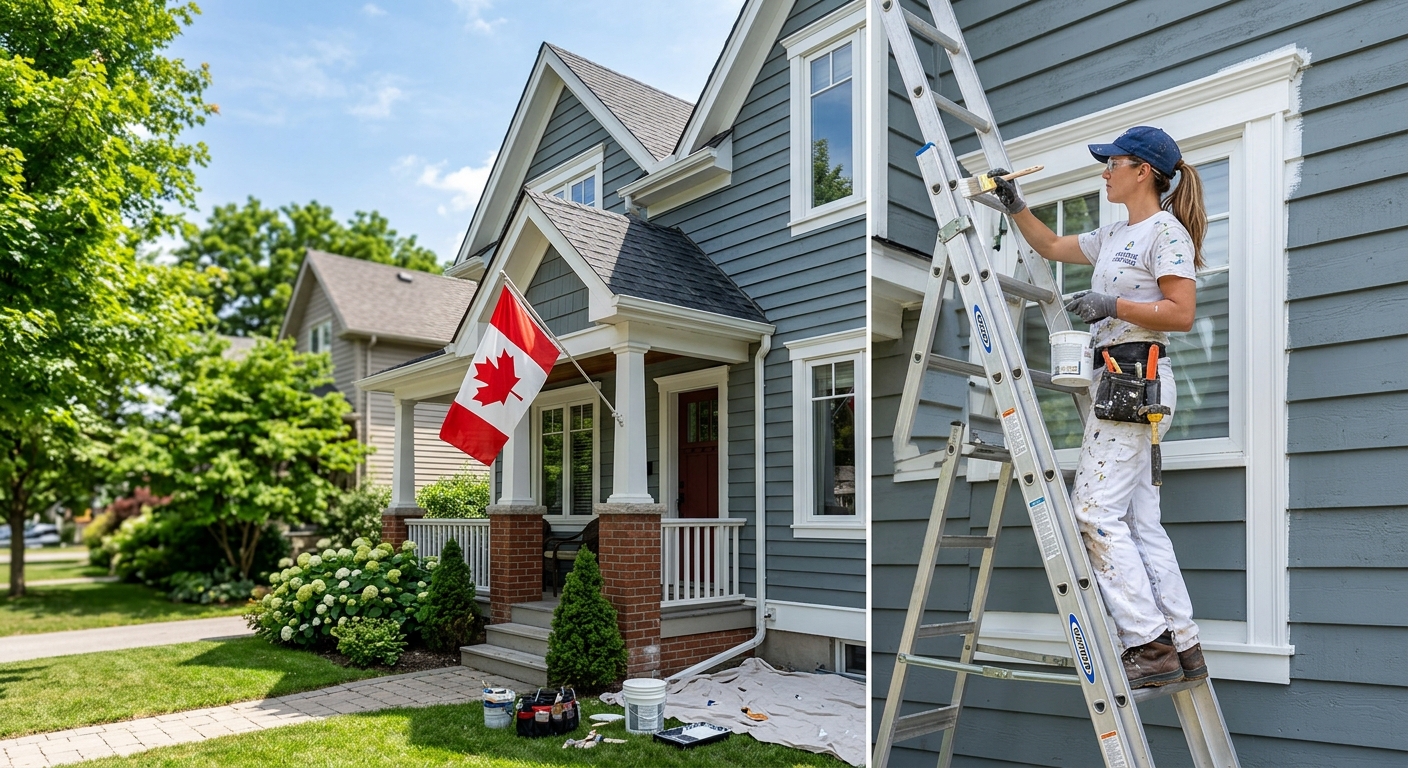
Painting options and costs in Canmore
Canmore homeowners typically have a clear set of painting choices—interior refresh, exterior protection, and the big “appearance projects” like trim or cabinets—each with a different labour profile. In Canmore, a notable share of housing stock is older: 11.6% of dwellings were built before 1981, and those homes often need more surface prep (scraping, patching, caulking, and spot-priming) before any finish coat goes on. That prep time is one of the main reasons two quotes for the “same paint colour” can still end up far apart. With 66.2% of households owning their homes (Statistics Canada, 2021 Census), repaint cycles are common, especially as owners maintain rentals, mountain-view homes, and longer-term family residences.
In the Banff–Jasper–Rocky Mountain House region, exterior painting is tightly weather-dependent. In practical terms, contractors concentrate exterior work into short, warm, drier windows—so summer scheduling pressure can lift rates when crews are fully booked. In Canmore’s mountain-town conditions, wind-driven dust and rapid temperature swings also mean prep and product selection matter; applying too early (or when surfaces aren’t fully dry) can lead to adhesion issues and premature failure.
Demand is especially noticeable in neighbourhoods with higher turnaround of older, detached homes and cabins around the Valleyview/West Canmore corridor and the more established residential pockets near downtown, where access is tighter and repainting often involves detailed trim and multiple exterior materials. Below is a realistic budget range to help you compare options before we talk about the specific factors that move pricing—use the table as your starting point.
| Service |
What's Included |
Typical Duration |
Price Range |
| Interior — whole home (walls, ceilings, trim) |
Protect floors and fixtures, prep/sand, spot-prime as needed, caulk where required, 2-coat finish on walls/ceilings, paint trim/doors to spec |
5–12 days |
$3,500–$8,500 |
| Interior — per room (standard bedroom or living room) |
Prep, sand/fill, spot-prime, 2-coat finish, cut-in around trim and ceiling edges |
1–3 days |
$3,000–$6,500 |
| Exterior — full house (siding, trim, soffits) |
Wash/degrease, scrape loose paint, caulk, sand where required, prime bare spots, 2-coat exterior system, detail work around doors/windows |
2–5 weeks (weather-dependent) |
$5,500–$14,000 |
| Exterior — trim and accent colours only |
Surface prep for trim areas, prime bare spots, caulk edges, paint trim and selected accents only |
1–3 weeks (weather-dependent) |
$4,500–$9,500 |
| Kitchen cabinet painting (doors, frames, spray finish) |
Degrease, light sanding/conditioning, fill and smooth, prime, sprayed finish, reinstall/adjustment |
5–12 days |
$5,500–$18,000 |
| Specialty / faux finish (accent wall, texture) |
Surface prep, base coat, specialty application (e.g., texture/razor finish), sealing as required |
2–7 days |
$1,500–$6,000 |
Prices are estimates only and vary by project scope, site access and material selection.
What affects the price of painting in Canmore
In Banff–Jasper–Rocky Mountain House, it’s normal to see quotes for the “same” painting job differ by 30–50%. The biggest drivers aren’t just square footage—they’re surface condition, prep scope, access, and how many days the crew can work safely during Canmore’s short exterior window. For example, exterior work is typically concentrated into brief warm, drier weeks in the inland Rockies, where crews need surfaces above roughly 10°C and rising during application. By contrast, coastal BC painters often plan around damp conditions and rely more heavily on mildew-resistant systems; the regional logic still matters here because it highlights why product choice and timing impact adhesion and recoat windows. In Canmore, the season is shorter, so scheduling pressure can raise rates when multiple homeowners want the same summer window.
Prep is also a major cost lever. Across older detached homes and cabins—common in Canmore—scraping, sanding, caulking, patching, and prime work can take up 50–70% of total labour on a repainting project. That’s why a “2-coat paint” price can jump when the contractor has to stabilize failing substrate before finish coats begin. On interior projects, ceiling height and trim complexity can push an interior whole-home repaint toward the upper end of the interior band (up to about $8,000), even if walls look clean.
Concrete Canmore examples: if your exterior has failed caulking at window returns, you’ll pay more for removal, re-caulking, and spot-priming before the finish system—often the difference between a trim-only touch-up and a full exterior approach. Likewise, a home with multiple exterior materials (wood trim next to fibre cement or stucco) can increase priming and coat-count requirements. And if your house is on a sloped site requiring lifts or scaffolding access, labour time rises. With Canmore’s older housing mix (11.6% pre-1981 built, Statistics Canada, 2021 Census), the prep-heavy scenarios are frequent, which pushes many jobs from the middle to the top portion of the exterior band ($4,500–$14,000).
| Price Factor |
Why It Matters |
Cost Impact |
| Surface prep — scraping, sanding, patching drywall or wood |
Paint only lasts when the substrate is sound and smooth |
Can shift total cost by 20–40%+ |
| Number of coats — 2-coat system over primer vs. 1 coat over existing |
Coverage and uniform sheen depend on primers and substrate condition |
Often adds 10–25% labour/time |
| Paint quality tier — contractor-grade vs. premium (Benjamin Moore, Sherwin) |
Higher-tier paints can improve durability and hide, reducing rework |
Material delta typically adds ~5–15% |
| Ceilings and trim — adds significant time vs. walls-only |
More cutting-in, masking, and detail passes |
Can add 15–30% to interior scope |
| Exterior season window — short season raises summer rates |
Weather limits working days and tightens crew scheduling |
Can add 10–20% during peak weeks |
| Lead-safe precautions — required for pre-1978 homes with lead paint |
Proper containment, wet methods, HEPA vacuuming, and disposal add labour |
Often adds 5–15% depending on condition and extent |
| Surface material — drywall vs. plaster vs. wood vs. stucco |
Each surface needs different prep and primer chemistry |
Can swing job time by 10–25% |
| Height and access — multi-storey exterior requires scaffolding or lifts |
Setup, safety planning, and slower application increase labour |
May add 10–30% depending on layout |
Permits & regulations in Alberta
In Alberta, painting typically does not require a permit for standard interior or exterior repainting. What matters most is how the work is done on older coatings. For homes built before 1978, health guidelines recommend testing for lead paint before sanding, scraping, or disturbing surfaces. If lead is present, contractors generally follow lead-safe work practices such as wet methods to reduce dust, HEPA-filter vacuuming, controlled containment where needed, and proper disposal of waste. This is not legally mandated for homeowners in the same way it is for licensed professionals, but it’s standard practice for professional contractors because the risk is real—especially during abrasive prep that creates airborne dust.
Even without permits, you should confirm the contractor carries liability insurance and has WSIB/WCB workers’ compensation coverage for their employees. Then, insist on a written contract that specifies the paint brand and finish, the number of coats, and the exact surface prep included (for example: how many primer coats, which areas are spot-primed vs. fully primed, and whether caulking is included).
Step-by-step verification in Canmore: (1) Ask for their Alberta business registration and the insurance certificates before work starts. (2) Request a current certificate of liability insurance naming you as the certificate holder if possible. (3) Ask for proof of WSIB/WCB coverage (or the applicable employer account confirmation). (4) Verify the scope includes a disposal plan (covered waste removal) and avoids “mystery extras” by listing what prep and caulking are included.
Interior vs exterior painting — getting the best result in Canmore
In Canmore, the difference between a long-lasting paint job and a premature failure is usually prep quality and product choice—not just the brand. For interior work, many homeowners focus on topcoat selection, but what really drives durability is getting the surface right: filling, sanding, degreasing where needed, and priming repairs and stained areas. Sheen matters too. In living areas and hallways, an eggshell or satin finish often resists scuffs better than flat paint; kitchens and trim typically call for a more washable sheen. Also, two coats over a proper primer nearly always outlast one thick coat—especially when you’re changing colours or covering patched spots.
For exteriors, the same rule applies on a larger scale: surface prep is critical in Alberta’s freeze–thaw swings and brisk drying conditions. Caulking first (before finish coating) helps prevent water ingress behind trim and at window/door edges. Primer type matters by substrate. Wood and repaired areas typically require a primer designed to bond and block uneven absorption; fibre cement and masonry-type surfaces often need primers formulated for adhesion and stability. Temperature and dry time are part of why exterior work is seasonal here in the Banff–Jasper–Rocky Mountain House region—applying when surfaces are too cool or damp can compromise adhesion.
Cabinet painting is a strong budget alternative to replacement, but only if doors and frames are properly prepped and finished (often sprayed) for a smooth, durable sheen. For pre-1978 homes, lead-safe precautions are important during sanding/scraping—don’t skip this on trim and older layers.
A simple dollar example: if you choose to paint exterior trim only because your siding is in good shape, you may stay closer to the exterior trim band ($4,500–$9,500). If, during prep, we find widespread failing caulking and deteriorated primer at returns, the scope can expand toward the higher end of the full exterior band ($5,500–$14,000)—and that extra cost is justified because it addresses the failure points that would otherwise come back.
| Project Type |
Key Prep Step |
Recommended Coats |
Price Band |
| Interior — fresh drywall (new construction) |
Prime bare drywall thoroughly, sand smooth, caulk edges |
Primer + 2 coats finish |
$3,000–$7,500 |
| Interior — repaint (good condition, no repairs) |
Clean and lightly scuff-sand, spot-prime any marks |
1–2 coats finish depending on colour change |
$3,000–$6,800 |
| Interior — repaint (patching and priming needed) |
Patch/feather, sand, prime repairs and stains |
Primer + 2 coats finish |
$3,500–$8,000 |
| Exterior siding (wood or fibre cement) |
Scrape loose paint, caulk gaps, prime bare spots |
Prime bare + 2 coats exterior system |
$5,500–$14,000 |
| Exterior trim and accents only |
Mask carefully, prep trim edges, caulk before topcoat |
Prime bare + 2 coats on trim surfaces |
$4,500–$9,500 |
| Kitchen cabinets (spray finish) |
Degrease and sand/condition for adhesion, prime evenly |
Prime + 2 finish coats (plus topcoat if required) |
$5,500–$18,000 |
How to choose a painting contractor in Canmore
Choosing a painter in Canmore starts with verification. In Alberta, ask for proof of liability insurance and WSIB/WCB coverage (for the company’s employees). To check: (1) Request certificate(s) of insurance and confirm the dates are current; you should see the policy limits and the insurer listed. (2) Ask for WSIB/WCB proof for the employer—don’t accept “we’re all covered” without documents. (3) For licensing, confirm the contractor’s business information and any applicable registrations through the business listing they provide, then compare it against what’s on their invoices/estimates so the name matches.
Next, get 2–3 itemised written quotes with a labour and materials breakdown. A useful quote will separate prep tasks (scraping/sanding, patching, priming, caulking), the number of coats, paint/primer brands, and disposal/masking time. Be specific when you review the scope: is power washing included, is lead-safe prep required for pre-1978 homes, is caulking included, and is the contract clear about what isn’t included (e.g., window trim disassembly, repairs beyond certain size limits, or removing fixtures)? Permits are usually not needed for standard painting, but the quote should still clearly state whether any site-specific approvals or HOA documents are included or excluded.
For warranty, ask for workmanship warranty length and whether it covers prep and adhesion issues—not just blistering. Ask if product/manufacturer warranties are transferable to you. Payment should protect you: never pay more than 10–15% upfront, and use a holdback until the punch list is complete. Get a written start date and completion estimate, and ask how weather delays will be handled for exterior work.
- Request current liability insurance and WSIB/WCB proof before signing.
- Ask what paint/primer brands are included (and the exact sheen).
- Confirm whether the quote includes washing, scraping, sanding, caulking, and spot-priming.
- For pre-1978 homes, ask about lead-safe process (containment/wet methods/HEPA disposal).
- Verify the number of coats for walls, trim, and any exterior bare spots.
- Ensure an itemised labour breakdown (prep time vs. finish time) is shown.
- Clarify disposal: waste handling and leftover materials removal.
- Check surface protection: how floors/landscaping/windows are masked and covered.
- Review prep exclusions (what happens if rot or major drywall damage is found).
- Get a written timeline with weather contingencies for exterior work.
- Ask about colour-change method (primer tinted to reduce flash).
- Agree on a punch-list process and the warranty terms in writing.
In Canmore, watch for red flags like: refusing to provide insurance/WSIB documents, quoting only “per square foot” without explaining prep, offering unusually low exterior pricing that ignores caulking and primer, starting work before confirming surface condition and lead-safe considerations on older homes, and demanding large upfront payments with no holdback or written timeline.
Frequently asked questions — painting in Canmore
What is the best primer for older Canmore homes?
For older Canmore homes—especially those built before 1978—the “best” primer depends on what you’re bonding to: peeling areas, bare wood, previously painted trim, or patched drywall. In practice, professional contractors usually start with an adhesion/spot-priming approach for sound existing coatings and a dedicated bonding primer for any scraped-to-bare sections. Where lead-safe precautions apply, we focus prep methods on controlling dust (wet methods and HEPA cleanup) before primer goes on. If your surfaces have chalking or poor adhesion, a primer made for bonding and sealing typically performs better than a simple stain-blocker. Cost-wise, you may still fit within interior ranges like $3,000–$8,000 for multi-room repainting, but primer choice and prep scope can push you toward the upper end if there’s extensive patching.
Should I paint or wallpaper my Canmore home?
In Canmore, painting is usually the more practical long-term option because it’s easier to maintain and repair in real-life use—hallway scuffs, kitchen grease, and seasonal humidity changes. Wallpaper can look great, but it can be unforgiving when walls have texture issues, old patch lines, or minor movement; removing it later is also more labour-intensive. If you have older surfaces (11.6% of dwellings built before 1981, Statistics Canada, 2021 Census), painting with proper primer and patching tends to be the safer bet for a consistent finish. Wallpaper is most attractive for controlled areas like a single accent wall, and for that kind of project you’ll often be in specialty finish territory (commonly around $1,500–$6,000 depending on complexity). Bottom line: if you want the simplest maintenance and the best ROI across multiple rooms, painting wins.
How do I fix peeling exterior paint in Canmore?
Peeling exterior paint isn’t just a “topcoat problem”—it usually means moisture issues and failing bond at some layer. In Canmore, the correct fix starts with scraping all loose material down to firm edges, then sanding/scuffing surrounding areas so primer can grab. Next, caulking must be addressed at joints and window/door returns; otherwise, water continues to drive under the coating and you’ll see failure again after recoat. After prep, the contractor should prime bare spots with a primer suited to the substrate and exposure conditions, then apply a full 2-coat exterior system. This is why “repair-only” quotes can be risky: the scope expands once prep reveals how much of the surface has lost adhesion. A full exterior repaint typically lands in the $5,500–$14,000 band depending on access and prep severity.
What colours add the most resale value in Canmore?
For resale in Canmore, buyers generally respond best to clean, light-reflecting neutrals and warm whites that work with mountain light. Think soft greige, warm off-white, and light taupe for walls, with consistent trim colours (often bright white or an eggshell-ready trim option). It’s also smart to match how the house is used: if it’s a rental or high-traffic area, moderate washable sheens reduce visible scuffs. While colour trends change, consistency and brightness usually help interior showings. If you’re doing exterior accents, choosing a restrained trim colour can make the facade look newly updated without looking overdone. Pricing-wise, colour changes themselves don’t always change the labour cost much, but a full repaint can range around $3,500–$8,500 for interior whole-home work. If you want, tell me your current wall/trim colours and I can suggest a safe “buyer-friendly” palette.
How much does it cost to paint a house in Canmore?
The cost to paint a house in Canmore depends on whether you mean interior, exterior, or both, and how much prep is required. For interiors, a whole-home repaint (walls/ceilings/trim) commonly falls in the $3,500–$8,500 range. For exteriors, a full house repaint—siding, trim, and soffits—is typically higher, often $5,500–$14,000, because exterior work is prep-heavy (scraping, caulking, priming) and weather-dependent. In the Banff–Jasper–Rocky Mountain House region, exterior scheduling is concentrated into short warm, dry windows, which can tighten availability. Also, with 11.6% of dwellings built before 1981 (Statistics Canada, 2021 Census), many homes require more stabilizing prep to ensure the finish coat bonds properly. If you share your home type, approximate size, and whether it’s interior/exterior, I can narrow the likely band.
How much does interior painting cost per room in Canmore?
Interior painting per room in Canmore typically depends on whether there’s patching, how much trim/ceiling work you want, and how many coats are needed. A standard bedroom or living room—assuming cut-in work, masking, prep, and 2-coat finish—often prices in the $3,000–$6,500 range. If the room is in very good condition with minimal repairs, costs can land toward the lower portion; if you need sanding, drywall patching, and primer for repaired spots, the job moves upward. Sheen choice also matters for durability: higher-traffic rooms often benefit from eggshell/satin rather than flat, but the labour is similar—surface prep and number of coats drive the real cost. Always ask your contractor to list included prep (filling/sanding/priming) so you can compare quotes fairly.